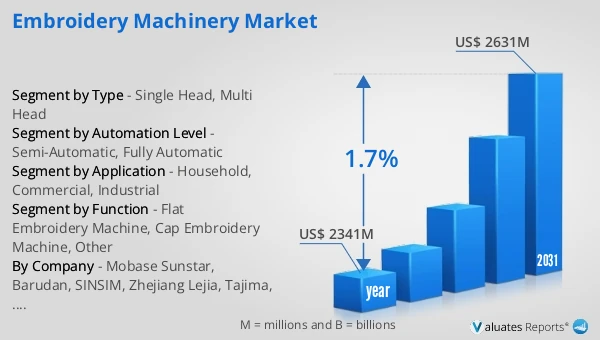
The global market for Embroidery Machinery was valued at US$ 2341 million in the year 2024 and is projected to reach a revised size of US$ 2631 million by 2031, growing at a CAGR of 1.7% during the forecast period.
Embroidery Machinery Market
The 2025 U.S. tariff policies introduce profound uncertainty into the global economic landscape. This report critically examines the implications of recent tariff adjustments and international strategic countermeasures on Embroidery Machinery competitive dynamics, regional economic interdependencies, and supply chain reconfigurations.
In 2024, global Embroidery Machinery production reached approximately 700 thousand units, with an average global market price of around US$ 3400 per unit. Embroidery Machinery is a machine used to embroider; it can be divided into general machinery and computer Embroidery Machinery Embroidery Machinery. Most modern Embroidery Machinery are computer Embroidery Machinery, which can automatically create a design from a pre-programmed digital embroidery pattern. The Embroidery Machinery gross margins between 25% and 45% for finished machines.
The Embroidery Machinery market has witnessed significant growth in recent years, driven by increasing demand for customized apparel, technological advancements, and the expansion of the textile industry. Embroidery Machinery automate the process of stitching intricate designs onto fabrics, offering precision, speed, and efficiency compared to traditional hand embroidery. These machines are widely used in the fashion industry, home décor, corporate branding, and promotional products. Consumers increasingly prefer personalized clothing, driving demand for Embroidery Machinery. Modern machines feature computerized designs, automatic thread trimming, and IoT integration for remote monitoring. Expanding garment manufacturing in emerging economies boosts the need for industrial Embroidery Machinery. The Embroidery Machinery market is expected to grow steadily, with trends like sustainable embroidery (eco-friendly threads and fabrics) and smart machines (IoT and AI integration) shaping the industry. The rise of on-demand embroidery services through digital platforms will further drive market expansion. The Embroidery Machinery market is thriving due to increasing demand for customization, technological advancements, and textile industry growth. While high costs and skill requirements pose challenges, innovations in automation and digitalization present lucrative opportunities for manufacturers and businesses in this sector. The integration of artificial intelligence and machine learning in Embroidery Machinery enhances stitching accuracy, optimizes design patterns, and automates the digitization process, improving overall productivity. Consumers' increasing preference for customized and unique products fuels the demand for advanced Embroidery Machinery capable of delivering intricate and personalized designs. There is a growing emphasis on eco-friendly practices within the industry, with manufacturers focusing on sustainable materials and energy-efficient machines to reduce environmental impact. The Embroidery Machinery market is poised for continued growth, driven by technological innovations, increasing demand for personalized products, and expansion in key industries. As manufacturers continue to innovate and adapt to consumer preferences, the market is expected to witness sustained growth and transformation in the coming years. The Embroidery Machinery industry chain forms a complete ecosystem that spans from core components to end-market applications, integrating mechanical engineering, electronics, software, and textile manufacturing. At the upstream level, it relies on precision mechanical parts, needles, hooks, motors, drive systems, high-strength frames, electronic control units, servo systems, and specialized embroidery software and sensors that ensure stitching accuracy and machine stability. The midstream segment consists of Embroidery Machinery manufacturers who integrate mechanical structures, multi-needle systems, automation modules, digital control technology, and pattern-design software to produce flat Embroidery Machinery, cap Embroidery Machinery, multi-head machines, and high-speed automated units. Supporting distributors and service providers handle equipment sales, installation, technical training, spare-part supply, and maintenance services. At the downstream end, Embroidery Machinery are widely used by garment factories, home-textile producers, footwear manufacturers, fashion brands, craft workshops, and customization businesses, enabling mass production as well as personalized or high-value decorative embroidery. The entire industry chain is being reshaped by trends such as digital automation, intelligent pattern-design platforms, integration with CAD/CAM systems, and rising demand for customization, pushing manufacturers toward higher precision, greater speed, and smarter, software-driven embroidery solutions.
Report Scope
This report aims to provide a comprehensive presentation of the global market for Embroidery Machinery, with both quantitative and qualitative analysis, to help readers develop business/growth strategies, assess the market competitive situation, analyze their position in the current marketplace, and make informed business decisions regarding Embroidery Machinery.
The Embroidery Machinery market size, estimations, and forecasts are provided in terms of output/shipments (K Units) and revenue ($ millions), considering 2024 as the base year, with history and forecast data for the period from 2020 to 2031. This report segments the global Embroidery Machinery market comprehensively. Regional market sizes, concerning products by Type, by Application, by Function and by players, are also provided.
For a more in-depth understanding of the market, the report provides profiles of the competitive landscape, key competitors, and their respective market ranks. The report also discusses technological trends and new product developments.
The report will help the Embroidery Machinery manufacturers, new entrants, and industry chain related companies in this market with information on the revenues, production, and average price for the overall market and the sub-segments across the different segments, by company, by Type, by Application, by Function and by regions.
Scope of Embroidery Machinery Market Report
| Report Metric |
Details |
| Report Name |
Embroidery Machinery Market |
| Accounted market size in year |
US$ 2341 million |
| Forecasted market size in 2031 |
US$ 2631 million |
| CAGR |
1.7% |
| Base Year |
year |
| Forecasted years |
2026 - 2031 |
| Segment by Type |
|
| Segment by Function |
- Flat Embroidery Machine
- Cap Embroidery Machine
- Other
|
| Segment by Automation Level |
- Semi-Automatic
- Fully Automatic
|
| Segment by Application |
- Household
- Commercial
- Industrial
|
| Production by Region |
- North America
- Europe
- China
- Japan
|
| Consumption by Region |
- North America (United States, Canada)
- Europe (Germany, France, UK, Italy, Russia)
- Asia-Pacific (China, Japan, South Korea, Taiwan)
- Southeast Asia (India)
- Latin America (Mexico, Brazil)
|
| By Company |
Mobase Sunstar, Barudan, SINSIM, Zhejiang Lejia, Tajima, Feiya, TANG, Yuelong Sewing, Maya, Zhejiang Feiying, Foshan Autowin, ZSK, Shenshilei Group, Ricoma, FSSANXIN, Happy Japan, Fujian Yonthin, Brother |
| Forecast units |
USD million in value |
| Report coverage |
Revenue and volume forecast, company share, competitive landscape, growth factors and trends |
Chapter Outline
- Chapter 1: Introduces the report scope of the report, executive summary of different market segments (by region, by Type, by Application, by Function etc), including the market size of each market segment, future development potential, and so on. It offers a high-level view of the current state of the market and its likely evolution in the short to mid-term, and long term.
- Chapter 2: Detailed analysis of Embroidery Machinery manufacturers competitive landscape, price, production and value market share, latest development plan, merger, and acquisition information, etc.
- Chapter 3: Production/output, value of Embroidery Machinery by region/country. It provides a quantitative analysis of the market size and development potential of each region in the next six years.
- Chapter 4: Consumption of Embroidery Machinery in regional level and country level. It provides a quantitative analysis of the market size and development potential of each region and its main countries and introduces the market development, future development prospects, market space, and production of each country in the world.
- Chapter 5: Provides the analysis of various market segments by Type, covering the market size and development potential of each market segment, to help readers find the blue ocean market in different market segments.
- Chapter 6: Provides the analysis of various market segments by Application, covering the market size and development potential of each market segment, to help readers find the blue ocean market in different downstream markets.
- Chapter 7: Provides profiles of key players, introducing the basic situation of the main companies in the market in detail, including product production/output, value, price, gross margin, product introduction, recent development, etc.
- Chapter 8: Analysis of industrial chain, including the upstream and downstream of the industry.
- Chapter 9: Introduces the market dynamics, latest developments of the market, the driving factors and restrictive factors of the market, the challenges and risks faced by manufacturers in the industry, and the analysis of relevant policies in the industry.
- Chapter 10: The main points and conclusions of the report.
Ans: The Embroidery Machinery Market witnessing a CAGR of 1.7% during the forecast period 2026-2031.
Ans: The Embroidery Machinery Market size in 2031 will be US$ 2631 million.
Ans: The main players in the Embroidery Machinery Market are Mobase Sunstar, Barudan, SINSIM, Zhejiang Lejia, Tajima, Feiya, TANG, Yuelong Sewing, Maya, Zhejiang Feiying, Foshan Autowin, ZSK, Shenshilei Group, Ricoma, FSSANXIN, Happy Japan, Fujian Yonthin, Brother
Ans: The Applications covered in the Embroidery Machinery Market report are Household, Commercial, Industrial
Ans: The Types covered in the Embroidery Machinery Market report are Single Head, Multi Head