0
U.S. (TOLL FREE)
+1 (315) 215-3225
Automative

0
U.S. (TOLL FREE)
+1 (315) 215-3225
Upcycled Cosmetic Ingredients Market By Applications (Skin Care, Hair Care, Color Cosmetics): Global Opportunity Analysis and Industry Forecast, 2021-2031
Published Date: 2023-03-01
|
Report Code: ALLI-Auto-2D778
Home | Market Reports
Upcycled Cosmetic Ingredients Market By Applications Skin Care Hair Care Color Cosmetics Global Opportunity Analysis and Industry Forecast 2021 2031
BUY CHAPTERS

Upcycled Cosmetic Ingredients Market By Applications (Skin Care, Hair Care, Color Cosmetics): Global Opportunity Analysis and Industry Forecast, 2021-2031

Code: ALLI-Auto-2D778
Report
2023-03-01
Pages:230
Allied Market Research
Buy Now with 15% Discount
DESCRIPTION
TABLE OF CONTENT
TABLES & FIGURES

Upcycled Cosmetic Ingredients Market Size

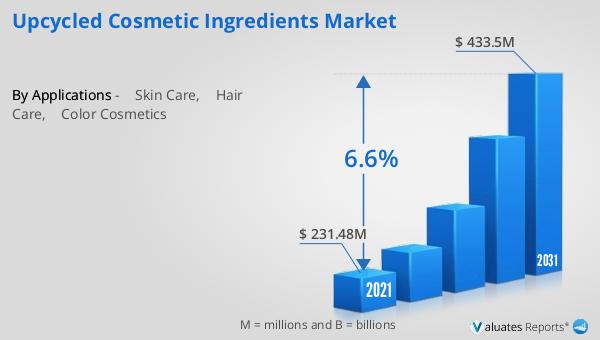
According to a new report published by , titled, “Upcycled Cosmetic Ingredients Market," The upcycled cosmetic ingredients market was valued at $231.48 million in 2021, and is estimated to reach $433.5 million by 2031, growing at a CAGR of 6.6% from 2022 to 2031.

Upcycled Cosmetic Ingredients Market

Upcycled Cosmetic Ingredients Market

Upcycled cosmetic ingredients are nothing but recycled food waste. The best approaches to creating ingredients from food production waste have been studied by suppliers and researchers in the cosmetics sector. AMR estimates that 1.3 billion tons, or one-third, of the food produced, is wasted. This sum includes products that were deemed attractive enough for the supermarket as well as trash from the food manufacturing process. Methane, a greenhouse gas that is 21 times more powerful than carbon dioxide, is produced when food is disposed of in landfills. Nutritional characteristics related to food waste, such as micronutrients and vitamins, may allow upcycled materials to be just as effective as conventional ingredients. Cosmetic formulations use fruit seeds, fruit pulp, coffee, and derivatives, waste from the perfumery industry, and waste from the rice industry as a new source of ingredients. The upcycling process does not prematurely close the life cycle of products, contributing sustainability to the production processes. For instance, Full Circle offers anti-skin irritation ingredients produced from beer brewing waste. Also, Sanam Company Colombia offers Naox Derma, a coffee cherry extract that is derived from the pulp of coffee and offers anti-inflammatory, anti-aging, and antioxidant properties. 
Key factors that drive the growth of the upcycled cosmetic ingredients market include growth of the vegan cosmetics industry, increase in the use of upcycled ingredients in cosmetics, and increase in pressure on reducing food waste. Climate change puts additional strain on available agricultural land around the world, so food crops are a top priority. According to the United Nations, the world may need to produce 50% more food than it did in 2010 by 2050 to feed its expected 9.3 billion people. Almost one-third of the food produced for human consumption in the U.S. is wasted. The resources used in the production, processing, transportation, preparation, and storage of food are wasted. Food waste and loss exacerbate the climate change problem by emitting large amounts of greenhouse gases (GHG). According to the U.S. Environmental Protection Agency, food waste accounts for about 6% of human-caused greenhouse gas emissions. Reduced and eliminated food waste can improve economic efficiency, productivity, and climate change mitigation. It can also help to conserve resources and energy while reducing supply chain shocks caused by climate change. Food waste can be used as an important ingredient in a variety of industries. Tomato, grape, or olive seed debris, for example, is used as a cosmetic component to keep organic waste from decomposing in landfills and emitting greenhouse gases that contribute to climate change. The market for upcycled cosmetics ingredients is expected to grow as a result of increased pressure to reduce food waste and the effective use of food waste as a raw material in the cosmetic industry to reduce environmental impact.
It takes time, trial and error, and R&D investments to create any upcycled ingredient and source it directly from the food and beverage industries. Furthermore, despite the abundance of available upcycled ingredients, it is difficult to find more unique and recently launched upcycled ingredients to provide a competitive advantage in cosmetic formulations. In addition, when using the ingredients in formulations, it must be verified whether or not the ingredient is made from upcycled materials. If the cosmetics are to be certified organic, for example, manufacturers must be cautious in locating the sources of any recycled materials that must be included. As a result of the difficulties in sourcing and using the ingredients in final formulations, the market for upcycled cosmetic ingredients may suffer.
The market also offers growth opportunities to the key players in the market.  The increase in demand for products that are not only good for people but also good for the environment and sustainable has created an ideal market for upcycled cosmetic ingredients. Furthermore, in order to stay ahead of the competition, key manufacturers are eager to launch novel ingredients. P2 Science, Inc., for example, launched the Citrosperse color cosmetics product line in November 2022. It contains ten bio-based ingredients, including repurposed forestry by-products. In addition, Symrise launched SymFerment, a skincare ingredient based on probiotic science, in November 2022. The component was developed in collaboration with Probi, a leading producer of probiotics for the medical and food industries. Upcycling was used by the partners to transform valuable byproducts into potent cosmetic components. Micronutrients are provided to the skin by the fermentation broth created during the manufacturing process. This provides immediate skin benefits in a wide range of cosmetic applications, including dermo-cosmetics and face and body care.
The upcycled cosmetic ingredients market is segmented on the basis of application and region. On the basis of application, the upcycled cosmetics ingredient are classified into skin care, hair care, and color cosmetics. On the basis of region, the market is divided across North America (the U.S., Canada, and Mexico), Europe (Germany, UK, France, Italy, Spain, Netherlands, Rest of Europe), Asia-Pacific (China, Japan, India, South Korea, Australia, and rest of Asia-Pacific), and LAMEA (Brazil, South Africa, and Rest of LAMEA).   
 
Key Market Insights
The skin care segment dominated the market in 2021 and is expected to continue to dominate during the forecast period.  
On the basis of region, North America was the highest revenue contributor accounting for more than 45% in 2021 and is estimated to grow at a CAGR of 6.2%.

Overview

The global Upcycled Cosmetic Ingredients market size was valued at $231.48 million in 2021 and is projected to reach $433.48 million by 2031, registering a CAGR of 6.6%. In 2021, the skin care upcycled cosmetic ingredients segment accounted for the majority of the total upcycled cosmetic ingredients market.
Upcycled cosmetics are new cosmetic components made from plant-based waste that would otherwise be wasted. Traditional ingredient lists, which are frequently harmful to humans and the environment, can be replaced with upcycled cosmetic ingredients.
Producers of upcycled cosmetic ingredients may find new markets as a result of the increase in demand for vegan cosmetics. The market for vegan cosmetics is anticipated to reach $16.6 billion in value in 2021 and $28.5 billion by 2031, according to AMR research. The skincare segment in vegan cosmetics market is anticipated to expand at a CAGR of 5.2%. The rise of veganism is being fueled by worries about environmental destruction as well as growth in awareness of animal suffering. A lifestyle choice, veganism covers not only food but also clothing and cosmetics. The demand from consumers for plant-based personal care products also boosts market growth.  New formulas in skincare, personal care, scent, and makeup have appeared due to the rise in demand for clean, vegan, and cruelty-free beauty products.
Creating any upcycled ingredient and sourcing it directly from the food and beverage industries takes time, trial and error, and R&D investments. Furthermore, despite the abundance of available upcycled ingredients, it is difficult to find more unique and recently launched upcycled ingredients to be used in cosmetic formulations to provide a competitive advantage. Moreover,  it must be verified whether the ingredient is an upcycled material or not while using the ingredients in formulations. For example, if cosmetic goods are to be certified organic, manufacturers must be cautious in locating the sources of any recycled materials that must be included. Even if the plant by-product was grown in accordance with organic certification standards, it may not have been processed in a way that conforms to organic certification. As a result, the difficulties in sourcing and using the ingredients in final formulations may have a negative impact on the market for upcycled cosmetic ingredients.
Companies have traditionally relied on a linear economic model to manufacture their products. In the traditional or linear approach, manufacturers obtained their raw materials either through extraction or by producing agricultural resources. Then, with the creation of trash, they used to transform these materials and resources into final products. Furthermore, these companies used fresh water in their processes, and manufacturers did very little waste recovery or utilization. This has had a significant impact on the environment, including greenhouse gas emissions from resource extraction, depletion of nonrenewable resources, and the destruction of biodiversity for agricultural resource production, as well as contamination of the soil, water, or air caused by waste disposal or storage. In contrast to this linear approach, the circular economy emphasizes efficiency and sustainability at all stages of production and encourages upcycling, recycling, and reusing whenever possible.  Every step of the process, including production, consumption, and disposal, must be considered using this strategy.
Seeds, peels, flowers, fruit, and other food items that are frequently discarded by the food industry can be upcycled for use in cosmetic products. Commodity products such as vegetable oils, butter, extracts, and fruit seeds that exfoliate are frequently used for skin care and hair care. Specialties, on the other hand, represent a more sophisticated method of food extraction. According to the AMR analysis, almost 20% of the banana production of the world is lost owing to damage and flaws, meaning that roughly 24 million tons of bananas end up in the trash. Formulators can produce Musa sapientum (banana) extract from banana leaves via enzymatic extraction, which can then be utilized as a preservative booster or preservative. For instance, Kadalys is a company based in Martinique that obtains active compounds rich in nutrients for skin treatment by using the pulp and shell of a banana. Similar to this, pectin for cosmetic formulations can be produced from citrus peels via enzymatic extraction. For instance, the Cargill company has created pectin from discarded citrus peels which are used as an emulsion stabilizer and texturizer for cosmetics. Almost all materials derived from plants can be recycled to create new cosmetics. Coffee grounds, walnut shell powder, fruit peel extracts, cacao bean waste, fruits discarded from the juice and jam sector, and even grape waste from wine manufacturing are some of the most popular ones. Thus, the increase in usage of waste from the food and beverages industry to formulate potential ingredients to be used in cosmetic products may drive the upcycled cosmetic ingredients market demand.
The upcycled cosmetic ingredients market is segmented on the basis of application and region. On the basis of application, the upcycled cosmetics ingredient are classified into skin care, hair care, and color cosmetics. On the basis of region, the market is divided across North America (the U.S., Canada, and Mexico), Europe (Germany, UK, France, Italy, Spain, Rest of Europe), Asia-Pacific (China, Japan, India, South Korea, Australia, and rest of Asia-Pacific), and LAMEA (Brazil, South Africa, and Rest of LAMEA). 
Some of the major players analyzed in this report are Givaudan, Symrise, Cargill, OLVEA, Mibelle Biochemistry, P2 Science, Inc., Rahn AG, Hair O'right International Corporation, Lignopure, and SOPHIM IBERIA S.L. 

Key Benefits For Stakeholders

●This report provides a quantitative analysis of the market segments, current trends, estimations, and dynamics of the upcycled cosmetic ingredients market analysis from 2021 to 2031 to identify the prevailing upcycled cosmetic ingredients market opportunities.
●The market research is offered along with information related to key drivers, restraints, and opportunities.
●Porter's five forces analysis highlights the potency of buyers and suppliers to enable stakeholders make profit-oriented business decisions and strengthen their supplier-buyer network.
●In-depth analysis of the upcycled cosmetic ingredients market segmentation assists to determine the prevailing market opportunities.
●Major countries in each region are mapped according to their revenue contribution to the global market.
●Market player positioning facilitates benchmarking and provides a clear understanding of the present position of the market players.
●The report includes the analysis of the regional as well as global upcycled cosmetic ingredients market trends, key players, market segments, application areas, and market growth strategies.
Key Market Segments
○ SOPHI

Scope of Upcycled Cosmetic Ingredients Market Report

Report Metric Details
Report Name Upcycled Cosmetic Ingredients Market
Accounted market size in 2021 $ 231.48 million
Forecasted market size in 2031 $ 433.5 million
CAGR 6.6%
Base Year 2021
Forecasted years 2024 - 2031
By Applications ● Skin Care
● Hair Care
● Color Cosmetics
By Region
  • North America (United States, Canada)
  • Europe (Germany, France, UK, Italy, Russia) Rest of Europe
  • Nordic Countries
  • Asia-Pacific (China, Japan, South Korea)
  • Southeast Asia (India, Australia)
  • Rest of Asia
  • Latin America (Mexico, Brazil)
  • Rest of Latin America
  • Middle East & Africa (Turkey, Saudi Arabia, UAE, Rest of MEA)
Forecast units USD million in value
Report coverage Revenue and volume forecast, company share, competitive landscape, growth factors and trends

FAQ for this report

How fast is Upcycled Cosmetic Ingredients Market growing?

Ans: The Upcycled Cosmetic Ingredients Market witnessing a CAGR of 6.6% during the forecast period 2024-2031.

What is the Upcycled Cosmetic Ingredients Market size in 2031?

Ans: The Upcycled Cosmetic Ingredients Market size in 2031 will be $ 433.5 million.

What are the Application segmentation covered in the Upcycled Cosmetic Ingredients Market report?

Ans: The Applications covered in the Upcycled Cosmetic Ingredients Market report are ● Skin Care, ● Hair Care, ● Color Cosmetics

CHAPTER 1: INTRODUCTION
1.1. Report description
1.2. Key market segments
1.3. Key benefits to the stakeholders
1.4. Research Methodology
1.4.1. Primary research
1.4.2. Secondary research
1.4.3. Analyst tools and models
CHAPTER 2: EXECUTIVE SUMMARY
2.1. CXO Perspective
CHAPTER 3: MARKET OVERVIEW
3.1. Market definition and scope
3.2. Key findings
3.2.1. Top impacting factors
3.2.2. Top investment pockets
3.3. Porter’s five forces analysis
3.3.1. Bargaining power of suppliers
3.3.2. Bargaining power of buyers
3.3.3. Threat of substitutes
3.3.4. Threat of new entrants
3.3.5. Intensity of rivalry
3.4. Market dynamics
3.4.1. Drivers
3.4.1.1. Growth of the vegan cosmetics industry
3.4.1.2. Increase in use of upcycled ingredients in cosmetics
3.4.1.3. Increase in pressure on reducing food waste
3.4.2. Restraints
3.4.2.1. Unsustainable practices to manufacture the ingredient
3.4.2.2. Difficulty while using the ingredients
3.4.3. Opportunities
3.4.3.1. Product launches
3.4.3.2. Manufacturers turn their focus from linear economy to circular economy
3.5. COVID-19 Impact Analysis on the market
CHAPTER 4: UPCYCLED COSMETIC INGREDIENTS MARKET, BY APPLICATIONS
4.1. Overview
4.1.1. Market size and forecast
4.2. Skin Care
4.2.1. Key market trends, growth factors and opportunities
4.2.2. Market size and forecast, by region
4.2.3. Market share analysis by country
4.3. Hair Care
4.3.1. Key market trends, growth factors and opportunities
4.3.2. Market size and forecast, by region
4.3.3. Market share analysis by country
4.4. Color Cosmetics
4.4.1. Key market trends, growth factors and opportunities
4.4.2. Market size and forecast, by region
4.4.3. Market share analysis by country
CHAPTER 5: UPCYCLED COSMETIC INGREDIENTS MARKET, BY REGION
5.1. Overview
5.1.1. Market size and forecast By Region
5.2. North America
5.2.1. Key trends and opportunities
5.2.2. Market size and forecast, by Applications
5.2.3. Market size and forecast, by country
5.2.3.1. U.S.
5.2.3.1.1. Key market trends, growth factors and opportunities
5.2.3.1.2. Market size and forecast, by Applications
5.2.3.2. Canada
5.2.3.2.1. Key market trends, growth factors and opportunities
5.2.3.2.2. Market size and forecast, by Applications
5.2.3.3. Mexico
5.2.3.3.1. Key market trends, growth factors and opportunities
5.2.3.3.2. Market size and forecast, by Applications
5.3. Europe
5.3.1. Key trends and opportunities
5.3.2. Market size and forecast, by Applications
5.3.3. Market size and forecast, by country
5.3.3.1. Germany
5.3.3.1.1. Key market trends, growth factors and opportunities
5.3.3.1.2. Market size and forecast, by Applications
5.3.3.2. France
5.3.3.2.1. Key market trends, growth factors and opportunities
5.3.3.2.2. Market size and forecast, by Applications
5.3.3.3. UK
5.3.3.3.1. Key market trends, growth factors and opportunities
5.3.3.3.2. Market size and forecast, by Applications
5.3.3.4. Spain
5.3.3.4.1. Key market trends, growth factors and opportunities
5.3.3.4.2. Market size and forecast, by Applications
5.3.3.5. Italy
5.3.3.5.1. Key market trends, growth factors and opportunities
5.3.3.5.2. Market size and forecast, by Applications
5.3.3.6. Rest of Europe
5.3.3.6.1. Key market trends, growth factors and opportunities
5.3.3.6.2. Market size and forecast, by Applications
5.4. Asia-Pacific
5.4.1. Key trends and opportunities
5.4.2. Market size and forecast, by Applications
5.4.3. Market size and forecast, by country
5.4.3.1. China
5.4.3.1.1. Key market trends, growth factors and opportunities
5.4.3.1.2. Market size and forecast, by Applications
5.4.3.2. Japan
5.4.3.2.1. Key market trends, growth factors and opportunities
5.4.3.2.2. Market size and forecast, by Applications
5.4.3.3. India
5.4.3.3.1. Key market trends, growth factors and opportunities
5.4.3.3.2. Market size and forecast, by Applications
5.4.3.4. South Korea
5.4.3.4.1. Key market trends, growth factors and opportunities
5.4.3.4.2. Market size and forecast, by Applications
5.4.3.5. Australia
5.4.3.5.1. Key market trends, growth factors and opportunities
5.4.3.5.2. Market size and forecast, by Applications
5.4.3.6. Rest of Asia-Pacific
5.4.3.6.1. Key market trends, growth factors and opportunities
5.4.3.6.2. Market size and forecast, by Applications
5.5. LAMEA
5.5.1. Key trends and opportunities
5.5.2. Market size and forecast, by Applications
5.5.3. Market size and forecast, by country
5.5.3.1. Brazil
5.5.3.1.1. Key market trends, growth factors and opportunities
5.5.3.1.2. Market size and forecast, by Applications
5.5.3.2. South Africa
5.5.3.2.1. Key market trends, growth factors and opportunities
5.5.3.2.2. Market size and forecast, by Applications
5.5.3.3. Rest of LAMEA
5.5.3.3.1. Key market trends, growth factors and opportunities
5.5.3.3.2. Market size and forecast, by Applications
CHAPTER 6: COMPETITIVE LANDSCAPE
6.1. Introduction
6.2. Top winning strategies
6.3. Product Mapping of Top 10 Player
6.4. Competitive Dashboard
6.5. Competitive Heatmap
6.6. Top player positioning, 2021
CHAPTER 7: COMPANY PROFILES
7.1. Givaudan SA
7.1.1. Company overview
7.1.2. Key Executives
7.1.3. Company snapshot
7.1.4. Operating business segments
7.1.5. Product portfolio
7.1.6. Business performance
7.1.7. Key strategic moves and developments
7.2. Symrise
7.2.1. Company overview
7.2.2. Key Executives
7.2.3. Company snapshot
7.2.4. Operating business segments
7.2.5. Product portfolio
7.2.6. Business performance
7.2.7. Key strategic moves and developments
7.3. Cargill, Incorporated
7.3.1. Company overview
7.3.2. Key Executives
7.3.3. Company snapshot
7.3.4. Operating business segments
7.3.5. Product portfolio
7.3.6. Business performance
7.4. OLVEA Group
7.4.1. Company overview
7.4.2. Key Executives
7.4.3. Company snapshot
7.4.4. Operating business segments
7.4.5. Product portfolio
7.4.6. Key strategic moves and developments
7.5. Mibelle AG
7.5.1. Company overview
7.5.2. Key Executives
7.5.3. Company snapshot
7.5.4. Operating business segments
7.5.5. Product portfolio
7.5.6. Key strategic moves and developments
7.6. P2 Science, Inc.
7.6.1. Company overview
7.6.2. Key Executives
7.6.3. Company snapshot
7.6.4. Operating business segments
7.6.5. Product portfolio
7.6.6. Key strategic moves and developments
7.7. RAHN AG
7.7.1. Company overview
7.7.2. Key Executives
7.7.3. Company snapshot
7.7.4. Operating business segments
7.7.5. Product portfolio
7.7.6. Business performance
7.7.7. Key strategic moves and developments
7.8. Hair O'right International Corporation
7.8.1. Company overview
7.8.2. Key Executives
7.8.3. Company snapshot
7.8.4. Operating business segments
7.8.5. Product portfolio
7.9. Lignopure GmbH
7.9.1. Company overview
7.9.2. Key Executives
7.9.3. Company snapshot
7.9.4. Operating business segments
7.9.5. Product portfolio
7.9.6. Key strategic moves and developments
7.10. SOPHIM
7.10.1. Company overview
7.10.2. Key Executives
7.10.3. Company snapshot
7.10.4. Operating business segments
7.10.5. Product portfoli
LIST OF TABLES
TABLE 01. GLOBAL UPCYCLED COSMETIC INGREDIENTS MARKET, BY APPLICATIONS, 2021-2031 ($MILLION)
TABLE 02. UPCYCLED COSMETIC INGREDIENTS MARKET FOR SKIN CARE, BY REGION, 2021-2031 ($MILLION)
TABLE 03. UPCYCLED COSMETIC INGREDIENTS MARKET FOR HAIR CARE, BY REGION, 2021-2031 ($MILLION)
TABLE 04. UPCYCLED COSMETIC INGREDIENTS MARKET FOR COLOR COSMETICS, BY REGION, 2021-2031 ($MILLION)
TABLE 05. UPCYCLED COSMETIC INGREDIENTS MARKET, BY REGION, 2021-2031 ($MILLION)
TABLE 06. NORTH AMERICA UPCYCLED COSMETIC INGREDIENTS MARKET, BY APPLICATIONS, 2021-2031 ($MILLION)
TABLE 07. NORTH AMERICA UPCYCLED COSMETIC INGREDIENTS MARKET, BY COUNTRY, 2021-2031 ($MILLION)
TABLE 08. U.S. UPCYCLED COSMETIC INGREDIENTS MARKET, BY APPLICATIONS, 2021-2031 ($MILLION)
TABLE 09. CANADA UPCYCLED COSMETIC INGREDIENTS MARKET, BY APPLICATIONS, 2021-2031 ($MILLION)
TABLE 10. MEXICO UPCYCLED COSMETIC INGREDIENTS MARKET, BY APPLICATIONS, 2021-2031 ($MILLION)
TABLE 11. EUROPE UPCYCLED COSMETIC INGREDIENTS MARKET, BY APPLICATIONS, 2021-2031 ($MILLION)
TABLE 12. EUROPE UPCYCLED COSMETIC INGREDIENTS MARKET, BY COUNTRY, 2021-2031 ($MILLION)
TABLE 13. GERMANY UPCYCLED COSMETIC INGREDIENTS MARKET, BY APPLICATIONS, 2021-2031 ($MILLION)
TABLE 14. FRANCE UPCYCLED COSMETIC INGREDIENTS MARKET, BY APPLICATIONS, 2021-2031 ($MILLION)
TABLE 15. UK UPCYCLED COSMETIC INGREDIENTS MARKET, BY APPLICATIONS, 2021-2031 ($MILLION)
TABLE 16. SPAIN UPCYCLED COSMETIC INGREDIENTS MARKET, BY APPLICATIONS, 2021-2031 ($MILLION)
TABLE 17. ITALY UPCYCLED COSMETIC INGREDIENTS MARKET, BY APPLICATIONS, 2021-2031 ($MILLION)
TABLE 18. REST OF EUROPE UPCYCLED COSMETIC INGREDIENTS MARKET, BY APPLICATIONS, 2021-2031 ($MILLION)
TABLE 19. ASIA-PACIFIC UPCYCLED COSMETIC INGREDIENTS MARKET, BY APPLICATIONS, 2021-2031 ($MILLION)
TABLE 20. ASIA-PACIFIC UPCYCLED COSMETIC INGREDIENTS MARKET, BY COUNTRY, 2021-2031 ($MILLION)
TABLE 21. CHINA UPCYCLED COSMETIC INGREDIENTS MARKET, BY APPLICATIONS, 2021-2031 ($MILLION)
TABLE 22. JAPAN UPCYCLED COSMETIC INGREDIENTS MARKET, BY APPLICATIONS, 2021-2031 ($MILLION)
TABLE 23. INDIA UPCYCLED COSMETIC INGREDIENTS MARKET, BY APPLICATIONS, 2021-2031 ($MILLION)
TABLE 24. SOUTH KOREA UPCYCLED COSMETIC INGREDIENTS MARKET, BY APPLICATIONS, 2021-2031 ($MILLION)
TABLE 25. AUSTRALIA UPCYCLED COSMETIC INGREDIENTS MARKET, BY APPLICATIONS, 2021-2031 ($MILLION)
TABLE 26. REST OF ASIA-PACIFIC UPCYCLED COSMETIC INGREDIENTS MARKET, BY APPLICATIONS, 2021-2031 ($MILLION)
TABLE 27. LAMEA UPCYCLED COSMETIC INGREDIENTS MARKET, BY APPLICATIONS, 2021-2031 ($MILLION)
TABLE 28. LAMEA UPCYCLED COSMETIC INGREDIENTS MARKET, BY COUNTRY, 2021-2031 ($MILLION)
TABLE 29. BRAZIL UPCYCLED COSMETIC INGREDIENTS MARKET, BY APPLICATIONS, 2021-2031 ($MILLION)
TABLE 30. SOUTH AFRICA UPCYCLED COSMETIC INGREDIENTS MARKET, BY APPLICATIONS, 2021-2031 ($MILLION)
TABLE 31. REST OF LAMEA UPCYCLED COSMETIC INGREDIENTS MARKET, BY APPLICATIONS, 2021-2031 ($MILLION)
TABLE 32. GIVAUDAN SA: KEY EXECUTIVES
TABLE 33. GIVAUDAN SA: COMPANY SNAPSHOT
TABLE 34. GIVAUDAN SA: PRODUCT SEGMENTS
TABLE 35. GIVAUDAN SA: PRODUCT PORTFOLIO
TABLE 36. GIVAUDAN SA: KEY STRATERGIES
TABLE 37. SYMRISE: KEY EXECUTIVES
TABLE 38. SYMRISE: COMPANY SNAPSHOT
TABLE 39. SYMRISE: PRODUCT SEGMENTS
TABLE 40. SYMRISE: PRODUCT PORTFOLIO
TABLE 41. SYMRISE: KEY STRATERGIES
TABLE 42. CARGILL, INCORPORATED: KEY EXECUTIVES
TABLE 43. CARGILL, INCORPORATED: COMPANY SNAPSHOT
TABLE 44. CARGILL, INCORPORATED: PRODUCT SEGMENTS
TABLE 45. CARGILL, INCORPORATED: PRODUCT PORTFOLIO
TABLE 46. OLVEA GROUP: KEY EXECUTIVES
TABLE 47. OLVEA GROUP: COMPANY SNAPSHOT
TABLE 48. OLVEA GROUP: PRODUCT SEGMENTS
TABLE 49. OLVEA GROUP: PRODUCT PORTFOLIO
TABLE 50. OLVEA GROUP: KEY STRATERGIES
TABLE 51. MIBELLE AG: KEY EXECUTIVES
TABLE 52. MIBELLE AG: COMPANY SNAPSHOT
TABLE 53. MIBELLE AG: PRODUCT SEGMENTS
TABLE 54. MIBELLE AG: PRODUCT PORTFOLIO
TABLE 55. MIBELLE AG: KEY STRATERGIES
TABLE 56. P2 SCIENCE, INC.: KEY EXECUTIVES
TABLE 57. P2 SCIENCE, INC.: COMPANY SNAPSHOT
TABLE 58. P2 SCIENCE, INC.: PRODUCT SEGMENTS
TABLE 59. P2 SCIENCE, INC.: PRODUCT PORTFOLIO
TABLE 60. P2 SCIENCE, INC.: KEY STRATERGIES
TABLE 61. RAHN AG: KEY EXECUTIVES
TABLE 62. RAHN AG: COMPANY SNAPSHOT
TABLE 63. RAHN AG: PRODUCT SEGMENTS
TABLE 64. RAHN AG: PRODUCT PORTFOLIO
TABLE 65. RAHN AG: KEY STRATERGIES
TABLE 66. HAIR O'RIGHT INTERNATIONAL CORPORATION: KEY EXECUTIVES
TABLE 67. HAIR O'RIGHT INTERNATIONAL CORPORATION: COMPANY SNAPSHOT
TABLE 68. HAIR O'RIGHT INTERNATIONAL CORPORATION: PRODUCT SEGMENTS
TABLE 69. HAIR O'RIGHT INTERNATIONAL CORPORATION: PRODUCT PORTFOLIO
TABLE 70. LIGNOPURE GMBH: KEY EXECUTIVES
TABLE 71. LIGNOPURE GMBH: COMPANY SNAPSHOT
TABLE 72. LIGNOPURE GMBH: PRODUCT SEGMENTS
TABLE 73. LIGNOPURE GMBH: PRODUCT PORTFOLIO
TABLE 74. LIGNOPURE GMBH: KEY STRATERGIES
TABLE 75. SOPHIM: KEY EXECUTIVES
TABLE 76. SOPHIM: COMPANY SNAPSHOT
TABLE 77. SOPHIM: PRODUCT SEGMENTS
TABLE 78. SOPHIM: PRODUCT PORTFOLIO LIST OF FIGURES
FIGURE 01. UPCYCLED COSMETIC INGREDIENTS MARKET, 2021-2031
FIGURE 02. SEGMENTATION OF UPCYCLED COSMETIC INGREDIENTS MARKET, 2021-2031
FIGURE 03. TOP INVESTMENT POCKETS IN UPCYCLED COSMETIC INGREDIENTS MARKET (2022-2031)
FIGURE 04. LOW BARGAINING POWER OF SUPPLIERS
FIGURE 05. LOW BARGAINING POWER OF BUYERS
FIGURE 06. LOW THREAT OF SUBSTITUTES
FIGURE 07. LOW THREAT OF NEW ENTRANTS
FIGURE 08. LOW INTENSITY OF RIVALRY
FIGURE 09. DRIVERS, RESTRAINTS AND OPPORTUNITIES: GLOBALUPCYCLED COSMETIC INGREDIENTS MARKET
FIGURE 10. UPCYCLED COSMETIC INGREDIENTS MARKET, BY APPLICATIONS, 2021(%)
FIGURE 11. COMPARATIVE SHARE ANALYSIS OF UPCYCLED COSMETIC INGREDIENTS MARKET FOR SKIN CARE, BY COUNTRY 2021 AND 2031(%)
FIGURE 12. COMPARATIVE SHARE ANALYSIS OF UPCYCLED COSMETIC INGREDIENTS MARKET FOR HAIR CARE, BY COUNTRY 2021 AND 2031(%)
FIGURE 13. COMPARATIVE SHARE ANALYSIS OF UPCYCLED COSMETIC INGREDIENTS MARKET FOR COLOR COSMETICS, BY COUNTRY 2021 AND 2031(%)
FIGURE 14. UPCYCLED COSMETIC INGREDIENTS MARKET BY REGION, 2021
FIGURE 15. U.S. UPCYCLED COSMETIC INGREDIENTS MARKET, 2021-2031 ($MILLION)
FIGURE 16. CANADA UPCYCLED COSMETIC INGREDIENTS MARKET, 2021-2031 ($MILLION)
FIGURE 17. MEXICO UPCYCLED COSMETIC INGREDIENTS MARKET, 2021-2031 ($MILLION)
FIGURE 18. GERMANY UPCYCLED COSMETIC INGREDIENTS MARKET, 2021-2031 ($MILLION)
FIGURE 19. FRANCE UPCYCLED COSMETIC INGREDIENTS MARKET, 2021-2031 ($MILLION)
FIGURE 20. UK UPCYCLED COSMETIC INGREDIENTS MARKET, 2021-2031 ($MILLION)
FIGURE 21. SPAIN UPCYCLED COSMETIC INGREDIENTS MARKET, 2021-2031 ($MILLION)
FIGURE 22. ITALY UPCYCLED COSMETIC INGREDIENTS MARKET, 2021-2031 ($MILLION)
FIGURE 23. REST OF EUROPE UPCYCLED COSMETIC INGREDIENTS MARKET, 2021-2031 ($MILLION)
FIGURE 24. CHINA UPCYCLED COSMETIC INGREDIENTS MARKET, 2021-2031 ($MILLION)
FIGURE 25. JAPAN UPCYCLED COSMETIC INGREDIENTS MARKET, 2021-2031 ($MILLION)
FIGURE 26. INDIA UPCYCLED COSMETIC INGREDIENTS MARKET, 2021-2031 ($MILLION)
FIGURE 27. SOUTH KOREA UPCYCLED COSMETIC INGREDIENTS MARKET, 2021-2031 ($MILLION)
FIGURE 28. AUSTRALIA UPCYCLED COSMETIC INGREDIENTS MARKET, 2021-2031 ($MILLION)
FIGURE 29. REST OF ASIA-PACIFIC UPCYCLED COSMETIC INGREDIENTS MARKET, 2021-2031 ($MILLION)
FIGURE 30. BRAZIL UPCYCLED COSMETIC INGREDIENTS MARKET, 2021-2031 ($MILLION)
FIGURE 31. SOUTH AFRICA UPCYCLED COSMETIC INGREDIENTS MARKET, 2021-2031 ($MILLION)
FIGURE 32. REST OF LAMEA UPCYCLED COSMETIC INGREDIENTS MARKET, 2021-2031 ($MILLION)
FIGURE 33. TOP WINNING STRATEGIES, BY YEAR
FIGURE 34. TOP WINNING STRATEGIES, BY DEVELOPMENT
FIGURE 35. TOP WINNING STRATEGIES, BY COMPANY
FIGURE 36. PRODUCT MAPPING OF TOP 10 PLAYERS
FIGURE 37. COMPETITIVE DASHBOARD
FIGURE 38. COMPETITIVE HEATMAP: UPCYCLED COSMETIC INGREDIENTS MARKET
FIGURE 39. TOP PLAYER POSITIONING, 2021
FIGURE 40. GIVAUDAN SA: NET REVENUE, 2020-2022 ($MILLION)
FIGURE 41. GIVAUDAN SA: RESEARCH & DEVELOPMENT EXPENDITURE, 2020-2022 ($MILLION)
FIGURE 42. GIVAUDAN SA: REVENUE SHARE BY SEGMENT, 2022 (%)
FIGURE 43. GIVAUDAN SA: REVENUE SHARE BY REGION, 2022 (%)
FIGURE 44. SYMRISE: NET REVENUE, 2019-2021 ($MILLION)
FIGURE 45. SYMRISE: RESEARCH & DEVELOPMENT EXPENDITURE, 2019-2021
FIGURE 46. SYMRISE: REVENUE SHARE BY SEGMENT, 2021 (%)
FIGURE 47. SYMRISE: REVENUE SHARE BY REGION, 2021 (%)
FIGURE 48. CARGILL, INCORPORATED: NET REVENUE, 2019-2021 ($MILLION)
FIGURE 49. RAHN AG: NET SALES, 2019-2021 ($MILLION)
FIGURE 50. RAHN AG: REVENUE SHARE BY REGION, 2021 (%

SELECT A FORMAT
Added to Cart
Electronic

$5730

Single User License
Electronic

$6450

Multi User License
Electronic

$9600

Enterprise License
Electronic

$3840

Data Pack License
Add to Cart
Buy Now (15% Discount)

OUR CUSTOMER

SIS Group of Schools

SIMILAR REPORTS