
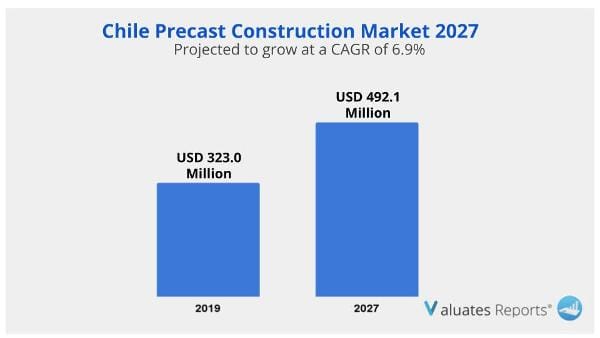
The Chile precast construction market size is expected to reach $492.1 million in 2027, from $323.0 million in 2019, growing at a CAGR of 6.9% from 2020 to 2027.
Building or infrastructure components are cast off-site during precast construction, commonly referred to as prefabricated construction or off-site construction. After that, the casted member is moved and firmly fastened to create a monolithic structure. Typically, bolts or concrete are poured into the connecting gaps to bind the various construction components together. In precast construction, between 60% and 90% of the work is done off-site. Modular buildings and prefabricated houses are the two primary categories under which precast construction falls. Modular construction mostly involves the casting of individual building components in a factory setting, whereas prefabricated houses involve the entire fabrication of buildings that are brought to the appropriate place on their own frame or chassis.
Precast construction is frequently done in enclosed, regulated spaces, which helps to preserve the quality of the building. Additionally, high-strength concrete is used during precast construction to increase the structure's resilience to earthquakes. Chile is located in the Peru-Chile Trench, a region of compressional deformation caused by the sinking of the oceanic crust beneath the continent of South America. As a result, the nation is earthquake-prone.
The need for precast building techniques in Chile is also fueled by rising investment in upcoming infrastructure projects. A total of 98 contracts worth more than $25.05 billion have been issued through public-private partnerships (PPP) since 1993. Additionally, the Chilean Ministry of Public Works (MOP) has said that it intends to issue $3 billion in contracts on average per year from 2020 through 2024 for the country's 74 ongoing projects and 24 completed projects.
When compared to conventional methods, precast building may shorten construction time by 30% to 50%, according to the U.S.-based Modular Building Institute. In order to maintain the quality of the construction, this also includes the use of high-grade building materials and techniques. This further increases the need for precast buildings in Chile, which in turn stimulates the market's expansion.
The unpredictable socioeconomic situation, however, is expected to impede the expansion of the Chilean economy. Chile's recent economic progress has been hampered by social instability and demographic disparities in living conditions. The World Bank reports that social turmoil has caused the GDP to fall from 3.9% in 2018 to 1.1% in 2019. Due to the divided service delivery in healthcare, education, and the separated labor market, the nation is also dealing with a substantial disparity of opportunities to the expanding middle class. Such elements limit the precast construction sector's expansion in Chile.
On the other hand, the development of Chile's precast construction sector is projected to be aided by the use of technology like digital tools in planning and designing precast components. The quality of precast construction is also improved by the employment of modern concrete technologies including ultra-high-performance concrete, low-weight concrete, fiber reinforced concrete, and others. This may potentially increase precast building demand in Chile throughout the anticipated period.
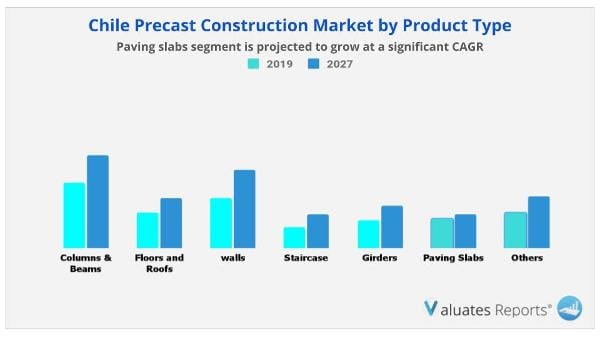
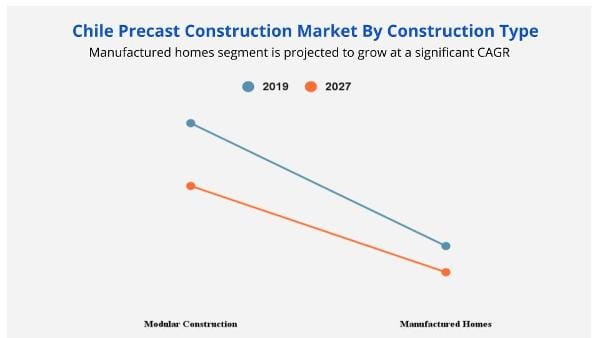
The product, construction type, and end-user industries are used to segment the Chilean precast construction market. The precast construction market in Chile is divided based on products into columns and beams, floors and roofs, walls, staircases, girders, paving slabs, and others. The housing market is divided into prefabricated and modular homes according to building type.
The Chilean precast construction market is divided into residential and non-residential segments based on end-user industries.
The key market players profiled in the report include Ecomundo, Hormipret, Pacadar SAU, Prefabrik Yapı A.Ş, Prefast SpA, Ramaq Chile, Tecno Fast, Tensacon, Tensocret, and Vollert Anlagenbau GmbH.
Many competitors in the Chile precast construction market adopted business expansion as their key developmental strategy to expand their geographical foothold and upgrade their product technologies. For instance, in October 2019, the Chile based company E2E, which is a joint venture between Celulosa Arauco y Constitución based in Chile and Belgian company Etex, inaugurated its first manufacturing unit for wooden buildings and prefabricated housing. The company started business in Chile in February 2019 and has developed two 4-storey buildings and four hundred 2-storey houses in Chile and Casablanca respectively.
The report provides an extensive analysis of the current and emerging Chile precast construction market trends and dynamics.
In-depth analysis of the market is conducted by constructing market estimations for the key market segments between 2019 and 2027.
Extensive analysis of the market is conducted by following key product positioning and monitoring of the top competitors within the market framework.
A comprehensive Chile precast construction market opportunity analysis of all the countries is also provided in the report.
The Chile precast construction market forecast analysis from 2020 to 2027 is included in the report.
The key players within the market are profiled in this report and their strategies are analyzed thoroughly, which help understand the competitive outlook of the industry.
| Report Metric | Details |
| Report Name | Chile Precast Construction Market |
| Base Year | 2019 |
| Forecasted years | 2020-2027 |
| By Company | Ecomundo, Hormipret, Pacadar SAU, Prefabrik Yapı A.Ş, Prefast SpA, Ramaq Chile, Tecno Fast, Tensacon, Tensocret, Vollert Anlagenbau GmbH |
| Segment by Production |
|
| Segment by Construction Type |
|
| Segment by End User |
|
| By Region |
|
| Forecast units | USD million in value |
| Report coverage | Revenue and volume forecast, company share, competitive landscape, growth factors and trends |
Ans. On the basis of product type, the columns & beams segment is expected to be the most influencing segment growing in the Chile precast construction market report.
Ans. No, the report doesn’t provide Value Chain Analysis for the Chile precast construction market. However, it provides Chile's market share in the global precast construction market.
Ans. To get latest version of Chile precast construction market report can be obtained on demand from the website.
Ans. The Chile precast construction market size was $323.0 million in 2019 and is projected to reach $492.1 million in 2027, growing at a CAGR of 6.9% from 2020 to 2027.
Ans. The forecast period considered for the Chile precast construction market is 2020 to 2027, wherein, 2019 is the base year, 2020 is the estimated year, and 2027 is the forecast year.
$2175
$2612
$4643
$1555
HAVE A QUERY?
OUR CUSTOMER

Add to Cart
Add to Cart
Add to Cart
Add to Cart