0
U.S. (TOLL FREE)
+1 (315) 215-3225
Automative

0
U.S. (TOLL FREE)
+1 (315) 215-3225
Combined Heat Power Market By Fuel Type (Natural Gas, Coal, Biomass, Others), By Capacity (Up to 10 MW, 10-150 MW, 151-300 MW, Above 300 MW), By Technology (Combined Cycle, Steam Turbine, Gas Turbine, Reciprocating Engine, Others), By Application (Commercial, Residential, Industrial, Utility): Global Opportunity Analysis and Industry Forecast, 2021-2031
Published Date: 2023-02-01
|
Report Code: ALLI-Auto-4G778
Home | Market Reports | Business & Industrial| Energy & Utilities| Renewable & Alternative Energy
Combined Heat Power Market By Fuel Type Natural Gas Coal Biomass Others By Capacity Up to 10 MW 10 150 MW 151 300 MW Above 300 MW By Technology Combined Cycle Steam Turbine Gas Turbine Reciprocating Engine Others By Application Commercial Residential Industrial Utility Global Opportunity Analysis and Industry Forecast 2021 2031
BUY CHAPTERS

Combined Heat Power Market By Fuel Type (Natural Gas, Coal, Biomass, Others), By Capacity (Up to 10 MW, 10-150 MW, 151-300 MW, Above 300 MW), By Technology (Combined Cycle, Steam Turbine, Gas Turbine, Reciprocating Engine, Others), By Application (Commercial, Residential, Industrial, Utility): Global Opportunity Analysis and Industry Forecast, 2021-2031

Code: ALLI-Auto-4G778
Report
2023-02-01
Pages:280
Allied Market Research
Buy Now with 15% Discount
DESCRIPTION
TABLE OF CONTENT
TABLES & FIGURES

Combined Heat Power Market Size

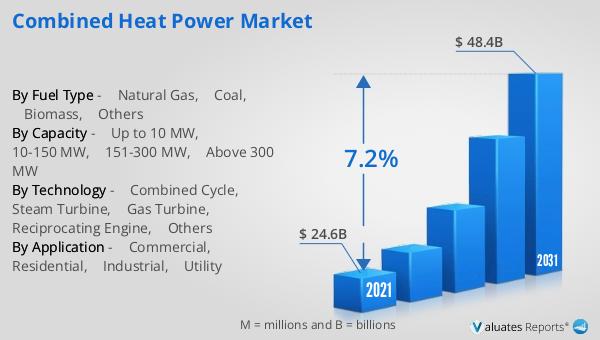
According to a new report published by , titled, “Global Combined Heat Power Market," The global combined heat power market was valued at $24.6 billion in 2021, and is estimated to reach $48.4 billion by 2031, growing at a CAGR of 7.2% from 2022 to 2031.

Combined Heat Power Market

Combined Heat Power Market

Combined heat power, also known as cogeneration, is a group of technologies that generate both electricity and useful heat at the same moment. This combined creation of heat and power is far more efficient than separate generation of electricity and useable heat, since combined heat power offers increased energy efficiency, lower operating costs, lower CO2 emissions, and other benefits. The installation of combined heat power saves a significant amount of energy, which is suitable for a variety of end users. The produced energy is utilized to cool residential and commercial structures as well as for space heating. These installations are less expensive, have lower distribution losses, and achieve a high rate of efficiency. 
Automation in combined heat and power systems serves companies in a variety of ways, including optimization of district heating networks, steam systems, and safety systems. Additionally, it is used to increase plant production and needs less effort than the previous method. Because of automation, power plants can predict flue gas emissions, allowing them to respond pro-actively and rapidly to potential problems. The emphasis on industrial automation and resource efficiency, as well as the use of cutting-edge technologies such as IoT and AI in industrial settings, are expected to be the primary drivers of development in the global market for combined heat and power automation. Furthermore, the notion of linked organisations is growing, which is driving overall market growth.
Combined heat and power plants create electricity by combining energy from several sources. A type of renewable energy is combined heat power, which produces hot water utilising renewable energy sources. A renewable combined heat and power system might be powered by biomass, solar, wind, hydroelectricity, geothermal, nuclear, and landfill gas. The utilisation of a renewable energy source delivers the best efficiency gains. These are the primary variables that are expected to increase the combined heat power market share throughout the projected period.
The combined heat power industry is expected to be driven by a change in consumer preferences toward replacing traditional power sources due to operational costs and consistent utility supply. Continued investment in captive energy generation, along with customers' desire for renewable energy sources, are expected to drive market growth. Rise in concern about greenhouse gas emission levels, along with improved stability and dependability across all co-generation system applications, are anticipated to drive new product adoption even further. In addition, growing investment opportunities in renewable energy sources to address climate change is expected to foster the combined heat power market. 
A distributed generating system is a fixed or portable system with less than 100 MW of capacity. Gas turbines are an essential part of distributed power generation technology, which also includes reciprocating engines, solar panels with turbines, and fuel cells. Due to their higher efficiency and steady generation capacity, gas turbines have an advantage over other dispersed generation technologies in terms of backup power capacity and onsite producing demands. The rising popularity of distributed power generation creates a substantial potential for the combined heat and power market.
Technological developments by major players, significant expenditure in product development, and the launch of cost-effective goods are factors that are expected to provide new opportunities for players during the forecast period. In addition, business growth activities such as strategic mergers and acquisitions are intended to enhance the target market's revenue traction. For instance, in 2021, Toplana Zenica, the newly installed combined heat and power plant, began operations. The new facility has removed the use of coal for district heating and instead makes use of waste gases from the ArcelorMittal Zenica steel factory. The CHP plant has a power output of 14.45 MW and a heat capacity of 112.5 MW. 
The key players profiled in the study include MAN Diesel & Turbo SE, Caterpillar Inc., Mitsubishi heavy Industries ltd., General Electric, Cummins, Bosch Thermotechnology Ltd., ABB Limited, ENER-G Rudox, and Veolia. The players in the market are actively engaged in the adoption of various strategies such as acquisitions, product launches, and expansion to remain competitive and gain advantage over competitors in the market. 
Key Market Insights 
On the basis of fuel type, the natural gas segment had a dominating market share in 2021 and is estimated to be the fastest growing segment during the forecast period. 
On the basis of capacity, the up to 10 MW segment accounted for a dominating market share in 2021.  
On the basis of technology, the combined cycle segment accounted for a dominating market share in 2021.  
On the basis of application, the industrial cycle segment had a dominating market share in 2021.  
On the basis of region, Europe was the highest revenue contributor in 2021. 
 

Overview

The global combined heat power market is envisioned to garner $48,399.1 million by 2031, growing from $24,600.0 million in 2021 at a CAGR of 7.5% from 2022 to 2031. 
The combined heat power industry is being driven by unofficial rules and motives, as well as an increase in the use of various gases for power generation. Cogeneration is another phrase for integrated intensity and power. This method produces both intensity and power at the same time. Some of the key forces driving the growth of the combined heat power industry are the increase int the number of   organization of combined heat power developments, the need for energy productivity, and the surge in use of government incentives.  
However, some of the disadvantages of combined heat power include installing a combined heat power system that is more expensive than installing a standard system. However, over the first few years, when any loan is taken out to pay for the combined heat power equipment, it gets paid back by the savings. The combined heat power industry is growing due to the multiple benefits it provides, such as cutting manufacturing system costs by reducing redundant power use. Energy can now be recovered by repurposing waste materials. Implementation of combined heat & power (CHP) systems, greater use of government investment to encourage produced electricity, and the need for renewable energy are the factors driving the worldwide combined heat and power market. In addition, government agencies across the globe are attempting to encourage advanced CHP technologies through a number of attractive long-term financial and regulatory incentives, which are likely to boost combined heat power market growth during the forecast period. 
The COVID-19 pandemic has resulted in a significant decrease in energy consumption from the residential, commercial, and industrial sectors. The energy industry suffered as the majority of countries around the world, including the US and UK China, and India, imposed lockdown restrictions, shutting down industrial operations and halting various industrial projects, causing supply chains and business operations to be disrupted, leading to a decline in global demand for energy. According to the International Energy Agency (IEA), worldwide demand will fell by 6% in 2020, approximately seven times the decrease experienced during the 2008 global recession. 
The key players profiled in this report include MAN Diesel & Turbo SE, Caterpillar Inc., Mitsubishi heavy Industries ltd., General Electric, Cummins, Bosch Thermotechnology Ltd., ABB Limited, ENER-G Rudox, and Veolia 

Key Benefits For Stakeholders

●This report provides a quantitative analysis of the market segments, current trends, estimations, and dynamics of the global combined heat power market analysis from 2021 to 2031 to identify the prevailing global combined heat power market opportunities.
●The market research is offered along with information related to key drivers, restraints, and opportunities.
●Porter's five forces analysis highlights the potency of buyers and suppliers to enable stakeholders make profit-oriented business decisions and strengthen their supplier-buyer network.
●In-depth analysis of the global combined heat power market segmentation assists to determine the prevailing market opportunities.
●Major countries in each region are mapped according to their revenue contribution to the global market.
●Market player positioning facilitates benchmarking and provides a clear understanding of the present position of the market players.
●The report includes the analysis of the regional as well as global global combined heat power market trends, key players, market segments, application areas, and market growth strategies.
Key Market Segments
○ FuelCell Energy, Inc

Scope of Combined Heat Power Market Report

Report Metric Details
Report Name Combined Heat Power Market
Accounted market size in 2021 $ 24.6 billion
Forecasted market size in 2031 $ 48.4 billion
CAGR 7.2%
Base Year 2021
Forecasted years 2024 - 2031
By Technology ● Combined Cycle
● Steam Turbine
● Gas Turbine
● Reciprocating Engine
● Others
By Application ● Commercial
● Residential
● Industrial
● Utility
By Fuel Type ● Natural Gas
● Coal
● Biomass
● Others
By Capacity ● Up to 10 MW
● 10-150 MW
● 151-300 MW
● Above 300 MW
By Region
  • North America (United States, Canada)
  • Europe (Germany, France, UK, Italy, Russia) Rest of Europe
  • Nordic Countries
  • Asia-Pacific (China, Japan, South Korea)
  • Southeast Asia (India, Australia)
  • Rest of Asia
  • Latin America (Mexico, Brazil)
  • Rest of Latin America
  • Middle East & Africa (Turkey, Saudi Arabia, UAE, Rest of MEA)
Forecast units USD million in value
Report coverage Revenue and volume forecast, company share, competitive landscape, growth factors and trends

FAQ for this report

How fast is Combined Heat Power Market growing?

Ans: The Combined Heat Power Market witnessing a CAGR of 7.2% during the forecast period 2024-2031.

What is the Combined Heat Power Market size in 2031?

Ans: The Combined Heat Power Market size in 2031 will be $ 48.4 billion.

What are the Application segmentation covered in the Combined Heat Power Market report?

Ans: The Applications covered in the Combined Heat Power Market report are ● Commercial, ● Residential, ● Industrial, ● Utility

What are the Type segmentation covered in the Combined Heat Power Market report?

Ans: The Types covered in the Combined Heat Power Market report are ● Natural Gas, ● Coal, ● Biomass, ● Others

CHAPTER 1: INTRODUCTION
1.1. Report description
1.2. Key market segments
1.3. Key benefits to the stakeholders
1.4. Research Methodology
1.4.1. Primary research
1.4.2. Secondary research
1.4.3. Analyst tools and models
CHAPTER 2: EXECUTIVE SUMMARY
2.1. CXO Perspective
CHAPTER 3: MARKET OVERVIEW
3.1. Market definition and scope
3.2. Key findings
3.2.1. Top impacting factors
3.2.2. Top investment pockets
3.3. Porter’s five forces analysis
3.4. Market dynamics
3.4.1. Drivers
3.4.2. Restraints
3.4.3. Opportunities
3.5. COVID-19 Impact Analysis on the market
3.6. Key Regulation Analysis
3.7. Market Share Analysis
3.8. Patent Landscape
3.9. Regulatory Guidelines
3.10. Value Chain Analysis
CHAPTER 4: COMBINED HEAT POWER MARKET, BY FUEL TYPE
4.1. Overview
4.1.1. Market size and forecast
4.2. Natural Gas
4.2.1. Key market trends, growth factors and opportunities
4.2.2. Market size and forecast, by region
4.2.3. Market share analysis by country
4.3. Coal
4.3.1. Key market trends, growth factors and opportunities
4.3.2. Market size and forecast, by region
4.3.3. Market share analysis by country
4.4. Biomass
4.4.1. Key market trends, growth factors and opportunities
4.4.2. Market size and forecast, by region
4.4.3. Market share analysis by country
4.5. Others
4.5.1. Key market trends, growth factors and opportunities
4.5.2. Market size and forecast, by region
4.5.3. Market share analysis by country
CHAPTER 5: COMBINED HEAT POWER MARKET, BY CAPACITY
5.1. Overview
5.1.1. Market size and forecast
5.2. Up to 10 MW
5.2.1. Key market trends, growth factors and opportunities
5.2.2. Market size and forecast, by region
5.2.3. Market share analysis by country
5.3. 10-150 MW
5.3.1. Key market trends, growth factors and opportunities
5.3.2. Market size and forecast, by region
5.3.3. Market share analysis by country
5.4. 151-300 MW
5.4.1. Key market trends, growth factors and opportunities
5.4.2. Market size and forecast, by region
5.4.3. Market share analysis by country
5.5. Above 300 MW
5.5.1. Key market trends, growth factors and opportunities
5.5.2. Market size and forecast, by region
5.5.3. Market share analysis by country
CHAPTER 6: COMBINED HEAT POWER MARKET, BY TECHNOLOGY
6.1. Overview
6.1.1. Market size and forecast
6.2. Combined Cycle
6.2.1. Key market trends, growth factors and opportunities
6.2.2. Market size and forecast, by region
6.2.3. Market share analysis by country
6.3. Steam Turbine
6.3.1. Key market trends, growth factors and opportunities
6.3.2. Market size and forecast, by region
6.3.3. Market share analysis by country
6.4. Gas Turbine
6.4.1. Key market trends, growth factors and opportunities
6.4.2. Market size and forecast, by region
6.4.3. Market share analysis by country
6.5. Reciprocating Engine
6.5.1. Key market trends, growth factors and opportunities
6.5.2. Market size and forecast, by region
6.5.3. Market share analysis by country
6.6. Others
6.6.1. Key market trends, growth factors and opportunities
6.6.2. Market size and forecast, by region
6.6.3. Market share analysis by country
CHAPTER 7: COMBINED HEAT POWER MARKET, BY APPLICATION
7.1. Overview
7.1.1. Market size and forecast
7.2. Commercial
7.2.1. Key market trends, growth factors and opportunities
7.2.2. Market size and forecast, by region
7.2.3. Market share analysis by country
7.3. Residential
7.3.1. Key market trends, growth factors and opportunities
7.3.2. Market size and forecast, by region
7.3.3. Market share analysis by country
7.4. Industrial
7.4.1. Key market trends, growth factors and opportunities
7.4.2. Market size and forecast, by region
7.4.3. Market share analysis by country
7.5. Utility
7.5.1. Key market trends, growth factors and opportunities
7.5.2. Market size and forecast, by region
7.5.3. Market share analysis by country
CHAPTER 8: COMBINED HEAT POWER MARKET, BY REGION
8.1. Overview
8.1.1. Market size and forecast By Region
8.2. North America
8.2.1. Key trends and opportunities
8.2.2. Market size and forecast, by Fuel Type
8.2.3. Market size and forecast, by Capacity
8.2.4. Market size and forecast, by Technology
8.2.5. Market size and forecast, by Application
8.2.6. Market size and forecast, by country
8.2.6.1. U.S.
8.2.6.1.1. Key market trends, growth factors and opportunities
8.2.6.1.2. Market size and forecast, by Fuel Type
8.2.6.1.3. Market size and forecast, by Capacity
8.2.6.1.4. Market size and forecast, by Technology
8.2.6.1.5. Market size and forecast, by Application
8.2.6.2. Canada
8.2.6.2.1. Key market trends, growth factors and opportunities
8.2.6.2.2. Market size and forecast, by Fuel Type
8.2.6.2.3. Market size and forecast, by Capacity
8.2.6.2.4. Market size and forecast, by Technology
8.2.6.2.5. Market size and forecast, by Application
8.2.6.3. Mexico
8.2.6.3.1. Key market trends, growth factors and opportunities
8.2.6.3.2. Market size and forecast, by Fuel Type
8.2.6.3.3. Market size and forecast, by Capacity
8.2.6.3.4. Market size and forecast, by Technology
8.2.6.3.5. Market size and forecast, by Application
8.3. Europe
8.3.1. Key trends and opportunities
8.3.2. Market size and forecast, by Fuel Type
8.3.3. Market size and forecast, by Capacity
8.3.4. Market size and forecast, by Technology
8.3.5. Market size and forecast, by Application
8.3.6. Market size and forecast, by country
8.3.6.1. Germany
8.3.6.1.1. Key market trends, growth factors and opportunities
8.3.6.1.2. Market size and forecast, by Fuel Type
8.3.6.1.3. Market size and forecast, by Capacity
8.3.6.1.4. Market size and forecast, by Technology
8.3.6.1.5. Market size and forecast, by Application
8.3.6.2. UK
8.3.6.2.1. Key market trends, growth factors and opportunities
8.3.6.2.2. Market size and forecast, by Fuel Type
8.3.6.2.3. Market size and forecast, by Capacity
8.3.6.2.4. Market size and forecast, by Technology
8.3.6.2.5. Market size and forecast, by Application
8.3.6.3. France
8.3.6.3.1. Key market trends, growth factors and opportunities
8.3.6.3.2. Market size and forecast, by Fuel Type
8.3.6.3.3. Market size and forecast, by Capacity
8.3.6.3.4. Market size and forecast, by Technology
8.3.6.3.5. Market size and forecast, by Application
8.3.6.4. Spain
8.3.6.4.1. Key market trends, growth factors and opportunities
8.3.6.4.2. Market size and forecast, by Fuel Type
8.3.6.4.3. Market size and forecast, by Capacity
8.3.6.4.4. Market size and forecast, by Technology
8.3.6.4.5. Market size and forecast, by Application
8.3.6.5. Italy
8.3.6.5.1. Key market trends, growth factors and opportunities
8.3.6.5.2. Market size and forecast, by Fuel Type
8.3.6.5.3. Market size and forecast, by Capacity
8.3.6.5.4. Market size and forecast, by Technology
8.3.6.5.5. Market size and forecast, by Application
8.3.6.6. Rest of Europe
8.3.6.6.1. Key market trends, growth factors and opportunities
8.3.6.6.2. Market size and forecast, by Fuel Type
8.3.6.6.3. Market size and forecast, by Capacity
8.3.6.6.4. Market size and forecast, by Technology
8.3.6.6.5. Market size and forecast, by Application
8.4. Asia-Pacific
8.4.1. Key trends and opportunities
8.4.2. Market size and forecast, by Fuel Type
8.4.3. Market size and forecast, by Capacity
8.4.4. Market size and forecast, by Technology
8.4.5. Market size and forecast, by Application
8.4.6. Market size and forecast, by country
8.4.6.1. China
8.4.6.1.1. Key market trends, growth factors and opportunities
8.4.6.1.2. Market size and forecast, by Fuel Type
8.4.6.1.3. Market size and forecast, by Capacity
8.4.6.1.4. Market size and forecast, by Technology
8.4.6.1.5. Market size and forecast, by Application
8.4.6.2. Japan
8.4.6.2.1. Key market trends, growth factors and opportunities
8.4.6.2.2. Market size and forecast, by Fuel Type
8.4.6.2.3. Market size and forecast, by Capacity
8.4.6.2.4. Market size and forecast, by Technology
8.4.6.2.5. Market size and forecast, by Application
8.4.6.3. India
8.4.6.3.1. Key market trends, growth factors and opportunities
8.4.6.3.2. Market size and forecast, by Fuel Type
8.4.6.3.3. Market size and forecast, by Capacity
8.4.6.3.4. Market size and forecast, by Technology
8.4.6.3.5. Market size and forecast, by Application
8.4.6.4. South Korea
8.4.6.4.1. Key market trends, growth factors and opportunities
8.4.6.4.2. Market size and forecast, by Fuel Type
8.4.6.4.3. Market size and forecast, by Capacity
8.4.6.4.4. Market size and forecast, by Technology
8.4.6.4.5. Market size and forecast, by Application
8.4.6.5. Australia
8.4.6.5.1. Key market trends, growth factors and opportunities
8.4.6.5.2. Market size and forecast, by Fuel Type
8.4.6.5.3. Market size and forecast, by Capacity
8.4.6.5.4. Market size and forecast, by Technology
8.4.6.5.5. Market size and forecast, by Application
8.4.6.6. Rest of Asia-Pacific
8.4.6.6.1. Key market trends, growth factors and opportunities
8.4.6.6.2. Market size and forecast, by Fuel Type
8.4.6.6.3. Market size and forecast, by Capacity
8.4.6.6.4. Market size and forecast, by Technology
8.4.6.6.5. Market size and forecast, by Application
8.5. LAMEA
8.5.1. Key trends and opportunities
8.5.2. Market size and forecast, by Fuel Type
8.5.3. Market size and forecast, by Capacity
8.5.4. Market size and forecast, by Technology
8.5.5. Market size and forecast, by Application
8.5.6. Market size and forecast, by country
8.5.6.1. Brazil
8.5.6.1.1. Key market trends, growth factors and opportunities
8.5.6.1.2. Market size and forecast, by Fuel Type
8.5.6.1.3. Market size and forecast, by Capacity
8.5.6.1.4. Market size and forecast, by Technology
8.5.6.1.5. Market size and forecast, by Application
8.5.6.2. Saudi Arabia
8.5.6.2.1. Key market trends, growth factors and opportunities
8.5.6.2.2. Market size and forecast, by Fuel Type
8.5.6.2.3. Market size and forecast, by Capacity
8.5.6.2.4. Market size and forecast, by Technology
8.5.6.2.5. Market size and forecast, by Application
8.5.6.3. UAE
8.5.6.3.1. Key market trends, growth factors and opportunities
8.5.6.3.2. Market size and forecast, by Fuel Type
8.5.6.3.3. Market size and forecast, by Capacity
8.5.6.3.4. Market size and forecast, by Technology
8.5.6.3.5. Market size and forecast, by Application
8.5.6.4. South Africa
8.5.6.4.1. Key market trends, growth factors and opportunities
8.5.6.4.2. Market size and forecast, by Fuel Type
8.5.6.4.3. Market size and forecast, by Capacity
8.5.6.4.4. Market size and forecast, by Technology
8.5.6.4.5. Market size and forecast, by Application
8.5.6.5. Rest of LAMEA
8.5.6.5.1. Key market trends, growth factors and opportunities
8.5.6.5.2. Market size and forecast, by Fuel Type
8.5.6.5.3. Market size and forecast, by Capacity
8.5.6.5.4. Market size and forecast, by Technology
8.5.6.5.5. Market size and forecast, by Application
CHAPTER 9: COMPETITIVE LANDSCAPE
9.1. Introduction
9.2. Top winning strategies
9.3. Product Mapping of Top 10 Player
9.4. Competitive Dashboard
9.5. Competitive Heatmap
9.6. Top player positioning, 2021
CHAPTER 10: COMPANY PROFILES
10.1. General Electric
10.1.1. Company overview
10.1.2. Key Executives
10.1.3. Company snapshot
10.2. Simens AG
10.2.1. Company overview
10.2.2. Key Executives
10.2.3. Company snapshot
10.3. Veolia
10.3.1. Company overview
10.3.2. Key Executives
10.3.3. Company snapshot
10.4. Wartsila
10.4.1. Company overview
10.4.2. Key Executives
10.4.3. Company snapshot
10.5. Mitsubishi Electric Corporation
10.5.1. Company overview
10.5.2. Key Executives
10.5.3. Company snapshot
10.6. 2G Energy AG
10.6.1. Company overview
10.6.2. Key Executives
10.6.3. Company snapshot
10.7. Bosch Ltd
10.7.1. Company overview
10.7.2. Key Executives
10.7.3. Company snapshot
10.8. bdr thermea
10.8.1. Company overview
10.8.2. Key Executives
10.8.3. Company snapshot
10.9. Tecogen Inc
10.9.1. Company overview
10.9.2. Key Executives
10.9.3. Company snapshot
10.10. FuelCell Energy, Inc.
10.10.1. Company overview
10.10.2. Key Executives
10.10.3. Company snapsho
LIST OF TABLES
TABLE 01. GLOBAL COMBINED HEAT POWER MARKET, BY FUEL TYPE, 2021-2031 ($MILLION)
TABLE 02. COMBINED HEAT POWER MARKET FOR NATURAL GAS, BY REGION, 2021-2031 ($MILLION)
TABLE 03. COMBINED HEAT POWER MARKET FOR COAL, BY REGION, 2021-2031 ($MILLION)
TABLE 04. COMBINED HEAT POWER MARKET FOR BIOMASS, BY REGION, 2021-2031 ($MILLION)
TABLE 05. COMBINED HEAT POWER MARKET FOR OTHERS, BY REGION, 2021-2031 ($MILLION)
TABLE 06. GLOBAL COMBINED HEAT POWER MARKET, BY CAPACITY, 2021-2031 ($MILLION)
TABLE 07. COMBINED HEAT POWER MARKET FOR UP TO 10 MW, BY REGION, 2021-2031 ($MILLION)
TABLE 08. COMBINED HEAT POWER MARKET FOR 10-150 MW, BY REGION, 2021-2031 ($MILLION)
TABLE 09. COMBINED HEAT POWER MARKET FOR 151-300 MW, BY REGION, 2021-2031 ($MILLION)
TABLE 10. COMBINED HEAT POWER MARKET FOR ABOVE 300 MW, BY REGION, 2021-2031 ($MILLION)
TABLE 11. GLOBAL COMBINED HEAT POWER MARKET, BY TECHNOLOGY, 2021-2031 ($MILLION)
TABLE 12. COMBINED HEAT POWER MARKET FOR COMBINED CYCLE, BY REGION, 2021-2031 ($MILLION)
TABLE 13. COMBINED HEAT POWER MARKET FOR STEAM TURBINE, BY REGION, 2021-2031 ($MILLION)
TABLE 14. COMBINED HEAT POWER MARKET FOR GAS TURBINE, BY REGION, 2021-2031 ($MILLION)
TABLE 15. COMBINED HEAT POWER MARKET FOR RECIPROCATING ENGINE, BY REGION, 2021-2031 ($MILLION)
TABLE 16. COMBINED HEAT POWER MARKET FOR OTHERS, BY REGION, 2021-2031 ($MILLION)
TABLE 17. GLOBAL COMBINED HEAT POWER MARKET, BY APPLICATION, 2021-2031 ($MILLION)
TABLE 18. COMBINED HEAT POWER MARKET FOR COMMERCIAL, BY REGION, 2021-2031 ($MILLION)
TABLE 19. COMBINED HEAT POWER MARKET FOR RESIDENTIAL, BY REGION, 2021-2031 ($MILLION)
TABLE 20. COMBINED HEAT POWER MARKET FOR INDUSTRIAL, BY REGION, 2021-2031 ($MILLION)
TABLE 21. COMBINED HEAT POWER MARKET FOR UTILITY, BY REGION, 2021-2031 ($MILLION)
TABLE 22. COMBINED HEAT POWER MARKET, BY REGION, 2021-2031 ($MILLION)
TABLE 23. NORTH AMERICA COMBINED HEAT POWER MARKET, BY FUEL TYPE, 2021-2031 ($MILLION)
TABLE 24. NORTH AMERICA COMBINED HEAT POWER MARKET, BY CAPACITY, 2021-2031 ($MILLION)
TABLE 25. NORTH AMERICA COMBINED HEAT POWER MARKET, BY TECHNOLOGY, 2021-2031 ($MILLION)
TABLE 26. NORTH AMERICA COMBINED HEAT POWER MARKET, BY APPLICATION, 2021-2031 ($MILLION)
TABLE 27. NORTH AMERICA COMBINED HEAT POWER MARKET, BY COUNTRY, 2021-2031 ($MILLION)
TABLE 28. U.S. COMBINED HEAT POWER MARKET, BY FUEL TYPE, 2021-2031 ($MILLION)
TABLE 29. U.S. COMBINED HEAT POWER MARKET, BY CAPACITY, 2021-2031 ($MILLION)
TABLE 30. U.S. COMBINED HEAT POWER MARKET, BY TECHNOLOGY, 2021-2031 ($MILLION)
TABLE 31. U.S. COMBINED HEAT POWER MARKET, BY APPLICATION, 2021-2031 ($MILLION)
TABLE 32. CANADA COMBINED HEAT POWER MARKET, BY FUEL TYPE, 2021-2031 ($MILLION)
TABLE 33. CANADA COMBINED HEAT POWER MARKET, BY CAPACITY, 2021-2031 ($MILLION)
TABLE 34. CANADA COMBINED HEAT POWER MARKET, BY TECHNOLOGY, 2021-2031 ($MILLION)
TABLE 35. CANADA COMBINED HEAT POWER MARKET, BY APPLICATION, 2021-2031 ($MILLION)
TABLE 36. MEXICO COMBINED HEAT POWER MARKET, BY FUEL TYPE, 2021-2031 ($MILLION)
TABLE 37. MEXICO COMBINED HEAT POWER MARKET, BY CAPACITY, 2021-2031 ($MILLION)
TABLE 38. MEXICO COMBINED HEAT POWER MARKET, BY TECHNOLOGY, 2021-2031 ($MILLION)
TABLE 39. MEXICO COMBINED HEAT POWER MARKET, BY APPLICATION, 2021-2031 ($MILLION)
TABLE 40. EUROPE COMBINED HEAT POWER MARKET, BY FUEL TYPE, 2021-2031 ($MILLION)
TABLE 41. EUROPE COMBINED HEAT POWER MARKET, BY CAPACITY, 2021-2031 ($MILLION)
TABLE 42. EUROPE COMBINED HEAT POWER MARKET, BY TECHNOLOGY, 2021-2031 ($MILLION)
TABLE 43. EUROPE COMBINED HEAT POWER MARKET, BY APPLICATION, 2021-2031 ($MILLION)
TABLE 44. EUROPE COMBINED HEAT POWER MARKET, BY COUNTRY, 2021-2031 ($MILLION)
TABLE 45. GERMANY COMBINED HEAT POWER MARKET, BY FUEL TYPE, 2021-2031 ($MILLION)
TABLE 46. GERMANY COMBINED HEAT POWER MARKET, BY CAPACITY, 2021-2031 ($MILLION)
TABLE 47. GERMANY COMBINED HEAT POWER MARKET, BY TECHNOLOGY, 2021-2031 ($MILLION)
TABLE 48. GERMANY COMBINED HEAT POWER MARKET, BY APPLICATION, 2021-2031 ($MILLION)
TABLE 49. UK COMBINED HEAT POWER MARKET, BY FUEL TYPE, 2021-2031 ($MILLION)
TABLE 50. UK COMBINED HEAT POWER MARKET, BY CAPACITY, 2021-2031 ($MILLION)
TABLE 51. UK COMBINED HEAT POWER MARKET, BY TECHNOLOGY, 2021-2031 ($MILLION)
TABLE 52. UK COMBINED HEAT POWER MARKET, BY APPLICATION, 2021-2031 ($MILLION)
TABLE 53. FRANCE COMBINED HEAT POWER MARKET, BY FUEL TYPE, 2021-2031 ($MILLION)
TABLE 54. FRANCE COMBINED HEAT POWER MARKET, BY CAPACITY, 2021-2031 ($MILLION)
TABLE 55. FRANCE COMBINED HEAT POWER MARKET, BY TECHNOLOGY, 2021-2031 ($MILLION)
TABLE 56. FRANCE COMBINED HEAT POWER MARKET, BY APPLICATION, 2021-2031 ($MILLION)
TABLE 57. SPAIN COMBINED HEAT POWER MARKET, BY FUEL TYPE, 2021-2031 ($MILLION)
TABLE 58. SPAIN COMBINED HEAT POWER MARKET, BY CAPACITY, 2021-2031 ($MILLION)
TABLE 59. SPAIN COMBINED HEAT POWER MARKET, BY TECHNOLOGY, 2021-2031 ($MILLION)
TABLE 60. SPAIN COMBINED HEAT POWER MARKET, BY APPLICATION, 2021-2031 ($MILLION)
TABLE 61. ITALY COMBINED HEAT POWER MARKET, BY FUEL TYPE, 2021-2031 ($MILLION)
TABLE 62. ITALY COMBINED HEAT POWER MARKET, BY CAPACITY, 2021-2031 ($MILLION)
TABLE 63. ITALY COMBINED HEAT POWER MARKET, BY TECHNOLOGY, 2021-2031 ($MILLION)
TABLE 64. ITALY COMBINED HEAT POWER MARKET, BY APPLICATION, 2021-2031 ($MILLION)
TABLE 65. REST OF EUROPE COMBINED HEAT POWER MARKET, BY FUEL TYPE, 2021-2031 ($MILLION)
TABLE 66. REST OF EUROPE COMBINED HEAT POWER MARKET, BY CAPACITY, 2021-2031 ($MILLION)
TABLE 67. REST OF EUROPE COMBINED HEAT POWER MARKET, BY TECHNOLOGY, 2021-2031 ($MILLION)
TABLE 68. REST OF EUROPE COMBINED HEAT POWER MARKET, BY APPLICATION, 2021-2031 ($MILLION)
TABLE 69. ASIA-PACIFIC COMBINED HEAT POWER MARKET, BY FUEL TYPE, 2021-2031 ($MILLION)
TABLE 70. ASIA-PACIFIC COMBINED HEAT POWER MARKET, BY CAPACITY, 2021-2031 ($MILLION)
TABLE 71. ASIA-PACIFIC COMBINED HEAT POWER MARKET, BY TECHNOLOGY, 2021-2031 ($MILLION)
TABLE 72. ASIA-PACIFIC COMBINED HEAT POWER MARKET, BY APPLICATION, 2021-2031 ($MILLION)
TABLE 73. ASIA-PACIFIC COMBINED HEAT POWER MARKET, BY COUNTRY, 2021-2031 ($MILLION)
TABLE 74. CHINA COMBINED HEAT POWER MARKET, BY FUEL TYPE, 2021-2031 ($MILLION)
TABLE 75. CHINA COMBINED HEAT POWER MARKET, BY CAPACITY, 2021-2031 ($MILLION)
TABLE 76. CHINA COMBINED HEAT POWER MARKET, BY TECHNOLOGY, 2021-2031 ($MILLION)
TABLE 77. CHINA COMBINED HEAT POWER MARKET, BY APPLICATION, 2021-2031 ($MILLION)
TABLE 78. JAPAN COMBINED HEAT POWER MARKET, BY FUEL TYPE, 2021-2031 ($MILLION)
TABLE 79. JAPAN COMBINED HEAT POWER MARKET, BY CAPACITY, 2021-2031 ($MILLION)
TABLE 80. JAPAN COMBINED HEAT POWER MARKET, BY TECHNOLOGY, 2021-2031 ($MILLION)
TABLE 81. JAPAN COMBINED HEAT POWER MARKET, BY APPLICATION, 2021-2031 ($MILLION)
TABLE 82. INDIA COMBINED HEAT POWER MARKET, BY FUEL TYPE, 2021-2031 ($MILLION)
TABLE 83. INDIA COMBINED HEAT POWER MARKET, BY CAPACITY, 2021-2031 ($MILLION)
TABLE 84. INDIA COMBINED HEAT POWER MARKET, BY TECHNOLOGY, 2021-2031 ($MILLION)
TABLE 85. INDIA COMBINED HEAT POWER MARKET, BY APPLICATION, 2021-2031 ($MILLION)
TABLE 86. SOUTH KOREA COMBINED HEAT POWER MARKET, BY FUEL TYPE, 2021-2031 ($MILLION)
TABLE 87. SOUTH KOREA COMBINED HEAT POWER MARKET, BY CAPACITY, 2021-2031 ($MILLION)
TABLE 88. SOUTH KOREA COMBINED HEAT POWER MARKET, BY TECHNOLOGY, 2021-2031 ($MILLION)
TABLE 89. SOUTH KOREA COMBINED HEAT POWER MARKET, BY APPLICATION, 2021-2031 ($MILLION)
TABLE 90. AUSTRALIA COMBINED HEAT POWER MARKET, BY FUEL TYPE, 2021-2031 ($MILLION)
TABLE 91. AUSTRALIA COMBINED HEAT POWER MARKET, BY CAPACITY, 2021-2031 ($MILLION)
TABLE 92. AUSTRALIA COMBINED HEAT POWER MARKET, BY TECHNOLOGY, 2021-2031 ($MILLION)
TABLE 93. AUSTRALIA COMBINED HEAT POWER MARKET, BY APPLICATION, 2021-2031 ($MILLION)
TABLE 94. REST OF ASIA-PACIFIC COMBINED HEAT POWER MARKET, BY FUEL TYPE, 2021-2031 ($MILLION)
TABLE 95. REST OF ASIA-PACIFIC COMBINED HEAT POWER MARKET, BY CAPACITY, 2021-2031 ($MILLION)
TABLE 96. REST OF ASIA-PACIFIC COMBINED HEAT POWER MARKET, BY TECHNOLOGY, 2021-2031 ($MILLION)
TABLE 97. REST OF ASIA-PACIFIC COMBINED HEAT POWER MARKET, BY APPLICATION, 2021-2031 ($MILLION)
TABLE 98. LAMEA COMBINED HEAT POWER MARKET, BY FUEL TYPE, 2021-2031 ($MILLION)
TABLE 99. LAMEA COMBINED HEAT POWER MARKET, BY CAPACITY, 2021-2031 ($MILLION)
TABLE 100. LAMEA COMBINED HEAT POWER MARKET, BY TECHNOLOGY, 2021-2031 ($MILLION)
TABLE 101. LAMEA COMBINED HEAT POWER MARKET, BY APPLICATION, 2021-2031 ($MILLION)
TABLE 102. LAMEA COMBINED HEAT POWER MARKET, BY COUNTRY, 2021-2031 ($MILLION)
TABLE 103. BRAZIL COMBINED HEAT POWER MARKET, BY FUEL TYPE, 2021-2031 ($MILLION)
TABLE 104. BRAZIL COMBINED HEAT POWER MARKET, BY CAPACITY, 2021-2031 ($MILLION)
TABLE 105. BRAZIL COMBINED HEAT POWER MARKET, BY TECHNOLOGY, 2021-2031 ($MILLION)
TABLE 106. BRAZIL COMBINED HEAT POWER MARKET, BY APPLICATION, 2021-2031 ($MILLION)
TABLE 107. SAUDI ARABIA COMBINED HEAT POWER MARKET, BY FUEL TYPE, 2021-2031 ($MILLION)
TABLE 108. SAUDI ARABIA COMBINED HEAT POWER MARKET, BY CAPACITY, 2021-2031 ($MILLION)
TABLE 109. SAUDI ARABIA COMBINED HEAT POWER MARKET, BY TECHNOLOGY, 2021-2031 ($MILLION)
TABLE 110. SAUDI ARABIA COMBINED HEAT POWER MARKET, BY APPLICATION, 2021-2031 ($MILLION)
TABLE 111. UAE COMBINED HEAT POWER MARKET, BY FUEL TYPE, 2021-2031 ($MILLION)
TABLE 112. UAE COMBINED HEAT POWER MARKET, BY CAPACITY, 2021-2031 ($MILLION)
TABLE 113. UAE COMBINED HEAT POWER MARKET, BY TECHNOLOGY, 2021-2031 ($MILLION)
TABLE 114. UAE COMBINED HEAT POWER MARKET, BY APPLICATION, 2021-2031 ($MILLION)
TABLE 115. SOUTH AFRICA COMBINED HEAT POWER MARKET, BY FUEL TYPE, 2021-2031 ($MILLION)
TABLE 116. SOUTH AFRICA COMBINED HEAT POWER MARKET, BY CAPACITY, 2021-2031 ($MILLION)
TABLE 117. SOUTH AFRICA COMBINED HEAT POWER MARKET, BY TECHNOLOGY, 2021-2031 ($MILLION)
TABLE 118. SOUTH AFRICA COMBINED HEAT POWER MARKET, BY APPLICATION, 2021-2031 ($MILLION)
TABLE 119. REST OF LAMEA COMBINED HEAT POWER MARKET, BY FUEL TYPE, 2021-2031 ($MILLION)
TABLE 120. REST OF LAMEA COMBINED HEAT POWER MARKET, BY CAPACITY, 2021-2031 ($MILLION)
TABLE 121. REST OF LAMEA COMBINED HEAT POWER MARKET, BY TECHNOLOGY, 2021-2031 ($MILLION)
TABLE 122. REST OF LAMEA COMBINED HEAT POWER MARKET, BY APPLICATION, 2021-2031 ($MILLION)
TABLE 123. GENERAL ELECTRIC: KEY EXECUTIVES
TABLE 124. GENERAL ELECTRIC: COMPANY SNAPSHOT
TABLE 125. SIMENS AG: KEY EXECUTIVES
TABLE 126. SIMENS AG: COMPANY SNAPSHOT
TABLE 127. VEOLIA: KEY EXECUTIVES
TABLE 128. VEOLIA: COMPANY SNAPSHOT
TABLE 129. WARTSILA: KEY EXECUTIVES
TABLE 130. WARTSILA: COMPANY SNAPSHOT
TABLE 131. MITSUBISHI ELECTRIC CORPORATION: KEY EXECUTIVES
TABLE 132. MITSUBISHI ELECTRIC CORPORATION: COMPANY SNAPSHOT
TABLE 133. 2G ENERGY AG: KEY EXECUTIVES
TABLE 134. 2G ENERGY AG: COMPANY SNAPSHOT
TABLE 135. BOSCH LTD: KEY EXECUTIVES
TABLE 136. BOSCH LTD: COMPANY SNAPSHOT
TABLE 137. BDR THERMEA: KEY EXECUTIVES
TABLE 138. BDR THERMEA: COMPANY SNAPSHOT
TABLE 139. TECOGEN INC: KEY EXECUTIVES
TABLE 140. TECOGEN INC: COMPANY SNAPSHOT
TABLE 141. FUELCELL ENERGY, INC.: KEY EXECUTIVES
TABLE 142. FUELCELL ENERGY, INC.: COMPANY SNAPSHOT LIST OF FIGURES
FIGURE 01. COMBINED HEAT POWER MARKET, 2021-2031
FIGURE 02. SEGMENTATION OF COMBINED HEAT POWER MARKET, 2021-2031
FIGURE 03. TOP INVESTMENT POCKETS IN COMBINED HEAT POWER MARKET (2022-2031)
FIGURE 04. PORTER FIVE-1
FIGURE 05. PORTER FIVE-2
FIGURE 06. PORTER FIVE-3
FIGURE 07. PORTER FIVE-4
FIGURE 08. PORTER FIVE-5
FIGURE 09. DRIVERS, RESTRAINTS AND OPPORTUNITIES: GLOBALCOMBINED HEAT POWER MARKET
FIGURE 10. IMPACT OF KEY REGULATION: COMBINED HEAT POWER MARKET
FIGURE 11. MARKET SHARE ANALYSIS: COMBINED HEAT POWER MARKET
FIGURE 12. PATENT ANALYSIS BY COMPANY
FIGURE 13. PATENT ANALYSIS BY COUNTRY
FIGURE 14. REGULATORY GUIDELINES: COMBINED HEAT POWER MARKET
FIGURE 15. VALUE CHAIN ANALYSIS: COMBINED HEAT POWER MARKET
FIGURE 16. COMBINED HEAT POWER MARKET, BY FUEL TYPE, 2021(%)
FIGURE 17. COMPARATIVE SHARE ANALYSIS OF COMBINED HEAT POWER MARKET FOR NATURAL GAS, BY COUNTRY 2021-2031(%)
FIGURE 18. COMPARATIVE SHARE ANALYSIS OF COMBINED HEAT POWER MARKET FOR COAL, BY COUNTRY 2021-2031(%)
FIGURE 19. COMPARATIVE SHARE ANALYSIS OF COMBINED HEAT POWER MARKET FOR BIOMASS, BY COUNTRY 2021-2031(%)
FIGURE 20. COMPARATIVE SHARE ANALYSIS OF COMBINED HEAT POWER MARKET FOR OTHERS, BY COUNTRY 2021-2031(%)
FIGURE 21. COMBINED HEAT POWER MARKET, BY CAPACITY, 2021(%)
FIGURE 22. COMPARATIVE SHARE ANALYSIS OF COMBINED HEAT POWER MARKET FOR UP TO 10 MW, BY COUNTRY 2021-2031(%)
FIGURE 23. COMPARATIVE SHARE ANALYSIS OF COMBINED HEAT POWER MARKET FOR 10-150 MW, BY COUNTRY 2021-2031(%)
FIGURE 24. COMPARATIVE SHARE ANALYSIS OF COMBINED HEAT POWER MARKET FOR 151-300 MW, BY COUNTRY 2021-2031(%)
FIGURE 25. COMPARATIVE SHARE ANALYSIS OF COMBINED HEAT POWER MARKET FOR ABOVE 300 MW, BY COUNTRY 2021-2031(%)
FIGURE 26. COMBINED HEAT POWER MARKET, BY TECHNOLOGY, 2021(%)
FIGURE 27. COMPARATIVE SHARE ANALYSIS OF COMBINED HEAT POWER MARKET FOR COMBINED CYCLE, BY COUNTRY 2021-2031(%)
FIGURE 28. COMPARATIVE SHARE ANALYSIS OF COMBINED HEAT POWER MARKET FOR STEAM TURBINE, BY COUNTRY 2021-2031(%)
FIGURE 29. COMPARATIVE SHARE ANALYSIS OF COMBINED HEAT POWER MARKET FOR GAS TURBINE, BY COUNTRY 2021-2031(%)
FIGURE 30. COMPARATIVE SHARE ANALYSIS OF COMBINED HEAT POWER MARKET FOR RECIPROCATING ENGINE, BY COUNTRY 2021-2031(%)
FIGURE 31. COMPARATIVE SHARE ANALYSIS OF COMBINED HEAT POWER MARKET FOR OTHERS, BY COUNTRY 2021-2031(%)
FIGURE 32. COMBINED HEAT POWER MARKET, BY APPLICATION, 2021(%)
FIGURE 33. COMPARATIVE SHARE ANALYSIS OF COMBINED HEAT POWER MARKET FOR COMMERCIAL, BY COUNTRY 2021-2031(%)
FIGURE 34. COMPARATIVE SHARE ANALYSIS OF COMBINED HEAT POWER MARKET FOR RESIDENTIAL, BY COUNTRY 2021-2031(%)
FIGURE 35. COMPARATIVE SHARE ANALYSIS OF COMBINED HEAT POWER MARKET FOR INDUSTRIAL, BY COUNTRY 2021-2031(%)
FIGURE 36. COMPARATIVE SHARE ANALYSIS OF COMBINED HEAT POWER MARKET FOR UTILITY, BY COUNTRY 2021-2031(%)
FIGURE 37. COMBINED HEAT POWER MARKET BY REGION, 2021
FIGURE 38. U.S. COMBINED HEAT POWER MARKET, 2021-2031 ($MILLION)
FIGURE 39. CANADA COMBINED HEAT POWER MARKET, 2021-2031 ($MILLION)
FIGURE 40. MEXICO COMBINED HEAT POWER MARKET, 2021-2031 ($MILLION)
FIGURE 41. GERMANY COMBINED HEAT POWER MARKET, 2021-2031 ($MILLION)
FIGURE 42. UK COMBINED HEAT POWER MARKET, 2021-2031 ($MILLION)
FIGURE 43. FRANCE COMBINED HEAT POWER MARKET, 2021-2031 ($MILLION)
FIGURE 44. SPAIN COMBINED HEAT POWER MARKET, 2021-2031 ($MILLION)
FIGURE 45. ITALY COMBINED HEAT POWER MARKET, 2021-2031 ($MILLION)
FIGURE 46. REST OF EUROPE COMBINED HEAT POWER MARKET, 2021-2031 ($MILLION)
FIGURE 47. CHINA COMBINED HEAT POWER MARKET, 2021-2031 ($MILLION)
FIGURE 48. JAPAN COMBINED HEAT POWER MARKET, 2021-2031 ($MILLION)
FIGURE 49. INDIA COMBINED HEAT POWER MARKET, 2021-2031 ($MILLION)
FIGURE 50. SOUTH KOREA COMBINED HEAT POWER MARKET, 2021-2031 ($MILLION)
FIGURE 51. AUSTRALIA COMBINED HEAT POWER MARKET, 2021-2031 ($MILLION)
FIGURE 52. REST OF ASIA-PACIFIC COMBINED HEAT POWER MARKET, 2021-2031 ($MILLION)
FIGURE 53. BRAZIL COMBINED HEAT POWER MARKET, 2021-2031 ($MILLION)
FIGURE 54. SAUDI ARABIA COMBINED HEAT POWER MARKET, 2021-2031 ($MILLION)
FIGURE 55. UAE COMBINED HEAT POWER MARKET, 2021-2031 ($MILLION)
FIGURE 56. SOUTH AFRICA COMBINED HEAT POWER MARKET, 2021-2031 ($MILLION)
FIGURE 57. REST OF LAMEA COMBINED HEAT POWER MARKET, 2021-2031 ($MILLION)
FIGURE 58. TOP WINNING STRATEGIES, BY YEAR
FIGURE 59. TOP WINNING STRATEGIES, BY DEVELOPMENT
FIGURE 60. TOP WINNING STRATEGIES, BY COMPANY
FIGURE 61. PRODUCT MAPPING OF TOP 10 PLAYERS
FIGURE 62. COMPETITIVE DASHBOARD
FIGURE 63. COMPETITIVE HEATMAP: COMBINED HEAT POWER MARKET
FIGURE 64. TOP PLAYER POSITIONING, 202

SELECT A FORMAT
Added to Cart
Electronic

$5730

Single User License
Electronic

$6450

Multi User License
Electronic

$9600

Enterprise License
Electronic

$3840

Data Pack License
Add to Cart
Buy Now (15% Discount)

OUR CUSTOMER

Lukasiewicz Research Network

SIMILAR REPORTS