Polyanionic Cellulose Market Size
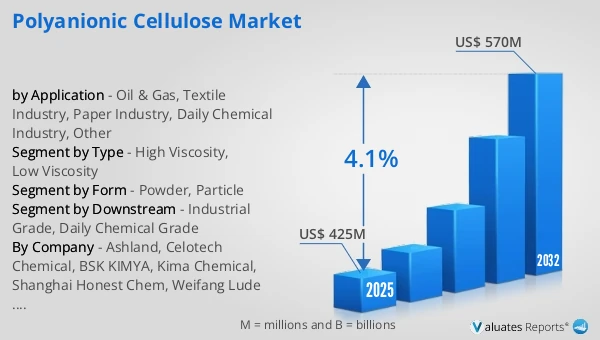
The global Polyanionic Cellulose market was valued at US$ 425 million in 2025 and is anticipated to reach US$ 570 million by 2032, at a CAGR of 4.1% from 2026 to 2032.
Polyanionic Cellulose Market
The 2025 U.S. tariff policies introduce profound uncertainty into the global economic landscape. This report critically examines the implications of recent tariff adjustments and international strategic countermeasures on Polyanionic Cellulose competitive dynamics, regional economic interdependencies, and supply chain reconfigurations.
Polyanionic cellulose is a water-soluble polymer additive obtained by chemically modifying cellulose as a raw material and introducing anionic groups. It is commonly used in water-based drilling and completion fluid systems. Its main function is to control water loss and regulate rheology and viscosity, reduce filtration by forming a dense mud cake, improve rock carrying and suspension stability, and have certain salt and calcium resistance and wide pH adaptability; Products are usually divided into two categories: low viscosity PAC LV and high viscosity PAC HV, which focus on filtration control and rheological fine-tuning or stronger thickening and sand carrying capacity, respectively. In trade and acceptance, they are often benchmarked against API and OCMA indicator systems. In 2025, global Polyanionic Cellulose production reached approximately 126.43 K MT, with an average global market price of around US$ 3,364 per MT.
The demand for polyanionic cellulose is highly correlated with the strength of water-based drilling fluids. It has stronger viscosity in conditions that are more sensitive to water loss control and wellbore stability, such as deep wells, horizontal wells, offshore and complex formations. At the same time, the increase in environmental protection and compliance pressure will promote the penetration of water-based systems and the demand for PAC with low toxicity, biodegradability and better batch consistency. The competition focus will shift from simple price to effective substitution degree and molecular weight stability, salt and temperature resistance, dissolution and dispersion speed and low impurity control, and will lock in oil service and mud system customers through formulation services and on-site application support.
This report delivers a comprehensive overview of the global Polyanionic Cellulose market, with both quantitative and qualitative analyses, to help readers develop growth strategies, assess the competitive landscape, evaluate their position in the current market, and make informed business decisions regarding Polyanionic Cellulose. The Polyanionic Cellulose market size, estimates, and forecasts are provided in terms of output/shipments (Kilotons) and revenue (US$ millions), with 2025 as the base year and historical and forecast data for 2021–2032.
The report segments the global Polyanionic Cellulose market comprehensively. Regional market sizes by Type, by Application, by Form, and by company are also provided. For deeper insight, the report profiles the competitive landscape, key competitors, and their respective market rankings, and discusses technological trends and new product developments.
This report will assist Polyanionic Cellulose manufacturers, new entrants, and companies across the industry value chain with information on revenues, production, and average prices for the overall market and its sub-segments, by company, by Type, by Application, and by region.
Market Segmentation
Scope of Polyanionic Cellulose Market Report
| Report Metric |
Details |
| Report Name |
Polyanionic Cellulose Market |
| Accounted market size in 2025 |
US$ 425 million |
| Forecasted market size in 2032 |
US$ 570 million |
| CAGR |
4.1% |
| Base Year |
2025 |
| Forecasted years |
2026 - 2032 |
| Segment by Type |
- High Viscosity
- Low Viscosity
|
| Segment by Form |
|
| Segment by Downstream |
- Industrial Grade
- Daily Chemical Grade
|
| by Application |
- Oil & Gas
- Textile Industry
- Paper Industry
- Daily Chemical Industry
- Other
|
| Production by Region |
- North America
- Europe
- China
- Japan
|
| Consumption by Region |
- North America (United States, Canada)
- Europe (Germany, France, UK, Italy, Russia)
- Asia-Pacific (China, Japan, South Korea, Taiwan)
- Southeast Asia (India)
- Latin America (Mexico, Brazil)
|
| By Company |
Ashland, Celotech Chemical, BSK KIMYA, Kima Chemical, Shanghai Honest Chem, Weifang Lude Chemical, Qingdao Doeast Chemical, Feicheng Yutian Chemical, Hebei Huayi Cellulose, LANDU, Mikazone, Zouping Yizhong Industrial, Jiangsu Licheng Chemical |
| Forecast units |
USD million in value |
| Report coverage |
Revenue and volume forecast, company share, competitive landscape, growth factors and trends |
Chapter Outline
- Chapter 1: Defines the scope of the report and presents an executive summary of market segments (by Type, by Application, by Form, etc.), including the size of each segment and its future growth potential. It offers a high-level view of the current market and its likely evolution in the short, medium, and long term.
- Chapter 2: Provides a detailed analysis of the competitive landscape for Polyanionic Cellulose manufacturers, including prices, production, value-based market shares, latest development plans, and information on mergers and acquisitions.
- Chapter 3: Examines Polyanionic Cellulose production/output and value by region and country, providing a quantitative assessment of market size and growth potential for each region over the next six years.
- Chapter 4: Analyzes Polyanionic Cellulose consumption at the regional and country levels. It quantifies market size and growth potential for each region and its key countries, and outlines market development, outlook, addressable space, and national production.
- Chapter 5: Analyzes market segments by Type, covering the size and growth potential of each segment to help readers identify “blue ocean” opportunities.
- Chapter 6: Analyzes market segments by Application, covering the size and growth potential of each segment to help readers identify “blue ocean” opportunities in downstream markets.
- Chapter 7: Profiles key players, detailing the fundamentals of major companies, including product production/output, value, price, gross margin, product portfolio/introductions, and recent developments.
- Chapter 8: Reviews the industry value chain, including upstream and downstream segments.
- Chapter 9: Discusses market dynamics and recent developments, including drivers, restraints, challenges and risks for manufacturers, U.S. Tariffs and relevant policy analysis.
- Chapter 10: Summarizes the key findings and conclusions of the report.
FAQ for this report
How fast is Polyanionic Cellulose Market growing?
Ans: The Polyanionic Cellulose Market witnessing a CAGR of 4.1% during the forecast period 2026-2032.
What is the Polyanionic Cellulose Market size in 2032?
Ans: The Polyanionic Cellulose Market size in 2032 will be US$ 570 million.
Who are the main players in the Polyanionic Cellulose Market report?
Ans: The main players in the Polyanionic Cellulose Market are Ashland, Celotech Chemical, BSK KIMYA, Kima Chemical, Shanghai Honest Chem, Weifang Lude Chemical, Qingdao Doeast Chemical, Feicheng Yutian Chemical, Hebei Huayi Cellulose, LANDU, Mikazone, Zouping Yizhong Industrial, Jiangsu Licheng Chemical
What are the Application segmentation covered in the Polyanionic Cellulose Market report?
Ans: The Applications covered in the Polyanionic Cellulose Market report are Oil & Gas, Textile Industry, Paper Industry, Daily Chemical Industry, Other
What are the Type segmentation covered in the Polyanionic Cellulose Market report?
Ans: The Types covered in the Polyanionic Cellulose Market report are High Viscosity, Low Viscosity