FEATURED COMPANIES
Evonik
Hexcel
HOS-Technik
Bismaleimide (BMI) Resins Powder Market Size
The global Bismaleimide (BMI) Resins Powder market was valued at US$ 92.72 million in 2025 and is anticipated to reach US$ 129 million by 2032, at a CAGR of 5.3% from 2026 to 2032.
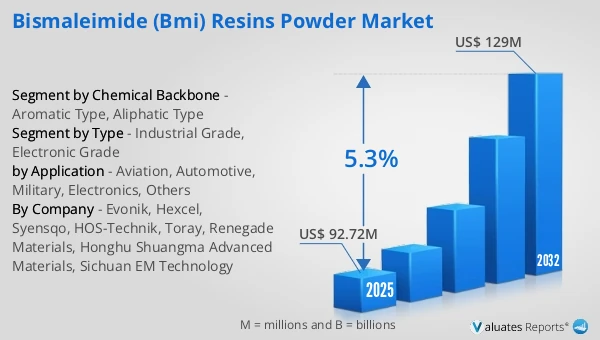
Bismaleimide (BMI) Resins Powder Market
The 2025 U.S. tariff policies introduce profound uncertainty into the global economic landscape. This report critically examines the implications of recent tariff adjustments and international strategic countermeasures on Bismaleimide (BMI) Resins Powder competitive dynamics, regional economic interdependencies, and supply chain reconfigurations.
Global sales of Bismaleimide (BMI) Resins Powder was about 1220 tons in 2025 with average price of 76 USD/kg. The average gross margin of the industry is between 25%-30%. Composites are the direct and most important field of Bismaleimide (BMI) Resins Powder.
Bismaleimide (BMI) Resins Powder are a class of high-performance thermosetting resins based on bismaleimide functional groups (typically derived from maleic anhydride and aromatic diamines). It cures mainly through addition reactions (often with co-reactants) to form a highly crosslinked network, offering high glass-transition temperature (Tg), excellent thermal stability, good dielectric performance, and chemical resistance, and is widely used in advanced composites, aerospace structures, high-temperature adhesives, and electronic laminates.
BMI resin powder remain compelling where “high-temperature durability” is non-negotiable, thanks to their high Tg, thermal-oxidative stability, and low creep. Growth in aerospace structures, hot-zone composite parts, high-temperature film adhesives, and honeycomb bonding continues to create room for BMI systems that can hold dimensions and properties over long service times. In parallel, advanced electronics that demand a balance of thermal stability and dielectric performance open incremental opportunities for tailored BMI-based laminates and specialty adhesive formulations.
A key limitation of BMI networks is inherent brittleness, so achieving high toughness often requires sophisticated toughening strategies that can compromise flow, viscosity, cure shrinkage, or dielectric loss if not carefully engineered. Processing commonly involves higher cure temperatures and tighter cure-cycle control, raising the bar for prepreg manufacture, part quality consistency, and scale-up—especially for large or thick sections where exotherm and residual stress become harder to manage. Cost and supply-chain complexity (monomer quality, modifiers, film processing know-how) also constrain adoption beyond premium applications.
BMI development is trending toward “high performance with improved processability and toughness,” enabled by thermoplastic toughening, controlled phase-separation, nano-reinforcement, and co-curing/blending with systems such as cyanate ester, benzoxazine, or epoxy to optimize the overall property envelope. Formulations with lower volatility/outgassing, lower moisture uptake, and stronger batch-to-batch consistency are likely to gain emphasis for both aerospace qualification and electronics reliability. As automated manufacturing and faster curing cycles advance, BMI solutions will increasingly be packaged as engineered, process-robust systems—shorter cure, wider processing windows, and repair-friendly implementations.
This report delivers a comprehensive overview of the global Bismaleimide (BMI) Resins Powder market, with both quantitative and qualitative analyses, to help readers develop growth strategies, assess the competitive landscape, evaluate their position in the current market, and make informed business decisions regarding Bismaleimide (BMI) Resins Powder. The Bismaleimide (BMI) Resins Powder market size, estimates, and forecasts are provided in terms of output/shipments (Kiloton) and revenue (US$ millions), with 2025 as the base year and historical and forecast data for 2021–2032.
The report segments the global Bismaleimide (BMI) Resins Powder market comprehensively. Regional market sizes by Type, by Application, by Chemical Backbone, and by company are also provided. For deeper insight, the report profiles the competitive landscape, key competitors, and their respective market rankings, and discusses technological trends and new product developments.
This report will assist Bismaleimide (BMI) Resins Powder manufacturers, new entrants, and companies across the industry value chain with information on revenues, production, and average prices for the overall market and its sub-segments, by company, by Type, by Application, and by region.
Market Segmentation
Scope of Bismaleimide (BMI) Resins Powder Market Report
| Report Metric |
Details |
| Report Name |
Bismaleimide (BMI) Resins Powder Market |
| Accounted market size in 2025 |
US$ 92.72 million |
| Forecasted market size in 2032 |
US$ 129 million |
| CAGR |
5.3% |
| Base Year |
2025 |
| Forecasted years |
2026 - 2032 |
| Segment by Type |
- Industrial Grade
- Electronic Grade
|
| Segment by Chemical Backbone |
- Aromatic Type
- Aliphatic Type
|
| by Application |
- Aviation
- Automotive
- Military
- Electronics
- Others
|
| Production by Region |
- North America
- Europe
- China
- Japan
|
| Consumption by Region |
- North America (United States, Canada)
- Europe (Germany, France, UK, Italy, Russia)
- Asia-Pacific (China, Japan, South Korea, Taiwan)
- Southeast Asia (India)
- Latin America (Mexico, Brazil)
|
| By Company |
Evonik, Hexcel, Syensqo, HOS-Technik, Toray, Renegade Materials, Honghu Shuangma Advanced Materials, Sichuan EM Technology |
| Forecast units |
USD million in value |
| Report coverage |
Revenue and volume forecast, company share, competitive landscape, growth factors and trends |
Chapter Outline
- Chapter 1: Defines the scope of the report and presents an executive summary of market segments (by Type, by Application, by Chemical Backbone, etc.), including the size of each segment and its future growth potential. It offers a high-level view of the current market and its likely evolution in the short, medium, and long term.
- Chapter 2: Provides a detailed analysis of the competitive landscape for Bismaleimide (BMI) Resins Powder manufacturers, including prices, production, value-based market shares, latest development plans, and information on mergers and acquisitions.
- Chapter 3: Examines Bismaleimide (BMI) Resins Powder production/output and value by region and country, providing a quantitative assessment of market size and growth potential for each region over the next six years.
- Chapter 4: Analyzes Bismaleimide (BMI) Resins Powder consumption at the regional and country levels. It quantifies market size and growth potential for each region and its key countries, and outlines market development, outlook, addressable space, and national production.
- Chapter 5: Analyzes market segments by Type, covering the size and growth potential of each segment to help readers identify “blue ocean” opportunities.
- Chapter 6: Analyzes market segments by Application, covering the size and growth potential of each segment to help readers identify “blue ocean” opportunities in downstream markets.
- Chapter 7: Profiles key players, detailing the fundamentals of major companies, including product production/output, value, price, gross margin, product portfolio/introductions, and recent developments.
- Chapter 8: Reviews the industry value chain, including upstream and downstream segments.
- Chapter 9: Discusses market dynamics and recent developments, including drivers, restraints, challenges and risks for manufacturers, U.S. Tariffs and relevant policy analysis.
- Chapter 10: Summarizes the key findings and conclusions of the report.
FAQ for this report
How fast is Bismaleimide (BMI) Resins Powder Market growing?
Ans: The Bismaleimide (BMI) Resins Powder Market witnessing a CAGR of 5.3% during the forecast period 2026-2032.
What is the Bismaleimide (BMI) Resins Powder Market size in 2032?
Ans: The Bismaleimide (BMI) Resins Powder Market size in 2032 will be US$ 129 million.
Who are the main players in the Bismaleimide (BMI) Resins Powder Market report?
Ans: The main players in the Bismaleimide (BMI) Resins Powder Market are Evonik, Hexcel, Syensqo, HOS-Technik, Toray, Renegade Materials, Honghu Shuangma Advanced Materials, Sichuan EM Technology
What are the Application segmentation covered in the Bismaleimide (BMI) Resins Powder Market report?
Ans: The Applications covered in the Bismaleimide (BMI) Resins Powder Market report are Aviation, Automotive, Military, Electronics, Others
What are the Type segmentation covered in the Bismaleimide (BMI) Resins Powder Market report?
Ans: The Types covered in the Bismaleimide (BMI) Resins Powder Market report are Industrial Grade, Electronic Grade