FEATURED COMPANIES
Knorr-Bremse
Akebono Brake Industry
Beijing Puran Railway Braking High-Tech
Alstom Flertex
Railway Brake Shoes Market Size
The global Railway Brake Shoes market was valued at US$ 920 million in 2025 and is anticipated to reach US$ 1151 million by 2032, at a CAGR of 3.3% from 2026 to 2032.
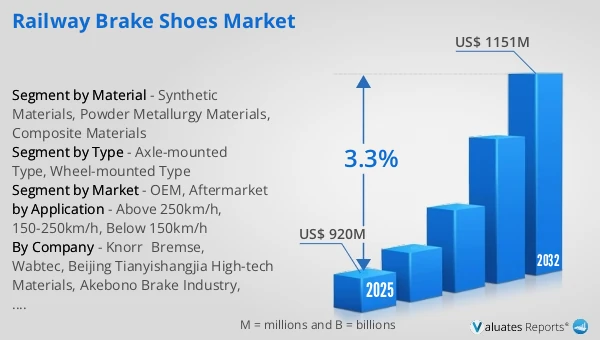
Railway Brake Shoes Market
The 2025 U.S. tariff policies introduce profound uncertainty into the global economic landscape. This report critically examines the implications of recent tariff adjustments and international strategic countermeasures on Railway Brake Shoes competitive dynamics, regional economic interdependencies, and supply chain reconfigurations.
Railway brake shoes are the friction linings mounted on a steel backing plate and clamped by a brake caliper against a rotating brake disc to slow or stop a high-speed train by converting kinetic energy into heat. Because braking energy and temperatures can be extremely high at speed, these pads are engineered for stable friction performance, strong fade and thermal shock resistance, controlled wear, low noise and vibration, and minimal damage to the disc surface, while still delivering consistent braking in dry, wet, and varying load conditions. In commercial practice they are most commonly disc-brake pads made from either resin-bonded composite materials or sintered metallic materials, selected to match the train’s speed class, duty cycle, and braking strategy. The product has an annual sales volume of approximately 4 million units, with an average selling price of approximately $200-$400 per unit.
Railway brake shoes sit in a supply chain that starts upstream with steel backing plates and friction-material constituents—either resin-bonded composite ingredients or metallic powders for sintered formulations—followed by specialized manufacturing such as hot pressing/curing (organic) or powder metallurgy and sintering (metallic), then bonding/riveting, machining, and surface finishing to meet tight thickness, flatness, and friction requirements; because they are safety-critical wear parts, this upstream stage also includes heavy process control, traceability, dynamometer validation, and qualification/certification. Downstream, pads are selected and qualified by train OEMs and brake-system integrators for new-build programs, then purchased repeatedly by rail operators and maintenance depots as consumables through scheduled inspection and replacement cycles, often under long-term service agreements and fleet-standard part numbers to ensure consistent braking performance across vehicles and routes.
Railway brake shoes are a safety-critical consumable market where purchasing decisions are strongly shaped by qualification regimes and reliability expectations, so suppliers compete less on “generic friction material” and more on proven performance, traceability, and certification status for specific service categories and duty cycles. Commercially, demand is anchored by two steady streams: new high-speed fleet deliveries that require pad types validated for the train’s braking energy and disc interface, and a recurring aftermarket driven by predictable wear replacement and overhaul programs. At the same time, the market is moving toward higher value formulations and system optimization as operators push for longer life, stable friction under high thermal loads, and lower noise and disc wear, while regulators and public stakeholders increase scrutiny of non-exhaust particulate emissions from braking—prompting R&D into lower-emission pad materials and better friction-pair management. Finally, adoption of condition monitoring and data-driven maintenance is making pad wear and performance more measurable, which can shift buying toward suppliers that can demonstrate consistency, predictive maintenance compatibility, and lower lifecycle cost rather than just unit price.
This report delivers a comprehensive overview of the global Railway Brake Shoes market, with both quantitative and qualitative analyses, to help readers develop growth strategies, assess the competitive landscape, evaluate their position in the current market, and make informed business decisions regarding Railway Brake Shoes. The Railway Brake Shoes market size, estimates, and forecasts are provided in terms of output/shipments (K Units) and revenue (US$ millions), with 2025 as the base year and historical and forecast data for 2021–2032.
The report segments the global Railway Brake Shoes market comprehensively. Regional market sizes by Material, by Application, by Type, and by company are also provided. For deeper insight, the report profiles the competitive landscape, key competitors, and their respective market rankings, and discusses technological trends and new product developments.
This report will assist Railway Brake Shoes manufacturers, new entrants, and companies across the industry value chain with information on revenues, production, and average prices for the overall market and its sub-segments, by company, by Material, by Application, and by region.
Market Segmentation
Scope of Railway Brake Shoes Market Report
| Report Metric |
Details |
| Report Name |
Railway Brake Shoes Market |
| Accounted market size in 2025 |
US$ 920 million |
| Forecasted market size in 2032 |
US$ 1151 million |
| CAGR |
3.3% |
| Base Year |
2025 |
| Forecasted years |
2026 - 2032 |
| Segment by Material |
- Synthetic Materials
- Powder Metallurgy Materials
- Composite Materials
|
| Segment by Type |
- Axle-mounted Type
- Wheel-mounted Type
|
| Segment by Market |
|
| by Application |
- Above 250km/h
- 150-250km/h
- Below 150km/h
|
| Production by Region |
- North America
- Europe
- China
- Japan
|
| Consumption by Region |
- North America (United States, Canada)
- Europe (Germany, France, UK, Italy, Russia)
- Asia-Pacific (China, Japan, South Korea, Taiwan)
- Southeast Asia (India)
- Latin America (Mexico, Brazil)
|
| By Company |
Knorr⁃Bremse, Wabtec, Beijing Tianyishangjia High-tech Materials, Akebono Brake Industry, Bremskerl, Tribo, Escorts, CRRC Qishuyan, Alstom Flertex, Dellner Frimatrail Frenoplast, Masu Brakes, Guangdong Huatie Tongda High-speed Railway Equipment, Youcaitec Material, Beijing Puran Railway Braking High-tech |
| Forecast units |
USD million in value |
| Report coverage |
Revenue and volume forecast, company share, competitive landscape, growth factors and trends |
Chapter Outline
- Chapter 1: Defines the scope of the report and presents an executive summary of market segments (by Material, by Application, by Type, etc.), including the size of each segment and its future growth potential. It offers a high-level view of the current market and its likely evolution in the short, medium, and long term.
- Chapter 2: Provides a detailed analysis of the competitive landscape for Railway Brake Shoes manufacturers, including prices, production, value-based market shares, latest development plans, and information on mergers and acquisitions.
- Chapter 3: Examines Railway Brake Shoes production/output and value by region and country, providing a quantitative assessment of market size and growth potential for each region over the next six years.
- Chapter 4: Analyzes Railway Brake Shoes consumption at the regional and country levels. It quantifies market size and growth potential for each region and its key countries, and outlines market development, outlook, addressable space, and national production.
- Chapter 5: Analyzes market segments by Material, covering the size and growth potential of each segment to help readers identify “blue ocean” opportunities.
- Chapter 6: Analyzes market segments by Application, covering the size and growth potential of each segment to help readers identify “blue ocean” opportunities in downstream markets.
- Chapter 7: Profiles key players, detailing the fundamentals of major companies, including product production/output, value, price, gross margin, product portfolio/introductions, and recent developments.
- Chapter 8: Reviews the industry value chain, including upstream and downstream segments.
- Chapter 9: Discusses market dynamics and recent developments, including drivers, restraints, challenges and risks for manufacturers, U.S. Tariffs and relevant policy analysis.
- Chapter 10: Summarizes the key findings and conclusions of the report.
FAQ for this report
How fast is Railway Brake Shoes Market growing?
Ans: The Railway Brake Shoes Market witnessing a CAGR of 3.3% during the forecast period 2026-2032.
What is the Railway Brake Shoes Market size in 2032?
Ans: The Railway Brake Shoes Market size in 2032 will be US$ 1151 million.
Who are the main players in the Railway Brake Shoes Market report?
Ans: The main players in the Railway Brake Shoes Market are Knorr⁃Bremse, Wabtec, Beijing Tianyishangjia High-tech Materials, Akebono Brake Industry, Bremskerl, Tribo, Escorts, CRRC Qishuyan, Alstom Flertex, Dellner Frimatrail Frenoplast, Masu Brakes, Guangdong Huatie Tongda High-speed Railway Equipment, Youcaitec Material, Beijing Puran Railway Braking High-tech
What are the Application segmentation covered in the Railway Brake Shoes Market report?
Ans: The Applications covered in the Railway Brake Shoes Market report are Above 250km/h, 150-250km/h, Below 150km/h
What are the Type segmentation covered in the Railway Brake Shoes Market report?
Ans: The Types covered in the Railway Brake Shoes Market report are Axle-mounted Type, Wheel-mounted Type