0
U.S. (TOLL FREE)
+1 (315) 215-3225
Automative

0
U.S. (TOLL FREE)
+1 (315) 215-3225
Multi-Format Matrix Switcher- Global Market Share and Ranking, Overall Sales and Demand Forecast 2026-2032
Published Date: 2026-01-13
|
Report Code: QYRE-Auto-10D18233
Home | Market Reports | Computers & Electronics
Global Multi Format Matrix Switcher Market Research Report 2024
BUY CHAPTERS

Multi-Format Matrix Switcher- Global Market Share and Ranking, Overall Sales and Demand Forecast 2026-2032

Code: QYRE-Auto-10D18233
Report
2026-01-13
Pages:115
QYResearch
Buy Now with 15% Discount
DESCRIPTION
TABLE OF CONTENT
TABLES & FIGURES

Multi-Format Matrix Switcher- Market Size

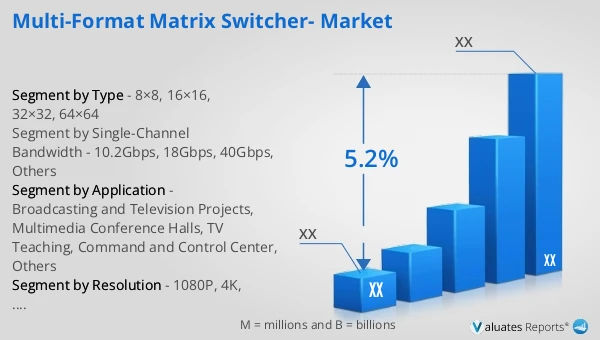
The global market for Multi-Format Matrix Switcher was estimated to be worth US$ 1208 million in 2025 and is projected to reach US$ 1721 million, growing at a CAGR of 5.2% from 2026 to 2032.

Multi-Format Matrix Switcher- Market

Multi-Format Matrix Switcher- Market

The potential shifts in the 2025 U.S. tariff framework pose substantial volatility risks to global markets. This report provides a comprehensive assessment of recent tariff adjustments and international strategic countermeasures on Multi-Format Matrix Switcher cross-border industrial footprints, capital allocation patterns, regional economic interdependencies, and supply chain reconfigurations.
Multi-format matrix switchers, serving as the "signal hub" in modern conference rooms, command centers, campus multimedia systems, and stage performance systems, are essentially valuable for solving the problems inherent in the traditional "single-interface switcher + various adapters/extenders" model. These problems include difficulty in managing multiple signal formats, high failure rates due to cable and adapter stacking, instability of high-bandwidth signals such as 4K/60 HDR, audio-video synchronization issues, lack of remote management, and the pain points of "old interfaces + new interfaces" coexisting in renovation projects. In typical corporate headquarters, multi-functional lecture halls, or municipal command centers, multiple signal sources such as HDMI, DisplayPort, USB-C, HDBaseT, SDI, and analog audio often coexist. Using separate single-format switchers and a pile of converters to connect them easily leads to HDCP/EDID compatibility issues, resolution negotiation failures, audio loss, switching black screens, and maintenance difficulties. In scenarios involving hybrid online and offline meetings, recording, and streaming, it is also necessary to simultaneously provide different resolutions and aspect ratios of signal output to local large screens, recording systems, encoders/live streaming, and bypass monitoring. Multi-format matrix switchers integrate various video/audio interface boards, signal format conversion and scaling, audio embedding/de-embedding, control interfaces, and network management into a single unit. This packages "any input-any output" routing capabilities with multi-format compatibility, unified EDID/HDCP management, and preset scene recall functions, allowing system integrators to complete most signal organization work within a single chassis, significantly reducing external converters and "flying wires," and improving system reliability and maintainability. In 2025, the global sales of multi-format matrix switchers in various application scenarios are estimated at approximately 323,000 units, with the average price of mainstream models around USD 3,740 per unit, and a comprehensive gross profit margin of approximately 27%-35%. Integrated matrix switchers for conference systems and education account for the largest share of shipments, while high-end command center and broadcast/event production products have significantly higher average selling prices. A multi-format matrix switcher is a core device for centralized signal switching and format conversion in professional AV and conferencing systems. It typically integrates various video/audio input and output interfaces (such as HDMI/DP/VGA/HDBaseT, analog/digital audio, etc.), a signal switching matrix, scaling/format conversion, audio embedding/de-embedding, and control interfaces within a single chassis. It is used to flexibly route signals from multiple sources such as computers, players, cameras, and video conferencing terminals to multiple display/processing devices such as projectors, LED screens, video walls, recording and streaming encoders in a conference room, classroom, command center, or multi-purpose hall. Typical parameters include: input/output sizes ranging from 4×2, 8×4, 8×8 to 16×16/32×32, supporting resolutions from 1080p to 4K60 4:4:4 (some high-end models support HDR/4K120 or 8K readiness), video bandwidth of 10–18 Gbps/channel, support for HDCP 2.2/2.3, audio support for analog balanced/unbalanced and digital S/PDIF, built-in or external DSP mixing/equalization, and control interfaces including RS-232, Ethernet, IR, GPIO, and protocols compatible with mainstream control systems (such as Crestron, AMX, etc.); the power consumption is generally 20–120 W, and the chassis specifications are mostly 1U–3U rack-mountable or wall/under-desk mountable. Typical usage: a standard video conferencing room usually has one 4×2 or 4×4 multi-format matrix switcher; a 100–200 person lecture hall/multi-purpose hall often has one 8×4 or 8×8 model; a command center/monitoring room often uses 2–6 medium-to-large matrix switchers or works in conjunction with IP AV encoders/decoders to form the core of the signal routing system. The upstream supply chain primarily relies on dedicated interface chips such as HDMI/HDBaseT, FPGAs/dedicated video processing SoCs, analog/digital audio codecs, power modules, chassis metalwork, and connectors; the downstream market is concentrated in system integrators, conference and education project contractors, broadcast and television engineering companies, and manufacturers providing complete AV solutions.
Supply Situation
Upstream raw materials and key components mainly include high-speed multi-layer PCB boards, video interface and switching chips (HDMI/DP/SDI/HDBaseT transceivers and crossbar switches), programmable logic devices and SoCs, industrial-grade power modules, metal enclosures and heat sinks, and professional connectors. The cost of raw materials and components typically accounts for 55%–68% of the total machine cost. Among these, the price and supply of high-speed interface chips and FPGA/SoCs, licensing costs for technologies such as HDBaseT, and fluctuations in multi-layer PCB processing prices have the greatest impact on the BOM cost of these products. Typical upstream suppliers include Texas Instruments, Analog Devices, AMD (Xilinx), Intel, and Molex, whose product lines and supply capabilities largely determine the performance limits of multi-format matrix switchers in terms of bandwidth, interface types, and power consumption.
Manufacturer Characteristics
Atlona, ​​leveraging its AV over IP and multi-format matrix products, has a wide presence in enterprise conference rooms and the education market, emphasizing integration with control systems and cloud management platforms; Roland excels in "integrated audio-visual processing + multi-format switching" for live performances, auditoriums, and small studio applications, enjoying high penetration in small and medium-sized scenarios; Kramer Electronics has long cultivated the professional AV signal management field, possessing a solid brand and channel foundation in the European and Middle Eastern markets, with its multi-format matrices covering a wide range of specifications from small meeting rooms to large conference centers and command centers.
Case Study
In 2024, the Ministry of Education of a Southeast Asian country launched a "Smart Campus and Remote Teaching Upgrade Plan," covering 18 public universities and over 60 vocational colleges, involving the renovation of audio-visual systems in more than 1,200 multimedia classrooms, 60 large lecture halls, and 40 remote teaching centers. Atlona multi-format matrix switchers were adopted, supporting mixed access of HDMI, HDBaseT, USB-C, and traditional VGA, meeting the requirements of 4K/60 4:4:4 transmission, centralized control, and remote operation and maintenance management; simultaneously achieving flexible "any source to any screen" routing in lecture halls and remote teaching centers, and reserving the capability for future integration with AV-over-IP codecs. Through a unified matrix platform, while meeting the needs of multi-interface compatibility and local/remote teaching, it reduces the number of discrete converters and on-site failure points, and lowers subsequent maintenance labor costs through a centralized monitoring platform.
Applications
Multi-format matrix switchers are widely used in various application scenarios, including conference/training room systems in corporate headquarters and campuses, multi-functional conference halls and press conference rooms in government agencies and municipal buildings, multimedia classrooms and lecture halls in universities and primary/secondary schools, academic lecture halls and telemedicine centers in hospitals, monitoring and command centers in the energy and transportation industries, monitoring halls in financial and operational centers, conference and banquet hall systems in hotels and convention centers, stage audio-visual systems in theaters and auditoriums, and broadcast studios and small live/recording rooms. They are the core routing component for applications requiring "multiple signal types + multiple display terminals + centralized control". Typical downstream customers include large enterprises and co-working space operators (such as multinational company headquarters and regional operation centers), large universities and convention groups, energy and transportation operating companies, and government agencies responsible for municipal command and public services. These customers typically procure and integrate multi-format matrix switchers through professional system integrators or general contractors.
Product Advantages
For downstream system integrators and end-users, the biggest advantage of multi-format matrix switchers is that they consolidate the chaotic environment of "small black boxes, small converters, and various cables everywhere" into a manageable, monitorable, and remotely maintainable central node: On the one hand, it handles multiple signals such as HDMI/DP/USB-C/HDBaseT/SDI within the same chassis, reducing the number of adapters and discrete converters, thus reducing failure points and compatibility risks from the design stage; on the other hand, through centralized EDID/HDCP management, seamless or fast switching, and one-click recall of preset scenarios, it improves the stability and experience of meetings and events, reducing embarrassing situations such as "no picture" or "black screen during switching"; coupled with network management and logging, multi-format matrix switchers can also help operation and maintenance teams remotely troubleshoot problems, centrally update firmware, and unify configurations, significantly reducing long-term maintenance costs. In bidding and project competition, integrated solutions with multi-format matrices are more likely to gain an advantage in scoring across three dimensions: system reliability, scalability, and remote operation and maintenance. This allows integrators and brand manufacturers to achieve higher winning rates and a certain premium in the highly competitive AV engineering market.
Technological Trends
Technological evolution is concentrated in several directions: Firstly, towards higher bandwidth and higher resolution, with support for 4K/60 4:4:4 becoming mainstream, and high-end models starting to target 8K or 4K/120 scenarios. This is achieved through higher bandwidth backplane design, signal equalization and compensation technologies, and support for new generation interface standards (such as HDMI 2.1), ensuring stable operation even under long-distance transmission and complex wiring conditions; Secondly, deep integration with AV-over-IP, transitioning from "pure baseband matrices" to "baseband + IP hybrid matrices" and even "virtual IP matrix platforms," ​​balancing traditional data center wiring practices with future network evolution directions by managing local interfaces and network streams under the same management interface; Thirdly, the integration of interfaces and functions, with more and more multi-format matrices integrating front-end USB-C power supply (such as 60–100 W PD), USB data return, audio DSP, and simple multi-screen functions, making them "conference hosts" in small spaces; Fourthly, cloud management and enhanced security, enabling unified monitoring, configuration backup, and permission management of matrices in multiple locations via cloud or local servers, while strengthening device access control, log auditing, and secure firmware updates to meet the network and information security requirements of government and enterprise clients. The overall trend points towards higher bandwidth, stronger multi-format compatibility, deeper IP and control integration, and better manageability and security.
Market Influencing Factors
The growth of the multi-format matrix switcher market stems from several factors. Firstly, the continuous increase in the number of global meeting spaces and multimedia scenarios, coupled with the long-term coexistence of offline and online meetings, is driving system upgrade demands. The digital transformation of enterprises, hybrid work models, and the normalization of online education have led to a need for many small and medium-sized meeting rooms and educational spaces to upgrade from "single projector + simple switching" to integrated scenarios with "multi-source access + remote conferencing + recording/live streaming," directly boosting the installation of multi-format matrices in renovation projects. Secondly, government and public institutions' command centers, emergency platforms, and transportation and energy monitoring centers are increasingly reliant on centralized monitoring and flexible routing of multiple signal sources, providing stable demand for medium and large-scale matrix platforms. Simultaneously, the trend towards larger, higher-resolution, and multi-screen display terminals means that traditional simple switchers are gradually unable to meet bandwidth and routing requirements, prompting system integrators to adopt matrix solutions with scaling and multi-format support. In terms of cost and competition, AV-over-IP solutions are creating some pressure on large hardware matrices in some new projects, leading the latter to emphasize the advantages of "low latency, determinism, and plug-and-play" in high-end projects, while maintaining competitiveness in small and medium-sized projects through increased integration and cost optimization. Fluctuations in upstream chip and PCB prices, and delivery uncertainties during periods of supply chain tension, will also temporarily affect shipping schedules and profit margins. Overall, multi-format matrix switchers remain one of the core forms of "physical signal routing" in many meeting and multimedia scenarios. Despite the rising penetration of AV-over-IP, small and medium-sized scenarios with multiple interfaces and high demands for determinism and reliability will continue to rely on this product category in the long term. The market structure will show a structural evolution of "high-end evolving towards networking and platformization, while mainstream engineering continues to be centered around multi-format matrices."
This report provides a comprehensive view of the global market for Multi-Format Matrix Switcher, covering total sales volume, sales revenue, pricing, the market share and ranking of key companies, along with analyses by region & country, by Type, and by Application.
The Multi-Format Matrix Switcher market size, estimations, and forecasts are presented in terms of sales volume (K Units) and revenue ($ millions), with 2025 as the base year and historical and forecast data from 2021 to 2032. The report combines quantitative and qualitative analysis to help readers develop growth strategies, assess the competitive landscape, evaluate their position in the current marketplace, and make informed business decisions regarding Multi-Format Matrix Switcher.
Market Segmentation

Scope of Multi-Format Matrix Switcher- Market Report

Report Metric Details
Report Name Multi-Format Matrix Switcher- Market
CAGR 5.2%
Segment by Type
  • 8×8
  • 16×16
  • 32×32
  • 64×64
Segment by Resolution
  • 1080P
  • 4K
  • Others
Segment by Single-Channel Bandwidth
  • 10.2Gbps
  • 18Gbps
  • 40Gbps
  • Others
Segment by Application
  • Broadcasting and Television Projects
  • Multimedia Conference Halls
  • TV Teaching
  • Command and Control Center
  • Others
By Region
  • North America (United States, Canada)
  • Europe (Germany, France, UK, Italy, Russia) Rest of Europe
  • Nordic Countries
  • Asia-Pacific (China, Japan, South Korea)
  • Southeast Asia (India, Australia)
  • Rest of Asia
  • Latin America (Mexico, Brazil)
  • Rest of Latin America
  • Middle East & Africa (Turkey, Saudi Arabia, UAE, Rest of MEA)
Consumption by Region
  • North America (United States, Canada)
  • Europe (Germany, France, UK, Italy, Russia)
  • Asia-Pacific (China, Japan, South Korea, Taiwan)
  • Southeast Asia (India)
  • Latin America (Mexico, Brazil)
By Company Crestron, Atlona, Roland, Kramer Electronics, Barco, Aten, Sony, HARMAN International, Extron, AVProEdge, BZBGEAR, WyreStorm, Key Digital, Lightware, DVDO
Forecast units USD million in value
Report coverage Revenue and volume forecast, company share, competitive landscape, growth factors and trends

Chapter Outline

  • Chapter 1: Introduces the scope of the report and the global market size (value, volume, and price). It also summarizes market dynamics and Recent Developments; identifies key drivers and restraints; outlines challenges and risks for manufacturers; reviews relevant industry policies and U.S. tariff implications.
  • Chapter 2: Provides a detailed analysis of the Multi-Format Matrix Switcher manufacturers' competitive landscape—including pricing, sales and revenue shares, Recent Developments plans, and mergers and acquisitions (M&A).
  • Chapter 3: Analyzes market segmentation by Type, presenting the size and growth potential of each segment to help readers identify blue-ocean opportunities.
  • Chapter 4: Analyzes market segmentation by Application, presenting the size and growth potential of each downstream segment to help readers identify blue-ocean opportunities.
  • Chapter 5: Presents Multi-Format Matrix Switcher sales and revenue at the regional level. It offers a quantitative assessment of market size and growth potential by region and summarizes market development, future prospects, addressable space, and country-level market size worldwide.
  • Chapter 6: Presents Multi-Format Matrix Switcher sales and revenue at the country level. It provides segmented data by Type and by Application for each country/region.
  • Chapter 7: Profiles key players, detailing the main companies' product sales, revenue, pricing, gross margin, product portfolios, Recent Developments, etc.
  • Chapter 8: Analyzes the industry value chain, including upstream suppliers and downstream applications/customers.
  • Chapter 9: Conclusion.

FAQ for this report

Who are the main players in the Multi-Format Matrix Switcher- Market report?

Ans: The main players in the Multi-Format Matrix Switcher- Market are Crestron, Atlona, Roland, Kramer Electronics, Barco, Aten, Sony, HARMAN International, Extron, AVProEdge, BZBGEAR, WyreStorm, Key Digital, Lightware, DVDO

What are the Application segmentation covered in the Multi-Format Matrix Switcher- Market report?

Ans: The Applications covered in the Multi-Format Matrix Switcher- Market report are Broadcasting and Television Projects, Multimedia Conference Halls, TV Teaching, Command and Control Center, Others

What are the Type segmentation covered in the Multi-Format Matrix Switcher- Market report?

Ans: The Types covered in the Multi-Format Matrix Switcher- Market report are 8×8, 16×16, 32×32, 64×64

1 Market Overview
1.1 Multi-Format Matrix Switcher Product Introduction
1.2 Global Multi-Format Matrix Switcher Market Size Forecast
1.2.1 Global Multi-Format Matrix Switcher Sales Value (2021–2032)
1.2.2 Global Multi-Format Matrix Switcher Sales Volume (2021–2032)
1.2.3 Global Multi-Format Matrix Switcher Sales Price (2021–2032)
1.3 Multi-Format Matrix Switcher Market Trends & Drivers
1.3.1 Multi-Format Matrix Switcher Industry Trends
1.3.2 Multi-Format Matrix Switcher Market Drivers & Opportunities
1.3.3 Multi-Format Matrix Switcher Market Challenges
1.3.4 Multi-Format Matrix Switcher Market Restraints
1.3.5 Impact of U.S. Tariffs
1.4 Assumptions and Limitations
1.5 Study Objectives
1.6 Years Considered
2 Competitive Analysis by Company
2.1 Global Multi-Format Matrix Switcher Players Revenue Ranking (2025)
2.2 Global Multi-Format Matrix Switcher Revenue by Company (2021–2026)
2.3 Global Multi-Format Matrix Switcher Sales Volume Ranking of Players (2025)
2.4 Global Multi-Format Matrix Switcher Sales Volume by Company (2021–2026)
2.5 Global Multi-Format Matrix Switcher Average Price by Company (2021–2026)
2.6 Key Manufacturers Multi-Format Matrix Switcher Manufacturing Base and Headquarters
2.7 Key Manufacturers Multi-Format Matrix Switcher Product Offerings
2.8 Key Manufacturers Start of Mass Production of Multi-Format Matrix Switcher
2.9 Multi-Format Matrix Switcher Market Competitive Analysis
2.9.1 Multi-Format Matrix Switcher Market Concentration Rate (2021–2026)
2.9.2 Global 5 and 10 Largest Manufacturers by Multi-Format Matrix Switcher Revenue in 2025
2.9.3 Global Companies by Tier (Tier 1, Tier 2, Tier 3), based on Multi-Format Matrix Switcher revenue, 2025
2.10 Mergers & Acquisitions and Expansion
3 Segmentation Multi-Format Matrix Switcher Market Classification
3.1 Introduction by Type
3.1.1 8×8
3.1.2 16×16
3.1.3 32×32
3.1.4 64×64
3.1.5 Global Multi-Format Matrix Switcher Sales Value by Type
3.1.5.1 Global Multi-Format Matrix Switcher Sales Value by Type (2021 vs 2025 vs 2032)
3.1.5.2 Global Multi-Format Matrix Switcher Sales Value, by Type (2021–2032)
3.1.5.3 Global Multi-Format Matrix Switcher Sales Value, by Type (%), 2021–2032
3.1.6 Global Multi-Format Matrix Switcher Sales Volume by Type
3.1.6.1 Global Multi-Format Matrix Switcher Sales Volume by Type (2021 vs 2025 vs 2032)
3.1.6.2 Global Multi-Format Matrix Switcher Sales Volume, by Type (2021–2032)
3.1.6.3 Global Multi-Format Matrix Switcher Sales Volume, by Type (%), 2021–2032
3.1.7 Global Multi-Format Matrix Switcher Average Price by Type (2021–2032)
3.2 Introduction by Resolution
3.2.1 1080P
3.2.2 4K
3.2.3 Others
3.2.4 Global Multi-Format Matrix Switcher Sales Value by Resolution
3.2.4.1 Global Multi-Format Matrix Switcher Sales Value by Resolution (2021 vs 2025 vs 2032)
3.2.4.2 Global Multi-Format Matrix Switcher Sales Value, by Resolution (2021–2032)
3.2.4.3 Global Multi-Format Matrix Switcher Sales Value, by Resolution (%), 2021–2032
3.2.5 Global Multi-Format Matrix Switcher Sales Volume by Resolution
3.2.5.1 Global Multi-Format Matrix Switcher Sales Volume by Resolution (2021 vs 2025 vs 2032)
3.2.5.2 Global Multi-Format Matrix Switcher Sales Volume, by Resolution (2021–2032)
3.2.5.3 Global Multi-Format Matrix Switcher Sales Volume, by Resolution (%), 2021–2032
3.2.6 Global Multi-Format Matrix Switcher Average Price by Resolution (2021–2032)
3.3 Introduction by Single-Channel Bandwidth
3.3.1 10.2Gbps
3.3.2 18Gbps
3.3.3 40Gbps
3.3.4 Others
3.3.5 Global Multi-Format Matrix Switcher Sales Value by Single-Channel Bandwidth
3.3.5.1 Global Multi-Format Matrix Switcher Sales Value by Single-Channel Bandwidth (2021 vs 2025 vs 2032)
3.3.5.2 Global Multi-Format Matrix Switcher Sales Value, by Single-Channel Bandwidth (2021–2032)
3.3.5.3 Global Multi-Format Matrix Switcher Sales Value, by Single-Channel Bandwidth (%), 2021–2032
3.3.6 Global Multi-Format Matrix Switcher Sales Volume by Single-Channel Bandwidth
3.3.6.1 Global Multi-Format Matrix Switcher Sales Volume by Single-Channel Bandwidth (2021 vs 2025 vs 2032)
3.3.6.2 Global Multi-Format Matrix Switcher Sales Volume, by Single-Channel Bandwidth (2021–2032)
3.3.6.3 Global Multi-Format Matrix Switcher Sales Volume, by Single-Channel Bandwidth (%), 2021–2032
3.3.7 Global Multi-Format Matrix Switcher Average Price by Single-Channel Bandwidth (2021–2032)
4 Segmentation by Application
4.1 Introduction by Application
4.1.1 Broadcasting and Television Projects
4.1.2 Multimedia Conference Halls
4.1.3 TV Teaching
4.1.4 Command and Control Center
4.1.5 Others
4.2 Global Multi-Format Matrix Switcher Sales Value by Application
4.2.1 Global Multi-Format Matrix Switcher Sales Value by Application (2021 vs 2025 vs 2032)
4.2.2 Global Multi-Format Matrix Switcher Sales Value, by Application (2021–2032)
4.2.3 Global Multi-Format Matrix Switcher Sales Value, by Application (%), 2021–2032
4.3 Global Multi-Format Matrix Switcher Sales Volume by Application
4.3.1 Global Multi-Format Matrix Switcher Sales Volume by Application (2021 vs 2025 vs 2032)
4.3.2 Global Multi-Format Matrix Switcher Sales Volume, by Application (2021–2032)
4.3.3 Global Multi-Format Matrix Switcher Sales Volume, by Application (%), 2021–2032
4.4 Global Multi-Format Matrix Switcher Average Price by Application (2021–2032)
5 Segmentation by Region
5.1 Global Multi-Format Matrix Switcher Sales Value by Region
5.1.1 Global Multi-Format Matrix Switcher Sales Value by Region: 2021 vs 2025 vs 2032
5.1.2 Global Multi-Format Matrix Switcher Sales Value by Region (2021–2026)
5.1.3 Global Multi-Format Matrix Switcher Sales Value by Region (2027–2032)
5.1.4 Global Multi-Format Matrix Switcher Sales Value by Region (%), 2021–2032
5.2 Global Multi-Format Matrix Switcher Sales Volume by Region
5.2.1 Global Multi-Format Matrix Switcher Sales Volume by Region: 2021 vs 2025 vs 2032
5.2.2 Global Multi-Format Matrix Switcher Sales Volume by Region (2021–2026)
5.2.3 Global Multi-Format Matrix Switcher Sales Volume by Region (2027–2032)
5.2.4 Global Multi-Format Matrix Switcher Sales Volume by Region (%), 2021–2032
5.3 Global Multi-Format Matrix Switcher Average Price by Region (2021–2032)
5.4 North America
5.4.1 North America Multi-Format Matrix Switcher Sales Value, 2021–2032
5.4.2 North America Multi-Format Matrix Switcher Sales Value by Country (%), 2025 vs 2032
5.5 Europe
5.5.1 Europe Multi-Format Matrix Switcher Sales Value, 2021–2032
5.5.2 Europe Multi-Format Matrix Switcher Sales Value by Country (%), 2025 vs 2032
5.6 Asia Pacific
5.6.1 Asia Pacific Multi-Format Matrix Switcher Sales Value, 2021–2032
5.6.2 Asia Pacific Multi-Format Matrix Switcher Sales Value by Region (%), 2025 vs 2032
5.7 South America
5.7.1 South America Multi-Format Matrix Switcher Sales Value, 2021–2032
5.7.2 South America Multi-Format Matrix Switcher Sales Value by Country (%), 2025 vs 2032
5.8 Middle East & Africa
5.8.1 Middle East & Africa Multi-Format Matrix Switcher Sales Value, 2021–2032
5.8.2 Middle East & Africa Multi-Format Matrix Switcher Sales Value by Country (%), 2025 vs 2032
6 Segmentation by Key Countries/Regions
6.1 Key Countries/Regions Multi-Format Matrix Switcher Sales Value Growth Trends, 2021 vs 2025 vs 2032
6.2 Key Countries/Regions Multi-Format Matrix Switcher Sales Value and Sales Volume
6.2.1 Key Countries/Regions Multi-Format Matrix Switcher Sales Value, 2021–2032
6.2.2 Key Countries/Regions Multi-Format Matrix Switcher Sales Volume, 2021–2032
6.3 United States
6.3.1 United States Multi-Format Matrix Switcher Sales Value, 2021–2032
6.3.2 United States Multi-Format Matrix Switcher Sales Value by Type (%), 2025 vs 2032
6.3.3 United States Multi-Format Matrix Switcher Sales Value by Application, 2025 vs 2032
6.4 Europe
6.4.1 Europe Multi-Format Matrix Switcher Sales Value, 2021–2032
6.4.2 Europe Multi-Format Matrix Switcher Sales Value by Type (%), 2025 vs 2032
6.4.3 Europe Multi-Format Matrix Switcher Sales Value by Application, 2025 vs 2032
6.5 China
6.5.1 China Multi-Format Matrix Switcher Sales Value, 2021–2032
6.5.2 China Multi-Format Matrix Switcher Sales Value by Type (%), 2025 vs 2032
6.5.3 China Multi-Format Matrix Switcher Sales Value by Application, 2025 vs 2032
6.6 Japan
6.6.1 Japan Multi-Format Matrix Switcher Sales Value, 2021–2032
6.6.2 Japan Multi-Format Matrix Switcher Sales Value by Type (%), 2025 vs 2032
6.6.3 Japan Multi-Format Matrix Switcher Sales Value by Application, 2025 vs 2032
6.7 South Korea
6.7.1 South Korea Multi-Format Matrix Switcher Sales Value, 2021–2032
6.7.2 South Korea Multi-Format Matrix Switcher Sales Value by Type (%), 2025 vs 2032
6.7.3 South Korea Multi-Format Matrix Switcher Sales Value by Application, 2025 vs 2032
6.8 Southeast Asia
6.8.1 Southeast Asia Multi-Format Matrix Switcher Sales Value, 2021–2032
6.8.2 Southeast Asia Multi-Format Matrix Switcher Sales Value by Type (%), 2025 vs 2032
6.8.3 Southeast Asia Multi-Format Matrix Switcher Sales Value by Application, 2025 vs 2032
6.9 India
6.9.1 India Multi-Format Matrix Switcher Sales Value, 2021–2032
6.9.2 India Multi-Format Matrix Switcher Sales Value by Type (%), 2025 vs 2032
6.9.3 India Multi-Format Matrix Switcher Sales Value by Application, 2025 vs 2032
7 Company Profiles
7.1 Crestron
7.1.1 Crestron Company Information
7.1.2 Crestron Introduction and Business Overview
7.1.3 Crestron Multi-Format Matrix Switcher Sales, Revenue, Price and Gross Margin (2021–2026)
7.1.4 Crestron Multi-Format Matrix Switcher Product Offerings
7.1.5 Crestron Recent Developments
7.2 Atlona
7.2.1 Atlona Company Information
7.2.2 Atlona Introduction and Business Overview
7.2.3 Atlona Multi-Format Matrix Switcher Sales, Revenue, Price and Gross Margin (2021–2026)
7.2.4 Atlona Multi-Format Matrix Switcher Product Offerings
7.2.5 Atlona Recent Developments
7.3 Roland
7.3.1 Roland Company Information
7.3.2 Roland Introduction and Business Overview
7.3.3 Roland Multi-Format Matrix Switcher Sales, Revenue, Price and Gross Margin (2021–2026)
7.3.4 Roland Multi-Format Matrix Switcher Product Offerings
7.3.5 Roland Recent Developments
7.4 Kramer Electronics
7.4.1 Kramer Electronics Company Information
7.4.2 Kramer Electronics Introduction and Business Overview
7.4.3 Kramer Electronics Multi-Format Matrix Switcher Sales, Revenue, Price and Gross Margin (2021–2026)
7.4.4 Kramer Electronics Multi-Format Matrix Switcher Product Offerings
7.4.5 Kramer Electronics Recent Developments
7.5 Barco
7.5.1 Barco Company Information
7.5.2 Barco Introduction and Business Overview
7.5.3 Barco Multi-Format Matrix Switcher Sales, Revenue, Price and Gross Margin (2021–2026)
7.5.4 Barco Multi-Format Matrix Switcher Product Offerings
7.5.5 Barco Recent Developments
7.6 Aten
7.6.1 Aten Company Information
7.6.2 Aten Introduction and Business Overview
7.6.3 Aten Multi-Format Matrix Switcher Sales, Revenue, Price and Gross Margin (2021–2026)
7.6.4 Aten Multi-Format Matrix Switcher Product Offerings
7.6.5 Aten Recent Developments
7.7 Sony
7.7.1 Sony Company Information
7.7.2 Sony Introduction and Business Overview
7.7.3 Sony Multi-Format Matrix Switcher Sales, Revenue, Price and Gross Margin (2021–2026)
7.7.4 Sony Multi-Format Matrix Switcher Product Offerings
7.7.5 Sony Recent Developments
7.8 HARMAN International
7.8.1 HARMAN International Company Information
7.8.2 HARMAN International Introduction and Business Overview
7.8.3 HARMAN International Multi-Format Matrix Switcher Sales, Revenue, Price and Gross Margin (2021–2026)
7.8.4 HARMAN International Multi-Format Matrix Switcher Product Offerings
7.8.5 HARMAN International Recent Developments
7.9 Extron
7.9.1 Extron Company Information
7.9.2 Extron Introduction and Business Overview
7.9.3 Extron Multi-Format Matrix Switcher Sales, Revenue, Price and Gross Margin (2021–2026)
7.9.4 Extron Multi-Format Matrix Switcher Product Offerings
7.9.5 Extron Recent Developments
7.10 AVProEdge
7.10.1 AVProEdge Company Information
7.10.2 AVProEdge Introduction and Business Overview
7.10.3 AVProEdge Multi-Format Matrix Switcher Sales, Revenue, Price and Gross Margin (2021–2026)
7.10.4 AVProEdge Multi-Format Matrix Switcher Product Offerings
7.10.5 AVProEdge Recent Developments
7.11 BZBGEAR
7.11.1 BZBGEAR Company Information
7.11.2 BZBGEAR Introduction and Business Overview
7.11.3 BZBGEAR Multi-Format Matrix Switcher Sales, Revenue, Price and Gross Margin (2021–2026)
7.11.4 BZBGEAR Multi-Format Matrix Switcher Product Offerings
7.11.5 BZBGEAR Recent Developments
7.12 WyreStorm
7.12.1 WyreStorm Company Information
7.12.2 WyreStorm Introduction and Business Overview
7.12.3 WyreStorm Multi-Format Matrix Switcher Sales, Revenue, Price and Gross Margin (2021–2026)
7.12.4 WyreStorm Multi-Format Matrix Switcher Product Offerings
7.12.5 WyreStorm Recent Developments
7.13 Key Digital
7.13.1 Key Digital Company Information
7.13.2 Key Digital Introduction and Business Overview
7.13.3 Key Digital Multi-Format Matrix Switcher Sales, Revenue, Price and Gross Margin (2021–2026)
7.13.4 Key Digital Multi-Format Matrix Switcher Product Offerings
7.13.5 Key Digital Recent Developments
7.14 Lightware
7.14.1 Lightware Company Information
7.14.2 Lightware Introduction and Business Overview
7.14.3 Lightware Multi-Format Matrix Switcher Sales, Revenue, Price and Gross Margin (2021–2026)
7.14.4 Lightware Multi-Format Matrix Switcher Product Offerings
7.14.5 Lightware Recent Developments
7.15 DVDO
7.15.1 DVDO Company Information
7.15.2 DVDO Introduction and Business Overview
7.15.3 DVDO Multi-Format Matrix Switcher Sales, Revenue, Price and Gross Margin (2021–2026)
7.15.4 DVDO Multi-Format Matrix Switcher Product Offerings
7.15.5 DVDO Recent Developments
8 Industry Chain Analysis
8.1 Multi-Format Matrix Switcher Industrial Chain
8.2 Multi-Format Matrix Switcher Upstream Analysis
8.2.1 Key Raw Materials
8.2.2 Key Suppliers of Raw Materials
8.2.3 Manufacturing Cost Structure
8.3 Midstream Analysis
8.4 Downstream Analysis (Customer Analysis)
8.5 Sales Model and Sales Channelss
8.5.1 Multi-Format Matrix Switcher Sales Model
8.5.2 Sales Channels
8.5.3 Multi-Format Matrix Switcher Distributors
9 Research Findings and Conclusion
10 Appendix
10.1 Research Methodology
10.1.1 Methodology/Research Approach
10.1.1.1 Research Programs/Design
10.1.1.2 Market Size Estimation
10.1.1.3 Market Breakdown and Data Triangulation
10.1.2 Data Source
10.1.2.1 Secondary Sources
10.1.2.2 Primary Sources
10.2 Author Details
10.3 Disclaimer

List of Tables
 Table 1. Multi-Format Matrix Switcher Market Trends
 Table 2. Multi-Format Matrix Switcher Market Drivers & Opportunities
 Table 3. Multi-Format Matrix Switcher Market Challenges
 Table 4. Multi-Format Matrix Switcher Market Restraints


List of Figures
 Figure 1. Multi-Format Matrix Switcher Product Picture
 Figure 2. Global Multi-Format Matrix Switcher Sales Value, 2021 vs 2025 vs 2032 (US$ Million)
 Figure 3. Global Multi-Format Matrix Switcher Sales Value (US$ Million), 2021–2032
 Figure 4. Global Multi-Format Matrix Switcher Sales Volume (K Units), 2021–2032
 Figure 5. Global Multi-Format Matrix Switcher Sales Price (US$/Unit), 2021–2032
 Figure 6. Multi-Format Matrix Switcher Report Years Considered
 Figure 7. Global Multi-Format Matrix Switcher Players Revenue Ranking (US$ Million), 2025
 Figure 8. Global Multi-Format Matrix Switcher Sales Volume Ranking of Players (K Units), 2025
 Figure 9. The 5 and 10 Largest Manufacturers in the World: Market Share by Multi-Format Matrix Switcher Revenue in 2025
 Figure 10. Multi-Format Matrix Switcher Market Share by Company Type (Tier 1, Tier 2, and Tier 3): 2021 vs 2025
 Figure 11. 8×8 Picture
 Figure 12. 16×16 Picture
 Figure 13. 32×32 Picture
 Figure 14. 64×64 Picture
 Figure 15. Global Multi-Format Matrix Switcher Sales Value by Type (US$ Million), 2021 vs 2025 vs 2032
 Figure 16. Global Multi-Format Matrix Switcher Sales Value Market Share by Type, 2025 & 2032
 Figure 17. Global Multi-Format Matrix Switcher Sales Volume by Type (K Units), 2021 vs 2025 vs 2032
 Figure 18. Global Multi-Format Matrix Switcher Sales Volume Market Share by Type, 2025 & 2032
 Figure 19. Global Multi-Format Matrix Switcher Price by Type (US$/Unit), 2021–2032
 Figure 20. 1080P Picture
 Figure 21. 4K Picture
 Figure 22. Others Picture
 Figure 23. Global Multi-Format Matrix Switcher Sales Value by Resolution (US$ Million), 2021 vs 2025 vs 2032
 Figure 24. Global Multi-Format Matrix Switcher Sales Value Market Share by Resolution, 2025 & 2032
 Figure 25. Global Multi-Format Matrix Switcher Sales Volume by Resolution (K Units), 2021 vs 2025 vs 2032
 Figure 26. Global Multi-Format Matrix Switcher Sales Volume Market Share by Resolution, 2025 & 2032
 Figure 27. Global Multi-Format Matrix Switcher Price by Resolution (US$/Unit), 2021–2032
 Figure 28. 10.2Gbps Picture
 Figure 29. 18Gbps Picture
 Figure 30. 40Gbps Picture
 Figure 31. Others Picture
 Figure 32. Global Multi-Format Matrix Switcher Sales Value by Single-Channel Bandwidth (US$ Million), 2021 vs 2025 vs 2032
 Figure 33. Global Multi-Format Matrix Switcher Sales Value Market Share by Single-Channel Bandwidth, 2025 & 2032
 Figure 34. Global Multi-Format Matrix Switcher Sales Volume by Single-Channel Bandwidth (K Units), 2021 vs 2025 vs 2032
 Figure 35. Global Multi-Format Matrix Switcher Sales Volume Market Share by Single-Channel Bandwidth, 2025 & 2032
 Figure 36. Global Multi-Format Matrix Switcher Price by Single-Channel Bandwidth (US$/Unit), 2021–2032
 Figure 37. Product Picture of Broadcasting and Television Projects
 Figure 38. Product Picture of Multimedia Conference Halls
 Figure 39. Product Picture of TV Teaching
 Figure 40. Product Picture of Command and Control Center
 Figure 41. Product Picture of Others
 Figure 42. Global Multi-Format Matrix Switcher Sales Value by Application (US$ Million), 2021 vs 2025 vs 2032
 Figure 43. Global Multi-Format Matrix Switcher Sales Value Market Share by Application, 2025 & 2032
 Figure 44. Global Multi-Format Matrix Switcher Sales Volume by Application (K Units), 2021 vs 2025 vs 2032
 Figure 45. Global Multi-Format Matrix Switcher Sales Volume Market Share by Application, 2025 & 2032
 Figure 46. Global Multi-Format Matrix Switcher Price by Application (US$/Unit), 2021–2032
 Figure 47. North America Multi-Format Matrix Switcher Sales Value (US$ Million), 2021–2032
 Figure 48. North America Multi-Format Matrix Switcher Sales Value by Country (%), 2025 vs 2032
 Figure 49. Europe Multi-Format Matrix Switcher Sales Value (US$ Million), 2021–2032
 Figure 50. Europe Multi-Format Matrix Switcher Sales Value by Country (%), 2025 vs 2032
 Figure 51. Asia Pacific Multi-Format Matrix Switcher Sales Value (US$ Million), 2021–2032
 Figure 52. Asia Pacific Multi-Format Matrix Switcher Sales Value by Region (%), 2025 vs 2032
 Figure 53. South America Multi-Format Matrix Switcher Sales Value (US$ Million), 2021–2032
 Figure 54. South America Multi-Format Matrix Switcher Sales Value by Country (%), 2025 vs 2032
 Figure 55. Middle East & Africa Multi-Format Matrix Switcher Sales Value (US$ Million), 2021–2032
 Figure 56. Middle East & Africa Multi-Format Matrix Switcher Sales Value by Country (%), 2025 vs 2032
 Figure 57. Key Countries/Regions Multi-Format Matrix Switcher Sales Value (%), 2021–2032
 Figure 58. Key Countries/Regions Multi-Format Matrix Switcher Sales Volume (%), 2021–2032
 Figure 59. United States Multi-Format Matrix Switcher Sales Value (US$ Million), 2021–2032
 Figure 60. United States Multi-Format Matrix Switcher Sales Value by Type (%), 2025 vs 2032
 Figure 61. United States Multi-Format Matrix Switcher Sales Value by Application (%), 2025 vs 2032
 Figure 62. Europe Multi-Format Matrix Switcher Sales Value (US$ Million), 2021–2032
 Figure 63. Europe Multi-Format Matrix Switcher Sales Value by Type (%), 2025 vs 2032
 Figure 64. Europe Multi-Format Matrix Switcher Sales Value by Application (%), 2025 vs 2032
 Figure 65. China Multi-Format Matrix Switcher Sales Value (US$ Million), 2021–2032
 Figure 66. China Multi-Format Matrix Switcher Sales Value by Type (%), 2025 vs 2032
 Figure 67. China Multi-Format Matrix Switcher Sales Value by Application (%), 2025 vs 2032
 Figure 68. Japan Multi-Format Matrix Switcher Sales Value (US$ Million), 2021–2032
 Figure 69. Japan Multi-Format Matrix Switcher Sales Value by Type (%), 2025 vs 2032
 Figure 70. Japan Multi-Format Matrix Switcher Sales Value by Application (%), 2025 vs 2032
 Figure 71. South Korea Multi-Format Matrix Switcher Sales Value (US$ Million), 2021–2032
 Figure 72. South Korea Multi-Format Matrix Switcher Sales Value by Type (%), 2025 vs 2032
 Figure 73. South Korea Multi-Format Matrix Switcher Sales Value by Application (%), 2025 vs 2032
 Figure 74. Southeast Asia Multi-Format Matrix Switcher Sales Value (US$ Million), 2021–2032
 Figure 75. Southeast Asia Multi-Format Matrix Switcher Sales Value by Type (%), 2025 vs 2032
 Figure 76. Southeast Asia Multi-Format Matrix Switcher Sales Value by Application (%), 2025 vs 2032
 Figure 77. India Multi-Format Matrix Switcher Sales Value (US$ Million), 2021–2032
 Figure 78. India Multi-Format Matrix Switcher Sales Value by Type (%), 2025 vs 2032
 Figure 79. India Multi-Format Matrix Switcher Sales Value by Application (%), 2025 vs 2032
 Figure 80. Multi-Format Matrix Switcher Industrial Chain
 Figure 81. Multi-Format Matrix Switcher Manufacturing Cost Structure
 Figure 82. Channels of Distribution (Direct Sales, and Distribution)
 Figure 83. Bottom-up and Top-down Approaches for This Report
 Figure 84. Data Triangulation
 Figure 85. Key Executives Interviewed
SELECT A FORMAT
Added to Cart
Electronic

$3950

Single User License
Electronic

$5925

Multi User License
Electronic

$7900

Enterprise License
Add to Cart
Buy Now (15% Discount)

OUR CUSTOMER

Accenture