0
U.S. (TOLL FREE)
+1 (315) 215-3225
Automative

0
U.S. (TOLL FREE)
+1 (315) 215-3225
Global Resistant Starch Market Research Report 2026
Published Date: 2026-02-06
|
Report Code: QYRE-Auto-10K4353
Home | Market Reports
Global Resistant Starch Market Research Report 2021
BUY CHAPTERS

Global Resistant Starch Market Research Report 2026

Code: QYRE-Auto-10K4353
Report
2026-02-06
Pages:96
QYResearch
Buy Now with 15% Discount
DESCRIPTION
TABLE OF CONTENT
TABLES & FIGURES

Resistant Starch Market Size

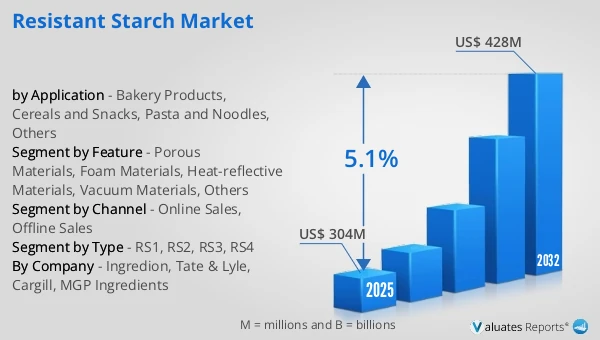
The global Resistant Starch market was valued at US$ 304 million in 2025 and is anticipated to reach US$ 428 million by 2032, at a CAGR of 5.1% from 2026 to 2032.

Resistant Starch Market

Resistant Starch Market

The 2025 U.S. tariff policies introduce profound uncertainty into the global economic landscape. This report critically examines the implications of recent tariff adjustments and international strategic countermeasures on Resistant Starch competitive dynamics, regional economic interdependencies, and supply chain reconfigurations.
Resistant starch is a type of starch that isn’t fully broken down and absorbed, but rather turned into short-chain fatty acids by intestinal bacteria.In 2024, global Resistant Starch production reached approximately 54.6 K MT, with an average global market price of around US$ 5311 per MT.
The global resistant starch market is a growing niche within the broader starch and functional fiber industries, positioned between commodity starches and high-value nutritional ingredients. It serves food, beverage, dietary supplement and, to a lesser extent, animal nutrition applications, driven by demand for better digestive health, lower-glycemic carbohydrates and reformulated products with higher fiber and reduced sugar or refined starch. Across regions, demand is strongest in areas with large processed-food sectors and rising health awareness, with particularly rapid growth where regulatory environments support functional foods and fiber-related claims. Overall, it functions as a value-added ingredient market rather than a bulk commodity business, which shapes both pricing and profitability dynamics.
Along the industry chain, the upstream segment consists of agricultural raw materials such as corn, wheat, rice, potatoes, cassava, bananas and various cereals and legumes, which are milled into native starches. These native starches are then converted midstream into different resistant starch types using physical treatments (like heat–moisture and extrusion), enzymatic modification, controlled retrogradation, or approved chemical modification, yielding materials classified into distinct types (e.g., RS1–RS4) with different technical and nutritional properties. The resulting resistant starch ingredients are standardized into powders or granules with defined fiber content, granule size, functionality and processing stability, often tailored for specific uses in bakery, snacks, beverages, dairy alternatives or supplements. Downstream, they are incorporated by manufacturers into finished products or sold as stand-alone powders, with distribution mainly through business-to-business ingredient channels and a growing presence in consumer-facing health and sports nutrition formats.
Several powerful driving factors underpin this market’s expansion. On the demand side, rising awareness of gut health and the microbiome, increasing prevalence of obesity and diabetes, and broad interest in low-glycemic, higher-fiber carbohydrates make resistant starch attractive to both consumers and product formulators. It allows manufacturers to increase labeled fiber content, support satiety and blood sugar management benefits, and partially replace flour, fat or sugar while maintaining acceptable taste and texture in familiar categories such as bread, cookies, breakfast cereals, snacks and ready meals. On the supply and technology side, innovations in processing, diversification of botanical sources, and supportive regulatory frameworks for functional foods and dietary fiber claims all contribute to market growth, even as challenges such as higher production costs versus commodity starches, limited consumer recognition of “resistant starch” as a front-of-pack concept, and competition from other fibers and specialty carbohydrates temper the pace in some segments.
Taken together, these structural and demand-side features mean that the resistant starch market typically enjoys gross profit margins characteristic of value-added specialty ingredients—generally higher than those of bulk industrial starches but lower than those of premium finished consumer health products.
This report delivers a comprehensive overview of the global Resistant Starch market, with both quantitative and qualitative analyses, to help readers develop growth strategies, assess the competitive landscape, evaluate their position in the current market, and make informed business decisions regarding Resistant Starch. The Resistant Starch market size, estimates, and forecasts are provided in terms of sales volume (K MT) and revenue (US$ millions), with 2025 as the base year and historical and forecast data for 2021–2032.
The report segments the global Resistant Starch market comprehensively. Regional market sizes by Type, by Application, by Feature, and by company are also provided. For deeper insight, the report profiles the competitive landscape, key competitors, and their respective market rankings, and discusses technological trends and new product developments.
This report will assist Resistant Starch manufacturers, new entrants, and companies across the industry value chain with information on revenues, sales volume, and average prices for the overall market and its sub-segments, by company, by Type, by Application, and by region.
Market Segmentation

Scope of Resistant Starch Market Report

Report Metric Details
Report Name Resistant Starch Market
Accounted market size in 2025 US$ 304 million
Forecasted market size in 2032 US$ 428 million
CAGR 5.1%
Base Year 2025
Forecasted years 2026 - 2032
Segment by Type
  • RS1
  • RS2
  • RS3
  • RS4
Segment by Feature
  • Porous Materials
  • Foam Materials
  • Heat-reflective Materials
  • Vacuum Materials
  • Others
Segment by Channel
  • Online Sales
  • Offline Sales
by Application
  • Bakery Products
  • Cereals and Snacks
  • Pasta and Noodles
  • Others
Consumption by Region
  • North America (United States, Canada)
  • Europe (Germany, France, UK, Italy, Russia)
  • Asia-Pacific (China, Japan, South Korea, Taiwan)
  • Southeast Asia (India)
  • Latin America (Mexico, Brazil)
By Company Ingredion, Tate & Lyle, Cargill, MGP Ingredients
Forecast units USD million in value
Report coverage Revenue and volume forecast, company share, competitive landscape, growth factors and trends

Chapter Outline

  • Chapter 1: Defines the scope of the report and presents an executive summary of market segments (by Type, by Application, by Feature, etc.), including the size of each segment and its future growth potential. It offers a high-level view of the current market and its likely evolution in the short, medium, and long term.
  • Chapter 2: Provides a detailed analysis of the competitive landscape for Resistant Starch manufacturers, covering pricing, sales and revenue shares, latest development plans, and mergers and acquisitions.
  • Chapter 3: Examines Resistant Starch sales and revenue at the regional and country levels. It quantifies market size and growth potential for each region and its key countries, and outlines market development, outlook, addressable space, and national market size.
  • Chapter 4: Analyzes segments by Type, detailing the size and growth potential of each segment to help readers identify “blue ocean” opportunities.
  • Chapter 5: Analyzes market segments by Application, covering the size and growth potential of each segment to help readers identify “blue ocean” opportunities in downstream markets.
  • Chapter 6: Profiles key players, presenting core information on leading companies, including product sales, revenue, pricing, gross margin, product portfolio/introductions, and recent developments.
  • Chapter 7: Reviews the industry value chain, including upstream and downstream segments.
  • Chapter 8: Discusses market dynamics and recent developments, including drivers, restraints, challenges and risks for manufacturers, U.S. Tariffs and relevant policy analysis.
  • Chapter 9: Summarizes the key findings and conclusions of the report.

FAQ for this report

How fast is Resistant Starch Market growing?

Ans: The Resistant Starch Market witnessing a CAGR of 5.1% during the forecast period 2026-2032.

What is the Resistant Starch Market size in 2032?

Ans: The Resistant Starch Market size in 2032 will be US$ 428 million.

Who are the main players in the Resistant Starch Market report?

Ans: The main players in the Resistant Starch Market are Ingredion, Tate & Lyle, Cargill, MGP Ingredients

What are the Application segmentation covered in the Resistant Starch Market report?

Ans: The Applications covered in the Resistant Starch Market report are Bakery Products, Cereals and Snacks, Pasta and Noodles, Others

What are the Type segmentation covered in the Resistant Starch Market report?

Ans: The Types covered in the Resistant Starch Market report are RS1, RS2, RS3, RS4

1 Resistant Starch Market Overview
1.1 Product Definition
1.2 Resistant Starch by Type
1.2.1 Global Resistant Starch Market Value by Type: 2025 vs 2032
1.2.2 RS1
1.2.3 RS2
1.2.4 RS3
1.2.5 RS4
1.3 Resistant Starch by Feature
1.3.1 Global Resistant Starch Market Value by Feature: 2025 vs 2032
1.3.2 Porous Materials
1.3.3 Foam Materials
1.3.4 Heat-reflective Materials
1.3.5 Vacuum Materials
1.3.6 Others
1.4 Resistant Starch by Channel
1.4.1 Global Resistant Starch Market Value by Channel: 2025 vs 2032
1.4.2 Online Sales
1.4.3 Offline Sales
1.5 Resistant Starch by Application
1.5.1 Global Resistant Starch Market Value by Application: 2025 vs 2032
1.5.2 Bakery Products
1.5.3 Cereals and Snacks
1.5.4 Pasta and Noodles
1.5.5 Others
1.6 Global Resistant Starch Market Size Estimates and Forecasts
1.6.1 Global Resistant Starch Revenue 2021–2032
1.6.2 Global Resistant Starch Sales 2021–2032
1.6.3 Global Resistant Starch Market Average Price (2021–2032)
1.7 Assumptions and Limitations
2 Resistant Starch Market Competition by Manufacturers
2.1 Global Resistant Starch Sales Market Share by Manufacturers (2021–2026)
2.2 Global Resistant Starch Revenue Market Share by Manufacturers (2021–2026)
2.3 Global Resistant Starch Average Price by Manufacturers (2021–2026)
2.4 Global Key Players of Resistant Starch, Industry Ranking, 2023 vs 2024 vs 2025
2.5 Global Key Manufacturers of Resistant Starch, Manufacturing Sites and Headquarters
2.6 Global Key Manufacturers of Resistant Starch, Product Types and Applications
2.7 Global Key Manufacturers of Resistant Starch, Date of Entry into the Industry
2.8 Global Resistant Starch Market Competitive Situation and Trends
2.8.1 Global Resistant Starch Market Concentration Rate
2.8.2 The Top 5 and Top 10 Global Resistant Starch Players Market Share by Revenue
2.8.3 Global Resistant Starch Market Share by Company Tier (Tier 1, Tier 2, Tier 3)
2.9 Manufacturers Mergers & Acquisitions, Expansion Plans
3 Global Resistant Starch Market Scenario by Region
3.1 Global Resistant Starch Market Size by Region: 2021 vs 2025 vs 2032
3.2 Global Resistant Starch Sales by Region: 2021–2032
3.2.1 Global Resistant Starch Sales by Region: 2021–2026
3.2.2 Global Resistant Starch Sales by Region: 2027–2032
3.3 Global Resistant Starch Revenue by Region: 2021–2032
3.3.1 Global Resistant Starch Revenue by Region: 2021–2026
3.3.2 Global Resistant Starch Revenue by Region: 2027–2032
3.4 North America Resistant Starch Market Facts & Figures by Country
3.4.1 North America Resistant Starch Market Size by Country: 2021 vs 2025 vs 2032
3.4.2 North America Resistant Starch Sales by Country (2021–2032)
3.4.3 North America Resistant Starch Revenue by Country (2021–2032)
3.4.4 U.S.
3.4.5 Canada
3.5 Europe Resistant Starch Market Facts & Figures by Country
3.5.1 Europe Resistant Starch Market Size by Country: 2021 vs 2025 vs 2032
3.5.2 Europe Resistant Starch Sales by Country (2021–2032)
3.5.3 Europe Resistant Starch Revenue by Country (2021–2032)
3.5.4 Germany
3.5.5 France
3.5.6 U.K.
3.5.7 Italy
3.5.8 Russia
3.6 Asia Pacific Resistant Starch Market Facts & Figures by Region
3.6.1 Asia Pacific Resistant Starch Market Size by Region: 2021 vs 2025 vs 2032
3.6.2 Asia Pacific Resistant Starch Sales by Region (2021–2032)
3.6.3 Asia Pacific Resistant Starch Revenue by Region (2021–2032)
3.6.4 China
3.6.5 Japan
3.6.6 South Korea
3.6.7 India
3.6.8 Australia
3.6.9 Taiwan
3.6.10 Indonesia
3.6.11 Thailand
3.6.12 Malaysia
3.6.13 Philippines
3.7 Latin America Resistant Starch Market Facts & Figures by Country
3.7.1 Latin America Resistant Starch Market Size by Country: 2021 vs 2025 vs 2032
3.7.2 Latin America Resistant Starch Sales by Country (2021–2032)
3.7.3 Latin America Resistant Starch Revenue by Country (2021–2032)
3.7.4 Mexico
3.7.5 Brazil
3.7.6 Argentina
3.8 Middle East and Africa Resistant Starch Market Facts & Figures by Country
3.8.1 Middle East and Africa Resistant Starch Market Size by Country: 2021 vs 2025 vs 2032
3.8.2 Middle East and Africa Resistant Starch Sales by Country (2021–2032)
3.8.3 Middle East and Africa Resistant Starch Revenue by Country (2021–2032)
3.8.4 Turkey
3.8.5 Saudi Arabia
3.8.6 U.A.E
4 Segment by Type
4.1 Global Resistant Starch Sales by Type (2021–2032)
4.1.1 Global Resistant Starch Sales by Type (2021–2026)
4.1.2 Global Resistant Starch Sales by Type (2027–2032)
4.1.3 Global Resistant Starch Sales Market Share by Type (2021–2032)
4.2 Global Resistant Starch Revenue by Type (2021–2032)
4.2.1 Global Resistant Starch Revenue by Type (2021–2026)
4.2.2 Global Resistant Starch Revenue by Type (2027–2032)
4.2.3 Global Resistant Starch Revenue Market Share by Type (2021–2032)
4.3 Global Resistant Starch Price by Type (2021–2032)
5 Segment by Application
5.1 Global Resistant Starch Sales by Application (2021–2032)
5.1.1 Global Resistant Starch Sales by Application (2021–2026)
5.1.2 Global Resistant Starch Sales by Application (2027–2032)
5.1.3 Global Resistant Starch Sales Market Share by Application (2021–2032)
5.2 Global Resistant Starch Revenue by Application (2021–2032)
5.2.1 Global Resistant Starch Revenue by Application (2021–2026)
5.2.2 Global Resistant Starch Revenue by Application (2027–2032)
5.2.3 Global Resistant Starch Revenue Market Share by Application (2021–2032)
5.3 Global Resistant Starch Price by Application (2021–2032)
6 Key Companies Profiled
6.1 Ingredion
6.1.1 Ingredion Company Information
6.1.2 Ingredion Description and Business Overview
6.1.3 Ingredion Resistant Starch Sales, Revenue, and Gross Margin (2021–2026)
6.1.4 Ingredion Resistant Starch Product Portfolio
6.1.5 Ingredion Recent Developments/Updates
6.2 Tate & Lyle
6.2.1 Tate & Lyle Company Information
6.2.2 Tate & Lyle Description and Business Overview
6.2.3 Tate & Lyle Resistant Starch Sales, Revenue, and Gross Margin (2021–2026)
6.2.4 Tate & Lyle Resistant Starch Product Portfolio
6.2.5 Tate & Lyle Recent Developments/Updates
6.3 Cargill
6.3.1 Cargill Company Information
6.3.2 Cargill Description and Business Overview
6.3.3 Cargill Resistant Starch Sales, Revenue, and Gross Margin (2021–2026)
6.3.4 Cargill Resistant Starch Product Portfolio
6.3.5 Cargill Recent Developments/Updates
6.4 MGP Ingredients
6.4.1 MGP Ingredients Company Information
6.4.2 MGP Ingredients Description and Business Overview
6.4.3 MGP Ingredients Resistant Starch Sales, Revenue, and Gross Margin (2021–2026)
6.4.4 MGP Ingredients Resistant Starch Product Portfolio
6.4.5 MGP Ingredients Recent Developments/Updates
7 Industry Chain and Sales Channels Analysis
7.1 Resistant Starch Industry Chain Analysis
7.2 Resistant Starch Raw Material Supply Analysis
7.2.1 Key Raw Materials
7.2.2 Raw Materials Key Suppliers
7.3 Resistant Starch Production Mode & Process Analysis
7.4 Resistant Starch Sales and Marketing
7.4.1 Resistant Starch Sales Channels
7.4.2 Resistant Starch Distributors
7.5 Resistant Starch Customer Analysis
8 Resistant Starch Market Dynamics
8.1 Resistant Starch Industry Trends
8.2 Resistant Starch Market Drivers
8.3 Resistant Starch Market Challenges
8.4 Resistant Starch Market Restraints
8.5 Impact of U.S. Tariffs
9 Research Findings and Conclusion
10 Methodology and Data Source
10.1 Methodology/Research Approach
10.1.1 Research Programs/Design
10.1.2 Market Size Estimation
10.1.3 Market Breakdown and Data Triangulation
10.2 Data Source
10.2.1 Secondary Sources
10.2.2 Primary Sources
10.3 Author List
10.4 Disclaimer
List of Tables
 Table 1. Global Resistant Starch Market Value by Type (US$ Million), 2025 vs 2032
 Table 2. Global Resistant Starch Market Value by Feature (US$ Million), 2025 vs 2032
 Table 3. Global Resistant Starch Market Value by Channel (US$ Million), 2025 vs 2032
 Table 4. Global Resistant Starch Market Value by Application (US$ Million), 2025 vs 2032
 Table 5. Global Resistant Starch Market Competitive Situation by Manufacturers in 2025
 Table 6. Global Resistant Starch Sales (K MT) of Key Manufacturers (2021–2026)
 Table 7. Global Resistant Starch Sales Market Share by Manufacturers (2021–2026)
 Table 8. Global Resistant Starch Revenue (US$ Million) by Manufacturers (2021–2026)
 Table 9. Global Resistant Starch Revenue Share by Manufacturers (2021–2026)
 Table 10. Global Market Resistant Starch Average Price (USD/MT) of Key Manufacturers (2021–2026)
 Table 11. Global Key Players of Resistant Starch, Industry Ranking, 2023 vs 2024 vs 2025
 Table 12. Global Key Manufacturers of Resistant Starch, Manufacturing Sites and Headquarters
 Table 13. Global Key Manufacturers of Resistant Starch, Product Types and Applications
 Table 14. Global Key Manufacturers of Resistant Starch, Date of Entry into the Industry
 Table 15. Global Manufacturers Market Concentration Ratio (CR5 and HHI)
 Table 16. Global Resistant Starch Companies by Tier (Tier 1, Tier 2, Tier 3), based on Resistant Starch Revenue, 2025
 Table 17. Manufacturers Mergers & Acquisitions, Expansion Plans
 Table 18. Global Resistant Starch Market Size by Region (US$ Million): 2021 vs 2025 vs 2032
 Table 19. Global Resistant Starch Sales by Region (K MT), 2021–2026
 Table 20. Global Resistant Starch Sales Market Share by Region (2021–2026)
 Table 21. Global Resistant Starch Sales by Region (K MT), 2027–2032
 Table 22. Global Resistant Starch Sales Market Share by Region (2027–2032)
 Table 23. Global Resistant Starch Revenue by Region (US$ Million), 2021–2026
 Table 24. Global Resistant Starch Revenue Market Share by Region (2021–2026)
 Table 25. Global Resistant Starch Revenue by Region (US$ Million), 2027–2032
 Table 26. Global Resistant Starch Revenue Market Share by Region (2027–2032)
 Table 27. North America Resistant Starch Revenue by Country: 2021 vs 2025 vs 2032 (US$ Million)
 Table 28. North America Resistant Starch Sales by Country (K MT), 2021–2026
 Table 29. North America Resistant Starch Sales by Country (K MT), 2027–2032
 Table 30. North America Resistant Starch Revenue by Country (US$ Million), 2021–2026
 Table 31. North America Resistant Starch Revenue by Country (US$ Million), 2027–2032
 Table 32. Europe Resistant Starch Revenue by Country: 2021 vs 2025 vs 2032 (US$ Million)
 Table 33. Europe Resistant Starch Sales by Country (K MT), 2021–2026
 Table 34. Europe Resistant Starch Sales by Country (K MT), 2027–2032
 Table 35. Europe Resistant Starch Revenue by Country (US$ Million), 2021–2026
 Table 36. Europe Resistant Starch Revenue by Country (US$ Million), 2027–2032
 Table 37. Asia Pacific Resistant Starch Revenue by Region: 2021 vs 2025 vs 2032 (US$ Million)
 Table 38. Asia Pacific Resistant Starch Sales by Region (K MT), 2021–2026
 Table 39. Asia Pacific Resistant Starch Sales by Region (K MT), 2027–2032
 Table 40. Asia Pacific Resistant Starch Revenue by Region (US$ Million), 2021–2026
 Table 41. Asia Pacific Resistant Starch Revenue by Region (US$ Million), 2027–2032
 Table 42. Latin America Resistant Starch Revenue by Country: 2021 vs 2025 vs 2032 (US$ Million)
 Table 43. Latin America Resistant Starch Sales by Country (K MT), 2021–2026
 Table 44. Latin America Resistant Starch Sales by Country (K MT), 2027–2032
 Table 45. Latin America Resistant Starch Revenue by Country (US$ Million), 2021–2026
 Table 46. Latin America Resistant Starch Revenue by Country (US$ Million), 2027–2032
 Table 47. Middle East and Africa Resistant Starch Revenue by Country: 2021 vs 2025 vs 2032 (US$ Million)
 Table 48. Middle East and Africa Resistant Starch Sales by Country (K MT), 2021–2026
 Table 49. Middle East and Africa Resistant Starch Sales by Country (K MT), 2027–2032
 Table 50. Middle East and Africa Resistant Starch Revenue by Country (US$ Million), 2021–2026
 Table 51. Middle East and Africa Resistant Starch Revenue by Country (US$ Million), 2027–2032
 Table 52. Global Resistant Starch Sales (K MT) by Type (2021–2026)
 Table 53. Global Resistant Starch Sales (K MT) by Type (2027–2032)
 Table 54. Global Resistant Starch Sales Market Share by Type (2021–2026)
 Table 55. Global Resistant Starch Sales Market Share by Type (2027–2032)
 Table 56. Global Resistant Starch Revenue (US$ Million) by Type (2021–2026)
 Table 57. Global Resistant Starch Revenue (US$ Million) by Type (2027–2032)
 Table 58. Global Resistant Starch Revenue Market Share by Type (2021–2026)
 Table 59. Global Resistant Starch Revenue Market Share by Type (2027–2032)
 Table 60. Global Resistant Starch Price (USD/MT) by Type (2021–2026)
 Table 61. Global Resistant Starch Price (USD/MT) by Type (2027–2032)
 Table 62. Global Resistant Starch Sales (K MT) by Application (2021–2026)
 Table 63. Global Resistant Starch Sales (K MT) by Application (2027–2032)
 Table 64. Global Resistant Starch Sales Market Share by Application (2021–2026)
 Table 65. Global Resistant Starch Sales Market Share by Application (2027–2032)
 Table 66. Global Resistant Starch Revenue (US$ Million) by Application (2021–2026)
 Table 67. Global Resistant Starch Revenue (US$ Million) by Application (2027–2032)
 Table 68. Global Resistant Starch Revenue Market Share by Application (2021–2026)
 Table 69. Global Resistant Starch Revenue Market Share by Application (2027–2032)
 Table 70. Global Resistant Starch Price (USD/MT) by Application (2021–2026)
 Table 71. Global Resistant Starch Price (USD/MT) by Application (2027–2032)
 Table 72. Ingredion Company Information
 Table 73. Ingredion Description and Business Overview
 Table 74. Ingredion Resistant Starch Sales (K MT), Revenue (US$ Million), Price (USD/MT), and Gross Margin (2021–2026)
 Table 75. Ingredion Resistant Starch Product
 Table 76. Ingredion Recent Developments/Updates
 Table 77. Tate & Lyle Company Information
 Table 78. Tate & Lyle Description and Business Overview
 Table 79. Tate & Lyle Resistant Starch Sales (K MT), Revenue (US$ Million), Price (USD/MT), and Gross Margin (2021–2026)
 Table 80. Tate & Lyle Resistant Starch Product
 Table 81. Tate & Lyle Recent Developments/Updates
 Table 82. Cargill Company Information
 Table 83. Cargill Description and Business Overview
 Table 84. Cargill Resistant Starch Sales (K MT), Revenue (US$ Million), Price (USD/MT), and Gross Margin (2021–2026)
 Table 85. Cargill Resistant Starch Product
 Table 86. Cargill Recent Developments/Updates
 Table 87. MGP Ingredients Company Information
 Table 88. MGP Ingredients Description and Business Overview
 Table 89. MGP Ingredients Resistant Starch Sales (K MT), Revenue (US$ Million), Price (USD/MT), and Gross Margin (2021–2026)
 Table 90. MGP Ingredients Resistant Starch Product
 Table 91. MGP Ingredients Recent Developments/Updates
 Table 92. Key Raw Materials Lists
 Table 93. Raw Materials Key Suppliers Lists
 Table 94. Resistant Starch Distributors List
 Table 95. Resistant Starch Customers List
 Table 96. Resistant Starch Market Trends
 Table 97. Resistant Starch Market Drivers
 Table 98. Resistant Starch Market Challenges
 Table 99. Resistant Starch Market Restraints
 Table 100. Research Programs/Design for This Report
 Table 101. Key Data Information from Secondary Sources
 Table 102. Key Data Information from Primary Sources
 Table 103. Authors List of This Report


List of Figures
 Figure 1. Product Picture of Resistant Starch
 Figure 2. Global Resistant Starch Market Value by Type (US$ Million), 2021–2032
 Figure 3. Global Resistant Starch Market Share by Type: 2025 & 2032
 Figure 4. RS1 Product Picture
 Figure 5. RS2 Product Picture
 Figure 6. RS3 Product Picture
 Figure 7. RS4 Product Picture
 Figure 8. Global Resistant Starch Market Value by Feature (US$ Million), 2021–2032
 Figure 9. Global Resistant Starch Market Share by Feature: 2025 vs 2032
 Figure 10. Porous Materials Product Picture
 Figure 11. Foam Materials Product Picture
 Figure 12. Heat-reflective Materials Product Picture
 Figure 13. Vacuum Materials Product Picture
 Figure 14. Others Product Picture
 Figure 15. Global Resistant Starch Market Value by Channel (US$ Million), 2021–2032
 Figure 16. Global Resistant Starch Market Share by Channel: 2025 vs 2032
 Figure 17. Online Sales Product Picture
 Figure 18. Offline Sales Product Picture
 Figure 19. Global Resistant Starch Market Value by Application (US$ Million), 2021–2032
 Figure 20. Global Resistant Starch Market Share by Application: 2025 & 2032
 Figure 21. Bakery Products
 Figure 22. Cereals and Snacks
 Figure 23. Pasta and Noodles
 Figure 24. Others
 Figure 25. Global Resistant Starch Revenue, (US$ Million), 2021 vs 2025 vs 2032
 Figure 26. Global Resistant Starch Market Size (US$ Million), 2021–2032
 Figure 27. Global Resistant Starch Sales (K MT), 2021–2032
 Figure 28. Global Resistant Starch Average Price (USD/MT), 2021–2032
 Figure 29. Resistant Starch Report Years Considered
 Figure 30. Resistant Starch Sales Share by Manufacturers in 2025
 Figure 31. Global Resistant Starch Revenue Share by Manufacturers in 2025
 Figure 32. Top 5 and Top 10 Global Resistant Starch Players: Market Share by Revenue in Resistant Starch in 2025
 Figure 33. Resistant Starch Market Share by Company Type (Tier 1, Tier 2, and Tier 3): 2021 vs 2025
 Figure 34. Global Resistant Starch Market Size by Region (US$ Million): 2021 vs 2025 vs 2032
 Figure 35. North America Resistant Starch Sales Market Share by Country (2021–2032)
 Figure 36. North America Resistant Starch Revenue Market Share by Country (2021–2032)
 Figure 37. U.S. Resistant Starch Revenue Growth Rate (US$ Million), 2021–2032
 Figure 38. Canada Resistant Starch Revenue Growth Rate (US$ Million), 2021–2032
 Figure 39. Europe Resistant Starch Sales Market Share by Country (2021–2032)
 Figure 40. Europe Resistant Starch Revenue Market Share by Country (2021–2032)
 Figure 41. Germany Resistant Starch Revenue Growth Rate (US$ Million), 2021–2032
 Figure 42. France Resistant Starch Revenue Growth Rate (US$ Million), 2021–2032
 Figure 43. U.K. Resistant Starch Revenue Growth Rate (US$ Million), 2021–2032
 Figure 44. Italy Resistant Starch Revenue Growth Rate (US$ Million), 2021–2032
 Figure 45. Russia Resistant Starch Revenue Growth Rate (US$ Million), 2021–2032
 Figure 46. Asia Pacific Resistant Starch Sales Market Share by Region (2021–2032)
 Figure 47. Asia Pacific Resistant Starch Revenue Market Share by Region (2021–2032)
 Figure 48. China Resistant Starch Revenue Growth Rate (US$ Million), 2021–2032
 Figure 49. Japan Resistant Starch Revenue Growth Rate (US$ Million), 2021–2032
 Figure 50. South Korea Resistant Starch Revenue Growth Rate (US$ Million), 2021–2032
 Figure 51. India Resistant Starch Revenue Growth Rate (US$ Million), 2021–2032
 Figure 52. Australia Resistant Starch Revenue Growth Rate (US$ Million), 2021–2032
 Figure 53. Taiwan Resistant Starch Revenue Growth Rate (US$ Million), 2021–2032
 Figure 54. Indonesia Resistant Starch Revenue Growth Rate (US$ Million), 2021–2032
 Figure 55. Thailand Resistant Starch Revenue Growth Rate (US$ Million), 2021–2032
 Figure 56. Malaysia Resistant Starch Revenue Growth Rate (US$ Million), 2021–2032
 Figure 57. Philippines Resistant Starch Revenue Growth Rate (US$ Million), 2021–2032
 Figure 58. Latin America Resistant Starch Sales Market Share by Country (2021–2032)
 Figure 59. Latin America Resistant Starch Revenue Market Share by Country (2021–2032)
 Figure 60. Mexico Resistant Starch Revenue Growth Rate (US$ Million), 2021–2032
 Figure 61. Brazil Resistant Starch Revenue Growth Rate (US$ Million), 2021–2032
 Figure 62. Argentina Resistant Starch Revenue Growth Rate (US$ Million), 2021–2032
 Figure 63. Middle East and Africa Resistant Starch Sales Market Share by Country (2021–2032)
 Figure 64. Middle East and Africa Resistant Starch Revenue Market Share by Country (2021–2032)
 Figure 65. Turkey Resistant Starch Revenue Growth Rate (US$ Million), 2021–2032
 Figure 66. Saudi Arabia Resistant Starch Revenue Growth Rate (US$ Million), 2021–2032
 Figure 67. U.A.E Resistant Starch Revenue Growth Rate (US$ Million), 2021–2032
 Figure 68. Global Sales Market Share of Resistant Starch by Type (2021–2032)
 Figure 69. Global Revenue Market Share of Resistant Starch by Type (2021–2032)
 Figure 70. Global Resistant Starch Price (USD/MT) by Type (2021–2032)
 Figure 71. Global Sales Market Share of Resistant Starch by Application (2021–2032)
 Figure 72. Global Revenue Market Share of Resistant Starch by Application (2021–2032)
 Figure 73. Global Resistant Starch Price (USD/MT) by Application (2021–2032)
 Figure 74. Resistant Starch Value Chain
 Figure 75. Channels of Distribution (Direct Vs Distribution)
 Figure 76. Bottom-up and Top-down Approaches for This Report
 Figure 77. Data Triangulation
 Figure 78. Key Executives Interviewed

SELECT A FORMAT
Added to Cart
Electronic

$2900

Single User License
Electronic

$4350

Multi User License
Electronic

$5800

Enterprise License
Add to Cart
Buy Now (15% Discount)

OUR CUSTOMER

Novocure