FEATURED COMPANIES
GE Healthcare
A& D Medical
Medtronic Inc
Boston Scientific
Spacelabs Healthcare
Medical Monitoring Platform Market Size
The global Medical Monitoring Platform market was valued at US$ 45271 million in 2025 and is anticipated to reach US$ 78456 million by 2032, at a CAGR of 8.5% from 2026 to 2032.
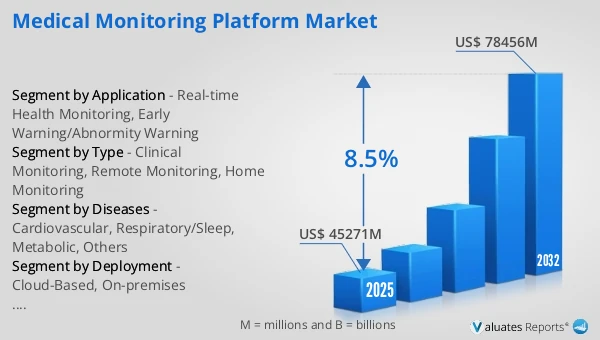
Medical Monitoring Platform Market
A Medical Monitoring Platform is an integrated hardware and software platform for hospitals, doctors, and patients. It is used to continuously or intermittently collect vital signs and disease-related indicators (such as electrocardiogram, blood pressure, blood oxygen, blood glucose, respiration, body temperature, activity level, etc.), and to complete data transmission, storage, analysis, alarm, visualization, and workflow linkage. It supports scenarios such as in-hospital monitoring, out-of-hospital follow-up, chronic disease management, telemedicine, and clinical decision support.
The development of medical monitoring platforms revolves around the integration of intelligent technologies and the comprehensive coverage of various scenarios. The deep integration of the Internet of Things (IoT), artificial intelligence (AI), big data, and portable sensing technologies is the core driving force. The platform has upgraded from traditional single physiological indicator collection to a full-process upgrade encompassing multi-dimensional real-time data monitoring, intelligent analysis and early warning, and personalized health assessment. Simultaneously, continuous optimization of the algorithm model enables the platform to possess stronger capabilities for early disease screening and dynamic disease tracking, providing accurate data analysis support for clinical diagnosis and treatment, and significantly improving the professionalism and predictive ability of monitoring. Furthermore, the platform's hardware and software compatibility continues to improve, seamlessly connecting to various portable wearable devices, home monitoring instruments, and professional hospital testing terminals, achieving interconnectivity of data from multiple terminals and breaking down data silos. At the same time, its lightweight and easy-to-use design makes the platform suitable not only for professional scenarios such as hospitals and healthcare institutions but also for the self-monitoring needs of ordinary users at home. This technological penetration is driving the platform's increasing popularity.
The service model and industrial ecosystem of medical monitoring platforms are continuously upgrading, transforming from a single monitoring tool to an integrated service platform encompassing "monitoring + diagnosis + health management." These platforms are gradually integrating value-added services such as online consultations, prescription circulation, chronic disease management, and rehabilitation guidance, forming a closed loop from data collection to health intervention, aligning with current medical needs for hierarchical medical treatment and long-term chronic disease management. Simultaneously, the industry is showing significant trends towards scenario expansion and compliance. Beyond traditional chronic disease monitoring and post-operative care for critically ill patients, platforms are increasingly penetrating into niche scenarios such as elderly care, maternal and infant care, occupational health, and sports medicine. Customized solutions for specific scenarios are becoming a key area of market competition. Meanwhile, increasingly stringent regulations in various countries regarding the privacy protection, secure transmission, and compliant use of medical data are driving platform companies to strengthen their data security technologies and compliance systems. Platforms with end-to-end data security capabilities are becoming the market mainstream. Furthermore, government-enterprise cooperation and ecosystem collaboration are deepening, with accelerated cross-sector integration among medical institutions, technology companies, equipment manufacturers, and insurance institutions, jointly building a healthcare ecosystem covering "monitoring - diagnosis - treatment - payment," further expanding the platform's commercial value and service boundaries.
This report delivers a comprehensive overview of the global Medical Monitoring Platform market, with both quantitative and qualitative analyses, to help readers develop growth strategies, assess the competitive landscape, evaluate their position in the current market, and make informed business decisions regarding Medical Monitoring Platform. The Medical Monitoring Platform market size, estimates, and forecasts are provided in terms of revenue (US$ millions), with 2025 as the base year and historical and forecast data for 2021–2032.
The report segments the global Medical Monitoring Platform market comprehensively. Regional market sizes by Type, by Application, by Deployment, and by player are also provided. For deeper insight, the report profiles the competitive landscape, key competitors, and their respective market rankings, and discusses technological trends and new product developments.
This report will assist Medical Monitoring Platform manufacturers, new entrants, and companies across the industry value chain with information on revenues, sales volume, and average prices for the overall market and its sub-segments, by company, by Type, by Application, and by region.
Market Segmentation
Scope of Medical Monitoring Platform Market Report
| Report Metric |
Details |
| Report Name |
Medical Monitoring Platform Market |
| Accounted market size in 2025 |
US$ 45271 million |
| Forecasted market size in 2032 |
US$ 78456 million |
| CAGR |
8.5% |
| Base Year |
2025 |
| Forecasted years |
2026 - 2032 |
| Segment by Type |
- Clinical Monitoring
- Remote Monitoring
- Home Monitoring
|
| Segment by Deployment |
|
| Segment by Diseases |
- Cardiovascular
- Respiratory/Sleep
- Metabolic
- Others
|
| Segment by Application |
- Real-time Health Monitoring
- Early Warning/Abnormity Warning
|
| By Region |
- North America (United States, Canada)
- Europe (Germany, France, UK, Italy, Russia) Rest of Europe
- Nordic Countries
- Asia-Pacific (China, Japan, South Korea)
- Southeast Asia (India, Australia)
- Rest of Asia
- Latin America (Mexico, Brazil)
- Rest of Latin America
- Middle East & Africa (Turkey, Saudi Arabia, UAE, Rest of MEA)
|
| By Company |
Philips, Medtronic, GE HealthCare, Dräger, Masimo, Nihon Kohden, Boston Scientific, A&D Medical, Mindray, Biofourmis, Baxter, Huma, Spacelabs Healthcare, Rimidi, iRhythm Technologies, Cadence Solutions, VitalConnect, Teladoc Health, InfoBionic, Cadence, Optimize Health, HealthSnap |
| Forecast units |
USD million in value |
| Report coverage |
Revenue and volume forecast, company share, competitive landscape, growth factors and trends |
Chapter Outline
- Chapter 1: Defines the scope of the report and presents an executive summary of market segments (by Type, by Application, by Deployment, etc.), including the size of each segment and its future growth potential. It offers a high-level view of the current market and its likely evolution in the short, medium, and long term.
- Chapter 2: Summarizes global and regional market size and outlines market dynamics and recent developments, including key drivers, restraints, challenges and risks for industry participants, and relevant policy analysis.
- Chapter 3: Provides a detailed view of the competitive landscape for Medical Monitoring Platform companies, covering revenue share, development plans, and mergers and acquisitions.
- Chapter 4: Analyzes segments by Type, detailing the size and growth potential of each segment to help readers identify blue-ocean opportunities.
- Chapter 5: Analyzes segments by Application, detailing the size and growth potential of each downstream segment to help readers identify blue-ocean opportunities.
- Chapter 6–10: Regional deep dives (North America, Europe, Asia Pacific, Latin America, Middle East & Africa) broken down by country. Each chapter quantifies market size and growth potential by region and key countries, and outlines market development, outlook, addressable space, and capacity.
- Chapter 11: Profiles key players, presenting essential information on leading companies, including product/ service offerings, revenue, gross margin, product introductions/portfolios, recent developments, etc.
- Chapter 12: Key findings and conclusions of the report.
FAQ for this report
How fast is Medical Monitoring Platform Market growing?
Ans: The Medical Monitoring Platform Market witnessing a CAGR of 8.5% during the forecast period 2026-2032.
What is the Medical Monitoring Platform Market size in 2032?
Ans: The Medical Monitoring Platform Market size in 2032 will be US$ 78456 million.
Who are the main players in the Medical Monitoring Platform Market report?
Ans: The main players in the Medical Monitoring Platform Market are Philips, Medtronic, GE HealthCare, Dräger, Masimo, Nihon Kohden, Boston Scientific, A&D Medical, Mindray, Biofourmis, Baxter, Huma, Spacelabs Healthcare, Rimidi, iRhythm Technologies, Cadence Solutions, VitalConnect, Teladoc Health, InfoBionic, Cadence, Optimize Health, HealthSnap
What are the Application segmentation covered in the Medical Monitoring Platform Market report?
Ans: The Applications covered in the Medical Monitoring Platform Market report are Real-time Health Monitoring, Early Warning/Abnormity Warning
What are the Type segmentation covered in the Medical Monitoring Platform Market report?
Ans: The Types covered in the Medical Monitoring Platform Market report are Clinical Monitoring, Remote Monitoring, Home Monitoring