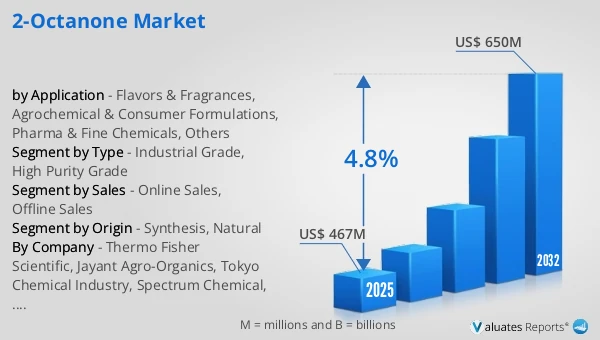
The global 2-Octanone market was valued at US$ 467 million in 2025 and is anticipated to reach US$ 650 million by 2032, at a CAGR of 4.8% from 2026 to 2032.
2-Octanone Market
The 2025 U.S. tariff policies introduce profound uncertainty into the global economic landscape. This report critically examines the implications of recent tariff adjustments and international strategic countermeasures on 2-Octanone competitive dynamics, regional economic interdependencies, and supply chain reconfigurations.
2-Octanone is a linear aliphatic secondary ketone (C8H16O), typically a colorless to pale-yellow liquid at ambient conditions, positioned as a mid-boiling solvent and an aroma/chemical intermediate. Upstream feedstocks are typically petro-based or bio-based carbon sources converted via chemical synthesis routes; midstream manufacturers supply technical, high-purity, and “natural” (aroma) grades; downstream demand concentrates in flavors & fragrances (food, personal/home care), agrochemical formulations (as permitted fragrance components/adjuncts), pharma/fine-chemical synthesis and laboratory/reagent use. Pricing and gross margin are driven by purity, origin (natural vs synthetic), compliance/QA specs, and end-market, resulting in a tiered structure (lower-priced technical grade vs higher-priced aroma/analytical grade).
As a multi-purpose organic compound, the development of 2-Octanone is deeply bound to the expansion of downstream applications, policy orientation, and technological innovation iteration, with multiple core factors jointly driving its continuous upgrading and market expansion. The release of demand in multiple downstream fields is the primary driving force. In the flavor and fragrance industry, it naturally exists in various fruits and vegetables, with unique fruity and milky flavor characteristics, serving as an important raw material for formulating food and daily chemical flavors, which is in line with the consumer market's preference for natural flavor additives. In the industrial field, it can be widely used as a solvent, defoamer, and flotation aid in coatings, textiles, coal mining and other scenarios. Meanwhile, as an intermediate for the synthesis of pharmaceuticals, pesticides, and surfactants, its rigid market demand continues to grow with the upgrading of the fine chemical industry. Policy support and green development orientation further strengthen the development momentum. Countries around the world are increasingly tightening environmental protection and safety supervision on the chemical industry, promoting the transformation of 2-Octanone production processes to low-energy consumption and low-emission clean routes. Relevant policies include high-purity 2-Octanone production in encouraged projects, providing a favorable environment for technological R&D and capacity upgrading. Breakthroughs in technological innovation empower the industry. The optimization of catalyst systems, continuous production processes, and upgrading of purification technologies not only improve product yield and purity, reduce production costs, but also expand its application boundaries in new pesticides and pharmaceutical fields, such as the potential application in nematode control drugs, further broadening the market space. In addition, the adjustment of the global supply chain and the effect of regional industrial agglomeration promote the concentration of production resources to enterprises with technological and compliance advantages, enhancing the overall competitiveness and market vitality of the industry.
Despite the wide application scenarios and gradual release of market potential of 2-Octanone, its industrial development and technological implementation still face many challenges that need to be overcome. The contradiction between process optimization and cost control is particularly prominent. Existing production processes mostly rely on traditional raw materials and reaction paths, with problems such as high energy consumption and complex by-products. High-end applications have extremely high requirements for product purity, and trace impurity residues limit its access to high-end flavors and pharmaceutical fields. The upgrading of refined process control and purification technology requires substantial R&D investment, further pushing up production costs. Environmental protection and safety compliance pressures continue to rise. As a hazardous chemical, its entire production, storage, and transportation process must comply with strict safety standards. Moreover, the volatile organic compounds (VOCs) generated during production require supporting efficient treatment facilities. The increase in environmental protection investment compresses enterprise profit margins, and small and medium-sized production capacities face the risk of elimination due to inability to bear transformation costs. The expansion of application scenarios is limited by technical barriers. Applications in high-end pharmaceuticals, new pesticides and other fields require breaking through specific synthetic routes and performance optimization technologies, while relevant core patents are mostly held by a few enterprises and research institutions, making independent innovation difficult for enterprises and restricting market expansion. In addition, the industry faces significant homogeneous competition and unbalanced regional development. Product quality in the mid-to-low-end market is uneven, and low-price competition disrupts the industry order. The high-end market is limited by technical and certification thresholds. Meanwhile, uneven regional capacity distribution affects the stability of the supply chain, further increasing the uncertainty of industry development.
This report delivers a comprehensive overview of the global 2-Octanone market, with both quantitative and qualitative analyses, to help readers develop growth strategies, assess the competitive landscape, evaluate their position in the current market, and make informed business decisions regarding 2-Octanone. The 2-Octanone market size, estimates, and forecasts are provided in terms of output/shipments (Tons) and revenue (US$ millions), with 2025 as the base year and historical and forecast data for 2021–2032.
The report segments the global 2-Octanone market comprehensively. Regional market sizes by Type, by Application, by Origin, and by company are also provided. For deeper insight, the report profiles the competitive landscape, key competitors, and their respective market rankings, and discusses technological trends and new product developments.
This report will assist 2-Octanone manufacturers, new entrants, and companies across the industry value chain with information on revenues, production, and average prices for the overall market and its sub-segments, by company, by Type, by Application, and by region.
Market Segmentation
Scope of 2-Octanone Market Report
| Report Metric |
Details |
| Report Name |
2-Octanone Market |
| Accounted market size in 2025 |
US$ 467 million |
| Forecasted market size in 2032 |
US$ 650 million |
| CAGR |
4.8% |
| Base Year |
2025 |
| Forecasted years |
2026 - 2032 |
| Segment by Type |
- Industrial Grade
- High Purity Grade
|
| Segment by Origin |
|
| Segment by Sales |
- Online Sales
- Offline Sales
|
| by Application |
- Flavors & Fragrances
- Agrochemical & Consumer Formulations
- Pharma & Fine Chemicals
- Others
|
| Production by Region |
|
| Consumption by Region |
- North America (United States, Canada)
- Europe (Germany, France, UK, Italy, Russia)
- Asia-Pacific (China, Japan, South Korea, Taiwan)
- Southeast Asia (India)
- Latin America (Mexico, Brazil)
|
| By Company |
Thermo Fisher Scientific, Jayant Agro-Organics, Tokyo Chemical Industry, Spectrum Chemical, Triveni Chemicals, Simson Pharma, CHANGZHOU XIAQING TECHNOLOGICAL, Hengli auxiliary Limited, Hatch Chemical |
| Forecast units |
USD million in value |
| Report coverage |
Revenue and volume forecast, company share, competitive landscape, growth factors and trends |
Chapter Outline
- Chapter 1: Defines the scope of the report and presents an executive summary of market segments (by Type, by Application, by Origin, etc.), including the size of each segment and its future growth potential. It offers a high-level view of the current market and its likely evolution in the short, medium, and long term.
- Chapter 2: Provides a detailed analysis of the competitive landscape for 2-Octanone manufacturers, including prices, production, value-based market shares, latest development plans, and information on mergers and acquisitions.
- Chapter 3: Examines 2-Octanone production/output and value by region and country, providing a quantitative assessment of market size and growth potential for each region over the next six years.
- Chapter 4: Analyzes 2-Octanone consumption at the regional and country levels. It quantifies market size and growth potential for each region and its key countries, and outlines market development, outlook, addressable space, and national production.
- Chapter 5: Analyzes market segments by Type, covering the size and growth potential of each segment to help readers identify “blue ocean” opportunities.
- Chapter 6: Analyzes market segments by Application, covering the size and growth potential of each segment to help readers identify “blue ocean” opportunities in downstream markets.
- Chapter 7: Profiles key players, detailing the fundamentals of major companies, including product production/output, value, price, gross margin, product portfolio/introductions, and recent developments.
- Chapter 8: Reviews the industry value chain, including upstream and downstream segments.
- Chapter 9: Discusses market dynamics and recent developments, including drivers, restraints, challenges and risks for manufacturers, U.S. Tariffs and relevant policy analysis.
- Chapter 10: Summarizes the key findings and conclusions of the report.
Ans: The 2-Octanone Market witnessing a CAGR of 4.8% during the forecast period 2026-2032.
Ans: The 2-Octanone Market size in 2032 will be US$ 650 million.
Ans: The main players in the 2-Octanone Market are Thermo Fisher Scientific, Jayant Agro-Organics, Tokyo Chemical Industry, Spectrum Chemical, Triveni Chemicals, Simson Pharma, CHANGZHOU XIAQING TECHNOLOGICAL, Hengli auxiliary Limited, Hatch Chemical
Ans: The Applications covered in the 2-Octanone Market report are Flavors & Fragrances, Agrochemical & Consumer Formulations, Pharma & Fine Chemicals, Others
Ans: The Types covered in the 2-Octanone Market report are Industrial Grade, High Purity Grade