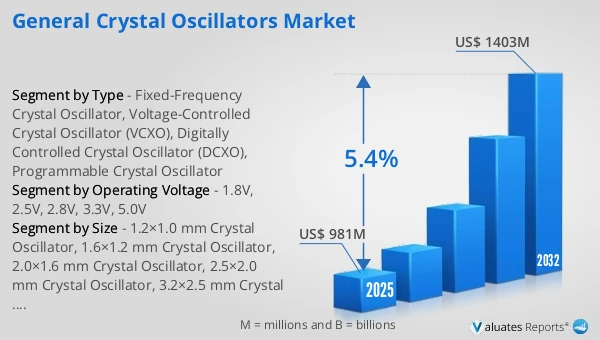
The global General Crystal Oscillators market was valued at US$ 981 million in 2025 and is anticipated to reach US$ 1403 million by 2032, at a CAGR of 5.4% from 2026 to 2032.
General Crystal Oscillators Market
The 2025 U.S. tariff policies introduce profound uncertainty into the global economic landscape. This report critically examines the implications of recent tariff adjustments and international strategic countermeasures on General Crystal Oscillators competitive dynamics, regional economic interdependencies, and supply chain reconfigurations.
General crystal oscillators are fundamental timing devices that use a quartz crystal resonator as the frequency-selective element and combine it with sustaining/buffer circuitry in a packaged form to output a stable clock signal for a wide range of electronic systems. They address a central system requirement: digital and mixed-signal circuits need a stable, repeatable reference frequency so processors, communication interfaces, memory operations, sensor sampling, power management, and audio/video subsystems can coordinate under a defined timing budget while maintaining acceptable frequency accuracy and phase-noise behavior across real-world variations in supply voltage, temperature, and loading conditions. The technology matured alongside the evolution of modern electronics, progressing from discrete oscillator constructions to standardized quartz-based oscillator modules as crystal processing, frequency trimming, and packaging became industrialized, and then advancing further through surface-mount miniaturization, lower-power operation, and higher reliability grades. This produced a tiered ecosystem spanning general-purpose XO/SPXO devices through temperature-compensated and higher-grade variants, making quartz oscillators one of the most widely adopted and best-established clock solutions in hardware design. Upstream inputs typically include high-purity quartz and consumables for wafer cutting, lapping, and polishing; metallization and lead materials for electrodes and interconnects; ceramic or metal packages and lids; substrates or leadframes; solder and flux; sealing and molding compounds; and enabling components and manufacturing elements such as oscillator/buffer ICs, ESD protection and filtering parts, frequency trimming and aging/screening processes, and automated assembly plus test-and-binning equipment to ensure consistency, reliability, and scalable deliverability.In 2025, the global production capacity of general crystal oscillators reached 3.2 billion units, with sales volume totaling 2.803 billion units. The average selling price was approximately USD 0.35 per unit, and industry gross margins generally ranged between 25% and 35%.
The general crystal oscillator market today is characterized by a stable, mature base with deepening segmentation. Consumer electronics and general embedded systems remain large demand pools, with shipment rhythms tied to end-market cycles, yet quartz oscillators continue to hold a durable position as the default timing reference across countless designs. In parallel, industrial control, security, communications equipment, and automotive electronics place stronger emphasis on consistency, reliability, and traceability, driving continued differentiation in quality grades, screening strategies, package robustness, and supply assurance. On the supply side, competitive emphasis has shifted from capacity-and-cost leadership to a broader capability stack that includes portfolio/platform coverage, quality-system maturity, automated test and aging-screening sophistication, and delivery resilience. As packaging shrinks and reliability requirements tighten, materials systems, process windows, and calibration/screening discipline become more critical—often enabling leading suppliers to build stronger positions in high-reliability and higher-grade segments, while lower tiers face greater commoditization pressure.
Looking forward, evolution will center on smaller footprints and lower power, platform-level substitutability, application-specific reliability, and tighter system-level co-optimization. Continued package miniaturization, reduced thickness, and higher-density assembly will push suppliers to refine package structures, land-pattern guidance, stress management, and thermal-cycling endurance, alongside stricter process control and outbound screening to mitigate risks such as micro-cracking, frequency drift, and solder-joint failures. From a platform perspective, customers increasingly aim to reduce part-number and frequency-point fragmentation by adopting more standardized frequency plans, broadly compatible electrical characteristics, and clearer substitution rules—encouraging suppliers to expand family coverage, tighten datasheet boundaries, and improve lot-to-lot consistency. Application-specific reliability will remain a key theme, especially for wide-temperature industrial and automotive environments and harsh conditions such as high humidity and corrosive atmospheres. In addition, design support that connects oscillators to EMI/EMC behavior, clock-tree distribution, and system jitter budgets will become more valuable, shifting oscillators from a “standalone procurement item” toward an element of system timing-quality management.
Growth drivers include ongoing electronics proliferation that sustains baseline timing demand, continued miniaturization and modularization that favors upgrades to smaller SMD packages, and persistent pull from industrial and automotive electronics for long-term supply commitments and higher reliability grades. On the supply-chain side, dual-sourcing and resilience strategies have become routine, reinforcing buyer focus on specification consistency, drop-in substitutability, and quality stability. Constraints include margin compression from intense price competition in a mature industry, which can trap lower tiers in scale-driven economics. Smaller packages and higher reliability expectations increase materials and process complexity, where yield, aging-screening time, and test capacity can introduce cost and lead-time volatility. Finally, some applications are evaluating alternatives such as MEMS oscillators, integrated clock generators, or even SoC-internal timing for specific use cases; while these are unlikely to displace quartz broadly in the near term, they can divert incremental demand in segments that value shock robustness, programmability, or supply stability—pressuring quartz suppliers to keep upgrading through higher reliability, lower noise, and stronger system-level support.
This report delivers a comprehensive overview of the global General Crystal Oscillators market, with both quantitative and qualitative analyses, to help readers develop growth strategies, assess the competitive landscape, evaluate their position in the current market, and make informed business decisions regarding General Crystal Oscillators. The General Crystal Oscillators market size, estimates, and forecasts are provided in terms of output/shipments (Million Units) and revenue (US$ millions), with 2025 as the base year and historical and forecast data for 2021–2032.
The report segments the global General Crystal Oscillators market comprehensively. Regional market sizes by Type, by Application, by Size, and by company are also provided. For deeper insight, the report profiles the competitive landscape, key competitors, and their respective market rankings, and discusses technological trends and new product developments.
This report will assist General Crystal Oscillators manufacturers, new entrants, and companies across the industry value chain with information on revenues, production, and average prices for the overall market and its sub-segments, by company, by Type, by Application, and by region.
Market Segmentation
Scope of General Crystal Oscillators Market Report
| Report Metric |
Details |
| Report Name |
General Crystal Oscillators Market |
| Accounted market size in 2025 |
US$ 981 million |
| Forecasted market size in 2032 |
US$ 1403 million |
| CAGR |
5.4% |
| Base Year |
2025 |
| Forecasted years |
2026 - 2032 |
| Segment by Type |
- Fixed-Frequency Crystal Oscillator
- Voltage-Controlled Crystal Oscillator (VCXO)
- Digitally Controlled Crystal Oscillator (DCXO)
- Programmable Crystal Oscillator
|
| Segment by Size |
- 1.2×1.0 mm Crystal Oscillator
- 1.6×1.2 mm Crystal Oscillator
- 2.0×1.6 mm Crystal Oscillator
- 2.5×2.0 mm Crystal Oscillator
- 3.2×2.5 mm Crystal Oscillator
- 5.0×3.2 mm Crystal Oscillator
- 7.0×5.0 mm Crystal Oscillator
- 10.0×7.0 mm Crystal Oscillator
- 14.0×9.0 mm Crystal Oscillator
|
| Segment by Operating Voltage |
|
| by Application |
- Industrial
- Automotive
- Wearable Equipment
- Consumer Electronics
- Communication Equipment
- Others
|
| Production by Region |
- North America
- Europe
- China
- Japan
- South Korea
|
| Consumption by Region |
- North America (United States, Canada)
- Europe (Germany, France, UK, Italy, Russia)
- Asia-Pacific (China, Japan, South Korea, Taiwan)
- Southeast Asia (India)
- Latin America (Mexico, Brazil)
|
| By Company |
Microchip, Epson, SiTime, Renesas, Kyocera Corporation, Murata, Rakon, TXC Corporation, Nihon Dempa Kogyo, Onsemi, CTS Corp, Taitien, NEL Frequency Controls, Bliley Technologies, Abracon, IQD Frequency Products |
| Forecast units |
USD million in value |
| Report coverage |
Revenue and volume forecast, company share, competitive landscape, growth factors and trends |
Chapter Outline
- Chapter 1: Defines the scope of the report and presents an executive summary of market segments (by Type, by Application, by Size, etc.), including the size of each segment and its future growth potential. It offers a high-level view of the current market and its likely evolution in the short, medium, and long term.
- Chapter 2: Provides a detailed analysis of the competitive landscape for General Crystal Oscillators manufacturers, including prices, production, value-based market shares, latest development plans, and information on mergers and acquisitions.
- Chapter 3: Examines General Crystal Oscillators production/output and value by region and country, providing a quantitative assessment of market size and growth potential for each region over the next six years.
- Chapter 4: Analyzes General Crystal Oscillators consumption at the regional and country levels. It quantifies market size and growth potential for each region and its key countries, and outlines market development, outlook, addressable space, and national production.
- Chapter 5: Analyzes market segments by Type, covering the size and growth potential of each segment to help readers identify “blue ocean” opportunities.
- Chapter 6: Analyzes market segments by Application, covering the size and growth potential of each segment to help readers identify “blue ocean” opportunities in downstream markets.
- Chapter 7: Profiles key players, detailing the fundamentals of major companies, including product production/output, value, price, gross margin, product portfolio/introductions, and recent developments.
- Chapter 8: Reviews the industry value chain, including upstream and downstream segments.
- Chapter 9: Discusses market dynamics and recent developments, including drivers, restraints, challenges and risks for manufacturers, U.S. Tariffs and relevant policy analysis.
- Chapter 10: Summarizes the key findings and conclusions of the report.
Ans: The General Crystal Oscillators Market witnessing a CAGR of 5.4% during the forecast period 2026-2032.
Ans: The General Crystal Oscillators Market size in 2032 will be US$ 1403 million.
Ans: The main players in the General Crystal Oscillators Market are Microchip, Epson, SiTime, Renesas, Kyocera Corporation, Murata, Rakon, TXC Corporation, Nihon Dempa Kogyo, Onsemi, CTS Corp, Taitien, NEL Frequency Controls, Bliley Technologies, Abracon, IQD Frequency Products
Ans: The Applications covered in the General Crystal Oscillators Market report are Industrial, Automotive, Wearable Equipment, Consumer Electronics, Communication Equipment, Others
Ans: The Types covered in the General Crystal Oscillators Market report are Fixed-Frequency Crystal Oscillator, Voltage-Controlled Crystal Oscillator (VCXO), Digitally Controlled Crystal Oscillator (DCXO), Programmable Crystal Oscillator