0
U.S. (TOLL FREE)
+1 (315) 215-3225
Automative

0
U.S. (TOLL FREE)
+1 (315) 215-3225
Global In-memory Computing Chips for AI Market Research Report 2026
Published Date: 2025-12-31
|
Report Code: QYRE-Auto-13C17160
Home | Market Reports | Computers & Electronics
Global In memory Computing Chips for AI Market Research Report 2024
BUY CHAPTERS

Global In-memory Computing Chips for AI Market Research Report 2026

Code: QYRE-Auto-13C17160
Report
2025-12-31
Pages:118
QYResearch
Buy Now with 15% Discount
DESCRIPTION
TABLE OF CONTENT
TABLES & FIGURES

In-memory Computing Chips for AI Market Size

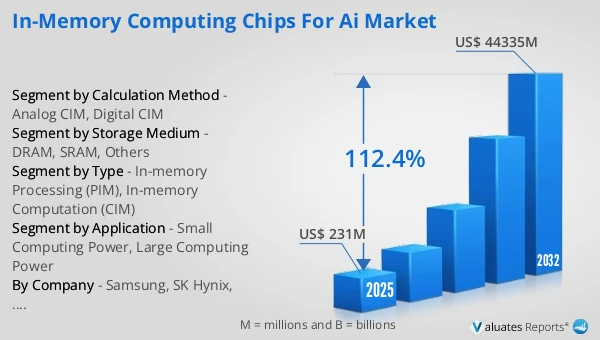
The global In-memory Computing Chips for AI market was valued at US$ 231 million in 2025 and is anticipated to reach US$ 44335 million by 2032, at a CAGR of 112.4% from 2026 to 2032.

In-memory Computing Chips for AI Market

In-memory Computing Chips for AI Market

In-memory Computing Chips for AI are specialized chips that perform AI computations directly inside memory arrays or very close to where data is stored, instead of moving data back and forth between memory and a separate processor. By integrating computation—such as multiply-accumulate operations used in neural networks—within memory, these chips significantly reduce data movement, energy consumption, and latency, overcoming the memory bandwidth bottleneck of traditional von Neumann architectures. In-memory computing chips are particularly well suited for AI inference and edge-AI applications, and are commonly implemented using SRAM, DRAM, or emerging non-volatile memory technologies (such as ReRAM or MRAM), offering a promising path toward high-efficiency, low-power AI acceleration. The downstream market for In-Memory Computing (CIM) Chips for AI is currently in an early adoption phase, with demand concentrated in power- and latency-sensitive AI inference scenarios rather than large-scale training. Key downstream users include edge AI device manufacturers, robotics OEMs, smart cameras, industrial automation system integrators, and IoT solution providers, where CIM chips are used to reduce energy consumption and enable real-time processing under tight thermal and power constraints. Deployment is typically project-based or design-win driven, with close collaboration between chip vendors and system customers, and volumes remain limited compared with mainstream GPUs and NPUs. As AI applications expand deeper into embedded, industrial, and always-on systems, downstream demand for CIM chips is expected to broaden, especially in scenarios where conventional architectures struggle to meet power-efficiency requirements.
The In-memory Computing Chips for AI market is at an early but rapidly emerging stage, driven by the growing need for energy-efficient AI inference as traditional GPU- and CPU-centric architectures face power and memory-bandwidth limitations. Current demand is mainly concentrated in edge AI, smart sensors, robotics, automotive, and low-power intelligent devices, where reducing latency and energy consumption is more critical than peak compute performance. The competitive landscape is dominated by startups, university spin-offs, and joint development programs with foundries and memory vendors, while large semiconductor companies are still largely in exploratory or pilot phases. Although large-scale adoption is constrained by challenges in accuracy, reliability, software ecosystem maturity, and manufacturing consistency, industry consensus expects commercial penetration to accelerate after the mid-2020s, with CIM chips first gaining traction in specialized and power-constrained AI applications before broader deployment.
This report delivers a comprehensive overview of the global In-memory Computing Chips for AI market, with both quantitative and qualitative analyses, to help readers develop growth strategies, assess the competitive landscape, evaluate their position in the current market, and make informed business decisions regarding In-memory Computing Chips for AI. The In-memory Computing Chips for AI market size, estimates, and forecasts are provided in terms of revenue (US$ millions), with 2025 as the base year and historical and forecast data for 2021–2032.
The report segments the global In-memory Computing Chips for AI market comprehensively. Regional market sizes by Type, by Application, by Storage Medium, and by player are also provided. For deeper insight, the report profiles the competitive landscape, key competitors, and their respective market rankings, and discusses technological trends and new product developments.
This report will assist In-memory Computing Chips for AI manufacturers, new entrants, and companies across the industry value chain with information on revenues, sales volume, and average prices for the overall market and its sub-segments, by company, by Type, by Application, and by region.
Market Segmentation

Scope of In-memory Computing Chips for AI Market Report

Report Metric Details
Report Name In-memory Computing Chips for AI Market
Accounted market size in 2025 US$ 231 million
Forecasted market size in 2032 US$ 44335 million
CAGR 112.4%
Base Year 2025
Forecasted years 2026 - 2032
Segment by Type
  • In-memory Processing (PIM)
  • In-memory Computation (CIM)
Segment by Storage Medium
  • DRAM
  • SRAM
  • Others
Segment by Calculation Method
  • Analog CIM
  • Digital CIM
Segment by Application
  • Small Computing Power
  • Large Computing Power
By Region
  • North America (United States, Canada)
  • Europe (Germany, France, UK, Italy, Russia) Rest of Europe
  • Nordic Countries
  • Asia-Pacific (China, Japan, South Korea)
  • Southeast Asia (India, Australia)
  • Rest of Asia
  • Latin America (Mexico, Brazil)
  • Rest of Latin America
  • Middle East & Africa (Turkey, Saudi Arabia, UAE, Rest of MEA)
By Company Samsung, SK Hynix, Syntiant, D-Matrix, Mythic, Graphcore, EnCharge AI, Axelera AI, Hangzhou Zhicun (Witmem) Technology, Suzhou Yizhu Intelligent Technology, Shenzhen Reexen Technology, Beijing Houmo Technology, AistarTek, Beijing Pingxin Technology
Forecast units USD million in value
Report coverage Revenue and volume forecast, company share, competitive landscape, growth factors and trends

Chapter Outline

  • Chapter 1: Defines the scope of the report and presents an executive summary of market segments (by Type, by Application, by Storage Medium, etc.), including the size of each segment and its future growth potential. It offers a high-level view of the current market and its likely evolution in the short, medium, and long term.
  • Chapter 2: Summarizes global and regional market size and outlines market dynamics and recent developments, including key drivers, restraints, challenges and risks for industry participants, and relevant policy analysis.
  • Chapter 3: Provides a detailed view of the competitive landscape for In-memory Computing Chips for AI companies, covering revenue share, development plans, and mergers and acquisitions.
  • Chapter 4: Analyzes segments by Type, detailing the size and growth potential of each segment to help readers identify blue-ocean opportunities.
  • Chapter 5: Analyzes segments by Application, detailing the size and growth potential of each downstream segment to help readers identify blue-ocean opportunities.
  • Chapter 6–10: Regional deep dives (North America, Europe, Asia Pacific, Latin America, Middle East & Africa) broken down by country. Each chapter quantifies market size and growth potential by region and key countries, and outlines market development, outlook, addressable space, and capacity.
  • Chapter 11: Profiles key players, presenting essential information on leading companies, including product/ service offerings, revenue, gross margin, product introductions/portfolios, recent developments, etc.
  • Chapter 12: Key findings and conclusions of the report.

FAQ for this report

How fast is In-memory Computing Chips for AI Market growing?

Ans: The In-memory Computing Chips for AI Market witnessing a CAGR of 112.4% during the forecast period 2026-2032.

What is the In-memory Computing Chips for AI Market size in 2032?

Ans: The In-memory Computing Chips for AI Market size in 2032 will be US$ 44335 million.

Who are the main players in the In-memory Computing Chips for AI Market report?

Ans: The main players in the In-memory Computing Chips for AI Market are Samsung, SK Hynix, Syntiant, D-Matrix, Mythic, Graphcore, EnCharge AI, Axelera AI, Hangzhou Zhicun (Witmem) Technology, Suzhou Yizhu Intelligent Technology, Shenzhen Reexen Technology, Beijing Houmo Technology, AistarTek, Beijing Pingxin Technology

What are the Application segmentation covered in the In-memory Computing Chips for AI Market report?

Ans: The Applications covered in the In-memory Computing Chips for AI Market report are Small Computing Power, Large Computing Power

What are the Type segmentation covered in the In-memory Computing Chips for AI Market report?

Ans: The Types covered in the In-memory Computing Chips for AI Market report are In-memory Processing (PIM), In-memory Computation (CIM)

1 Report Overview
1.1 Study Scope
1.2 Market Analysis by Type
1.2.1 Global In-memory Computing Chips for AI Market Size Growth Rate by Type: 2021 vs 2025 vs 2032
1.2.2 In-memory Processing (PIM)
1.2.3 In-memory Computation (CIM)
1.3 Market by Storage Medium
1.3.1 Global In-memory Computing Chips for AI Market Size Growth Rate by Storage Medium: 2021 vs 2025 vs 2032
1.3.2 DRAM
1.3.3 SRAM
1.3.4 Others
1.4 Market by Calculation Method
1.4.1 Global In-memory Computing Chips for AI Market Size Growth Rate by Calculation Method: 2021 vs 2025 vs 2032
1.4.2 Analog CIM
1.4.3 Digital CIM
1.5 Market by Application
1.5.1 Global In-memory Computing Chips for AI Market Growth by Application: 2021 vs 2025 vs 2032
1.5.2 Small Computing Power
1.5.3 Large Computing Power
1.6 Assumptions and Limitations
1.7 Study Objectives
1.8 Years Considered
2 Global Growth Trends
2.1 Global In-memory Computing Chips for AI Market Perspective (2021–2032)
2.2 Global In-memory Computing Chips for AI Growth Trends by Region
2.2.1 Global In-memory Computing Chips for AI Market Size by Region: 2021 vs 2025 vs 2032
2.2.2 In-memory Computing Chips for AI Historic Market Size by Region (2021–2026)
2.2.3 In-memory Computing Chips for AI Forecasted Market Size by Region (2027–2032)
2.3 In-memory Computing Chips for AI Market Dynamics
2.3.1 In-memory Computing Chips for AI Industry Trends
2.3.2 In-memory Computing Chips for AI Market Drivers
2.3.3 In-memory Computing Chips for AI Market Challenges
2.3.4 In-memory Computing Chips for AI Market Restraints
3 Competition Landscape by Key Players
3.1 Global Top In-memory Computing Chips for AI Players by Revenue
3.1.1 Global Top In-memory Computing Chips for AI Players by Revenue (2021–2026)
3.1.2 Global In-memory Computing Chips for AI Revenue Market Share by Players (2021–2026)
3.2 Global Top In-memory Computing Chips for AI Players Market Share by Company Tier (Tier 1, Tier 2, Tier 3)
3.3 Global Key Players Ranking by In-memory Computing Chips for AI Revenue
3.4 Global In-memory Computing Chips for AI Market Concentration Ratio
3.4.1 Global In-memory Computing Chips for AI Market Concentration Ratio (CR5 and HHI)
3.4.2 Global Top 10 and Top 5 Companies by In-memory Computing Chips for AI Revenue in 2025
3.5 Global Key Players of In-memory Computing Chips for AI Head Offices and Areas Served
3.6 Global Key Players of In-memory Computing Chips for AI, Products and Applications
3.7 Global Key Players of In-memory Computing Chips for AI, Date of General Availability (GA)
3.8 Mergers and Acquisitions, Expansion Plans
4 In-memory Computing Chips for AI Breakdown Data by Type
4.1 Global In-memory Computing Chips for AI Historic Market Size by Type (2021–2026)
4.2 Global In-memory Computing Chips for AI Forecasted Market Size by Type (2027–2032)
5 In-memory Computing Chips for AI Breakdown Data by Application
5.1 Global In-memory Computing Chips for AI Historic Market Size by Application (2021–2026)
5.2 Global In-memory Computing Chips for AI Forecasted Market Size by Application (2027–2032)
6 North America
6.1 North America In-memory Computing Chips for AI Market Size (2021–2032)
6.2 North America In-memory Computing Chips for AI Market Growth Rate by Country: 2021 vs 2025 vs 2032
6.3 North America In-memory Computing Chips for AI Market Size by Country (2021–2026)
6.4 North America In-memory Computing Chips for AI Market Size by Country (2027–2032)
6.5 United States
6.6 Canada
7 Europe
7.1 Europe In-memory Computing Chips for AI Market Size (2021–2032)
7.2 Europe In-memory Computing Chips for AI Market Growth Rate by Country: 2021 vs 2025 vs 2032
7.3 Europe In-memory Computing Chips for AI Market Size by Country (2021–2026)
7.4 Europe In-memory Computing Chips for AI Market Size by Country (2027–2032)
7.5 Germany
7.6 France
7.7 U.K.
7.8 Italy
7.9 Russia
7.10 Ireland
8 Asia-Pacific
8.1 Asia-Pacific In-memory Computing Chips for AI Market Size (2021–2032)
8.2 Asia-Pacific In-memory Computing Chips for AI Market Growth Rate by Region: 2021 vs 2025 vs 2032
8.3 Asia-Pacific In-memory Computing Chips for AI Market Size by Region (2021–2026)
8.4 Asia-Pacific In-memory Computing Chips for AI Market Size by Region (2027–2032)
8.5 China
8.6 Japan
8.7 South Korea
8.8 Southeast Asia
8.9 India
8.10 Australia & New Zealand
9 Latin America
9.1 Latin America In-memory Computing Chips for AI Market Size (2021–2032)
9.2 Latin America In-memory Computing Chips for AI Market Growth Rate by Country: 2021 vs 2025 vs 2032
9.3 Latin America In-memory Computing Chips for AI Market Size by Country (2021–2026)
9.4 Latin America In-memory Computing Chips for AI Market Size by Country (2027–2032)
9.5 Mexico
9.6 Brazil
10 Middle East & Africa
10.1 Middle East & Africa In-memory Computing Chips for AI Market Size (2021–2032)
10.2 Middle East & Africa In-memory Computing Chips for AI Market Growth Rate by Country: 2021 vs 2025 vs 2032
10.3 Middle East & Africa In-memory Computing Chips for AI Market Size by Country (2021–2026)
10.4 Middle East & Africa In-memory Computing Chips for AI Market Size by Country (2027–2032)
10.5 Israel
10.6 Saudi Arabia
10.7 UAE
11 Key Players Profiles
11.1 Samsung
11.1.1 Samsung Company Details
11.1.2 Samsung Business Overview
11.1.3 Samsung In-memory Computing Chips for AI Introduction
11.1.4 Samsung Revenue in In-memory Computing Chips for AI Business (2021–2026)
11.1.5 Samsung Recent Development
11.2 SK Hynix
11.2.1 SK Hynix Company Details
11.2.2 SK Hynix Business Overview
11.2.3 SK Hynix In-memory Computing Chips for AI Introduction
11.2.4 SK Hynix Revenue in In-memory Computing Chips for AI Business (2021–2026)
11.2.5 SK Hynix Recent Development
11.3 Syntiant
11.3.1 Syntiant Company Details
11.3.2 Syntiant Business Overview
11.3.3 Syntiant In-memory Computing Chips for AI Introduction
11.3.4 Syntiant Revenue in In-memory Computing Chips for AI Business (2021–2026)
11.3.5 Syntiant Recent Development
11.4 D-Matrix
11.4.1 D-Matrix Company Details
11.4.2 D-Matrix Business Overview
11.4.3 D-Matrix In-memory Computing Chips for AI Introduction
11.4.4 D-Matrix Revenue in In-memory Computing Chips for AI Business (2021–2026)
11.4.5 D-Matrix Recent Development
11.5 Mythic
11.5.1 Mythic Company Details
11.5.2 Mythic Business Overview
11.5.3 Mythic In-memory Computing Chips for AI Introduction
11.5.4 Mythic Revenue in In-memory Computing Chips for AI Business (2021–2026)
11.5.5 Mythic Recent Development
11.6 Graphcore
11.6.1 Graphcore Company Details
11.6.2 Graphcore Business Overview
11.6.3 Graphcore In-memory Computing Chips for AI Introduction
11.6.4 Graphcore Revenue in In-memory Computing Chips for AI Business (2021–2026)
11.6.5 Graphcore Recent Development
11.7 EnCharge AI
11.7.1 EnCharge AI Company Details
11.7.2 EnCharge AI Business Overview
11.7.3 EnCharge AI In-memory Computing Chips for AI Introduction
11.7.4 EnCharge AI Revenue in In-memory Computing Chips for AI Business (2021–2026)
11.7.5 EnCharge AI Recent Development
11.8 Axelera AI
11.8.1 Axelera AI Company Details
11.8.2 Axelera AI Business Overview
11.8.3 Axelera AI In-memory Computing Chips for AI Introduction
11.8.4 Axelera AI Revenue in In-memory Computing Chips for AI Business (2021–2026)
11.8.5 Axelera AI Recent Development
11.9 Hangzhou Zhicun (Witmem) Technology
11.9.1 Hangzhou Zhicun (Witmem) Technology Company Details
11.9.2 Hangzhou Zhicun (Witmem) Technology Business Overview
11.9.3 Hangzhou Zhicun (Witmem) Technology In-memory Computing Chips for AI Introduction
11.9.4 Hangzhou Zhicun (Witmem) Technology Revenue in In-memory Computing Chips for AI Business (2021–2026)
11.9.5 Hangzhou Zhicun (Witmem) Technology Recent Development
11.10 Suzhou Yizhu Intelligent Technology
11.10.1 Suzhou Yizhu Intelligent Technology Company Details
11.10.2 Suzhou Yizhu Intelligent Technology Business Overview
11.10.3 Suzhou Yizhu Intelligent Technology In-memory Computing Chips for AI Introduction
11.10.4 Suzhou Yizhu Intelligent Technology Revenue in In-memory Computing Chips for AI Business (2021–2026)
11.10.5 Suzhou Yizhu Intelligent Technology Recent Development
11.11 Shenzhen Reexen Technology
11.11.1 Shenzhen Reexen Technology Company Details
11.11.2 Shenzhen Reexen Technology Business Overview
11.11.3 Shenzhen Reexen Technology In-memory Computing Chips for AI Introduction
11.11.4 Shenzhen Reexen Technology Revenue in In-memory Computing Chips for AI Business (2021–2026)
11.11.5 Shenzhen Reexen Technology Recent Development
11.12 Beijing Houmo Technology
11.12.1 Beijing Houmo Technology Company Details
11.12.2 Beijing Houmo Technology Business Overview
11.12.3 Beijing Houmo Technology In-memory Computing Chips for AI Introduction
11.12.4 Beijing Houmo Technology Revenue in In-memory Computing Chips for AI Business (2021–2026)
11.12.5 Beijing Houmo Technology Recent Development
11.13 AistarTek
11.13.1 AistarTek Company Details
11.13.2 AistarTek Business Overview
11.13.3 AistarTek In-memory Computing Chips for AI Introduction
11.13.4 AistarTek Revenue in In-memory Computing Chips for AI Business (2021–2026)
11.13.5 AistarTek Recent Development
11.14 Beijing Pingxin Technology
11.14.1 Beijing Pingxin Technology Company Details
11.14.2 Beijing Pingxin Technology Business Overview
11.14.3 Beijing Pingxin Technology In-memory Computing Chips for AI Introduction
11.14.4 Beijing Pingxin Technology Revenue in In-memory Computing Chips for AI Business (2021–2026)
11.14.5 Beijing Pingxin Technology Recent Development
12 Analyst's Viewpoints/Conclusions
13 Appendix
13.1 Research Methodology
13.1.1 Methodology/Research Approach
13.1.1.1 Research Programs/Design
13.1.1.2 Market Size Estimation
13.1.1.3 Market Breakdown and Data Triangulation
13.1.2 Data Source
13.1.2.1 Secondary Sources
13.1.2.2 Primary Sources
13.2 Author Details
13.3 Disclaimer
List of Tables
 Table 1. Global In-memory Computing Chips for AI Market Size Growth Rate by Type (US$ Million): 2021 vs 2025 vs 2032
 Table 2. Key Players of In-memory Processing (PIM)
 Table 3. Key Players of In-memory Computation (CIM)
 Table 4. Global In-memory Computing Chips for AI Market Size Growth Rate by Storage Medium (US$ Million): 2021 vs 2025 vs 2032
 Table 5. Key Players of DRAM
 Table 6. Key Players of SRAM
 Table 7. Key Players of Others
 Table 8. Global In-memory Computing Chips for AI Market Size Growth Rate by Calculation Method (US$ Million): 2021 vs 2025 vs 2032
 Table 9. Key Players of Analog CIM
 Table 10. Key Players of Digital CIM
 Table 11. Global In-memory Computing Chips for AI Market Size Growth by Application (US$ Million): 2021 vs 2025 vs 2032
 Table 12. Global In-memory Computing Chips for AI Market Size by Region (US$ Million): 2021 vs 2025 vs 2032
 Table 13. Global In-memory Computing Chips for AI Market Size by Region (US$ Million), 2021–2026
 Table 14. Global In-memory Computing Chips for AI Market Share by Region (2021–2026)
 Table 15. Global In-memory Computing Chips for AI Forecasted Market Size by Region (US$ Million), 2027–2032
 Table 16. Global In-memory Computing Chips for AI Market Share by Region (2027–2032)
 Table 17. In-memory Computing Chips for AI Market Trends
 Table 18. In-memory Computing Chips for AI Market Drivers
 Table 19. In-memory Computing Chips for AI Market Challenges
 Table 20. In-memory Computing Chips for AI Market Restraints
 Table 21. Global In-memory Computing Chips for AI Revenue by Players (US$ Million), 2021–2026
 Table 22. Global In-memory Computing Chips for AI Market Share by Players (2021–2026)
 Table 23. Global Top In-memory Computing Chips for AI Players by Tier (Tier 1, Tier 2, and Tier 3), based on In-memory Computing Chips for AI Revenue, 2025
 Table 24. Ranking of Global Top In-memory Computing Chips for AI Companies by Revenue (US$ Million) in 2025
 Table 25. Global 5 Largest Players Market Share by In-memory Computing Chips for AI Revenue (CR5 and HHI), 2021–2026
 Table 26. Global Key Players of In-memory Computing Chips for AI, Headquarters and Area Served
 Table 27. Global Key Players of In-memory Computing Chips for AI, Products and Applications
 Table 28. Global Key Players of In-memory Computing Chips for AI, Date of General Availability (GA)
 Table 29. Mergers and Acquisitions, Expansion Plans
 Table 30. Global In-memory Computing Chips for AI Market Size by Type (US$ Million), 2021–2026
 Table 31. Global In-memory Computing Chips for AI Revenue Market Share by Type (2021–2026)
 Table 32. Global In-memory Computing Chips for AI Forecasted Market Size by Type (US$ Million), 2027–2032
 Table 33. Global In-memory Computing Chips for AI Revenue Market Share by Type (2027–2032)
 Table 34. Global In-memory Computing Chips for AI Market Size by Application (US$ Million), 2021–2026
 Table 35. Global In-memory Computing Chips for AI Revenue Market Share by Application (2021–2026)
 Table 36. Global In-memory Computing Chips for AI Forecasted Market Size by Application (US$ Million), 2027–2032
 Table 37. Global In-memory Computing Chips for AI Revenue Market Share by Application (2027–2032)
 Table 38. North America In-memory Computing Chips for AI Market Size Growth Rate by Country (US$ Million): 2021 vs 2025 vs 2032
 Table 39. North America In-memory Computing Chips for AI Market Size by Country (US$ Million), 2021–2026
 Table 40. North America In-memory Computing Chips for AI Market Size by Country (US$ Million), 2027–2032
 Table 41. Europe In-memory Computing Chips for AI Market Size Growth Rate by Country (US$ Million): 2021 vs 2025 vs 2032
 Table 42. Europe In-memory Computing Chips for AI Market Size by Country (US$ Million), 2021–2026
 Table 43. Europe In-memory Computing Chips for AI Market Size by Country (US$ Million), 2027–2032
 Table 44. Asia-Pacific In-memory Computing Chips for AI Market Size Growth Rate by Region (US$ Million): 2021 vs 2025 vs 2032
 Table 45. Asia-Pacific In-memory Computing Chips for AI Market Size by Region (US$ Million), 2021–2026
 Table 46. Asia-Pacific In-memory Computing Chips for AI Market Size by Region (US$ Million), 2027–2032
 Table 47. Latin America In-memory Computing Chips for AI Market Size Growth Rate by Country (US$ Million): 2021 vs 2025 vs 2032
 Table 48. Latin America In-memory Computing Chips for AI Market Size by Country (US$ Million), 2021–2026
 Table 49. Latin America In-memory Computing Chips for AI Market Size by Country (US$ Million), 2027–2032
 Table 50. Middle East & Africa In-memory Computing Chips for AI Market Size Growth Rate by Country (US$ Million): 2021 vs 2025 vs 2032
 Table 51. Middle East & Africa In-memory Computing Chips for AI Market Size by Country (US$ Million), 2021–2026
 Table 52. Middle East & Africa In-memory Computing Chips for AI Market Size by Country (US$ Million), 2027–2032
 Table 53. Samsung Company Details
 Table 54. Samsung Business Overview
 Table 55. Samsung In-memory Computing Chips for AI Product
 Table 56. Samsung Revenue in In-memory Computing Chips for AI Business (US$ Million), 2021–2026
 Table 57. Samsung Recent Development
 Table 58. SK Hynix Company Details
 Table 59. SK Hynix Business Overview
 Table 60. SK Hynix In-memory Computing Chips for AI Product
 Table 61. SK Hynix Revenue in In-memory Computing Chips for AI Business (US$ Million), 2021–2026
 Table 62. SK Hynix Recent Development
 Table 63. Syntiant Company Details
 Table 64. Syntiant Business Overview
 Table 65. Syntiant In-memory Computing Chips for AI Product
 Table 66. Syntiant Revenue in In-memory Computing Chips for AI Business (US$ Million), 2021–2026
 Table 67. Syntiant Recent Development
 Table 68. D-Matrix Company Details
 Table 69. D-Matrix Business Overview
 Table 70. D-Matrix In-memory Computing Chips for AI Product
 Table 71. D-Matrix Revenue in In-memory Computing Chips for AI Business (US$ Million), 2021–2026
 Table 72. D-Matrix Recent Development
 Table 73. Mythic Company Details
 Table 74. Mythic Business Overview
 Table 75. Mythic In-memory Computing Chips for AI Product
 Table 76. Mythic Revenue in In-memory Computing Chips for AI Business (US$ Million), 2021–2026
 Table 77. Mythic Recent Development
 Table 78. Graphcore Company Details
 Table 79. Graphcore Business Overview
 Table 80. Graphcore In-memory Computing Chips for AI Product
 Table 81. Graphcore Revenue in In-memory Computing Chips for AI Business (US$ Million), 2021–2026
 Table 82. Graphcore Recent Development
 Table 83. EnCharge AI Company Details
 Table 84. EnCharge AI Business Overview
 Table 85. EnCharge AI In-memory Computing Chips for AI Product
 Table 86. EnCharge AI Revenue in In-memory Computing Chips for AI Business (US$ Million), 2021–2026
 Table 87. EnCharge AI Recent Development
 Table 88. Axelera AI Company Details
 Table 89. Axelera AI Business Overview
 Table 90. Axelera AI In-memory Computing Chips for AI Product
 Table 91. Axelera AI Revenue in In-memory Computing Chips for AI Business (US$ Million), 2021–2026
 Table 92. Axelera AI Recent Development
 Table 93. Hangzhou Zhicun (Witmem) Technology Company Details
 Table 94. Hangzhou Zhicun (Witmem) Technology Business Overview
 Table 95. Hangzhou Zhicun (Witmem) Technology In-memory Computing Chips for AI Product
 Table 96. Hangzhou Zhicun (Witmem) Technology Revenue in In-memory Computing Chips for AI Business (US$ Million), 2021–2026
 Table 97. Hangzhou Zhicun (Witmem) Technology Recent Development
 Table 98. Suzhou Yizhu Intelligent Technology Company Details
 Table 99. Suzhou Yizhu Intelligent Technology Business Overview
 Table 100. Suzhou Yizhu Intelligent Technology In-memory Computing Chips for AI Product
 Table 101. Suzhou Yizhu Intelligent Technology Revenue in In-memory Computing Chips for AI Business (US$ Million), 2021–2026
 Table 102. Suzhou Yizhu Intelligent Technology Recent Development
 Table 103. Shenzhen Reexen Technology Company Details
 Table 104. Shenzhen Reexen Technology Business Overview
 Table 105. Shenzhen Reexen Technology In-memory Computing Chips for AI Product
 Table 106. Shenzhen Reexen Technology Revenue in In-memory Computing Chips for AI Business (US$ Million), 2021–2026
 Table 107. Shenzhen Reexen Technology Recent Development
 Table 108. Beijing Houmo Technology Company Details
 Table 109. Beijing Houmo Technology Business Overview
 Table 110. Beijing Houmo Technology In-memory Computing Chips for AI Product
 Table 111. Beijing Houmo Technology Revenue in In-memory Computing Chips for AI Business (US$ Million), 2021–2026
 Table 112. Beijing Houmo Technology Recent Development
 Table 113. AistarTek Company Details
 Table 114. AistarTek Business Overview
 Table 115. AistarTek In-memory Computing Chips for AI Product
 Table 116. AistarTek Revenue in In-memory Computing Chips for AI Business (US$ Million), 2021–2026
 Table 117. AistarTek Recent Development
 Table 118. Beijing Pingxin Technology Company Details
 Table 119. Beijing Pingxin Technology Business Overview
 Table 120. Beijing Pingxin Technology In-memory Computing Chips for AI Product
 Table 121. Beijing Pingxin Technology Revenue in In-memory Computing Chips for AI Business (US$ Million), 2021–2026
 Table 122. Beijing Pingxin Technology Recent Development
 Table 123. Research Programs/Design for This Report
 Table 124. Key Data Information from Secondary Sources
 Table 125. Key Data Information from Primary Sources
 Table 126. Authors List of This Report


List of Figures
 Figure 1. In-memory Computing Chips for AI Picture
 Figure 2. Global In-memory Computing Chips for AI Market Size Comparison by Type (US$ Million), 2021–2032
 Figure 3. Global In-memory Computing Chips for AI Market Share by Type: 2025 vs 2032
 Figure 4. In-memory Processing (PIM) Features
 Figure 5. In-memory Computation (CIM) Features
 Figure 6. Global In-memory Computing Chips for AI Market Size Comparison by Storage Medium (US$ Million), 2021–2032
 Figure 7. DRAM Features
 Figure 8. SRAM Features
 Figure 9. Others Features
 Figure 10. Global In-memory Computing Chips for AI Market Size Comparison by Calculation Method (US$ Million), 2021–2032
 Figure 11. Analog CIM Features
 Figure 12. Digital CIM Features
 Figure 13. Global In-memory Computing Chips for AI Market Size by Application (US$ Million), 2021–2032
 Figure 14. Global In-memory Computing Chips for AI Market Share by Application: 2025 vs 2032
 Figure 15. Small Computing Power Case Studies
 Figure 16. Large Computing Power Case Studies
 Figure 17. In-memory Computing Chips for AI Report Years Considered
 Figure 18. Global In-memory Computing Chips for AI Market Size (US$ Million), Year-over-Year: 2021–2032
 Figure 19. Global In-memory Computing Chips for AI Market Size, (US$ Million), 2021 vs 2025 vs 2032
 Figure 20. Global In-memory Computing Chips for AI Market Share by Region: 2025 vs 2032
 Figure 21. Global In-memory Computing Chips for AI Market Share by Players in 2025
 Figure 22. Global In-memory Computing Chips for AI Market Share by Company Type (Tier 1, Tier 2, and Tier 3)
 Figure 23. The Top 10 and 5 Players Market Share by In-memory Computing Chips for AI Revenue in 2025
 Figure 24. North America In-memory Computing Chips for AI Market Size YoY Growth (US$ Million), 2021–2032
 Figure 25. North America In-memory Computing Chips for AI Market Share by Country (2021–2032)
 Figure 26. United States In-memory Computing Chips for AI Market Size YoY Growth (US$ Million), 2021–2032
 Figure 27. Canada In-memory Computing Chips for AI Market Size YoY Growth (US$ Million), 2021–2032
 Figure 28. Europe In-memory Computing Chips for AI Market Size YoY Growth (US$ Million), 2021–2032
 Figure 29. Europe In-memory Computing Chips for AI Market Share by Country (2021–2032)
 Figure 30. Germany In-memory Computing Chips for AI Market Size YoY Growth (US$ Million), 2021–2032
 Figure 31. France In-memory Computing Chips for AI Market Size YoY Growth (US$ Million), 2021–2032
 Figure 32. U.K. In-memory Computing Chips for AI Market Size YoY Growth (US$ Million), 2021–2032
 Figure 33. Italy In-memory Computing Chips for AI Market Size YoY Growth (US$ Million), 2021–2032
 Figure 34. Russia In-memory Computing Chips for AI Market Size YoY Growth (US$ Million), 2021–2032
 Figure 35. Ireland In-memory Computing Chips for AI Market Size YoY Growth (US$ Million), 2021–2032
 Figure 36. Asia-Pacific In-memory Computing Chips for AI Market Size YoY Growth (US$ Million), 2021–2032
 Figure 37. Asia-Pacific In-memory Computing Chips for AI Market Share by Region (2021–2032)
 Figure 38. China In-memory Computing Chips for AI Market Size YoY Growth (US$ Million), 2021–2032
 Figure 39. Japan In-memory Computing Chips for AI Market Size YoY Growth (US$ Million), 2021–2032
 Figure 40. South Korea In-memory Computing Chips for AI Market Size YoY Growth (US$ Million), 2021–2032
 Figure 41. Southeast Asia In-memory Computing Chips for AI Market Size YoY Growth (US$ Million), 2021–2032
 Figure 42. India In-memory Computing Chips for AI Market Size YoY Growth (US$ Million), 2021–2032
 Figure 43. Australia & New Zealand In-memory Computing Chips for AI Market Size YoY Growth (US$ Million), 2021–2032
 Figure 44. Latin America In-memory Computing Chips for AI Market Size YoY Growth (US$ Million), 2021–2032
 Figure 45. Latin America In-memory Computing Chips for AI Market Share by Country (2021–2032)
 Figure 46. Mexico In-memory Computing Chips for AI Market Size YoY Growth (US$ Million), 2021–2032
 Figure 47. Brazil In-memory Computing Chips for AI Market Size YoY Growth (US$ Million), 2021–2032
 Figure 48. Middle East & Africa In-memory Computing Chips for AI Market Size YoY Growth (US$ Million), 2021–2032
 Figure 49. Middle East & Africa In-memory Computing Chips for AI Market Share by Country (2021–2032)
 Figure 50. Israel In-memory Computing Chips for AI Market Size YoY Growth (US$ Million), 2021–2032
 Figure 51. Saudi Arabia In-memory Computing Chips for AI Market Size YoY Growth (US$ Million), 2021–2032
 Figure 52. UAE In-memory Computing Chips for AI Market Size YoY Growth (US$ Million), 2021–2032
 Figure 53. Samsung Revenue Growth Rate in In-memory Computing Chips for AI Business (2021–2026)
 Figure 54. SK Hynix Revenue Growth Rate in In-memory Computing Chips for AI Business (2021–2026)
 Figure 55. Syntiant Revenue Growth Rate in In-memory Computing Chips for AI Business (2021–2026)
 Figure 56. D-Matrix Revenue Growth Rate in In-memory Computing Chips for AI Business (2021–2026)
 Figure 57. Mythic Revenue Growth Rate in In-memory Computing Chips for AI Business (2021–2026)
 Figure 58. Graphcore Revenue Growth Rate in In-memory Computing Chips for AI Business (2021–2026)
 Figure 59. EnCharge AI Revenue Growth Rate in In-memory Computing Chips for AI Business (2021–2026)
 Figure 60. Axelera AI Revenue Growth Rate in In-memory Computing Chips for AI Business (2021–2026)
 Figure 61. Hangzhou Zhicun (Witmem) Technology Revenue Growth Rate in In-memory Computing Chips for AI Business (2021–2026)
 Figure 62. Suzhou Yizhu Intelligent Technology Revenue Growth Rate in In-memory Computing Chips for AI Business (2021–2026)
 Figure 63. Shenzhen Reexen Technology Revenue Growth Rate in In-memory Computing Chips for AI Business (2021–2026)
 Figure 64. Beijing Houmo Technology Revenue Growth Rate in In-memory Computing Chips for AI Business (2021–2026)
 Figure 65. AistarTek Revenue Growth Rate in In-memory Computing Chips for AI Business (2021–2026)
 Figure 66. Beijing Pingxin Technology Revenue Growth Rate in In-memory Computing Chips for AI Business (2021–2026)
 Figure 67. Bottom-up and Top-down Approaches for This Report
 Figure 68. Data Triangulation
 Figure 69. Key Executives Interviewed

SELECT A FORMAT
Added to Cart
Electronic

$2900

Single User License
Electronic

$4350

Multi User License
Electronic

$5800

Enterprise License
Add to Cart
Buy Now (15% Discount)

OUR CUSTOMER

Leap India