Alumina Substrates for Chip Resistors Market Size
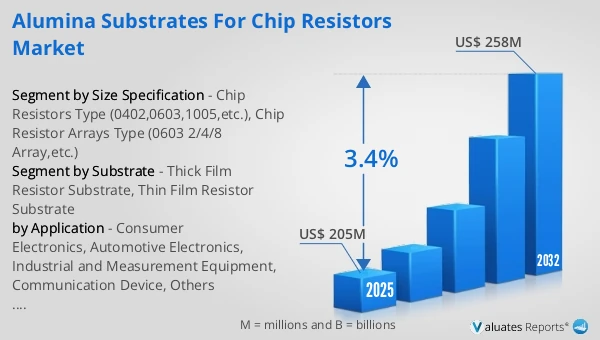
The global Alumina Substrates for Chip Resistors market was valued at US$ 205 million in 2025 and is anticipated to reach US$ 258 million by 2032, at a CAGR of 3.4% from 2026 to 2032.
Alumina Substrates for Chip Resistors Market
The 2025 U.S. tariff policies introduce profound uncertainty into the global economic landscape. This report critically examines the implications of recent tariff adjustments and international strategic countermeasures on Alumina Substrates for Chip Resistors competitive dynamics, regional economic interdependencies, and supply chain reconfigurations.
Alumina substrates for chip resistors are the core ceramic bases used to build chip resistors (predominantly thick-film types), providing electrical insulation, thermal robustness/heat spreading, mechanical support, and dimensional stability, while also enabling stable printing and singulation. Nippon Carbide Industries (NCI) explicitly states it manufactures alumina substrates for chip resistors using its accumulated sintering and sheet-formation technologies, and highlights its capability for thin and strong substrates. MARUWA emphasizes surface/geometry control—good smoothness/flatness with low porosity, smaller dimensional and thickness variance, and a surface condition that supports strong adhesion for thin-film and thick-film materials—directly aligning with thick-film resistor process requirements.
From a product/process and technology standpoint, these substrates are typically produced via powder preparation → slurry → tape casting (or equivalent sheet forming) → (optional) lamination → sintering → precision machining (lapping/polishing, dicing, grooves/slots, drilling) → cleaning and grading, then used in thick-film resistor manufacturing. NCI notes design breadth including chip-array formats and thinner substrates for very small chip sizes (e.g., 0402 / 01005), reflecting the industry trajectory toward thinner, smaller, yet mechanically robust ceramics. Kyoritsu Elex highlights high-purity alumina raw materials and advanced processing that delivers high dimensional accuracy and “divisibility,” and also describes pre-forming features (through-holes, singulation slits) at the green-sheet stage via precision die pressing to support tight downstream tolerances. At the circuit level, thick-film resistor systems rely on screen-printing conductive/resistive pastes and curing/firing; published engineering guidance notes RuO₂ as a typical resistive paste core material, with resistivity tuned by composition—making substrate surface and stability foundational to electrical consistency.
Competitive dynamics are characterized by high qualification barriers, concentrated leadership, and accelerating regional second-sourcing. Global high-end supply has been led by Japan/US/EU fine-ceramics specialists offering thick-film alumina substrates (e.g., MARUWA, Chaozhou Three-Circle (Group), NCI (Nippon Carbide Industries Co., Inc.), Zhejiang Xinna Ceramic New Material, etc.), differentiated by powder/sinter know-how, ultra-thin strength, low warp, surface/flatness control, and high-volume consistency. Meanwhile. Forward drivers are primarily: (i) automotive/industrial reliability and consistency requirements, (ii) continued miniaturization (thinner substrates and smaller chip sizes), (iii) higher power density and thermal needs, and (iv) supply-chain resilience initiatives expanding qualified supplier pools.
This report delivers a comprehensive overview of the global Alumina Substrates for Chip Resistors market, with both quantitative and qualitative analyses, to help readers develop growth strategies, assess the competitive landscape, evaluate their position in the current market, and make informed business decisions regarding Alumina Substrates for Chip Resistors. The Alumina Substrates for Chip Resistors market size, estimates, and forecasts are provided in terms of output/shipments (Sqm) and revenue (US$ millions), with 2025 as the base year and historical and forecast data for 2021–2032.
The report segments the global Alumina Substrates for Chip Resistors market comprehensively. Regional market sizes by Size Specification, by Application, by Substrate, and by company are also provided. For deeper insight, the report profiles the competitive landscape, key competitors, and their respective market rankings, and discusses technological trends and new product developments.
This report will assist Alumina Substrates for Chip Resistors manufacturers, new entrants, and companies across the industry value chain with information on revenues, production, and average prices for the overall market and its sub-segments, by company, by Size Specification, by Application, and by region.
Market Segmentation
Scope of Alumina Substrates for Chip Resistors Market Report
| Report Metric |
Details |
| Report Name |
Alumina Substrates for Chip Resistors Market |
| Accounted market size in 2025 |
US$ 205 million |
| Forecasted market size in 2032 |
US$ 258 million |
| CAGR |
3.4% |
| Base Year |
2025 |
| Forecasted years |
2026 - 2032 |
| Segment by Size Specification |
- Chip Resistors Type (0402,0603,1005,etc.)
- Chip Resistor Arrays Type (0603 2/4/8 Array,etc.)
|
| Segment by Substrate |
- Thick Film Resistor Substrate
- Thin Film Resistor Substrate
|
| by Application |
- Consumer Electronics
- Automotive Electronics
- Industrial and Measurement Equipment
- Communication Device
- Others
|
| Production by Region |
|
| Consumption by Region |
- North America (United States, Canada)
- Europe (Germany, France, UK, Italy, Russia)
- Asia-Pacific (China, Japan, South Korea, Taiwan)
- Southeast Asia (India)
- Latin America (Mexico, Brazil)
|
| By Company |
Chaozhou Three-Circle (Group), Maruwa, LEATEC Fine Ceramics, NCI (Nippon Carbide Industries Co., Inc.), Zhejiang Xinna Ceramic New Material, Kyoritsu Elex |
| Forecast units |
USD million in value |
| Report coverage |
Revenue and volume forecast, company share, competitive landscape, growth factors and trends |
Chapter Outline
- Chapter 1: Defines the scope of the report and presents an executive summary of market segments (by Size Specification, by Application, by Substrate, etc.), including the size of each segment and its future growth potential. It offers a high-level view of the current market and its likely evolution in the short, medium, and long term.
- Chapter 2: Provides a detailed analysis of the competitive landscape for Alumina Substrates for Chip Resistors manufacturers, including prices, production, value-based market shares, latest development plans, and information on mergers and acquisitions.
- Chapter 3: Examines Alumina Substrates for Chip Resistors production/output and value by region and country, providing a quantitative assessment of market size and growth potential for each region over the next six years.
- Chapter 4: Analyzes Alumina Substrates for Chip Resistors consumption at the regional and country levels. It quantifies market size and growth potential for each region and its key countries, and outlines market development, outlook, addressable space, and national production.
- Chapter 5: Analyzes market segments by Size Specification, covering the size and growth potential of each segment to help readers identify “blue ocean” opportunities.
- Chapter 6: Analyzes market segments by Application, covering the size and growth potential of each segment to help readers identify “blue ocean” opportunities in downstream markets.
- Chapter 7: Profiles key players, detailing the fundamentals of major companies, including product production/output, value, price, gross margin, product portfolio/introductions, and recent developments.
- Chapter 8: Reviews the industry value chain, including upstream and downstream segments.
- Chapter 9: Discusses market dynamics and recent developments, including drivers, restraints, challenges and risks for manufacturers, U.S. Tariffs and relevant policy analysis.
- Chapter 10: Summarizes the key findings and conclusions of the report.
FAQ for this report
How fast is Alumina Substrates for Chip Resistors Market growing?
Ans: The Alumina Substrates for Chip Resistors Market witnessing a CAGR of 3.4% during the forecast period 2026-2032.
What is the Alumina Substrates for Chip Resistors Market size in 2032?
Ans: The Alumina Substrates for Chip Resistors Market size in 2032 will be US$ 258 million.
Who are the main players in the Alumina Substrates for Chip Resistors Market report?
Ans: The main players in the Alumina Substrates for Chip Resistors Market are Chaozhou Three-Circle (Group), Maruwa, LEATEC Fine Ceramics, NCI (Nippon Carbide Industries Co., Inc.), Zhejiang Xinna Ceramic New Material, Kyoritsu Elex
What are the Application segmentation covered in the Alumina Substrates for Chip Resistors Market report?
Ans: The Applications covered in the Alumina Substrates for Chip Resistors Market report are Consumer Electronics, Automotive Electronics, Industrial and Measurement Equipment, Communication Device, Others