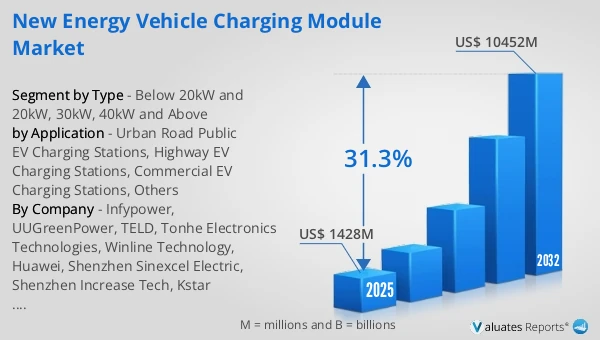
The global New Energy Vehicle Charging Module market was valued at US$ 1428 million in 2025 and is anticipated to reach US$ 10452 million by 2032, at a CAGR of 31.3% from 2026 to 2032.
New Energy Vehicle Charging Module Market
The 2025 U.S. tariff policies introduce profound uncertainty into the global economic landscape. This report critically examines the implications of recent tariff adjustments and international strategic countermeasures on New Energy Vehicle Charging Module competitive dynamics, regional economic interdependencies, and supply chain reconfigurations.
New Energy Vehicle Charging Module is an important component for electric vehicle (EV) charging equipment. It typically includes a series of electronic components and a power management system that converts and manages electrical energy so that electric vehicles can charge efficiently. EV Charging Station Power Module is the only core product with technical threshold in the entire charging pile industry.
As the core component of the charging pile, the Power Module belongs to a large category of power supply products. Its core function is to convert the AC power in the grid into DC power that can charge the battery. The charging module not only provides energy and power, but also controls and converts the circuit, which ensures the stability of the power supply circuit and is suitable for charging various types of power batteries. The performance of the Power Module not only directly affects the overall performance of the charging pile, but is also related to charging safety issues, and is the core of building a high-power charging infrastructure.
Power Module is mainly composed of: semiconductor power devices, integrated circuits, magnetic components, PCB, capacitors, chassis fans, etc. The key of the Power Module is the MOS tube switch. When the charging module is working, the three-phase AC power supply is rectified and filtered, and then becomes a DC input voltage for the DC/DC conversion circuit. The controller acts on the power switch MOS tube through the drive circuit to convert the rectified and filtered DC voltage into an AC voltage, and the AC voltage at this time is pulse width modulated. Then, the AC voltage is transformed and isolated by the high-frequency transformer, rectified and filtered again to obtain a DC pulse, and then charged to the battery pack.
In 2025, global New Energy Vehicle Charging Module sales reached approximately 3,283.3 k units, with an average global market price of around US$ 435 per unit. The single-line production capacity is about 50 k units, and the industry gross profit margin is about 28%.
The global New Energy Vehicle Charging Module market is experiencing robust growth, driven by the increasing adoption of electric vehicles, advancements in charging technology, and supportive government policies. Here are the key trends shaping the market:
1. Surge in Electric Vehicle Adoption:
The rising demand for electric vehicles, fueled by environmental concerns and the need for sustainable transportation, is significantly increasing the need for efficient and widespread charging infrastructure.
2. Government Incentives and Policies:
Many governments worldwide are implementing favorable policies, such as tax credits, subsidies, and grants, to promote EV adoption and the installation of charging stations. This regulatory support is driving investment in charging pile modules.
3. Technological Advancements:
Innovations in charging technology, including faster charging solutions like DC fast chargers, are enhancing user convenience and reducing downtime for EVs. Advanced charging modules with higher power outputs are becoming increasingly popular.
4. Smart Charging Solutions:
The integration of smart technologies, such as IoT and AI, in charging pile modules allows for features like remote monitoring, predictive maintenance, and dynamic load management. This enhances user experience and operational efficiency.
5. Expansion of Charging Infrastructure:
Significant investments in charging infrastructure are being made globally, particularly in urban areas and along major highways. This expansion is critical for supporting the growing number of electric vehicles and is leading to increased demand for charging modules.
6. Focus on Renewable Energy Integration:
There is a growing trend toward integrating renewable energy sources, such as solar and wind power, with EV charging stations. This approach not only reduces the carbon footprint of charging but also supports sustainable energy goals.
7. Standardization and Interoperability:
Efforts to standardize charging technologies and promote interoperability among different EV models and charging stations are gaining traction. This makes it easier for users to access charging services regardless of the vehicle brand.
This report delivers a comprehensive overview of the global New Energy Vehicle Charging Module market, with both quantitative and qualitative analyses, to help readers develop growth strategies, assess the competitive landscape, evaluate their position in the current market, and make informed business decisions regarding New Energy Vehicle Charging Module. The New Energy Vehicle Charging Module market size, estimates, and forecasts are provided in terms of output/shipments (K Units) and revenue (US$ millions), with 2025 as the base year and historical and forecast data for 2021–2032.
The report segments the global New Energy Vehicle Charging Module market comprehensively. Regional market sizes by Type, by Application, , and by company are also provided. For deeper insight, the report profiles the competitive landscape, key competitors, and their respective market rankings, and discusses technological trends and new product developments.
This report will assist New Energy Vehicle Charging Module manufacturers, new entrants, and companies across the industry value chain with information on revenues, production, and average prices for the overall market and its sub-segments, by company, by Type, by Application, and by region.
Market Segmentation
Scope of New Energy Vehicle Charging Module Market Report
| Report Metric |
Details |
| Report Name |
New Energy Vehicle Charging Module Market |
| Accounted market size in 2025 |
US$ 1428 million |
| Forecasted market size in 2032 |
US$ 10452 million |
| CAGR |
31.3% |
| Base Year |
2025 |
| Forecasted years |
2026 - 2032 |
| Segment by Type |
- Below 20kW and 20kW
- 30kW
- 40kW and Above
|
| by Application |
- Urban Road Public EV Charging Stations
- Highway EV Charging Stations
- Commercial EV Charging Stations
- Others
|
| Production by Region |
- North America
- Europe
- China
|
| Consumption by Region |
- North America (United States, Canada)
- Europe (Germany, France, UK, Italy, Russia)
- Asia-Pacific (China, Japan, South Korea, Taiwan)
- Southeast Asia (India)
- Latin America (Mexico, Brazil)
|
| By Company |
Infypower, UUGreenPower, TELD, Tonhe Electronics Technologies, Winline Technology, Huawei, Shenzhen Sinexcel Electric, Shenzhen Increase Tech, Kstar Science&Technology, XYPower, AcePower, WattSaving |
| Forecast units |
USD million in value |
| Report coverage |
Revenue and volume forecast, company share, competitive landscape, growth factors and trends |
Chapter Outline
- Chapter 1: Defines the scope of the report and presents an executive summary of market segments (by Type, by Application, , etc.), including the size of each segment and its future growth potential. It offers a high-level view of the current market and its likely evolution in the short, medium, and long term.
- Chapter 2: Provides a detailed analysis of the competitive landscape for New Energy Vehicle Charging Module manufacturers, including prices, production, value-based market shares, latest development plans, and information on mergers and acquisitions.
- Chapter 3: Examines New Energy Vehicle Charging Module production/output and value by region and country, providing a quantitative assessment of market size and growth potential for each region over the next six years.
- Chapter 4: Analyzes New Energy Vehicle Charging Module consumption at the regional and country levels. It quantifies market size and growth potential for each region and its key countries, and outlines market development, outlook, addressable space, and national production.
- Chapter 5: Analyzes market segments by Type, covering the size and growth potential of each segment to help readers identify “blue ocean” opportunities.
- Chapter 6: Analyzes market segments by Application, covering the size and growth potential of each segment to help readers identify “blue ocean” opportunities in downstream markets.
- Chapter 7: Profiles key players, detailing the fundamentals of major companies, including product production/output, value, price, gross margin, product portfolio/introductions, and recent developments.
- Chapter 8: Reviews the industry value chain, including upstream and downstream segments.
- Chapter 9: Discusses market dynamics and recent developments, including drivers, restraints, challenges and risks for manufacturers, U.S. Tariffs and relevant policy analysis.
- Chapter 10: Summarizes the key findings and conclusions of the report.
Ans: The New Energy Vehicle Charging Module Market witnessing a CAGR of 31.3% during the forecast period 2026-2032.
Ans: The main players in the New Energy Vehicle Charging Module Market are Infypower, UUGreenPower, TELD, Tonhe Electronics Technologies, Winline Technology, Huawei, Shenzhen Sinexcel Electric, Shenzhen Increase Tech, Kstar Science&Technology, XYPower, AcePower, WattSaving
Ans: The Applications covered in the New Energy Vehicle Charging Module Market report are Urban Road Public EV Charging Stations, Highway EV Charging Stations, Commercial EV Charging Stations, Others
Ans: The Types covered in the New Energy Vehicle Charging Module Market report are Below 20kW and 20kW, 30kW, 40kW and Above