0
U.S. (TOLL FREE)
+1 (315) 215-3225
Automative

0
U.S. (TOLL FREE)
+1 (315) 215-3225
Global Passive Electronic Components Market Research Report 2026
Published Date: 2026-04-02
|
Report Code: QYRE-Auto-13N9316
Home | Market Reports | Computers & Electronics| Electronics & Electrical| Electronic Components
Global Passive Electronic Components Market Insights and Forecast to 2028
BUY CHAPTERS

Global Passive Electronic Components Market Research Report 2026

Code: QYRE-Auto-13N9316
Report
2026-04-02
Pages:112
QYResearch
Buy Now with 15% Discount
DESCRIPTION
TABLE OF CONTENT
TABLES & FIGURES

Passive Electronic Components Market Size

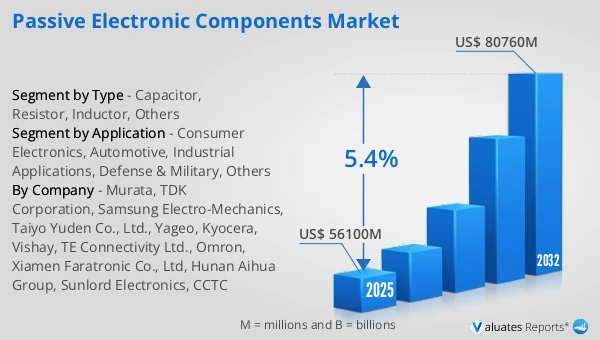
The global Passive Electronic Components market was valued at US$ 56100 million in 2025 and is anticipated to reach US$ 80760 million by 2032, at a CAGR of 5.4% from 2026 to 2032.

Passive Electronic Components Market

Passive Electronic Components Market

Passive electronic components are essential elements in modern electronic circuits, characterized by their inability to generate energy but instead storing, controlling, or dissipating energy. These components include capacitors, resistors, inductors, transformers, and varistors, among others. Unlike active components, which require external power to function, passive components operate without a power source and are crucial in regulating signals and energy flow in electronic devices. They are primarily used for filtering, signal conditioning, energy storage, and voltage regulation in a wide range of applications, from consumer electronics to industrial and automotive systems. These components are integral to maintaining the functionality, reliability, and efficiency of electronic systems.
The global market for passive electronic components has seen steady growth, driven by the increasing demand for consumer electronics, automotive applications, and industrial automation. The market is highly competitive, with several leading companies dominating the supply chain. Murata Manufacturing Co. Ltd., TDK Corporation, and Vishay Intertechnology are some of the largest players in the industry, accounting for over 30% of the global market share. Other notable players include Samsung Electro-Mechanics, Yageo Corporation, and Panasonic. These companies benefit from a robust product portfolio, advanced manufacturing capabilities, and strong relationships with end customers across multiple sectors.
China holds the largest share of the global market, representing over 40% of the demand for passive electronic components. This dominance is primarily due to China’s robust manufacturing sector and its status as the largest consumer of electronic products. The rapid growth of the consumer electronics and electric vehicle (EV) industries in China has fueled demand for passive components, particularly in mobile phones, computing devices, and electric powertrains. Japan and Europe are also significant markets, accounting for approximately 15% and 10% of the global market share, respectively. Japan’s strong industrial base and Europe’s focus on automotive electronics and automation contribute to their ongoing demand for high-quality passive components.
The passive components market has seen a shift towards miniaturization and high-performance solutions. As consumer electronics continue to evolve, particularly in smartphones, wearables, and other portable devices, there is an increasing demand for smaller, more efficient passive components that can fit into compact spaces while maintaining optimal performance. This trend is being driven by advancements in technology, such as the move towards 5G, which requires high-frequency capacitors, inductors, and resistors capable of operating at higher speeds. Additionally, automotive electrification and the transition to electric vehicles are pushing for more robust passive components that can handle higher voltages and currents, particularly in powertrains and battery management systems.
This report delivers a comprehensive overview of the global Passive Electronic Components market, with both quantitative and qualitative analyses, to help readers develop growth strategies, assess the competitive landscape, evaluate their position in the current market, and make informed business decisions regarding Passive Electronic Components. The Passive Electronic Components market size, estimates, and forecasts are provided in terms of revenue (US$ millions), with 2025 as the base year and historical and forecast data for 2021–2032.
The report segments the global Passive Electronic Components market comprehensively. Regional market sizes by Type, by Application, , and by player are also provided. For deeper insight, the report profiles the competitive landscape, key competitors, and their respective market rankings, and discusses technological trends and new product developments.
This report will assist Passive Electronic Components manufacturers, new entrants, and companies across the industry value chain with information on revenues, sales volume, and average prices for the overall market and its sub-segments, by company, by Type, by Application, and by region.
Market Segmentation

Scope of Passive Electronic Components Market Report

Report Metric Details
Report Name Passive Electronic Components Market
Accounted market size in 2025 US$ 56100 in million
Forecasted market size in 2032 US$ 80760 million
CAGR 5.4%
Base Year 2025
Forecasted years 2026 - 2032
Segment by Type
  • Capacitor
  • Resistor
  • Inductor
  • Others
Segment by Application
  • Consumer Electronics
  • Automotive
  • Industrial Applications
  • Defense & Military
  • Others
By Region
  • North America (United States, Canada)
  • Europe (Germany, France, UK, Italy, Russia) Rest of Europe
  • Nordic Countries
  • Asia-Pacific (China, Japan, South Korea)
  • Southeast Asia (India, Australia)
  • Rest of Asia
  • Latin America (Mexico, Brazil)
  • Rest of Latin America
  • Middle East & Africa (Turkey, Saudi Arabia, UAE, Rest of MEA)
By Company Murata, TDK Corporation, Samsung Electro-Mechanics, Taiyo Yuden Co., Ltd., Yageo, Kyocera, Vishay, TE Connectivity Ltd., Omron, Xiamen Faratronic Co., Ltd, Hunan Aihua Group, Sunlord Electronics, CCTC
Forecast units USD million in value
Report coverage Revenue and volume forecast, company share, competitive landscape, growth factors and trends

Chapter Outline

  • Chapter 1: Defines the scope of the report and presents an executive summary of market segments (by Type, by Application, , etc.), including the size of each segment and its future growth potential. It offers a high-level view of the current market and its likely evolution in the short, medium, and long term.
  • Chapter 2: Summarizes global and regional market size and outlines market dynamics and recent developments, including key drivers, restraints, challenges and risks for industry participants, and relevant policy analysis.
  • Chapter 3: Provides a detailed view of the competitive landscape for Passive Electronic Components companies, covering revenue share, development plans, and mergers and acquisitions.
  • Chapter 4: Analyzes segments by Type, detailing the size and growth potential of each segment to help readers identify blue-ocean opportunities.
  • Chapter 5: Analyzes segments by Application, detailing the size and growth potential of each downstream segment to help readers identify blue-ocean opportunities.
  • Chapter 6–10: Regional deep dives (North America, Europe, Asia Pacific, Latin America, Middle East & Africa) broken down by country. Each chapter quantifies market size and growth potential by region and key countries, and outlines market development, outlook, addressable space, and capacity.
  • Chapter 11: Profiles key players, presenting essential information on leading companies, including product/ service offerings, revenue, gross margin, product introductions/portfolios, recent developments, etc.
  • Chapter 12: Key findings and conclusions of the report.

FAQ for this report

How fast is Passive Electronic Components Market growing?

Ans: The Passive Electronic Components Market witnessing a CAGR of 5.4% during the forecast period 2026-2032.

What is the Passive Electronic Components Market size in 2032?

Ans: The Passive Electronic Components Market size in 2032 will be US$ 80760 million.

What is the Murata, TDK Corporation, Vishay share in Passive Electronic Components Market?

Ans: Murata Manufacturing Co. Ltd., TDK Corporation, and Vishay Intertechnology are some of the largest players in the industry, accounting for over 30% of the global market share.

What is the Passive Electronic Components Market share by region?

Ans: China holds the largest share of the global market, representing over 40% of the demand for passive electronic components.

Who are the main players in the Passive Electronic Components Market report?

Ans: The main players in the Passive Electronic Components Market are Murata, TDK Corporation, Samsung Electro-Mechanics, Taiyo Yuden Co., Ltd., Yageo, Kyocera, Vishay, TE Connectivity Ltd., Omron, Xiamen Faratronic Co., Ltd, Hunan Aihua Group, Sunlord Electronics, CCTC

What are the Application segmentation covered in the Passive Electronic Components Market report?

Ans: The Applications covered in the Passive Electronic Components Market report are Consumer Electronics, Automotive, Industrial Applications, Defense & Military, Others

What are the Type segmentation covered in the Passive Electronic Components Market report?

Ans: The Types covered in the Passive Electronic Components Market report are Capacitor, Resistor, Inductor, Others

1 Report Overview
1.1 Study Scope
1.2 Market Analysis by Type
1.2.1 Global Passive Electronic Components Market Size Growth Rate by Type: 2021 vs 2025 vs 2032
1.2.2 Capacitor
1.2.3 Resistor
1.2.4 Inductor
1.2.5 Others
1.3 Market by Application
1.3.1 Global Passive Electronic Components Market Growth by Application: 2021 vs 2025 vs 2032
1.3.2 Consumer Electronics
1.3.3 Automotive
1.3.4 Industrial Applications
1.3.5 Defense & Military
1.3.6 Others
1.4 Assumptions and Limitations
1.5 Study Objectives
1.6 Years Considered
2 Global Growth Trends
2.1 Global Passive Electronic Components Market Perspective (2021–2032)
2.2 Global Passive Electronic Components Growth Trends by Region
2.2.1 Global Passive Electronic Components Market Size by Region: 2021 vs 2025 vs 2032
2.2.2 Passive Electronic Components Historic Market Size by Region (2021–2026)
2.2.3 Passive Electronic Components Forecasted Market Size by Region (2027–2032)
2.3 Passive Electronic Components Market Dynamics
2.3.1 Passive Electronic Components Industry Trends
2.3.2 Passive Electronic Components Market Drivers
2.3.3 Passive Electronic Components Market Challenges
2.3.4 Passive Electronic Components Market Restraints
3 Competition Landscape by Key Players
3.1 Global Top Passive Electronic Components Players by Revenue
3.1.1 Global Top Passive Electronic Components Players by Revenue (2021–2026)
3.1.2 Global Passive Electronic Components Revenue Market Share by Players (2021–2026)
3.2 Global Top Passive Electronic Components Players Market Share by Company Tier (Tier 1, Tier 2, Tier 3)
3.3 Global Key Players Ranking by Passive Electronic Components Revenue
3.4 Global Passive Electronic Components Market Concentration Ratio
3.4.1 Global Passive Electronic Components Market Concentration Ratio (CR5 and HHI)
3.4.2 Global Top 10 and Top 5 Companies by Passive Electronic Components Revenue in 2025
3.5 Global Key Players of Passive Electronic Components Head Offices and Areas Served
3.6 Global Key Players of Passive Electronic Components, Products and Applications
3.7 Global Key Players of Passive Electronic Components, Date of General Availability (GA)
3.8 Mergers and Acquisitions, Expansion Plans
4 Passive Electronic Components Breakdown Data by Type
4.1 Global Passive Electronic Components Historic Market Size by Type (2021–2026)
4.2 Global Passive Electronic Components Forecasted Market Size by Type (2027–2032)
5 Passive Electronic Components Breakdown Data by Application
5.1 Global Passive Electronic Components Historic Market Size by Application (2021–2026)
5.2 Global Passive Electronic Components Forecasted Market Size by Application (2027–2032)
6 North America
6.1 North America Passive Electronic Components Market Size (2021–2032)
6.2 North America Passive Electronic Components Market Growth Rate by Country: 2021 vs 2025 vs 2032
6.3 North America Passive Electronic Components Market Size by Country (2021–2026)
6.4 North America Passive Electronic Components Market Size by Country (2027–2032)
6.5 United States
6.6 Canada
7 Europe
7.1 Europe Passive Electronic Components Market Size (2021–2032)
7.2 Europe Passive Electronic Components Market Growth Rate by Country: 2021 vs 2025 vs 2032
7.3 Europe Passive Electronic Components Market Size by Country (2021–2026)
7.4 Europe Passive Electronic Components Market Size by Country (2027–2032)
7.5 Germany
7.6 France
7.7 U.K.
7.8 Italy
7.9 Russia
7.10 Ireland
8 Asia-Pacific
8.1 Asia-Pacific Passive Electronic Components Market Size (2021–2032)
8.2 Asia-Pacific Passive Electronic Components Market Growth Rate by Region: 2021 vs 2025 vs 2032
8.3 Asia-Pacific Passive Electronic Components Market Size by Region (2021–2026)
8.4 Asia-Pacific Passive Electronic Components Market Size by Region (2027–2032)
8.5 China
8.6 Japan
8.7 South Korea
8.8 Southeast Asia
8.9 India
8.10 Australia & New Zealand
9 Latin America
9.1 Latin America Passive Electronic Components Market Size (2021–2032)
9.2 Latin America Passive Electronic Components Market Growth Rate by Country: 2021 vs 2025 vs 2032
9.3 Latin America Passive Electronic Components Market Size by Country (2021–2026)
9.4 Latin America Passive Electronic Components Market Size by Country (2027–2032)
9.5 Mexico
9.6 Brazil
10 Middle East & Africa
10.1 Middle East & Africa Passive Electronic Components Market Size (2021–2032)
10.2 Middle East & Africa Passive Electronic Components Market Growth Rate by Country: 2021 vs 2025 vs 2032
10.3 Middle East & Africa Passive Electronic Components Market Size by Country (2021–2026)
10.4 Middle East & Africa Passive Electronic Components Market Size by Country (2027–2032)
10.5 Israel
10.6 Saudi Arabia
10.7 UAE
11 Key Players Profiles
11.1 Murata
11.1.1 Murata Company Details
11.1.2 Murata Business Overview
11.1.3 Murata Passive Electronic Components Introduction
11.1.4 Murata Revenue in Passive Electronic Components Business (2021–2026)
11.1.5 Murata Recent Development
11.2 TDK Corporation
11.2.1 TDK Corporation Company Details
11.2.2 TDK Corporation Business Overview
11.2.3 TDK Corporation Passive Electronic Components Introduction
11.2.4 TDK Corporation Revenue in Passive Electronic Components Business (2021–2026)
11.2.5 TDK Corporation Recent Development
11.3 Samsung Electro-Mechanics
11.3.1 Samsung Electro-Mechanics Company Details
11.3.2 Samsung Electro-Mechanics Business Overview
11.3.3 Samsung Electro-Mechanics Passive Electronic Components Introduction
11.3.4 Samsung Electro-Mechanics Revenue in Passive Electronic Components Business (2021–2026)
11.3.5 Samsung Electro-Mechanics Recent Development
11.4 Taiyo Yuden Co., Ltd.
11.4.1 Taiyo Yuden Co., Ltd. Company Details
11.4.2 Taiyo Yuden Co., Ltd. Business Overview
11.4.3 Taiyo Yuden Co., Ltd. Passive Electronic Components Introduction
11.4.4 Taiyo Yuden Co., Ltd. Revenue in Passive Electronic Components Business (2021–2026)
11.4.5 Taiyo Yuden Co., Ltd. Recent Development
11.5 Yageo
11.5.1 Yageo Company Details
11.5.2 Yageo Business Overview
11.5.3 Yageo Passive Electronic Components Introduction
11.5.4 Yageo Revenue in Passive Electronic Components Business (2021–2026)
11.5.5 Yageo Recent Development
11.6 Kyocera
11.6.1 Kyocera Company Details
11.6.2 Kyocera Business Overview
11.6.3 Kyocera Passive Electronic Components Introduction
11.6.4 Kyocera Revenue in Passive Electronic Components Business (2021–2026)
11.6.5 Kyocera Recent Development
11.7 Vishay
11.7.1 Vishay Company Details
11.7.2 Vishay Business Overview
11.7.3 Vishay Passive Electronic Components Introduction
11.7.4 Vishay Revenue in Passive Electronic Components Business (2021–2026)
11.7.5 Vishay Recent Development
11.8 TE Connectivity Ltd.
11.8.1 TE Connectivity Ltd. Company Details
11.8.2 TE Connectivity Ltd. Business Overview
11.8.3 TE Connectivity Ltd. Passive Electronic Components Introduction
11.8.4 TE Connectivity Ltd. Revenue in Passive Electronic Components Business (2021–2026)
11.8.5 TE Connectivity Ltd. Recent Development
11.9 Omron
11.9.1 Omron Company Details
11.9.2 Omron Business Overview
11.9.3 Omron Passive Electronic Components Introduction
11.9.4 Omron Revenue in Passive Electronic Components Business (2021–2026)
11.9.5 Omron Recent Development
11.10 Xiamen Faratronic Co., Ltd
11.10.1 Xiamen Faratronic Co., Ltd Company Details
11.10.2 Xiamen Faratronic Co., Ltd Business Overview
11.10.3 Xiamen Faratronic Co., Ltd Passive Electronic Components Introduction
11.10.4 Xiamen Faratronic Co., Ltd Revenue in Passive Electronic Components Business (2021–2026)
11.10.5 Xiamen Faratronic Co., Ltd Recent Development
11.11 Hunan Aihua Group
11.11.1 Hunan Aihua Group Company Details
11.11.2 Hunan Aihua Group Business Overview
11.11.3 Hunan Aihua Group Passive Electronic Components Introduction
11.11.4 Hunan Aihua Group Revenue in Passive Electronic Components Business (2021–2026)
11.11.5 Hunan Aihua Group Recent Development
11.12 Sunlord Electronics
11.12.1 Sunlord Electronics Company Details
11.12.2 Sunlord Electronics Business Overview
11.12.3 Sunlord Electronics Passive Electronic Components Introduction
11.12.4 Sunlord Electronics Revenue in Passive Electronic Components Business (2021–2026)
11.12.5 Sunlord Electronics Recent Development
11.13 CCTC
11.13.1 CCTC Company Details
11.13.2 CCTC Business Overview
11.13.3 CCTC Passive Electronic Components Introduction
11.13.4 CCTC Revenue in Passive Electronic Components Business (2021–2026)
11.13.5 CCTC Recent Development
12 Analyst's Viewpoints/Conclusions
13 Appendix
13.1 Research Methodology
13.1.1 Methodology/Research Approach
13.1.1.1 Research Programs/Design
13.1.1.2 Market Size Estimation
13.1.1.3 Market Breakdown and Data Triangulation
13.1.2 Data Source
13.1.2.1 Secondary Sources
13.1.2.2 Primary Sources
13.2 Author Details
13.3 Disclaimer
List of Tables
 Table 1. Global Passive Electronic Components Market Size Growth Rate by Type (US$ Million): 2021 vs 2025 vs 2032
 Table 2. Key Players of Capacitor
 Table 3. Key Players of Resistor
 Table 4. Key Players of Inductor
 Table 5. Key Players of Others
 Table 6. Global Passive Electronic Components Market Size Growth by Application (US$ Million): 2021 vs 2025 vs 2032
 Table 7. Global Passive Electronic Components Market Size by Region (US$ Million): 2021 vs 2025 vs 2032
 Table 8. Global Passive Electronic Components Market Size by Region (US$ Million), 2021–2026
 Table 9. Global Passive Electronic Components Market Share by Region (2021–2026)
 Table 10. Global Passive Electronic Components Forecasted Market Size by Region (US$ Million), 2027–2032
 Table 11. Global Passive Electronic Components Market Share by Region (2027–2032)
 Table 12. Passive Electronic Components Market Trends
 Table 13. Passive Electronic Components Market Drivers
 Table 14. Passive Electronic Components Market Challenges
 Table 15. Passive Electronic Components Market Restraints
 Table 16. Global Passive Electronic Components Revenue by Players (US$ Million), 2021–2026
 Table 17. Global Passive Electronic Components Market Share by Players (2021–2026)
 Table 18. Global Top Passive Electronic Components Players by Tier (Tier 1, Tier 2, and Tier 3), based on Passive Electronic Components Revenue, 2025
 Table 19. Ranking of Global Top Passive Electronic Components Companies by Revenue (US$ Million) in 2025
 Table 20. Global 5 Largest Players Market Share by Passive Electronic Components Revenue (CR5 and HHI), 2021–2026
 Table 21. Global Key Players of Passive Electronic Components, Headquarters and Area Served
 Table 22. Global Key Players of Passive Electronic Components, Products and Applications
 Table 23. Global Key Players of Passive Electronic Components, Date of General Availability (GA)
 Table 24. Mergers and Acquisitions, Expansion Plans
 Table 25. Global Passive Electronic Components Market Size by Type (US$ Million), 2021–2026
 Table 26. Global Passive Electronic Components Revenue Market Share by Type (2021–2026)
 Table 27. Global Passive Electronic Components Forecasted Market Size by Type (US$ Million), 2027–2032
 Table 28. Global Passive Electronic Components Revenue Market Share by Type (2027–2032)
 Table 29. Global Passive Electronic Components Market Size by Application (US$ Million), 2021–2026
 Table 30. Global Passive Electronic Components Revenue Market Share by Application (2021–2026)
 Table 31. Global Passive Electronic Components Forecasted Market Size by Application (US$ Million), 2027–2032
 Table 32. Global Passive Electronic Components Revenue Market Share by Application (2027–2032)
 Table 33. North America Passive Electronic Components Market Size Growth Rate by Country (US$ Million): 2021 vs 2025 vs 2032
 Table 34. North America Passive Electronic Components Market Size by Country (US$ Million), 2021–2026
 Table 35. North America Passive Electronic Components Market Size by Country (US$ Million), 2027–2032
 Table 36. Europe Passive Electronic Components Market Size Growth Rate by Country (US$ Million): 2021 vs 2025 vs 2032
 Table 37. Europe Passive Electronic Components Market Size by Country (US$ Million), 2021–2026
 Table 38. Europe Passive Electronic Components Market Size by Country (US$ Million), 2027–2032
 Table 39. Asia-Pacific Passive Electronic Components Market Size Growth Rate by Region (US$ Million): 2021 vs 2025 vs 2032
 Table 40. Asia-Pacific Passive Electronic Components Market Size by Region (US$ Million), 2021–2026
 Table 41. Asia-Pacific Passive Electronic Components Market Size by Region (US$ Million), 2027–2032
 Table 42. Latin America Passive Electronic Components Market Size Growth Rate by Country (US$ Million): 2021 vs 2025 vs 2032
 Table 43. Latin America Passive Electronic Components Market Size by Country (US$ Million), 2021–2026
 Table 44. Latin America Passive Electronic Components Market Size by Country (US$ Million), 2027–2032
 Table 45. Middle East & Africa Passive Electronic Components Market Size Growth Rate by Country (US$ Million): 2021 vs 2025 vs 2032
 Table 46. Middle East & Africa Passive Electronic Components Market Size by Country (US$ Million), 2021–2026
 Table 47. Middle East & Africa Passive Electronic Components Market Size by Country (US$ Million), 2027–2032
 Table 48. Murata Company Details
 Table 49. Murata Business Overview
 Table 50. Murata Passive Electronic Components Product
 Table 51. Murata Revenue in Passive Electronic Components Business (US$ Million), 2021–2026
 Table 52. Murata Recent Development
 Table 53. TDK Corporation Company Details
 Table 54. TDK Corporation Business Overview
 Table 55. TDK Corporation Passive Electronic Components Product
 Table 56. TDK Corporation Revenue in Passive Electronic Components Business (US$ Million), 2021–2026
 Table 57. TDK Corporation Recent Development
 Table 58. Samsung Electro-Mechanics Company Details
 Table 59. Samsung Electro-Mechanics Business Overview
 Table 60. Samsung Electro-Mechanics Passive Electronic Components Product
 Table 61. Samsung Electro-Mechanics Revenue in Passive Electronic Components Business (US$ Million), 2021–2026
 Table 62. Samsung Electro-Mechanics Recent Development
 Table 63. Taiyo Yuden Co., Ltd. Company Details
 Table 64. Taiyo Yuden Co., Ltd. Business Overview
 Table 65. Taiyo Yuden Co., Ltd. Passive Electronic Components Product
 Table 66. Taiyo Yuden Co., Ltd. Revenue in Passive Electronic Components Business (US$ Million), 2021–2026
 Table 67. Taiyo Yuden Co., Ltd. Recent Development
 Table 68. Yageo Company Details
 Table 69. Yageo Business Overview
 Table 70. Yageo Passive Electronic Components Product
 Table 71. Yageo Revenue in Passive Electronic Components Business (US$ Million), 2021–2026
 Table 72. Yageo Recent Development
 Table 73. Kyocera Company Details
 Table 74. Kyocera Business Overview
 Table 75. Kyocera Passive Electronic Components Product
 Table 76. Kyocera Revenue in Passive Electronic Components Business (US$ Million), 2021–2026
 Table 77. Kyocera Recent Development
 Table 78. Vishay Company Details
 Table 79. Vishay Business Overview
 Table 80. Vishay Passive Electronic Components Product
 Table 81. Vishay Revenue in Passive Electronic Components Business (US$ Million), 2021–2026
 Table 82. Vishay Recent Development
 Table 83. TE Connectivity Ltd. Company Details
 Table 84. TE Connectivity Ltd. Business Overview
 Table 85. TE Connectivity Ltd. Passive Electronic Components Product
 Table 86. TE Connectivity Ltd. Revenue in Passive Electronic Components Business (US$ Million), 2021–2026
 Table 87. TE Connectivity Ltd. Recent Development
 Table 88. Omron Company Details
 Table 89. Omron Business Overview
 Table 90. Omron Passive Electronic Components Product
 Table 91. Omron Revenue in Passive Electronic Components Business (US$ Million), 2021–2026
 Table 92. Omron Recent Development
 Table 93. Xiamen Faratronic Co., Ltd Company Details
 Table 94. Xiamen Faratronic Co., Ltd Business Overview
 Table 95. Xiamen Faratronic Co., Ltd Passive Electronic Components Product
 Table 96. Xiamen Faratronic Co., Ltd Revenue in Passive Electronic Components Business (US$ Million), 2021–2026
 Table 97. Xiamen Faratronic Co., Ltd Recent Development
 Table 98. Hunan Aihua Group Company Details
 Table 99. Hunan Aihua Group Business Overview
 Table 100. Hunan Aihua Group Passive Electronic Components Product
 Table 101. Hunan Aihua Group Revenue in Passive Electronic Components Business (US$ Million), 2021–2026
 Table 102. Hunan Aihua Group Recent Development
 Table 103. Sunlord Electronics Company Details
 Table 104. Sunlord Electronics Business Overview
 Table 105. Sunlord Electronics Passive Electronic Components Product
 Table 106. Sunlord Electronics Revenue in Passive Electronic Components Business (US$ Million), 2021–2026
 Table 107. Sunlord Electronics Recent Development
 Table 108. CCTC Company Details
 Table 109. CCTC Business Overview
 Table 110. CCTC Passive Electronic Components Product
 Table 111. CCTC Revenue in Passive Electronic Components Business (US$ Million), 2021–2026
 Table 112. CCTC Recent Development
 Table 113. Research Programs/Design for This Report
 Table 114. Key Data Information from Secondary Sources
 Table 115. Key Data Information from Primary Sources
 Table 116. Authors List of This Report


List of Figures
 Figure 1. Passive Electronic Components Picture
 Figure 2. Global Passive Electronic Components Market Size Comparison by Type (US$ Million), 2021–2032
 Figure 3. Global Passive Electronic Components Market Share by Type: 2025 vs 2032
 Figure 4. Capacitor Features
 Figure 5. Resistor Features
 Figure 6. Inductor Features
 Figure 7. Others Features
 Figure 8. Global Passive Electronic Components Market Size by Application (US$ Million), 2021–2032
 Figure 9. Global Passive Electronic Components Market Share by Application: 2025 vs 2032
 Figure 10. Consumer Electronics Case Studies
 Figure 11. Automotive Case Studies
 Figure 12. Industrial Applications Case Studies
 Figure 13. Defense & Military Case Studies
 Figure 14. Others Case Studies
 Figure 15. Passive Electronic Components Report Years Considered
 Figure 16. Global Passive Electronic Components Market Size (US$ Million), Year-over-Year: 2021–2032
 Figure 17. Global Passive Electronic Components Market Size, (US$ Million), 2021 vs 2025 vs 2032
 Figure 18. Global Passive Electronic Components Market Share by Region: 2025 vs 2032
 Figure 19. Global Passive Electronic Components Market Share by Players in 2025
 Figure 20. Global Passive Electronic Components Market Share by Company Type (Tier 1, Tier 2, and Tier 3)
 Figure 21. The Top 10 and 5 Players Market Share by Passive Electronic Components Revenue in 2025
 Figure 22. North America Passive Electronic Components Market Size YoY Growth (US$ Million), 2021–2032
 Figure 23. North America Passive Electronic Components Market Share by Country (2021–2032)
 Figure 24. United States Passive Electronic Components Market Size YoY Growth (US$ Million), 2021–2032
 Figure 25. Canada Passive Electronic Components Market Size YoY Growth (US$ Million), 2021–2032
 Figure 26. Europe Passive Electronic Components Market Size YoY Growth (US$ Million), 2021–2032
 Figure 27. Europe Passive Electronic Components Market Share by Country (2021–2032)
 Figure 28. Germany Passive Electronic Components Market Size YoY Growth (US$ Million), 2021–2032
 Figure 29. France Passive Electronic Components Market Size YoY Growth (US$ Million), 2021–2032
 Figure 30. U.K. Passive Electronic Components Market Size YoY Growth (US$ Million), 2021–2032
 Figure 31. Italy Passive Electronic Components Market Size YoY Growth (US$ Million), 2021–2032
 Figure 32. Russia Passive Electronic Components Market Size YoY Growth (US$ Million), 2021–2032
 Figure 33. Ireland Passive Electronic Components Market Size YoY Growth (US$ Million), 2021–2032
 Figure 34. Asia-Pacific Passive Electronic Components Market Size YoY Growth (US$ Million), 2021–2032
 Figure 35. Asia-Pacific Passive Electronic Components Market Share by Region (2021–2032)
 Figure 36. China Passive Electronic Components Market Size YoY Growth (US$ Million), 2021–2032
 Figure 37. Japan Passive Electronic Components Market Size YoY Growth (US$ Million), 2021–2032
 Figure 38. South Korea Passive Electronic Components Market Size YoY Growth (US$ Million), 2021–2032
 Figure 39. Southeast Asia Passive Electronic Components Market Size YoY Growth (US$ Million), 2021–2032
 Figure 40. India Passive Electronic Components Market Size YoY Growth (US$ Million), 2021–2032
 Figure 41. Australia & New Zealand Passive Electronic Components Market Size YoY Growth (US$ Million), 2021–2032
 Figure 42. Latin America Passive Electronic Components Market Size YoY Growth (US$ Million), 2021–2032
 Figure 43. Latin America Passive Electronic Components Market Share by Country (2021–2032)
 Figure 44. Mexico Passive Electronic Components Market Size YoY Growth (US$ Million), 2021–2032
 Figure 45. Brazil Passive Electronic Components Market Size YoY Growth (US$ Million), 2021–2032
 Figure 46. Middle East & Africa Passive Electronic Components Market Size YoY Growth (US$ Million), 2021–2032
 Figure 47. Middle East & Africa Passive Electronic Components Market Share by Country (2021–2032)
 Figure 48. Israel Passive Electronic Components Market Size YoY Growth (US$ Million), 2021–2032
 Figure 49. Saudi Arabia Passive Electronic Components Market Size YoY Growth (US$ Million), 2021–2032
 Figure 50. UAE Passive Electronic Components Market Size YoY Growth (US$ Million), 2021–2032
 Figure 51. Murata Revenue Growth Rate in Passive Electronic Components Business (2021–2026)
 Figure 52. TDK Corporation Revenue Growth Rate in Passive Electronic Components Business (2021–2026)
 Figure 53. Samsung Electro-Mechanics Revenue Growth Rate in Passive Electronic Components Business (2021–2026)
 Figure 54. Taiyo Yuden Co., Ltd. Revenue Growth Rate in Passive Electronic Components Business (2021–2026)
 Figure 55. Yageo Revenue Growth Rate in Passive Electronic Components Business (2021–2026)
 Figure 56. Kyocera Revenue Growth Rate in Passive Electronic Components Business (2021–2026)
 Figure 57. Vishay Revenue Growth Rate in Passive Electronic Components Business (2021–2026)
 Figure 58. TE Connectivity Ltd. Revenue Growth Rate in Passive Electronic Components Business (2021–2026)
 Figure 59. Omron Revenue Growth Rate in Passive Electronic Components Business (2021–2026)
 Figure 60. Xiamen Faratronic Co., Ltd Revenue Growth Rate in Passive Electronic Components Business (2021–2026)
 Figure 61. Hunan Aihua Group Revenue Growth Rate in Passive Electronic Components Business (2021–2026)
 Figure 62. Sunlord Electronics Revenue Growth Rate in Passive Electronic Components Business (2021–2026)
 Figure 63. CCTC Revenue Growth Rate in Passive Electronic Components Business (2021–2026)
 Figure 64. Bottom-up and Top-down Approaches for This Report
 Figure 65. Data Triangulation
 Figure 66. Key Executives Interviewed

SELECT A FORMAT
Added to Cart
Electronic

$2900

Single User License
Electronic

$4350

Multi User License
Electronic

$5800

Enterprise License
Add to Cart
Buy Now (15% Discount)

OUR CUSTOMER

Nano String