0
U.S. (TOLL FREE)
+1 (315) 215-3225
Automative

0
U.S. (TOLL FREE)
+1 (315) 215-3225
Global MOCVD Market Research Report 2026
Published Date: 2026-01-28
|
Report Code: QYRE-Auto-14P1909
Home | Market Reports | Computers & Electronics| Electronics & Electrical| Electronic Components
Global MOCVD Market Insights Forecast to 2028
BUY CHAPTERS

Global MOCVD Market Research Report 2026

Code: QYRE-Auto-14P1909
Report
2026-01-28
Pages:127
QYResearch
Buy Now with 15% Discount
DESCRIPTION
TABLE OF CONTENT
TABLES & FIGURES

MOCVD Market Size

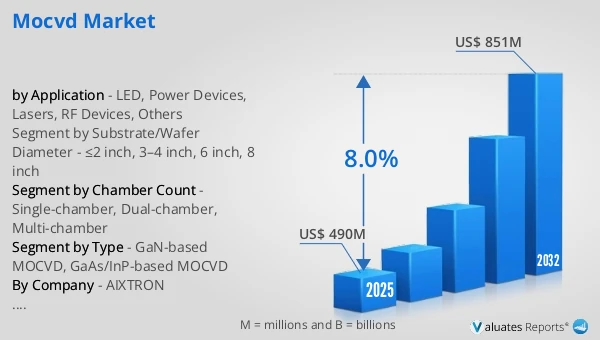
The global MOCVD market was valued at US$ 490 million in 2025 and is anticipated to reach US$ 851 million by 2032, at a CAGR of 8.0% from 2026 to 2032.

MOCVD Market

MOCVD Market

The 2025 U.S. tariff policies introduce profound uncertainty into the global economic landscape. This report critically examines the implications of recent tariff adjustments and international strategic countermeasures on MOCVD competitive dynamics, regional economic interdependencies, and supply chain reconfigurations.
MOCVD is a critical tool in the semiconductor industry, used to grow high-quality compound semiconductor layers on substrates with atomic-scale precision. These layers, typically composed of materials such as gallium nitride (GaN), indium phosphide (InP), or gallium arsenide (GaAs), form the foundation for a wide range of electronic and optoelectronic devices. By precisely controlling factors such as layer thickness, composition, and doping, MOCVD enables the production of highly efficient and reliable devices.
MOCVD finds applications in multiple fields, including light-emitting diodes (LEDs), laser diodes, and power electronics. In the LED sector, MOCVD is the primary method for creating epitaxial layers that determine brightness, colour quality, and energy efficiency. For power electronics, it enables the growth of GaN layers used in high-voltage transistors, electric vehicles, and renewable energy systems. MOCVD is also essential for producing vertical-cavity surface-emitting lasers (VCSELs) and other laser diodes that are widely used in communication, sensing, and industrial applications.
The MOCVD process involves introducing metal-organic precursors and hydride gases into a heated reactor chamber, where they decompose and deposit as crystalline layers on a substrate. Maintaining precise control over temperature, gas flow, and pressure is crucial to achieve uniform, defect-free layers. Modern MOCVD systems often include multi-wafer reactors, automated substrate handling, and real-time process monitoring, which significantly improve productivity and consistency.
As a core technology in the semiconductor industry, MOCVD directly impacts device performance, efficiency, and reliability. Its role continues to expand as demand grows for energy-efficient lighting, high-speed optical communication, and advanced power electronics, making it a cornerstone of modern electronics manufacturing.
In 2025, global MOCVD production reached 227 units, with an average selling price of USD 2,157 thousand per unit.
MOCVD sits at the core of the compound semiconductor manufacturing chain. Its value is primarily reflected in high-precision control of epitaxial layer thickness, composition, and doping, which ultimately determines device uniformity, yield, and performance limits. Long-term demand is driven by three main tracks: displays and lighting upgrading from conventional LEDs toward Mini/Micro LED and premium backlight; lasers and optical communications expanding with data centre interconnect, 3D sensing, and industrial processing; and GaN power and RF devices penetrating fast charging, automotive electrification, energy infrastructure, and communications. While the industry exhibits cyclical fluctuations tied to downstream capacity cycles and capex cadence, the medium-to-long-term trajectory remains structurally positive, with incremental demand increasingly driven by high-end epitaxy and new application adoption that triggers capacity expansion and equipment replacement.
From a regional perspective, demand and installed base generally follow downstream epitaxy and device manufacturing clusters. East Asia typically shows higher line density and stronger expansion elasticity across LED, display, and parts of the power/RF value chain. North America and Europe tend to be more influenced by high-end laser, R&D, and selected power/RF directions, where process iteration and technology upgrades play a larger role. On the supply side, manufacturing and delivery are also geographically concentrated. Given the dependence on critical components and accumulated process know-how, entry barriers are high and customer qualification cycles are long, making regional structure closely linked to suppliers’ service coverage, spare parts systems, and local engineering support.
In terms of product structure and application structure, the mainstream segmentation can be mapped clearly by material system and target device. Nitride-focused platforms mainly serve LED and GaN power/RF epitaxy, while GaAs/InP-focused platforms primarily address lasers, optical communication devices, and certain RF devices. Requirements vary significantly by application: LED and display emphasise mass-production consistency, throughput per reactor, and overall yield; lasers and optical communications stress composition and interface control, defect density, and repeatability; power and RF place higher demands on thick epitaxy, stress management, and doping uniformity. As a result, platform-based products coexist with application-driven customisation, and leading suppliers typically pursue a roadmap of a general platform plus application process modules to broaden coverage while improving delivery efficiency.
From a cost and manufacturing standpoint, system cost is typically distributed across the reactor and chamber system, gas delivery and safety, vacuum and thermal management, RF and electrical control, automated wafer handling and software, and metrology or in-situ monitoring modules. Critical components such as mass flow control, vacuum parts, heating and consumables, sensors, and control software can materially impact lead time and cost structure. Industry gross margin is around 40 percent, commonly in the 38 to 42 percent range, shaped by product mix, degree of customisation, aftermarket value from service and spares, and the depth of supply chain localisation. Manufacturing operations are largely based on assembly integration and system tuning, with single-line capacity typically at 10 to 40 tools per year, depending on platform complexity, availability of key parts, commissioning cadence, and customer acceptance timelines.
Regarding value chain structure and competitive landscape, upstream includes specialty gases and precursors, critical components and material parts, precision machining, and subsystem integration. Midstream comprises equipment suppliers’ platform development, process packages, delivery, and service. Downstream consists of epitaxy and device manufacturers’ volume production and process iteration. Competition is characterised by high concentration driven by technology and qualification: leading players maintain dominance through long-term process know-how, customer certifications, and global service networks; second-tier suppliers often enter via specific material systems or niche applications and then seek scale-up. Meanwhile, increasing customer focus on supply chain security and delivery controllability is making localisation, spare parts ecosystems, and field engineering capability more decisive competitive factors.
Looking ahead, technology evolution will continue to centre on larger wafer capability and higher throughput, tighter process windows, in-situ monitoring and closed-loop control, and platform modularisation. On the application side, the direction is toward higher-end displays, higher-performance lasers and optical communications, and power/RF devices moving to higher voltage and higher reliability. Future incremental growth is more likely to come from new applications that create new process windows rather than pure replacement demand. Accordingly, the ability to replicate capabilities across material systems, process packages, yield ramp, and full lifecycle service will be a key determinant of share gains in the next expansion cycle.
This report delivers a comprehensive overview of the global MOCVD market, with both quantitative and qualitative analyses, to help readers develop growth strategies, assess the competitive landscape, evaluate their position in the current market, and make informed business decisions regarding MOCVD. The MOCVD market size, estimates, and forecasts are provided in terms of output/shipments (Units) and revenue (US$ millions), with 2025 as the base year and historical and forecast data for 2021–2032.
The report segments the global MOCVD market comprehensively. Regional market sizes by Type, by Application, by Substrate/Wafer Diameter, and by company are also provided. For deeper insight, the report profiles the competitive landscape, key competitors, and their respective market rankings, and discusses technological trends and new product developments.
This report will assist MOCVD manufacturers, new entrants, and companies across the industry value chain with information on revenues, production, and average prices for the overall market and its sub-segments, by company, by Type, by Application, and by region.
Market Segmentation

Scope of MOCVD Market Report

Report Metric Details
Report Name MOCVD Market
Accounted market size in 2025 US$ 490 million
Forecasted market size in 2032 US$ 851 million
CAGR 8.0%
Base Year 2025
Forecasted years 2026 - 2032
Segment by Type
  • GaN-based MOCVD
  • GaAs/InP-based MOCVD
Segment by Substrate/Wafer Diameter
  • ≤2 inch
  • 3–4 inch
  • 6 inch
  • 8 inch
Segment by Chamber Count
  • Single-chamber
  • Dual-chamber
  • Multi-chamber
by Application
  • LED
  • Power Devices
  • Lasers
  • RF Devices
  • Others
Production by Region
  • North America
  • Europe
  • China
  • Japan
Consumption by Region
  • North America (United States, Canada)
  • Europe (Germany, France, UK, Italy, Russia)
  • Asia-Pacific (China, Japan, South Korea, Taiwan)
  • Southeast Asia (India)
  • Latin America (Mexico, Brazil)
By Company AIXTRON Technologies, Advanced Micro-Fabrication Equipment, Topecsh, Veeco Instruments, Taiyo Nippon Sanso, NuFlare Technology
Forecast units USD million in value
Report coverage Revenue and volume forecast, company share, competitive landscape, growth factors and trends

Chapter Outline

  • Chapter 1: Defines the scope of the report and presents an executive summary of market segments (by Type, by Application, by Substrate/Wafer Diameter, etc.), including the size of each segment and its future growth potential. It offers a high-level view of the current market and its likely evolution in the short, medium, and long term.
  • Chapter 2: Provides a detailed analysis of the competitive landscape for MOCVD manufacturers, including prices, production, value-based market shares, latest development plans, and information on mergers and acquisitions.
  • Chapter 3: Examines MOCVD production/output and value by region and country, providing a quantitative assessment of market size and growth potential for each region over the next six years.
  • Chapter 4: Analyzes MOCVD consumption at the regional and country levels. It quantifies market size and growth potential for each region and its key countries, and outlines market development, outlook, addressable space, and national production.
  • Chapter 5: Analyzes market segments by Type, covering the size and growth potential of each segment to help readers identify “blue ocean” opportunities.
  • Chapter 6: Analyzes market segments by Application, covering the size and growth potential of each segment to help readers identify “blue ocean” opportunities in downstream markets.
  • Chapter 7: Profiles key players, detailing the fundamentals of major companies, including product production/output, value, price, gross margin, product portfolio/introductions, and recent developments.
  • Chapter 8: Reviews the industry value chain, including upstream and downstream segments.
  • Chapter 9: Discusses market dynamics and recent developments, including drivers, restraints, challenges and risks for manufacturers, U.S. Tariffs and relevant policy analysis.
  • Chapter 10: Summarizes the key findings and conclusions of the report.

FAQ for this report

How fast is MOCVD Market growing?

Ans: The MOCVD Market witnessing a CAGR of 8.0% during the forecast period 2026-2032.

What is the MOCVD Market size in 2032?

Ans: The MOCVD Market size in 2032 will be US$ 851 million.

Who are the main players in the MOCVD Market report?

Ans: The main players in the MOCVD Market are AIXTRON Technologies, Advanced Micro-Fabrication Equipment, Topecsh, Veeco Instruments, Taiyo Nippon Sanso, NuFlare Technology

What are the Application segmentation covered in the MOCVD Market report?

Ans: The Applications covered in the MOCVD Market report are LED, Power Devices, Lasers, RF Devices, Others

What are the Type segmentation covered in the MOCVD Market report?

Ans: The Types covered in the MOCVD Market report are GaN-based MOCVD, GaAs/InP-based MOCVD

1 MOCVD Market Overview
1.1 Product Definition
1.2 MOCVD by Type
1.2.1 Global MOCVD Market Value Growth Rate Analysis by Type: 2025 vs 2032
1.2.2 GaN-based MOCVD
1.2.3 GaAs/InP-based MOCVD
1.3 MOCVD by Substrate/Wafer Diameter
1.3.1 Global MOCVD Market Value Growth Rate Analysis by Substrate/Wafer Diameter: 2025 vs 2032
1.3.2 ≤2 inch
1.3.3 3–4 inch
1.3.4 6 inch
1.3.5 8 inch
1.4 MOCVD by Chamber Count
1.4.1 Global MOCVD Market Value Growth Rate Analysis by Chamber Count: 2025 vs 2032
1.4.2 Single-chamber
1.4.3 Dual-chamber
1.4.4 Multi-chamber
1.5 MOCVD by Application
1.5.1 Global MOCVD Market Value Growth Rate Analysis by Application: 2025 vs 2032
1.5.2 LED
1.5.3 Power Devices
1.5.4 Lasers
1.5.5 RF Devices
1.5.6 Others
1.6 Global Market Growth Prospects
1.6.1 Global MOCVD Production Value Estimates and Forecasts (2021–2032)
1.6.2 Global MOCVD Production Capacity Estimates and Forecasts (2021–2032)
1.6.3 Global MOCVD Production Estimates and Forecasts (2021–2032)
1.6.4 Global MOCVD Market Average Price Estimates and Forecasts (2021–2032)
1.7 Assumptions and Limitations
2 Market Competition by Manufacturers
2.1 Global MOCVD Production Market Share by Manufacturers (2021–2026)
2.2 Global MOCVD Production Value Market Share by Manufacturers (2021–2026)
2.3 Global Key Players of MOCVD, Industry Ranking, 2024 vs 2025
2.4 Global MOCVD Market Share by Company Tier (Tier 1, Tier 2, Tier 3)
2.5 Global MOCVD Average Price by Manufacturers (2021–2026)
2.6 Global Key Manufacturers of MOCVD, Manufacturing Footprints and Headquarters
2.7 Global Key Manufacturers of MOCVD, Product Offerings and Applications
2.8 Global Key Manufacturers of MOCVD, Date of Entry into the Industry
2.9 MOCVD Market Competitive Situation and Trends
2.9.1 MOCVD Market Concentration Rate
2.9.2 Top 5 and Top 10 Global MOCVD Players Market Share by Revenue
2.10 Mergers & Acquisitions and Expansion
3 MOCVD Production by Region
3.1 Global MOCVD Production Value Estimates and Forecasts by Region: 2021 vs 2025 vs 2032
3.2 Global MOCVD Production Value by Region (2021–2032)
3.2.1 Global MOCVD Production Value by Region (2021–2026)
3.2.2 Global Forecasted Production Value of MOCVD by Region (2027–2032)
3.3 Global MOCVD Production Estimates and Forecasts by Region: 2021 vs 2025 vs 2032
3.4 Global MOCVD Production Volume by Region (2021–2032)
3.4.1 Global MOCVD Production by Region (2021–2026)
3.4.2 Global Forecasted Production of MOCVD by Region (2027–2032)
3.5 Global MOCVD Market Price Analysis by Region (2021–2032)
3.6 Global MOCVD Production, Value, and Year-over-Year Growth
3.6.1 North America MOCVD Production Value Estimates and Forecasts (2021–2032)
3.6.2 Europe MOCVD Production Value Estimates and Forecasts (2021–2032)
3.6.3 China MOCVD Production Value Estimates and Forecasts (2021–2032)
3.6.4 Japan MOCVD Production Value Estimates and Forecasts (2021–2032)
4 MOCVD Consumption by Region
4.1 Global MOCVD Consumption Estimates and Forecasts by Region: 2021 vs 2025 vs 2032
4.2 Global MOCVD Consumption by Region (2021–2032)
4.2.1 Global MOCVD Consumption by Region (2021–2026)
4.2.2 Global MOCVD Forecasted Consumption by Region (2027–2032)
4.3 North America
4.3.1 North America MOCVD Consumption Growth Rate by Country: 2021 vs 2025 vs 2032
4.3.2 North America MOCVD Consumption by Country (2021–2032)
4.3.3 U.S.
4.3.4 Canada
4.4 Europe
4.4.1 Europe MOCVD Consumption Growth Rate by Country: 2021 vs 2025 vs 2032
4.4.2 Europe MOCVD Consumption by Country (2021–2032)
4.4.3 Germany
4.4.4 France
4.4.5 U.K.
4.4.6 Italy
4.4.7 Russia
4.5 Asia Pacific
4.5.1 Asia Pacific MOCVD Consumption Growth Rate by Region: 2021 vs 2025 vs 2032
4.5.2 Asia Pacific MOCVD Consumption by Region (2021–2032)
4.5.3 China
4.5.4 Japan
4.5.5 South Korea
4.5.6 China Taiwan
4.5.7 Southeast Asia
4.5.8 India
4.6 Latin America, Middle East & Africa
4.6.1 Latin America, Middle East & Africa MOCVD Consumption Growth Rate by Country: 2021 vs 2025 vs 2032
4.6.2 Latin America, Middle East & Africa MOCVD Consumption by Country (2021–2032)
4.6.3 Mexico
4.6.4 Brazil
4.6.5 Israel
4.6.6 GCC Countries
5 Segment by Type
5.1 Global MOCVD Production by Type (2021–2032)
5.1.1 Global MOCVD Production by Type (2021–2026)
5.1.2 Global MOCVD Production by Type (2027–2032)
5.1.3 Global MOCVD Production Market Share by Type (2021–2032)
5.2 Global MOCVD Production Value by Type (2021–2032)
5.2.1 Global MOCVD Production Value by Type (2021–2026)
5.2.2 Global MOCVD Production Value by Type (2027–2032)
5.2.3 Global MOCVD Production Value Market Share by Type (2021–2032)
5.3 Global MOCVD Price by Type (2021–2032)
6 Segment by Application
6.1 Global MOCVD Production by Application (2021–2032)
6.1.1 Global MOCVD Production by Application (2021–2026)
6.1.2 Global MOCVD Production by Application (2027–2032)
6.1.3 Global MOCVD Production Market Share by Application (2021–2032)
6.2 Global MOCVD Production Value by Application (2021–2032)
6.2.1 Global MOCVD Production Value by Application (2021–2026)
6.2.2 Global MOCVD Production Value by Application (2027–2032)
6.2.3 Global MOCVD Production Value Market Share by Application (2021–2032)
6.3 Global MOCVD Price by Application (2021–2032)
7 Key Companies Profiled
7.1 AIXTRON Technologies
7.1.1 AIXTRON Technologies MOCVD Company Information
7.1.2 AIXTRON Technologies MOCVD Product Portfolio
7.1.3 AIXTRON Technologies MOCVD Production, Value, Price, and Gross Margin (2021–2026)
7.1.4 AIXTRON Technologies Main Business and Markets Served
7.1.5 AIXTRON Technologies Recent Developments/Updates
7.2 Advanced Micro-Fabrication Equipment
7.2.1 Advanced Micro-Fabrication Equipment MOCVD Company Information
7.2.2 Advanced Micro-Fabrication Equipment MOCVD Product Portfolio
7.2.3 Advanced Micro-Fabrication Equipment MOCVD Production, Value, Price, and Gross Margin (2021–2026)
7.2.4 Advanced Micro-Fabrication Equipment Main Business and Markets Served
7.2.5 Advanced Micro-Fabrication Equipment Recent Developments/Updates
7.3 Topecsh
7.3.1 Topecsh MOCVD Company Information
7.3.2 Topecsh MOCVD Product Portfolio
7.3.3 Topecsh MOCVD Production, Value, Price, and Gross Margin (2021–2026)
7.3.4 Topecsh Main Business and Markets Served
7.3.5 Topecsh Recent Developments/Updates
7.4 Veeco Instruments
7.4.1 Veeco Instruments MOCVD Company Information
7.4.2 Veeco Instruments MOCVD Product Portfolio
7.4.3 Veeco Instruments MOCVD Production, Value, Price, and Gross Margin (2021–2026)
7.4.4 Veeco Instruments Main Business and Markets Served
7.4.5 Veeco Instruments Recent Developments/Updates
7.5 Taiyo Nippon Sanso
7.5.1 Taiyo Nippon Sanso MOCVD Company Information
7.5.2 Taiyo Nippon Sanso MOCVD Product Portfolio
7.5.3 Taiyo Nippon Sanso MOCVD Production, Value, Price, and Gross Margin (2021–2026)
7.5.4 Taiyo Nippon Sanso Main Business and Markets Served
7.5.5 Taiyo Nippon Sanso Recent Developments/Updates
7.6 NuFlare Technology
7.6.1 NuFlare Technology MOCVD Company Information
7.6.2 NuFlare Technology MOCVD Product Portfolio
7.6.3 NuFlare Technology MOCVD Production, Value, Price, and Gross Margin (2021–2026)
7.6.4 NuFlare Technology Main Business and Markets Served
7.6.5 NuFlare Technology Recent Developments/Updates
8 Industry Chain and Sales Channels Analysis
8.1 MOCVD Industry Chain Analysis
8.2 MOCVD Raw Material Supply Analysis
8.2.1 Key Raw Materials
8.2.2 Raw Materials Key Suppliers
8.3 MOCVD Production Modes and Processes
8.4 MOCVD Sales and Marketing
8.4.1 MOCVD Sales Channels
8.4.2 MOCVD Distributors
8.5 MOCVD Customer Analysis
9 MOCVD Market Dynamics
9.1 MOCVD Industry Trends
9.2 MOCVD Market Drivers
9.3 MOCVD Market Challenges
9.4 MOCVD Market Restraints
9.5 Impact of U.S. Tariffs
10 Research Findings and Conclusion
11 Methodology and Data Source
11.1 Methodology/Research Approach
11.1.1 Research Programs/Design
11.1.2 Market Size Estimation
11.1.3 Market Breakdown and Data Triangulation
11.2 Data Source
11.2.1 Secondary Sources
11.2.2 Primary Sources
11.3 Author List
11.4 Disclaimer
List of Tables
 Table 1. Global MOCVD Market Value by Type (US$ Million), 2025 vs 2032
 Table 2. Global MOCVD Market Value by Substrate/Wafer Diameter (US$ Million), 2025 vs 2032
 Table 3. Global MOCVD Market Value by Chamber Count (US$ Million), 2025 vs 2032
 Table 4. Global MOCVD Market Value by Application (US$ Million), 2025 vs 2032
 Table 5. Global MOCVD Production Capacity (Units) by Manufacturers in 2025
 Table 6. Global MOCVD Production by Manufacturers (Units), 2021–2026
 Table 7. Global MOCVD Production Market Share by Manufacturers (2021–2026)
 Table 8. Global MOCVD Production Value by Manufacturers (US$ Million), 2021–2026
 Table 9. Global MOCVD Production Value Share by Manufacturers (2021–2026)
 Table 10. Global Key Players of MOCVD, Industry Ranking, 2024 vs 2025
 Table 11. Classification of Companies by Tier (Tier 1, Tier 2, Tier 3), based on MOCVD Production Value, 2025
 Table 12. Global Market MOCVD Average Price by Manufacturers (K US$/Unit), 2021–2026
 Table 13. Global Key Manufacturers of MOCVD, Manufacturing Footprints and Headquarters
 Table 14. Global Key Manufacturers of MOCVD, Product Offerings and Applications
 Table 15. Global Key Manufacturers of MOCVD, Date of Entry into the Industry
 Table 16. Global MOCVD Manufacturers Market Concentration Ratio (CR5 and HHI)
 Table 17. Mergers & Acquisitions and Expansion Plans
 Table 18. Global MOCVD Production Value by Region: 2021 vs 2025 vs 2032 (US$ Million)
 Table 19. Global MOCVD Production Value (US$ Million) by Region (2021–2026)
 Table 20. Global MOCVD Production Value Market Share by Region (2021–2026)
 Table 21. Global MOCVD Production Value (US$ Million) Forecast by Region (2027–2032)
 Table 22. Global MOCVD Production Value Market Share Forecast by Region (2027–2032)
 Table 23. Global MOCVD Production Comparison by Region: 2021 vs 2025 vs 2032 (Units)
 Table 24. Global MOCVD Production (Units) by Region (2021–2026)
 Table 25. Global MOCVD Production Market Share by Region (2021–2026)
 Table 26. Global MOCVD Production (Units) Forecast by Region (2027–2032)
 Table 27. Global MOCVD Production Market Share Forecast by Region (2027–2032)
 Table 28. Global MOCVD Market Average Price (K US$/Unit) by Region (2021–2026)
 Table 29. Global MOCVD Market Average Price (K US$/Unit) by Region (2027–2032)
 Table 30. Global MOCVD Consumption Growth Rate by Region: 2021 vs 2025 vs 2032 (Units)
 Table 31. Global MOCVD Consumption by Region (Units), 2021–2026
 Table 32. Global MOCVD Consumption Market Share by Region (2021–2026)
 Table 33. Global MOCVD Forecasted Consumption by Region (Units), 2027–2032
 Table 34. Global MOCVD Forecasted Consumption Market Share by Region (2027–2032)
 Table 35. North America MOCVD Consumption Growth Rate by Country: 2021 vs 2025 vs 2032 (Units)
 Table 36. North America MOCVD Consumption by Country (Units), 2021–2026
 Table 37. North America MOCVD Consumption by Country (Units), 2027–2032
 Table 38. Europe MOCVD Consumption Growth Rate by Country: 2021 vs 2025 vs 2032 (Units)
 Table 39. Europe MOCVD Consumption by Country (Units), 2021–2026
 Table 40. Europe MOCVD Consumption by Country (Units), 2027–2032
 Table 41. Asia Pacific MOCVD Consumption Growth Rate by Region: 2021 vs 2025 vs 2032 (Units)
 Table 42. Asia Pacific MOCVD Consumption by Region (Units), 2021–2026
 Table 43. Asia Pacific MOCVD Consumption by Region (Units), 2027–2032
 Table 44. Latin America, Middle East & Africa MOCVD Consumption Growth Rate by Country: 2021 vs 2025 vs 2032 (Units)
 Table 45. Latin America, Middle East & Africa MOCVD Consumption by Country (Units), 2021–2026
 Table 46. Latin America, Middle East & Africa MOCVD Consumption by Country (Units), 2027–2032
 Table 47. Global MOCVD Production (Units) by Type (2021–2026)
 Table 48. Global MOCVD Production (Units) by Type (2027–2032)
 Table 49. Global MOCVD Production Market Share by Type (2021–2026)
 Table 50. Global MOCVD Production Market Share by Type (2027–2032)
 Table 51. Global MOCVD Production Value (US$ Million) by Type (2021–2026)
 Table 52. Global MOCVD Production Value (US$ Million) by Type (2027–2032)
 Table 53. Global MOCVD Production Value Market Share by Type (2021–2026)
 Table 54. Global MOCVD Production Value Market Share by Type (2027–2032)
 Table 55. Global MOCVD Price (K US$/Unit) by Type (2021–2026)
 Table 56. Global MOCVD Price (K US$/Unit) by Type (2027–2032)
 Table 57. Global MOCVD Production (Units) by Application (2021–2026)
 Table 58. Global MOCVD Production (Units) by Application (2027–2032)
 Table 59. Global MOCVD Production Market Share by Application (2021–2026)
 Table 60. Global MOCVD Production Market Share by Application (2027–2032)
 Table 61. Global MOCVD Production Value (US$ Million) by Application (2021–2026)
 Table 62. Global MOCVD Production Value (US$ Million) by Application (2027–2032)
 Table 63. Global MOCVD Production Value Market Share by Application (2021–2026)
 Table 64. Global MOCVD Production Value Market Share by Application (2027–2032)
 Table 65. Global MOCVD Price (K US$/Unit) by Application (2021–2026)
 Table 66. Global MOCVD Price (K US$/Unit) by Application (2027–2032)
 Table 67. AIXTRON Technologies MOCVD Company Information
 Table 68. AIXTRON Technologies MOCVD Specification and Application
 Table 69. AIXTRON Technologies MOCVD Production (Units), Value (US$ Million), Price (K US$/Unit) and Gross Margin (2021–2026)
 Table 70. AIXTRON Technologies Main Business and Markets Served
 Table 71. AIXTRON Technologies Recent Developments/Updates
 Table 72. Advanced Micro-Fabrication Equipment MOCVD Company Information
 Table 73. Advanced Micro-Fabrication Equipment MOCVD Specification and Application
 Table 74. Advanced Micro-Fabrication Equipment MOCVD Production (Units), Value (US$ Million), Price (K US$/Unit) and Gross Margin (2021–2026)
 Table 75. Advanced Micro-Fabrication Equipment Main Business and Markets Served
 Table 76. Advanced Micro-Fabrication Equipment Recent Developments/Updates
 Table 77. Topecsh MOCVD Company Information
 Table 78. Topecsh MOCVD Specification and Application
 Table 79. Topecsh MOCVD Production (Units), Value (US$ Million), Price (K US$/Unit) and Gross Margin (2021–2026)
 Table 80. Topecsh Main Business and Markets Served
 Table 81. Topecsh Recent Developments/Updates
 Table 82. Veeco Instruments MOCVD Company Information
 Table 83. Veeco Instruments MOCVD Specification and Application
 Table 84. Veeco Instruments MOCVD Production (Units), Value (US$ Million), Price (K US$/Unit) and Gross Margin (2021–2026)
 Table 85. Veeco Instruments Main Business and Markets Served
 Table 86. Veeco Instruments Recent Developments/Updates
 Table 87. Taiyo Nippon Sanso MOCVD Company Information
 Table 88. Taiyo Nippon Sanso MOCVD Specification and Application
 Table 89. Taiyo Nippon Sanso MOCVD Production (Units), Value (US$ Million), Price (K US$/Unit) and Gross Margin (2021–2026)
 Table 90. Taiyo Nippon Sanso Main Business and Markets Served
 Table 91. Taiyo Nippon Sanso Recent Developments/Updates
 Table 92. NuFlare Technology MOCVD Company Information
 Table 93. NuFlare Technology MOCVD Specification and Application
 Table 94. NuFlare Technology MOCVD Production (Units), Value (US$ Million), Price (K US$/Unit) and Gross Margin (2021–2026)
 Table 95. NuFlare Technology Main Business and Markets Served
 Table 96. NuFlare Technology Recent Developments/Updates
 Table 97. Key Raw Materials Lists
 Table 98. Raw Materials Key Suppliers Lists
 Table 99. MOCVD Distributors List
 Table 100. MOCVD Customers List
 Table 101. MOCVD Market Trends
 Table 102. MOCVD Market Drivers
 Table 103. MOCVD Market Challenges
 Table 104. MOCVD Market Restraints
 Table 105. Research Programs/Design for This Report
 Table 106. Key Data Information from Secondary Sources
 Table 107. Key Data Information from Primary Sources
 Table 108. Authors List of This Report


List of Figures
 Figure 1. Product Picture of MOCVD
 Figure 2. Global MOCVD Market Value by Type (US$ Million), 2021–2032
 Figure 3. Global MOCVD Market Share by Type: 2025 vs 2032
 Figure 4. GaN-based MOCVD Product Picture
 Figure 5. GaAs/InP-based MOCVD Product Picture
 Figure 6. Global MOCVD Market Value by Substrate/Wafer Diameter (US$ Million), 2021–2032
 Figure 7. Global MOCVD Market Share by Substrate/Wafer Diameter: 2025 vs 2032
 Figure 8. ≤2 inch Product Picture
 Figure 9. 3–4 inch Product Picture
 Figure 10. 6 inch Product Picture
 Figure 11. 8 inch Product Picture
 Figure 12. Global MOCVD Market Value by Chamber Count (US$ Million), 2021–2032
 Figure 13. Global MOCVD Market Share by Chamber Count: 2025 vs 2032
 Figure 14. Single-chamber Product Picture
 Figure 15. Dual-chamber Product Picture
 Figure 16. Multi-chamber Product Picture
 Figure 17. Global MOCVD Market Value by Application (US$ Million), 2021–2032
 Figure 18. Global MOCVD Market Share by Application: 2025 vs 2032
 Figure 19. LED
 Figure 20. Power Devices
 Figure 21. Lasers
 Figure 22. RF Devices
 Figure 23. Others
 Figure 24. Global MOCVD Production Value (US$ Million), 2021 vs 2025 vs 2032
 Figure 25. Global MOCVD Production Value (US$ Million), 2021–2032
 Figure 26. Global MOCVD Production Capacity (Units), 2021–2032
 Figure 27. Global MOCVD Production (Units), 2021–2032
 Figure 28. Global MOCVD Average Price (K US$/Unit), 2021–2032
 Figure 29. MOCVD Report Years Considered
 Figure 30. MOCVD Production Share by Manufacturers in 2025
 Figure 31. Global MOCVD Production Value Share by Manufacturers (2025)
 Figure 32. MOCVD Market Share by Company Type (Tier 1, Tier 2, and Tier 3): 2021 vs 2025
 Figure 33. Top 5 and Top 10 Global Players: Market Share by MOCVD Revenue in 2025
 Figure 34. Global MOCVD Production Value by Region: 2021 vs 2025 vs 2032 (US$ Million)
 Figure 35. Global MOCVD Production Value Market Share by Region: 2021 vs 2025 vs 2032
 Figure 36. Global MOCVD Production Comparison by Region: 2021 vs 2025 vs 2032 (Units)
 Figure 37. Global MOCVD Production Market Share by Region: 2021 vs 2025 vs 2032
 Figure 38. North America MOCVD Production Value (US$ Million) Growth Rate (2021–2032)
 Figure 39. Europe MOCVD Production Value (US$ Million) Growth Rate (2021–2032)
 Figure 40. China MOCVD Production Value (US$ Million) Growth Rate (2021–2032)
 Figure 41. Japan MOCVD Production Value (US$ Million) Growth Rate (2021–2032)
 Figure 42. Global MOCVD Consumption by Region: 2021 vs 2025 vs 2032 (Units)
 Figure 43. Global MOCVD Consumption Market Share by Region: 2021 vs 2025 vs 2032
 Figure 44. North America MOCVD Consumption and Growth Rate (Units), 2021–2032
 Figure 45. North America MOCVD Consumption Market Share by Country (2021–2032)
 Figure 46. U.S. MOCVD Consumption and Growth Rate (Units), 2021–2032
 Figure 47. Canada MOCVD Consumption and Growth Rate (Units), 2021–2032
 Figure 48. Europe MOCVD Consumption and Growth Rate (Units), 2021–2032
 Figure 49. Europe MOCVD Consumption Market Share by Country (2021–2032)
 Figure 50. Germany MOCVD Consumption and Growth Rate (Units), 2021–2032
 Figure 51. France MOCVD Consumption and Growth Rate (Units), 2021–2032
 Figure 52. U.K. MOCVD Consumption and Growth Rate (Units), 2021–2032
 Figure 53. Italy MOCVD Consumption and Growth Rate (Units), 2021–2032
 Figure 54. Russia MOCVD Consumption and Growth Rate (Units), 2021–2032
 Figure 55. Asia Pacific MOCVD Consumption and Growth Rate (Units), 2021–2032
 Figure 56. Asia Pacific MOCVD Consumption Market Share by Region (2021–2032)
 Figure 57. China MOCVD Consumption and Growth Rate (Units), 2021–2032
 Figure 58. Japan MOCVD Consumption and Growth Rate (Units), 2021–2032
 Figure 59. South Korea MOCVD Consumption and Growth Rate (Units), 2021–2032
 Figure 60. China Taiwan MOCVD Consumption and Growth Rate (Units), 2021–2032
 Figure 61. Southeast Asia MOCVD Consumption and Growth Rate (Units), 2021–2032
 Figure 62. India MOCVD Consumption and Growth Rate (Units), 2021–2032
 Figure 63. Latin America, Middle East & Africa MOCVD Consumption and Growth Rate (Units), 2021–2032
 Figure 64. Latin America, Middle East & Africa MOCVD Consumption Market Share by Country (2021–2032)
 Figure 65. Mexico MOCVD Consumption and Growth Rate (Units), 2021–2032
 Figure 66. Brazil MOCVD Consumption and Growth Rate (Units), 2021–2032
 Figure 67. Israel MOCVD Consumption and Growth Rate (Units), 2021–2032
 Figure 68. GCC Countries MOCVD Consumption and Growth Rate (Units), 2021–2032
 Figure 69. Global Production Market Share of MOCVD by Type (2021–2032)
 Figure 70. Global Production Value Market Share of MOCVD by Type (2021–2032)
 Figure 71. Global MOCVD Price (K US$/Unit) by Type (2021–2032)
 Figure 72. Global Production Market Share of MOCVD by Application (2021–2032)
 Figure 73. Global Production Value Market Share of MOCVD by Application (2021–2032)
 Figure 74. Global MOCVD Price (K US$/Unit) by Application (2021–2032)
 Figure 75. MOCVD Value Chain
 Figure 76. Channels of Distribution (Direct Vs Distribution)
 Figure 77. Bottom-up and Top-down Approaches for This Report
 Figure 78. Data Triangulation

SELECT A FORMAT
Added to Cart
Electronic

$2900

Single User License
Electronic

$4350

Multi User License
Electronic

$5800

Enterprise License
Add to Cart
Buy Now (15% Discount)

OUR CUSTOMER

Accenture

SIMILAR REPORTS