0
U.S. (TOLL FREE)
+1 (315) 215-3225
Automative

0
U.S. (TOLL FREE)
+1 (315) 215-3225
Global Bus Transceiver Market Research Report 2026
Published Date: 2026-01-08
|
Report Code: QYRE-Auto-15I3776
Home | Market Reports | Computers & Electronics
Global Bus Transceiver Market Insights and Forecast to 2028
BUY CHAPTERS

Global Bus Transceiver Market Research Report 2026

Code: QYRE-Auto-15I3776
Report
2026-01-08
Pages:151
QYResearch
Buy Now with 15% Discount
DESCRIPTION
TABLE OF CONTENT
TABLES & FIGURES

Bus Transceiver Market Size

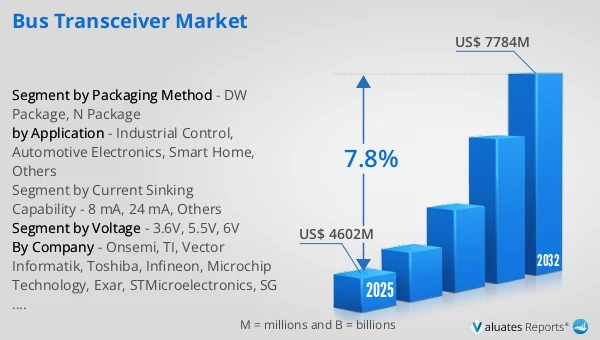
The global Bus Transceiver market was valued at US$ 4602 million in 2025 and is anticipated to reach US$ 7784 million by 2032, at a CAGR of 7.8% from 2026 to 2032.

Bus Transceiver Market

Bus Transceiver Market

The 2025 U.S. tariff policies introduce profound uncertainty into the global economic landscape. This report critically examines the implications of recent tariff adjustments and international strategic countermeasures on Bus Transceiver competitive dynamics, regional economic interdependencies, and supply chain reconfigurations.
Bus transceivers, as the physical layer interface chip between MCUs/SoCs and fieldbuses/vehicle buses, are fundamental components for reliable differential communication and bus protection in systems such as automotive electronics, motor drives, industrial control, and building/energy management. Their core value lies in solving the pain points of traditional single-ended communication in long-distance, multi-node, and electromagnetically interference-prone environments, such as easy bit errors, easy lock-up, difficulty in suppressing common-mode interference, and the ability of node power failure/short circuit to bring down the entire network. In typical automotive CAN/LIN networks, industrial RS-485 buses, and building and energy management fieldbuses, without highly robust bus transceivers, the controller side cannot withstand common-mode interference of -7 to +12 V or even higher, cable misconnections, and transient surges, making it difficult to guarantee system reliability and security. In 2025, global sales of bus transceivers across various application scenarios were estimated at 5.9 billion units. The average selling price was approximately USD 0.75-0.85 per unit, and the overall gross profit margin was approximately 28%-40%, with automotive and industrial bus transceivers such as CAN/LIN/RS-485 being the main contributors. A typical bus transceiver structure includes: TXD/RXD or differential I/O pins connected to the controller side, a bus-side differential driver/receiver stage (such as CANH/CANL, A/B lines), current limiting and overvoltage protection networks, ESD/surge protection circuitry, fault protection and bus fail-safe circuitry, low-power/standby/wake-up logic, power supply and reference circuitry, and package pin/heat dissipation structure. Common parameters include: support for bus standards (CAN FD/LIN/RS-485/RS-422, etc.), data rates from 20 kbit/s (LIN) to 1 Mbit/s, 2–5 Mbit/s (CAN FD) and even 50 Mbit/s, supply voltage of 3.3 V or 5 V, common-mode voltage range of −7 to +12 V or even −12 to +12 V, bus-side ESD protection of ±8–±16 kV, and operating temperature of −40 to +125 ℃. In terms of typical system usage: a gasoline-powered vehicle requires a total of 15–30 CAN/LIN bus transceivers, while a mid-to-high-end new energy vehicle can have 30–60; a medium-sized PLC/distributed I/O station requires approximately 2–6 RS-485/fieldbus transceivers; a photovoltaic inverter/energy storage BMS system requires 4–10 transceivers; and industrial motors/servo drives typically require 1–3 transceivers. The upstream mainly relies on mature process logic and high-voltage wafers (8/16/32 nm and above), packaging substrates and molding materials, precision resistors, capacitors and protection devices, and lead frames; the downstream focuses on automotive ECU manufacturers, industrial control and PLC manufacturers, motor and drive manufacturers, photovoltaic and energy storage system integrators, and building/energy management and rail transit control system suppliers.
Supply Situation
Upstream raw materials and key components include 8–65 nm wafer processes (logic + HV LDMOS) for analog/high-voltage mixed signals, wafer-level metals and doped materials, BT substrates and copper lead frames for FC-BGA/QFN/SOIC packaging, epoxy molding compounds, high-precision thin-film resistors and surface-mount capacitors, ESD/TVS protection devices, and industrial connectors. The combined cost of raw materials and wafer manufacturing/packaging accounts for approximately 55%–68% of the cost of a single bus transceiver, with fluctuations in wafer and packaging prices having the greatest impact on overall costs. Key suppliers include TSMC, UMC/GlobalFoundries, ASE/Amkor, Shin-Etsu/Sumco, and TE Connectivity. Their supply capacity and price changes directly determine the production capacity layout and profit margins of major manufacturers.
Manufacturer Features
Onsemi has a deep presence in the automotive CAN/LIN bus transceiver field, offering a variety of high-interference-resistant CAN FD and ISO11992 vehicle communication bus transceivers for 12V/24V automotive systems; TI has a complete product line in RS-485/RS-422, CAN/CAN FD, and LIN transceivers, holding a leading market share in industrial control and automotive electronics applications; Microchip Technology is highly competitive in automotive-grade CAN/LIN and industrial RS-485/multi-protocol transceivers, forming an integrated system solution capability in conjunction with its MCU/DSC/SoC.
Example
In 2024, Onsemi provided its body and chassis network physical layer solution for a North American new energy vehicle company project. The project planned to uniformly adopt a CAN FD + LIN multi-bus architecture on two new platform models, and reserved expansion interfaces for battery packs and electric drive systems. Over its first five-year lifecycle, the automaker will procure approximately 68 million Onsemi automotive-grade CAN/LIN bus transceivers across its two platforms, covering body control modules, BCM, gateways, BMS slave modules, OBCs, and some thermal management controllers. By introducing Onsemi transceivers with high EMC ratings, wide common-mode range, and bus fail-safe characteristics, the automaker has simplified peripheral protection circuits in vehicle EMC testing, communication reliability, and bus fault-tolerant design. Furthermore, platform-level cost reduction calculations have yielded a comprehensive effect of "slightly reduced per-vehicle material costs + significantly reduced design complexity and verification costs."
Applications
Bus transceivers are widely used in automotive electronic (E/E) architectures (powertrain, body, chassis, ADAS, infotainment, etc. ECUs), industrial automation and process control, electric and new energy, transportation and infrastructure, and various fieldbus and vehicle bus communication scenarios in general embedded systems. They are essential connection units between MCUs/SoCs and physical wiring. Typical downstream customers include major automotive and industrial control system suppliers and OEMs such as Bosch, Continental, Siemens, Schneider Electric, and BYD.
Product Advantages
For downstream OEMs, the greatest value of bus transceivers lies in transforming the complex, fragile, and difficult-to-control field communication into a standardized, replicable, and predictably cost-effective modular capability. Automotive-grade/industrial-grade transceivers offer unified interface pinouts and electrical characteristics, allowing the same platform to be easily replicated across different vehicle models, power ranges, and regional versions. This results in BOM convergence, certification reuse, and a reduction in spare parts SKUs, demonstrating significant platform benefits. Furthermore, features such as high EMC ratings, fail-safety, bus wake-up, and low-power standby help OEMs minimize the need for peripheral components, wiring harness protection, and debugging while meeting regulatory/standard requirements. Essentially, for a component costing only a few cents to a dollar or two, OEMs gain a combination of benefits: reliable communication, standards compliance, platform reuse, and reduced maintenance costs. With the rapid increase in automotive networks and industrial IoT nodes, this advantage will become increasingly pronounced.
Technology Trends
Technology upgrades are concentrated in four directions: First, higher data rates and stronger anti-interference capabilities. CAN FD, CAN SIC, and high-performance RS-485 transceivers, while meeting higher bus bandwidth requirements, improve reliability in high-noise environments through wider common-mode range, higher EMS/EMI performance, and integrated bus fault diagnosis functions. Second, integration and multi-protocol integration. A single chip integrates multiple CAN/LIN/RS-485 or multiple CAN FD channels, combined with isolation and protection circuits, to achieve "multi-channel + multi-protocol" integration, reducing PCB area and BOM costs. Third, enhanced isolation and functional safety. Isolated RS-485/CAN transceivers, leveraging digital isolation technology and integrated DC-DC converters, provide higher safety isolation levels for electric vehicle high-voltage domains, factory motor drives, and power systems, targeting safety applications such as SIL2/SIL3, ASIL-B/ASIL-D. Fourth, with the expansion of low power consumption and automotive-grade specifications, bus transceivers are evolving towards lower standby current, richer wake-up functions (bus wake-up/remote wake-up), wider operating temperature range, and higher AEC-Q100 ratings to adapt to the energy-saving and high-reliability requirements of centralized/regional E/E architectures and industrial field devices. Overall, bus transceivers are evolving from "single-protocol, single-function interface chips" to "high-bandwidth, multi-protocol, system-level bus interfaces with isolation and diagnostics," forming the next-generation automotive and industrial communication foundation together with automotive Ethernet, industrial Ethernet, and higher-level protocol stacks.
Market Influencing Factors
The growth of the bus transceiver market is driven by multiple factors: On the one hand, the significant increase in the penetration rate of automotive electronics and new energy vehicles has boosted the number of on-board bus nodes and the usage per vehicle. The new generation of E/E architecture is moving from distributed control to domain control and even regional control, increasing the number of ECUs and bus density, leading to a steady increase in the installation volume of transceivers such as CAN/LIN/CAN FD. On the other hand, industrial automation and the digitalization of energy infrastructure are driving the continued demand for RS-485/RS-422 and multi-protocol transceivers in PLC, DCS, inverters, photovoltaic and energy storage systems, especially isolated and high EMC versions, which are expanding with the trend of "electrification + intelligence + remote operation and maintenance". At the same time, the increasingly stringent requirements of automotive and industrial standards for EMC, functional safety and operating temperature are causing low-end devices to be replaced, while high-performance and highly integrated products are gaining higher ASPs and more stable customer loyalty. In terms of competitive landscape, international IDMs such as TI, Onsemi, ST, Microchip, and Renesas still hold technological and scale advantages, while Chinese domestic and regional manufacturers are gradually penetrating the market in general-purpose RS-485/LIN chips and some mid-to-low-end CAN devices, forming a tiered structure where "high-end and high-reliability products are dominated by international leaders, while mid-to-low-end and localized products are penetrated by regional manufacturers." On the cost side, the cyclical shortages of wafer foundry and packaging/testing capacity, as well as power/interface chips, coupled with fluctuations in copper, precious metals, and energy prices, will put some pressure on gross margins in the short term. However, in the long term, with the continuous increase in automotive and industrial networking nodes and the popularization of Ethernet and bus hybrid architectures, the overall demand for Bus Transceivers, as a rigid basic component "connecting computing power and the physical world," is expected to maintain medium-to-high-speed growth and continue to benefit from the upgrade cycle of automotive electronics and the Industrial Internet of Things.
This report delivers a comprehensive overview of the global Bus Transceiver market, with both quantitative and qualitative analyses, to help readers develop growth strategies, assess the competitive landscape, evaluate their position in the current market, and make informed business decisions regarding Bus Transceiver. The Bus Transceiver market size, estimates, and forecasts are provided in terms of shipments (Million Units) and revenue (US$ millions), with 2025 as the base year and historical and forecast data for 2021–2032.
The report segments the global Bus Transceiver market comprehensively. Regional market sizes by Voltage, by Application, by Current Sinking Capability, and by company are also provided. For deeper insight, the report profiles the competitive landscape, key competitors, and their respective market rankings, and discusses technological trends and new product developments.
This report will assist Bus Transceiver manufacturers, new entrants, and companies across the industry value chain with information on revenues, production, and average prices for the overall market and its sub-segments, by company, by Voltage, by Application, and by region.
Market Segmentation

Scope of Bus Transceiver Market Report

Report Metric Details
Report Name Bus Transceiver Market
Accounted market size in 2025 US$ 4602 million
Forecasted market size in 2032 US$ 7784 million
CAGR 7.8%
Base Year 2025
Forecasted years 2026 - 2032
Segment by Voltage
  • 3.6V
  • 5.5V
  • 6V
Segment by Current Sinking Capability
  • 8 mA
  • 24 mA
  • Others
Segment by Packaging Method
  • DW Package
  • N Package
by Application
  • Industrial Control
  • Automotive Electronics
  • Smart Home
  • Others
Production by Region
  • North America
  • Europe
  • China
  • Japan
  • South Korea
Consumption by Region
  • North America (United States, Canada)
  • Europe (Germany, France, UK, Italy, Russia)
  • Asia-Pacific (China, Japan, South Korea, Taiwan)
  • Southeast Asia (India)
  • Latin America (Mexico, Brazil)
By Company Onsemi, TI, Vector Informatik, Toshiba, Infineon, Microchip Technology, Exar, STMicroelectronics, SG MICRO, Nexperia, Adafruit, Analog Devices, NTE Electronics, Diodes Incorporated, Renesas Electronics, Teledyne
Forecast units USD million in value
Report coverage Revenue and volume forecast, company share, competitive landscape, growth factors and trends

Chapter Outline

  • Chapter 1: Defines the scope of the report and presents an executive summary of market segments (by Voltage, by Application, by Current Sinking Capability, etc.), including the size of each segment and its future growth potential. It offers a high-level view of the current market and its likely evolution in the short, medium, and long term.
  • Chapter 2: Provides a detailed analysis of the competitive landscape for Bus Transceiver manufacturers, including prices, production, value-based market shares, latest development plans, and information on mergers and acquisitions.
  • Chapter 3: Examines Bus Transceiver production/output and value by region and country, providing a quantitative assessment of market size and growth potential for each region over the next six years.
  • Chapter 4: Analyzes Bus Transceiver consumption at the regional and country levels. It quantifies market size and growth potential for each region and its key countries, and outlines market development, outlook, addressable space, and national production.
  • Chapter 5: Analyzes market segments by Voltage, covering the size and growth potential of each segment to help readers identify “blue ocean” opportunities.
  • Chapter 6: Analyzes market segments by Application, covering the size and growth potential of each segment to help readers identify “blue ocean” opportunities in downstream markets.
  • Chapter 7: Profiles key players, detailing the fundamentals of major companies, including product production/output, value, price, gross margin, product portfolio/introductions, and recent developments.
  • Chapter 8: Reviews the industry value chain, including upstream and downstream segments.
  • Chapter 9: Discusses market dynamics and recent developments, including drivers, restraints, challenges and risks for manufacturers, U.S. Tariffs and relevant policy analysis.
  • Chapter 10: Summarizes the key findings and conclusions of the report.

FAQ for this report

How fast is Bus Transceiver Market growing?

Ans: The Bus Transceiver Market witnessing a CAGR of 7.8% during the forecast period 2026-2032.

What is the Bus Transceiver Market size in 2032?

Ans: The Bus Transceiver Market size in 2032 will be US$ 7784 million.

Who are the main players in the Bus Transceiver Market report?

Ans: The main players in the Bus Transceiver Market are Onsemi, TI, Vector Informatik, Toshiba, Infineon, Microchip Technology, Exar, STMicroelectronics, SG MICRO, Nexperia, Adafruit, Analog Devices, NTE Electronics, Diodes Incorporated, Renesas Electronics, Teledyne

What are the Application segmentation covered in the Bus Transceiver Market report?

Ans: The Applications covered in the Bus Transceiver Market report are Industrial Control, Automotive Electronics, Smart Home, Others

1 Bus Transceiver Market Overview
1.1 Product Definition
1.2 Bus Transceiver by Voltage
1.2.1 Global Bus Transceiver Market Value Growth Rate Analysis by Voltage: 2025 vs 2032
1.2.2 3.6V
1.2.3 5.5V
1.2.4 6V
1.3 Bus Transceiver by Current Sinking Capability
1.3.1 Global Bus Transceiver Market Value Growth Rate Analysis by Current Sinking Capability: 2025 vs 2032
1.3.2 8 mA
1.3.3 24 mA
1.3.4 Others
1.4 Bus Transceiver by Packaging Method
1.4.1 Global Bus Transceiver Market Value Growth Rate Analysis by Packaging Method: 2025 vs 2032
1.4.2 DW Package
1.4.3 N Package
1.5 Bus Transceiver by Application
1.5.1 Global Bus Transceiver Market Value Growth Rate Analysis by Application: 2025 vs 2032
1.5.2 Industrial Control
1.5.3 Automotive Electronics
1.5.4 Smart Home
1.5.5 Others
1.6 Global Market Growth Prospects
1.6.1 Global Bus Transceiver Production Value Estimates and Forecasts (2021–2032)
1.6.2 Global Bus Transceiver Production Capacity Estimates and Forecasts (2021–2032)
1.6.3 Global Bus Transceiver Production Estimates and Forecasts (2021–2032)
1.6.4 Global Bus Transceiver Market Average Price Estimates and Forecasts (2021–2032)
1.7 Assumptions and Limitations
2 Market Competition by Manufacturers
2.1 Global Bus Transceiver Production Market Share by Manufacturers (2021–2026)
2.2 Global Bus Transceiver Production Value Market Share by Manufacturers (2021–2026)
2.3 Global Key Players of Bus Transceiver, Industry Ranking, 2024 vs 2025
2.4 Global Bus Transceiver Market Share by Company Tier (Tier 1, Tier 2, Tier 3)
2.5 Global Bus Transceiver Average Price by Manufacturers (2021–2026)
2.6 Global Key Manufacturers of Bus Transceiver, Manufacturing Footprints and Headquarters
2.7 Global Key Manufacturers of Bus Transceiver, Product Offerings and Applications
2.8 Global Key Manufacturers of Bus Transceiver, Date of Entry into the Industry
2.9 Bus Transceiver Market Competitive Situation and Trends
2.9.1 Bus Transceiver Market Concentration Rate
2.9.2 Top 5 and Top 10 Global Bus Transceiver Players Market Share by Revenue
2.10 Mergers & Acquisitions and Expansion
3 Bus Transceiver Production by Region
3.1 Global Bus Transceiver Production Value Estimates and Forecasts by Region: 2021 vs 2025 vs 2032
3.2 Global Bus Transceiver Production Value by Region (2021–2032)
3.2.1 Global Bus Transceiver Production Value by Region (2021–2026)
3.2.2 Global Forecasted Production Value of Bus Transceiver by Region (2027–2032)
3.3 Global Bus Transceiver Production Estimates and Forecasts by Region: 2021 vs 2025 vs 2032
3.4 Global Bus Transceiver Production Volume by Region (2021–2032)
3.4.1 Global Bus Transceiver Production by Region (2021–2026)
3.4.2 Global Forecasted Production of Bus Transceiver by Region (2027–2032)
3.5 Global Bus Transceiver Market Price Analysis by Region (2021–2026)
3.6 Global Bus Transceiver Production, Value, and Year-over-Year Growth
3.6.1 North America Bus Transceiver Production Value Estimates and Forecasts (2021–2032)
3.6.2 Europe Bus Transceiver Production Value Estimates and Forecasts (2021–2032)
3.6.3 China Bus Transceiver Production Value Estimates and Forecasts (2021–2032)
3.6.4 Japan Bus Transceiver Production Value Estimates and Forecasts (2021–2032)
3.6.5 South Korea Bus Transceiver Production Value Estimates and Forecasts (2021–2032)
4 Bus Transceiver Consumption by Region
4.1 Global Bus Transceiver Consumption Estimates and Forecasts by Region: 2021 vs 2025 vs 2032
4.2 Global Bus Transceiver Consumption by Region (2021–2032)
4.2.1 Global Bus Transceiver Consumption by Region (2021–2026)
4.2.2 Global Bus Transceiver Forecasted Consumption by Region (2027–2032)
4.3 North America
4.3.1 North America Bus Transceiver Consumption Growth Rate by Country: 2021 vs 2025 vs 2032
4.3.2 North America Bus Transceiver Consumption by Country (2021–2032)
4.3.3 U.S.
4.3.4 Canada
4.4 Europe
4.4.1 Europe Bus Transceiver Consumption Growth Rate by Country: 2021 vs 2025 vs 2032
4.4.2 Europe Bus Transceiver Consumption by Country (2021–2032)
4.4.3 Germany
4.4.4 France
4.4.5 U.K.
4.4.6 Italy
4.4.7 Russia
4.5 Asia Pacific
4.5.1 Asia Pacific Bus Transceiver Consumption Growth Rate by Region: 2021 vs 2025 vs 2032
4.5.2 Asia Pacific Bus Transceiver Consumption by Region (2021–2032)
4.5.3 China
4.5.4 Japan
4.5.5 South Korea
4.5.6 China Taiwan
4.5.7 Southeast Asia
4.5.8 India
4.6 Latin America, Middle East & Africa
4.6.1 Latin America, Middle East & Africa Bus Transceiver Consumption Growth Rate by Country: 2021 vs 2025 vs 2032
4.6.2 Latin America, Middle East & Africa Bus Transceiver Consumption by Country (2021–2032)
4.6.3 Mexico
4.6.4 Brazil
4.6.5 Israel
4.6.6 GCC Countries
5 Segment by Voltage
5.1 Global Bus Transceiver Production by Voltage (2021–2032)
5.1.1 Global Bus Transceiver Production by Voltage (2021–2026)
5.1.2 Global Bus Transceiver Production by Voltage (2027–2032)
5.1.3 Global Bus Transceiver Production Market Share by Voltage (2021–2032)
5.2 Global Bus Transceiver Production Value by Voltage (2021–2032)
5.2.1 Global Bus Transceiver Production Value by Voltage (2021–2026)
5.2.2 Global Bus Transceiver Production Value by Voltage (2027–2032)
5.2.3 Global Bus Transceiver Production Value Market Share by Voltage (2021–2032)
5.3 Global Bus Transceiver Price by Voltage (2021–2032)
6 Segment by Application
6.1 Global Bus Transceiver Production by Application (2021–2032)
6.1.1 Global Bus Transceiver Production by Application (2021–2026)
6.1.2 Global Bus Transceiver Production by Application (2027–2032)
6.1.3 Global Bus Transceiver Production Market Share by Application (2021–2032)
6.2 Global Bus Transceiver Production Value by Application (2021–2032)
6.2.1 Global Bus Transceiver Production Value by Application (2021–2026)
6.2.2 Global Bus Transceiver Production Value by Application (2027–2032)
6.2.3 Global Bus Transceiver Production Value Market Share by Application (2021–2032)
6.3 Global Bus Transceiver Price by Application (2021–2032)
7 Key Companies Profiled
7.1 Onsemi
7.1.1 Onsemi Bus Transceiver Company Information
7.1.2 Onsemi Bus Transceiver Product Portfolio
7.1.3 Onsemi Bus Transceiver Production, Value, Price, and Gross Margin (2021–2026)
7.1.4 Onsemi Main Business and Markets Served
7.1.5 Onsemi Recent Developments/Updates
7.2 TI
7.2.1 TI Bus Transceiver Company Information
7.2.2 TI Bus Transceiver Product Portfolio
7.2.3 TI Bus Transceiver Production, Value, Price, and Gross Margin (2021–2026)
7.2.4 TI Main Business and Markets Served
7.2.5 TI Recent Developments/Updates
7.3 Vector Informatik
7.3.1 Vector Informatik Bus Transceiver Company Information
7.3.2 Vector Informatik Bus Transceiver Product Portfolio
7.3.3 Vector Informatik Bus Transceiver Production, Value, Price, and Gross Margin (2021–2026)
7.3.4 Vector Informatik Main Business and Markets Served
7.3.5 Vector Informatik Recent Developments/Updates
7.4 Toshiba
7.4.1 Toshiba Bus Transceiver Company Information
7.4.2 Toshiba Bus Transceiver Product Portfolio
7.4.3 Toshiba Bus Transceiver Production, Value, Price, and Gross Margin (2021–2026)
7.4.4 Toshiba Main Business and Markets Served
7.4.5 Toshiba Recent Developments/Updates
7.5 Infineon
7.5.1 Infineon Bus Transceiver Company Information
7.5.2 Infineon Bus Transceiver Product Portfolio
7.5.3 Infineon Bus Transceiver Production, Value, Price, and Gross Margin (2021–2026)
7.5.4 Infineon Main Business and Markets Served
7.5.5 Infineon Recent Developments/Updates
7.6 Microchip Technology
7.6.1 Microchip Technology Bus Transceiver Company Information
7.6.2 Microchip Technology Bus Transceiver Product Portfolio
7.6.3 Microchip Technology Bus Transceiver Production, Value, Price, and Gross Margin (2021–2026)
7.6.4 Microchip Technology Main Business and Markets Served
7.6.5 Microchip Technology Recent Developments/Updates
7.7 Exar
7.7.1 Exar Bus Transceiver Company Information
7.7.2 Exar Bus Transceiver Product Portfolio
7.7.3 Exar Bus Transceiver Production, Value, Price, and Gross Margin (2021–2026)
7.7.4 Exar Main Business and Markets Served
7.7.5 Exar Recent Developments/Updates
7.8 STMicroelectronics
7.8.1 STMicroelectronics Bus Transceiver Company Information
7.8.2 STMicroelectronics Bus Transceiver Product Portfolio
7.8.3 STMicroelectronics Bus Transceiver Production, Value, Price, and Gross Margin (2021–2026)
7.8.4 STMicroelectronics Main Business and Markets Served
7.8.5 STMicroelectronics Recent Developments/Updates
7.9 SG MICRO
7.9.1 SG MICRO Bus Transceiver Company Information
7.9.2 SG MICRO Bus Transceiver Product Portfolio
7.9.3 SG MICRO Bus Transceiver Production, Value, Price, and Gross Margin (2021–2026)
7.9.4 SG MICRO Main Business and Markets Served
7.9.5 SG MICRO Recent Developments/Updates
7.10 Nexperia
7.10.1 Nexperia Bus Transceiver Company Information
7.10.2 Nexperia Bus Transceiver Product Portfolio
7.10.3 Nexperia Bus Transceiver Production, Value, Price, and Gross Margin (2021–2026)
7.10.4 Nexperia Main Business and Markets Served
7.10.5 Nexperia Recent Developments/Updates
7.11 Adafruit
7.11.1 Adafruit Bus Transceiver Company Information
7.11.2 Adafruit Bus Transceiver Product Portfolio
7.11.3 Adafruit Bus Transceiver Production, Value, Price, and Gross Margin (2021–2026)
7.11.4 Adafruit Main Business and Markets Served
7.11.5 Adafruit Recent Developments/Updates
7.12 Analog Devices
7.12.1 Analog Devices Bus Transceiver Company Information
7.12.2 Analog Devices Bus Transceiver Product Portfolio
7.12.3 Analog Devices Bus Transceiver Production, Value, Price, and Gross Margin (2021–2026)
7.12.4 Analog Devices Main Business and Markets Served
7.12.5 Analog Devices Recent Developments/Updates
7.13 NTE Electronics
7.13.1 NTE Electronics Bus Transceiver Company Information
7.13.2 NTE Electronics Bus Transceiver Product Portfolio
7.13.3 NTE Electronics Bus Transceiver Production, Value, Price, and Gross Margin (2021–2026)
7.13.4 NTE Electronics Main Business and Markets Served
7.13.5 NTE Electronics Recent Developments/Updates
7.14 Diodes Incorporated
7.14.1 Diodes Incorporated Bus Transceiver Company Information
7.14.2 Diodes Incorporated Bus Transceiver Product Portfolio
7.14.3 Diodes Incorporated Bus Transceiver Production, Value, Price, and Gross Margin (2021–2026)
7.14.4 Diodes Incorporated Main Business and Markets Served
7.14.5 Diodes Incorporated Recent Developments/Updates
7.15 Renesas Electronics
7.15.1 Renesas Electronics Bus Transceiver Company Information
7.15.2 Renesas Electronics Bus Transceiver Product Portfolio
7.15.3 Renesas Electronics Bus Transceiver Production, Value, Price, and Gross Margin (2021–2026)
7.15.4 Renesas Electronics Main Business and Markets Served
7.15.5 Renesas Electronics Recent Developments/Updates
7.16 Teledyne
7.16.1 Teledyne Bus Transceiver Company Information
7.16.2 Teledyne Bus Transceiver Product Portfolio
7.16.3 Teledyne Bus Transceiver Production, Value, Price, and Gross Margin (2021–2026)
7.16.4 Teledyne Main Business and Markets Served
7.16.5 Teledyne Recent Developments/Updates
8 Industry Chain and Sales Channels Analysis
8.1 Bus Transceiver Industry Chain Analysis
8.2 Bus Transceiver Raw Material Supply Analysis
8.2.1 Key Raw Materials
8.2.2 Raw Materials Key Suppliers
8.3 Bus Transceiver Production Modes and Processes
8.4 Bus Transceiver Sales and Marketing
8.4.1 Bus Transceiver Sales Channels
8.4.2 Bus Transceiver Distributors
8.5 Bus Transceiver Customer Analysis
9 Bus Transceiver Market Dynamics
9.1 Bus Transceiver Industry Trends
9.2 Bus Transceiver Market Drivers
9.3 Bus Transceiver Market Challenges
9.4 Bus Transceiver Market Restraints
9.5 Impact of U.S. Tariffs
10 Research Findings and Conclusion
11 Methodology and Data Source
11.1 Methodology/Research Approach
11.1.1 Research Programs/Design
11.1.2 Market Size Estimation
11.1.3 Market Breakdown and Data Triangulation
11.2 Data Source
11.2.1 Secondary Sources
11.2.2 Primary Sources
11.3 Author List
11.4 Disclaimer
List of Tables
 Table 1. Global Bus Transceiver Market Value by Voltage (US$ Million), 2025 vs 2032
 Table 2. Global Bus Transceiver Market Value by Current Sinking Capability (US$ Million), 2025 vs 2032
 Table 3. Global Bus Transceiver Market Value by Packaging Method (US$ Million), 2025 vs 2032
 Table 4. Global Bus Transceiver Market Value by Application (US$ Million), 2025 vs 2032
 Table 5. Global Bus Transceiver Production Capacity (Million Units) by Manufacturers in 2025
 Table 6. Global Bus Transceiver Production by Manufacturers (Million Units), 2021–2026
 Table 7. Global Bus Transceiver Production Market Share by Manufacturers (2021–2026)
 Table 8. Global Bus Transceiver Production Value by Manufacturers (US$ Million), 2021–2026
 Table 9. Global Bus Transceiver Production Value Share by Manufacturers (2021–2026)
 Table 10. Global Key Players of Bus Transceiver, Industry Ranking, 2024 vs 2025
 Table 11. Classification of Companies by Tier (Tier 1, Tier 2, Tier 3), based on Bus Transceiver Production Value, 2025
 Table 12. Global Market Bus Transceiver Average Price by Manufacturers (US$/Unit), 2021–2026
 Table 13. Global Key Manufacturers of Bus Transceiver, Manufacturing Footprints and Headquarters
 Table 14. Global Key Manufacturers of Bus Transceiver, Product Offerings and Applications
 Table 15. Global Key Manufacturers of Bus Transceiver, Date of Entry into the Industry
 Table 16. Global Bus Transceiver Manufacturers Market Concentration Ratio (CR5 and HHI)
 Table 17. Mergers & Acquisitions and Expansion Plans
 Table 18. Global Bus Transceiver Production Value by Region: 2021 vs 2025 vs 2032 (US$ Million)
 Table 19. Global Bus Transceiver Production Value (US$ Million) by Region (2021–2026)
 Table 20. Global Bus Transceiver Production Value Market Share by Region (2021–2026)
 Table 21. Global Bus Transceiver Production Value (US$ Million) Forecast by Region (2027–2032)
 Table 22. Global Bus Transceiver Production Value Market Share Forecast by Region (2027–2032)
 Table 23. Global Bus Transceiver Production Comparison by Region: 2021 vs 2025 vs 2032 (Million Units)
 Table 24. Global Bus Transceiver Production (Million Units) by Region (2021–2026)
 Table 25. Global Bus Transceiver Production Market Share by Region (2021–2026)
 Table 26. Global Bus Transceiver Production (Million Units) Forecast by Region (2027–2032)
 Table 27. Global Bus Transceiver Production Market Share Forecast by Region (2027–2032)
 Table 28. Global Bus Transceiver Market Average Price (US$/Unit) by Region (2021–2026)
 Table 29. Global Bus Transceiver Market Average Price (US$/Unit) by Region (2027–2032)
 Table 30. Global Bus Transceiver Consumption Growth Rate by Region: 2021 vs 2025 vs 2032 (Million Units)
 Table 31. Global Bus Transceiver Consumption by Region (Million Units), 2021–2026
 Table 32. Global Bus Transceiver Consumption Market Share by Region (2021–2026)
 Table 33. Global Bus Transceiver Forecasted Consumption by Region (Million Units), 2027–2032
 Table 34. Global Bus Transceiver Forecasted Consumption Market Share by Region (2027–2032)
 Table 35. North America Bus Transceiver Consumption Growth Rate by Country: 2021 vs 2025 vs 2032 (Million Units)
 Table 36. North America Bus Transceiver Consumption by Country (Million Units), 2021–2026
 Table 37. North America Bus Transceiver Consumption by Country (Million Units), 2027–2032
 Table 38. Europe Bus Transceiver Consumption Growth Rate by Country: 2021 vs 2025 vs 2032 (Million Units)
 Table 39. Europe Bus Transceiver Consumption by Country (Million Units), 2021–2026
 Table 40. Europe Bus Transceiver Consumption by Country (Million Units), 2027–2032
 Table 41. Asia Pacific Bus Transceiver Consumption Growth Rate by Region: 2021 vs 2025 vs 2032 (Million Units)
 Table 42. Asia Pacific Bus Transceiver Consumption by Region (Million Units), 2021–2026
 Table 43. Asia Pacific Bus Transceiver Consumption by Region (Million Units), 2027–2032
 Table 44. Latin America, Middle East & Africa Bus Transceiver Consumption Growth Rate by Country: 2021 vs 2025 vs 2032 (Million Units)
 Table 45. Latin America, Middle East & Africa Bus Transceiver Consumption by Country (Million Units), 2021–2026
 Table 46. Latin America, Middle East & Africa Bus Transceiver Consumption by Country (Million Units), 2027–2032
 Table 47. Global Bus Transceiver Production (Million Units) by Voltage (2021–2026)
 Table 48. Global Bus Transceiver Production (Million Units) by Voltage (2027–2032)
 Table 49. Global Bus Transceiver Production Market Share by Voltage (2021–2026)
 Table 50. Global Bus Transceiver Production Market Share by Voltage (2027–2032)
 Table 51. Global Bus Transceiver Production Value (US$ Million) by Voltage (2021–2026)
 Table 52. Global Bus Transceiver Production Value (US$ Million) by Voltage (2027–2032)
 Table 53. Global Bus Transceiver Production Value Market Share by Voltage (2021–2026)
 Table 54. Global Bus Transceiver Production Value Market Share by Voltage (2027–2032)
 Table 55. Global Bus Transceiver Price (US$/Unit) by Voltage (2021–2026)
 Table 56. Global Bus Transceiver Price (US$/Unit) by Voltage (2027–2032)
 Table 57. Global Bus Transceiver Production (Million Units) by Application (2021–2026)
 Table 58. Global Bus Transceiver Production (Million Units) by Application (2027–2032)
 Table 59. Global Bus Transceiver Production Market Share by Application (2021–2026)
 Table 60. Global Bus Transceiver Production Market Share by Application (2027–2032)
 Table 61. Global Bus Transceiver Production Value (US$ Million) by Application (2021–2026)
 Table 62. Global Bus Transceiver Production Value (US$ Million) by Application (2027–2032)
 Table 63. Global Bus Transceiver Production Value Market Share by Application (2021–2026)
 Table 64. Global Bus Transceiver Production Value Market Share by Application (2027–2032)
 Table 65. Global Bus Transceiver Price (US$/Unit) by Application (2021–2026)
 Table 66. Global Bus Transceiver Price (US$/Unit) by Application (2027–2032)
 Table 67. Onsemi Bus Transceiver Company Information
 Table 68. Onsemi Bus Transceiver Specification and Application
 Table 69. Onsemi Bus Transceiver Production (Million Units), Value (US$ Million), Price (US$/Unit) and Gross Margin (2021–2026)
 Table 70. Onsemi Main Business and Markets Served
 Table 71. Onsemi Recent Developments/Updates
 Table 72. TI Bus Transceiver Company Information
 Table 73. TI Bus Transceiver Specification and Application
 Table 74. TI Bus Transceiver Production (Million Units), Value (US$ Million), Price (US$/Unit) and Gross Margin (2021–2026)
 Table 75. TI Main Business and Markets Served
 Table 76. TI Recent Developments/Updates
 Table 77. Vector Informatik Bus Transceiver Company Information
 Table 78. Vector Informatik Bus Transceiver Specification and Application
 Table 79. Vector Informatik Bus Transceiver Production (Million Units), Value (US$ Million), Price (US$/Unit) and Gross Margin (2021–2026)
 Table 80. Vector Informatik Main Business and Markets Served
 Table 81. Vector Informatik Recent Developments/Updates
 Table 82. Toshiba Bus Transceiver Company Information
 Table 83. Toshiba Bus Transceiver Specification and Application
 Table 84. Toshiba Bus Transceiver Production (Million Units), Value (US$ Million), Price (US$/Unit) and Gross Margin (2021–2026)
 Table 85. Toshiba Main Business and Markets Served
 Table 86. Toshiba Recent Developments/Updates
 Table 87. Infineon Bus Transceiver Company Information
 Table 88. Infineon Bus Transceiver Specification and Application
 Table 89. Infineon Bus Transceiver Production (Million Units), Value (US$ Million), Price (US$/Unit) and Gross Margin (2021–2026)
 Table 90. Infineon Main Business and Markets Served
 Table 91. Infineon Recent Developments/Updates
 Table 92. Microchip Technology Bus Transceiver Company Information
 Table 93. Microchip Technology Bus Transceiver Specification and Application
 Table 94. Microchip Technology Bus Transceiver Production (Million Units), Value (US$ Million), Price (US$/Unit) and Gross Margin (2021–2026)
 Table 95. Microchip Technology Main Business and Markets Served
 Table 96. Microchip Technology Recent Developments/Updates
 Table 97. Exar Bus Transceiver Company Information
 Table 98. Exar Bus Transceiver Specification and Application
 Table 99. Exar Bus Transceiver Production (Million Units), Value (US$ Million), Price (US$/Unit) and Gross Margin (2021–2026)
 Table 100. Exar Main Business and Markets Served
 Table 101. Exar Recent Developments/Updates
 Table 102. STMicroelectronics Bus Transceiver Company Information
 Table 103. STMicroelectronics Bus Transceiver Specification and Application
 Table 104. STMicroelectronics Bus Transceiver Production (Million Units), Value (US$ Million), Price (US$/Unit) and Gross Margin (2021–2026)
 Table 105. STMicroelectronics Main Business and Markets Served
 Table 106. STMicroelectronics Recent Developments/Updates
 Table 107. SG MICRO Bus Transceiver Company Information
 Table 108. SG MICRO Bus Transceiver Specification and Application
 Table 109. SG MICRO Bus Transceiver Production (Million Units), Value (US$ Million), Price (US$/Unit) and Gross Margin (2021–2026)
 Table 110. SG MICRO Main Business and Markets Served
 Table 111. SG MICRO Recent Developments/Updates
 Table 112. Nexperia Bus Transceiver Company Information
 Table 113. Nexperia Bus Transceiver Specification and Application
 Table 114. Nexperia Bus Transceiver Production (Million Units), Value (US$ Million), Price (US$/Unit) and Gross Margin (2021–2026)
 Table 115. Nexperia Main Business and Markets Served
 Table 116. Nexperia Recent Developments/Updates
 Table 117. Adafruit Bus Transceiver Company Information
 Table 118. Adafruit Bus Transceiver Specification and Application
 Table 119. Adafruit Bus Transceiver Production (Million Units), Value (US$ Million), Price (US$/Unit) and Gross Margin (2021–2026)
 Table 120. Adafruit Main Business and Markets Served
 Table 121. Adafruit Recent Developments/Updates
 Table 122. Analog Devices Bus Transceiver Company Information
 Table 123. Analog Devices Bus Transceiver Specification and Application
 Table 124. Analog Devices Bus Transceiver Production (Million Units), Value (US$ Million), Price (US$/Unit) and Gross Margin (2021–2026)
 Table 125. Analog Devices Main Business and Markets Served
 Table 126. Analog Devices Recent Developments/Updates
 Table 127. NTE Electronics Bus Transceiver Company Information
 Table 128. NTE Electronics Bus Transceiver Specification and Application
 Table 129. NTE Electronics Bus Transceiver Production (Million Units), Value (US$ Million), Price (US$/Unit) and Gross Margin (2021–2026)
 Table 130. NTE Electronics Main Business and Markets Served
 Table 131. NTE Electronics Recent Developments/Updates
 Table 132. Diodes Incorporated Bus Transceiver Company Information
 Table 133. Diodes Incorporated Bus Transceiver Specification and Application
 Table 134. Diodes Incorporated Bus Transceiver Production (Million Units), Value (US$ Million), Price (US$/Unit) and Gross Margin (2021–2026)
 Table 135. Diodes Incorporated Main Business and Markets Served
 Table 136. Diodes Incorporated Recent Developments/Updates
 Table 137. Renesas Electronics Bus Transceiver Company Information
 Table 138. Renesas Electronics Bus Transceiver Specification and Application
 Table 139. Renesas Electronics Bus Transceiver Production (Million Units), Value (US$ Million), Price (US$/Unit) and Gross Margin (2021–2026)
 Table 140. Renesas Electronics Main Business and Markets Served
 Table 141. Renesas Electronics Recent Developments/Updates
 Table 142. Teledyne Bus Transceiver Company Information
 Table 143. Teledyne Bus Transceiver Specification and Application
 Table 144. Teledyne Bus Transceiver Production (Million Units), Value (US$ Million), Price (US$/Unit) and Gross Margin (2021–2026)
 Table 145. Teledyne Main Business and Markets Served
 Table 146. Teledyne Recent Developments/Updates
 Table 147. Key Raw Materials Lists
 Table 148. Raw Materials Key Suppliers Lists
 Table 149. Bus Transceiver Distributors List
 Table 150. Bus Transceiver Customers List
 Table 151. Bus Transceiver Market Trends
 Table 152. Bus Transceiver Market Drivers
 Table 153. Bus Transceiver Market Challenges
 Table 154. Bus Transceiver Market Restraints
 Table 155. Research Programs/Design for This Report
 Table 156. Key Data Information from Secondary Sources
 Table 157. Key Data Information from Primary Sources
 Table 158. Authors List of This Report


List of Figures
 Figure 1. Product Picture of Bus Transceiver
 Figure 2. Global Bus Transceiver Market Value by Voltage (US$ Million), 2021–2032
 Figure 3. Global Bus Transceiver Market Share by Voltage: 2025 vs 2032
 Figure 4. 3.6V Product Picture
 Figure 5. 5.5V Product Picture
 Figure 6. 6V Product Picture
 Figure 7. Global Bus Transceiver Market Value by Current Sinking Capability (US$ Million), 2021–2032
 Figure 8. Global Bus Transceiver Market Share by Current Sinking Capability: 2025 vs 2032
 Figure 9. 8 mA Product Picture
 Figure 10. 24 mA Product Picture
 Figure 11. Others Product Picture
 Figure 12. Global Bus Transceiver Market Value by Packaging Method (US$ Million), 2021–2032
 Figure 13. Global Bus Transceiver Market Share by Packaging Method: 2025 vs 2032
 Figure 14. DW Package Product Picture
 Figure 15. N Package Product Picture
 Figure 16. Global Bus Transceiver Market Value by Application (US$ Million), 2021–2032
 Figure 17. Global Bus Transceiver Market Share by Application: 2025 vs 2032
 Figure 18. Industrial Control
 Figure 19. Automotive Electronics
 Figure 20. Smart Home
 Figure 21. Others
 Figure 22. Global Bus Transceiver Production Value (US$ Million), 2021 vs 2025 vs 2032
 Figure 23. Global Bus Transceiver Production Value (US$ Million), 2021–2032
 Figure 24. Global Bus Transceiver Production Capacity (Million Units), 2021–2032
 Figure 25. Global Bus Transceiver Production (Million Units), 2021–2032
 Figure 26. Global Bus Transceiver Average Price (US$/Unit), 2021–2032
 Figure 27. Bus Transceiver Report Years Considered
 Figure 28. Bus Transceiver Production Share by Manufacturers in 2025
 Figure 29. Global Bus Transceiver Production Value Share by Manufacturers (2025)
 Figure 30. Bus Transceiver Market Share by Company Type (Tier 1, Tier 2, and Tier 3): 2021 vs 2025
 Figure 31. Top 5 and Top 10 Global Players: Market Share by Bus Transceiver Revenue in 2025
 Figure 32. Global Bus Transceiver Production Value by Region: 2021 vs 2025 vs 2032 (US$ Million)
 Figure 33. Global Bus Transceiver Production Value Market Share by Region: 2021 vs 2025 vs 2032
 Figure 34. Global Bus Transceiver Production Comparison by Region: 2021 vs 2025 vs 2032 (Million Units)
 Figure 35. Global Bus Transceiver Production Market Share by Region: 2021 vs 2025 vs 2032
 Figure 36. North America Bus Transceiver Production Value (US$ Million) Growth Rate (2021–2032)
 Figure 37. Europe Bus Transceiver Production Value (US$ Million) Growth Rate (2021–2032)
 Figure 38. China Bus Transceiver Production Value (US$ Million) Growth Rate (2021–2032)
 Figure 39. Japan Bus Transceiver Production Value (US$ Million) Growth Rate (2021–2032)
 Figure 40. South Korea Bus Transceiver Production Value (US$ Million) Growth Rate (2021–2032)
 Figure 41. Global Bus Transceiver Consumption by Region: 2021 vs 2025 vs 2032 (Million Units)
 Figure 42. Global Bus Transceiver Consumption Market Share by Region: 2021 vs 2025 vs 2032
 Figure 43. North America Bus Transceiver Consumption and Growth Rate (Million Units), 2021–2032
 Figure 44. North America Bus Transceiver Consumption Market Share by Country (2021–2032)
 Figure 45. U.S. Bus Transceiver Consumption and Growth Rate (Million Units), 2021–2032
 Figure 46. Canada Bus Transceiver Consumption and Growth Rate (Million Units), 2021–2032
 Figure 47. Europe Bus Transceiver Consumption and Growth Rate (Million Units), 2021–2032
 Figure 48. Europe Bus Transceiver Consumption Market Share by Country (2021–2032)
 Figure 49. Germany Bus Transceiver Consumption and Growth Rate (Million Units), 2021–2032
 Figure 50. France Bus Transceiver Consumption and Growth Rate (Million Units), 2021–2032
 Figure 51. U.K. Bus Transceiver Consumption and Growth Rate (Million Units), 2021–2032
 Figure 52. Italy Bus Transceiver Consumption and Growth Rate (Million Units), 2021–2032
 Figure 53. Russia Bus Transceiver Consumption and Growth Rate (Million Units), 2021–2032
 Figure 54. Asia Pacific Bus Transceiver Consumption and Growth Rate (Million Units), 2021–2032
 Figure 55. Asia Pacific Bus Transceiver Consumption Market Share by Region (2021–2032)
 Figure 56. China Bus Transceiver Consumption and Growth Rate (Million Units), 2021–2032
 Figure 57. Japan Bus Transceiver Consumption and Growth Rate (Million Units), 2021–2032
 Figure 58. South Korea Bus Transceiver Consumption and Growth Rate (Million Units), 2021–2032
 Figure 59. China Taiwan Bus Transceiver Consumption and Growth Rate (Million Units), 2021–2032
 Figure 60. Southeast Asia Bus Transceiver Consumption and Growth Rate (Million Units), 2021–2032
 Figure 61. India Bus Transceiver Consumption and Growth Rate (Million Units), 2021–2032
 Figure 62. Latin America, Middle East & Africa Bus Transceiver Consumption and Growth Rate (Million Units), 2021–2032
 Figure 63. Latin America, Middle East & Africa Bus Transceiver Consumption Market Share by Country (2021–2032)
 Figure 64. Mexico Bus Transceiver Consumption and Growth Rate (Million Units), 2021–2032
 Figure 65. Brazil Bus Transceiver Consumption and Growth Rate (Million Units), 2021–2032
 Figure 66. Israel Bus Transceiver Consumption and Growth Rate (Million Units), 2021–2032
 Figure 67. GCC Countries Bus Transceiver Consumption and Growth Rate (Million Units), 2021–2032
 Figure 68. Global Production Market Share of Bus Transceiver by Voltage (2021–2032)
 Figure 69. Global Production Value Market Share of Bus Transceiver by Voltage (2021–2032)
 Figure 70. Global Bus Transceiver Price (US$/Unit) by Voltage (2021–2032)
 Figure 71. Global Production Market Share of Bus Transceiver by Application (2021–2032)
 Figure 72. Global Production Value Market Share of Bus Transceiver by Application (2021–2032)
 Figure 73. Global Bus Transceiver Price (US$/Unit) by Application (2021–2032)
 Figure 74. Bus Transceiver Value Chain
 Figure 75. Channels of Distribution (Direct Vs Distribution)
 Figure 76. Bottom-up and Top-down Approaches for This Report
 Figure 77. Data Triangulation

SELECT A FORMAT
Added to Cart
Electronic

$2900

Single User License
Electronic

$4350

Multi User License
Electronic

$5800

Enterprise License
Add to Cart
Buy Now (15% Discount)

OUR CUSTOMER

Samsung SD