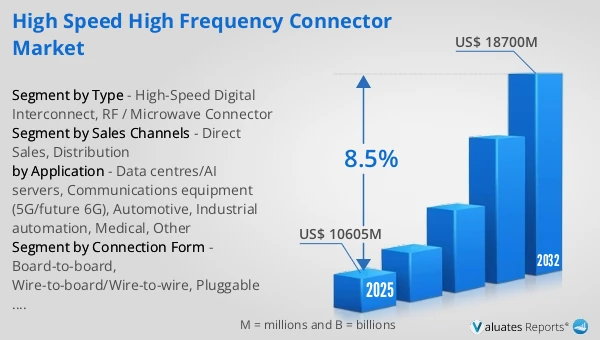
The global High Speed High Frequency Connector market was valued at US$ 10605 million in 2025 and is anticipated to reach US$ 18700 million by 2032, at a CAGR of 8.5% from 2026 to 2032.
High Speed High Frequency Connector Market
The 2025 U.S. tariff policies introduce profound uncertainty into the global economic landscape. This report critically examines the implications of recent tariff adjustments and international strategic countermeasures on High Speed High Frequency Connector competitive dynamics, regional economic interdependencies, and supply chain reconfigurations.
High-speed, high-frequency connectors are precision interconnect components capable of stable signal transmission at GHz-level frequencies and speeds exceeding tens of Gbps, ensuring signal integrity. They are core components in communications, data centres, automotive electronics, aerospace, and other applications. Their development is advancing towards higher frequencies, greater speeds, miniaturisation, integration, enhanced reliability, and environmental sustainability, while simultaneously adapting to emerging applications and domestic substitution requirements.
Global sales of high-speed, high-frequency connectors reached 1,662.20 million units in 2025, with an average price of US$6.38 per unit.
Core Development Trends
High-Frequency and High-Speed: Pushing Performance Boundaries
High-Frequency End: Advancing from Sub-6GHz to millimetre wave (40GHz–67GHz) and terahertz bands, driving innovations in air cavity structures, low-loss materials, and ultra-precision machining to support 5G-A, 6G, satellite communications, and radar applications.
High-Speed End: Single-channel upgrades from 112Gbps to 224Gbps and 448Gbps PAM4. Synergising PAM4 modulation, equalisation techniques, active optical cables (AOCs), and co-packaged optics (CPO) to enhance transmission efficiency and distance, supporting AI data centres and supercomputing demands.
Miniaturisation and Integration: Optimised for high-density deployment
Micro-scale: Pitch reduced from 1.27mm to 0.5mm–0.8mm, featuring low-profile designs (≤2mm) such as board-to-board connectors ≤1.5mm thick, meeting compact device requirements for smartphones, VR/AR, and automotive domain controllers.
Integration: Signal-power unification (e.g., PoE++), opto-electronic hybrid integration (supporting CPO/silicon photonics modules), modular design (replaceable terminals/shielding components) simplifies cabling, reduces costs, and enhances system integration.
High Reliability & Intelligent O&M: Addressing Complex Operating Conditions
Extreme Environment Adaptation: Wide temperature range (-65°C to 150°C), vibration resistance (≥1000Hz), corrosion resistance (salt spray ≥500h), waterproof/dustproof (IP68/IP69K) – meeting aerospace, deep-sea exploration, and new energy vehicle requirements.
Intelligent Features: Integrated temperature/humidity/contact resistance monitoring; self-cleaning contacts, blind-plug floating structure, and hot-swap design enhance maintenance convenience and connection stability.
Green and Sustainable: Cost Reduction, Efficiency Enhancement, Emissions Reduction
Material Optimisation: Lead-free, low-VOC materials; recycled copper alloy applications minimise environmental impact.
Energy Efficiency Enhancement: Low-power design (reduces additional energy consumption from signal loss); efficient thermal management (metal housing + thermal interface material) accommodates high-power RF and AI server cooling requirements.
Standardisation and Interoperability: Reducing Adaptation Costs
Unified Interface Standards: Supports SMA, SMP, 2.92mm, QSFP-DD, OSFP, PCIe 5.0/6.0, enabling seamless cross-vendor device integration.
Comprehensive Testing Protocols: Established high-frequency, high-speed compliance testing frameworks (e.g., eye diagram, jitter, EMI) to shorten product certification cycles and accelerate market access.
This report delivers a comprehensive overview of the global High Speed High Frequency Connector market, with both quantitative and qualitative analyses, to help readers develop growth strategies, assess the competitive landscape, evaluate their position in the current market, and make informed business decisions regarding High Speed High Frequency Connector. The High Speed High Frequency Connector market size, estimates, and forecasts are provided in terms of output/shipments (M Units) and revenue (US$ millions), with 2025 as the base year and historical and forecast data for 2021–2032.
The report segments the global High Speed High Frequency Connector market comprehensively. Regional market sizes by Type, by Application, by Connection Form, and by company are also provided. For deeper insight, the report profiles the competitive landscape, key competitors, and their respective market rankings, and discusses technological trends and new product developments.
This report will assist High Speed High Frequency Connector manufacturers, new entrants, and companies across the industry value chain with information on revenues, production, and average prices for the overall market and its sub-segments, by company, by Type, by Application, and by region.
Market Segmentation
Scope of High Speed High Frequency Connector Market Report
| Report Metric |
Details |
| Report Name |
High Speed High Frequency Connector Market |
| Accounted market size in 2025 |
US$ 10605 million |
| Forecasted market size in 2032 |
US$ 18700 million |
| CAGR |
8.5% |
| Base Year |
2025 |
| Forecasted years |
2026 - 2032 |
| Segment by Type |
- High-Speed Digital Interconnect
- RF / Microwave Connector
|
| Segment by Connection Form |
- Board-to-board
- Wire-to-board/Wire-to-wire
- Pluggable I/O
- Other
|
| Segment by Sales Channels |
- Direct Sales
- Distribution
|
| by Application |
- Data centres/AI servers
- Communications equipment (5G/future 6G)
- Automotive
- Industrial automation
- Medical
- Other
|
| Production by Region |
- North America
- Europe
- China
- Japan
|
| Consumption by Region |
- North America (United States, Canada)
- Europe (Germany, France, UK, Italy, Russia)
- Asia-Pacific (China, Japan, South Korea, Taiwan)
- Southeast Asia (India)
- Latin America (Mexico, Brazil)
|
| By Company |
Rosenberger, TE Connectivity, Amphenol, Delphi, Yazaki, Luxshare Precision, Molex, Sumitomo, JAE, KET, JST, AVIC Jonhon, Shenzhen ECT, Wenzhou CZT |
| Forecast units |
USD million in value |
| Report coverage |
Revenue and volume forecast, company share, competitive landscape, growth factors and trends |
Chapter Outline
- Chapter 1: Defines the scope of the report and presents an executive summary of market segments (by Type, by Application, by Connection Form, etc.), including the size of each segment and its future growth potential. It offers a high-level view of the current market and its likely evolution in the short, medium, and long term.
- Chapter 2: Provides a detailed analysis of the competitive landscape for High Speed High Frequency Connector manufacturers, including prices, production, value-based market shares, latest development plans, and information on mergers and acquisitions.
- Chapter 3: Examines High Speed High Frequency Connector production/output and value by region and country, providing a quantitative assessment of market size and growth potential for each region over the next six years.
- Chapter 4: Analyzes High Speed High Frequency Connector consumption at the regional and country levels. It quantifies market size and growth potential for each region and its key countries, and outlines market development, outlook, addressable space, and national production.
- Chapter 5: Analyzes market segments by Type, covering the size and growth potential of each segment to help readers identify “blue ocean” opportunities.
- Chapter 6: Analyzes market segments by Application, covering the size and growth potential of each segment to help readers identify “blue ocean” opportunities in downstream markets.
- Chapter 7: Profiles key players, detailing the fundamentals of major companies, including product production/output, value, price, gross margin, product portfolio/introductions, and recent developments.
- Chapter 8: Reviews the industry value chain, including upstream and downstream segments.
- Chapter 9: Discusses market dynamics and recent developments, including drivers, restraints, challenges and risks for manufacturers, U.S. Tariffs and relevant policy analysis.
- Chapter 10: Summarizes the key findings and conclusions of the report.
Ans: The main players in the High Speed High Frequency Connector Market are Rosenberger, TE Connectivity, Amphenol, Delphi, Yazaki, Luxshare Precision, Molex, Sumitomo, JAE, KET, JST, AVIC Jonhon, Shenzhen ECT, Wenzhou CZT
Ans: The Applications covered in the High Speed High Frequency Connector Market report are Data centres/AI servers, Communications equipment (5G/future 6G), Automotive, Industrial automation, Medical, Other