FEATURED COMPANIES
GFH GmbH
Control Micro Systems
Spectrum Plastics Group
Mitsubishi Electric
Y.A.C. HOLDINGS
Oxford Lasers
Laser Micro Drilling System Market Size
The global Laser Micro Drilling System market was valued at US$ 349 million in 2025 and is anticipated to reach US$ 560 million by 2032, at a CAGR of 7.1% from 2026 to 2032.
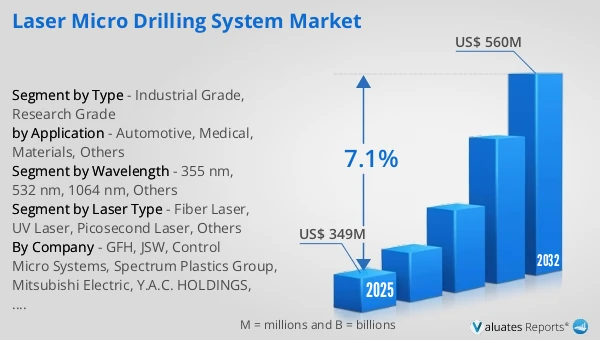
Laser Micro Drilling System Market
The 2025 U.S. tariff policies introduce profound uncertainty into the global economic landscape. This report critically examines the implications of recent tariff adjustments and international strategic countermeasures on Laser Micro Drilling System competitive dynamics, regional economic interdependencies, and supply chain reconfigurations.
A Laser Micro Drilling System is a high-precision manufacturing tool that uses focused laser energy to create micro-scale holes with tight tolerances in metals, ceramics, polymers, and composite materials. It enables non-contact processing with minimal mechanical stress, high aspect ratios, and excellent repeatability, making it suitable for applications requiring extreme precision. Laser micro drilling is widely used in electronics, semiconductors, aerospace components, medical devices, and advanced materials processing. As products continue to miniaturize and performance requirements increase, laser micro drilling systems have become essential equipment for achieving complex microstructures and high-throughput precision manufacturing.
In 2025, global Laser Micro Drilling System production reached approximately 20.71 k units, with an average global market price of around US$ 16851 per unit. And global Laser Micro Drilling System production capacity reached approximately 27 k units. The average gross margin in this industry reached 36.19%.
In the upstream supply chain, laser micro drilling systems rely on high-quality laser sources, optical components, motion platforms, and control electronics. Representative upstream suppliers include IPG Photonics for high-stability laser sources, Coherent for ultrafast laser technologies and optics, and THK for linear motion guides and positioning systems. The performance of these components directly affects drilling accuracy, throughput, and system reliability. Midstream system integrators focus on laser–material interaction optimization, beam delivery design, precision motion control, and process software development. Downstream, laser micro drilling systems are adopted by manufacturers such as Intel, Boeing, and Medtronic, where they are used for semiconductor via drilling, aerospace component fabrication, and medical implant production. Expanding demand for micro-scale precision continues to drive steady market growth.
This report delivers a comprehensive overview of the global Laser Micro Drilling System market, with both quantitative and qualitative analyses, to help readers develop growth strategies, assess the competitive landscape, evaluate their position in the current market, and make informed business decisions regarding Laser Micro Drilling System. The Laser Micro Drilling System market size, estimates, and forecasts are provided in terms of output/shipments (K Units) and revenue (US$ millions), with 2025 as the base year and historical and forecast data for 2021–2032.
The report segments the global Laser Micro Drilling System market comprehensively. Regional market sizes by Type, by Application, by Laser Type, and by company are also provided. For deeper insight, the report profiles the competitive landscape, key competitors, and their respective market rankings, and discusses technological trends and new product developments.
This report will assist Laser Micro Drilling System manufacturers, new entrants, and companies across the industry value chain with information on revenues, production, and average prices for the overall market and its sub-segments, by company, by Type, by Application, and by region.
Market Segmentation
Scope of Laser Micro Drilling System Market Report
| Report Metric |
Details |
| Report Name |
Laser Micro Drilling System Market |
| Accounted market size in 2025 |
US$ 349 million |
| Forecasted market size in 2032 |
US$ 560 million |
| CAGR |
7.1% |
| Base Year |
2025 |
| Forecasted years |
2026 - 2032 |
| Segment by Type |
- Industrial Grade
- Research Grade
|
| Segment by Laser Type |
- Fiber Laser
- UV Laser
- Picosecond Laser
- Others
|
| Segment by Wavelength |
- 355 nm
- 532 nm
- 1064 nm
- Others
|
| by Application |
- Automotive
- Medical
- Materials
- Others
|
| Production by Region |
- North America
- Europe
- China
- Japan
|
| Consumption by Region |
- North America (United States, Canada)
- Europe (Germany, France, UK, Italy, Russia)
- Asia-Pacific (China, Japan, South Korea, Taiwan)
- Southeast Asia (India)
- Latin America (Mexico, Brazil)
|
| By Company |
GFH, JSW, Control Micro Systems, Spectrum Plastics Group, Mitsubishi Electric, Y.A.C. HOLDINGS, Oxford Lasers, Hans Lasers, Keyence, 3D-Micromac, Jenoptik, Nidec, Posalux |
| Forecast units |
USD million in value |
| Report coverage |
Revenue and volume forecast, company share, competitive landscape, growth factors and trends |
Chapter Outline
- Chapter 1: Defines the scope of the report and presents an executive summary of market segments (by Type, by Application, by Laser Type, etc.), including the size of each segment and its future growth potential. It offers a high-level view of the current market and its likely evolution in the short, medium, and long term.
- Chapter 2: Provides a detailed analysis of the competitive landscape for Laser Micro Drilling System manufacturers, including prices, production, value-based market shares, latest development plans, and information on mergers and acquisitions.
- Chapter 3: Examines Laser Micro Drilling System production/output and value by region and country, providing a quantitative assessment of market size and growth potential for each region over the next six years.
- Chapter 4: Analyzes Laser Micro Drilling System consumption at the regional and country levels. It quantifies market size and growth potential for each region and its key countries, and outlines market development, outlook, addressable space, and national production.
- Chapter 5: Analyzes market segments by Type, covering the size and growth potential of each segment to help readers identify “blue ocean” opportunities.
- Chapter 6: Analyzes market segments by Application, covering the size and growth potential of each segment to help readers identify “blue ocean” opportunities in downstream markets.
- Chapter 7: Profiles key players, detailing the fundamentals of major companies, including product production/output, value, price, gross margin, product portfolio/introductions, and recent developments.
- Chapter 8: Reviews the industry value chain, including upstream and downstream segments.
- Chapter 9: Discusses market dynamics and recent developments, including drivers, restraints, challenges and risks for manufacturers, U.S. Tariffs and relevant policy analysis.
- Chapter 10: Summarizes the key findings and conclusions of the report.
FAQ for this report
How fast is Laser Micro Drilling System Market growing?
Ans: The Laser Micro Drilling System Market witnessing a CAGR of 7.1% during the forecast period 2026-2032.
What is the Laser Micro Drilling System Market size in 2032?
Ans: The Laser Micro Drilling System Market size in 2032 will be US$ 560 million.
Who are the main players in the Laser Micro Drilling System Market report?
Ans: The main players in the Laser Micro Drilling System Market are GFH, JSW, Control Micro Systems, Spectrum Plastics Group, Mitsubishi Electric, Y.A.C. HOLDINGS, Oxford Lasers, Hans Lasers, Keyence, 3D-Micromac, Jenoptik, Nidec, Posalux
What are the Application segmentation covered in the Laser Micro Drilling System Market report?
Ans: The Applications covered in the Laser Micro Drilling System Market report are Automotive, Medical, Materials, Others
What are the Type segmentation covered in the Laser Micro Drilling System Market report?
Ans: The Types covered in the Laser Micro Drilling System Market report are Fiber Laser, UV Laser, Picosecond Laser, Others