0
U.S. (TOLL FREE)
+1 (315) 215-3225
Automative

0
U.S. (TOLL FREE)
+1 (315) 215-3225
Global Solar Thermal (CSP) Market Research Report 2026
Published Date: 2026-01-28
|
Report Code: QYRE-Auto-17R20311
Home | Market Reports | Business & Industrial| Energy & Utilities| Renewable & Alternative Energy
Global Solar Thermal CSP Market Research Report 2026
BUY CHAPTERS

Global Solar Thermal (CSP) Market Research Report 2026

Code: QYRE-Auto-17R20311
Report
2026-01-28
Pages:124
QYResearch
Buy Now with 15% Discount
DESCRIPTION
TABLE OF CONTENT
TABLES & FIGURES

Solar Thermal (CSP) Market Size

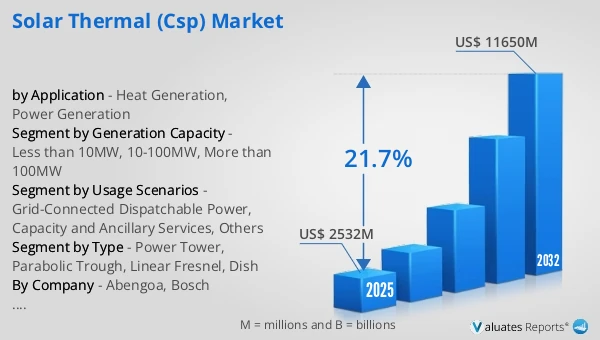
The global Solar Thermal (CSP) market was valued at US$ 2532 million in 2025 and is anticipated to reach US$ 11650 million by 2032, at a CAGR of 21.7% from 2026 to 2032.

Solar Thermal (CSP) Market

Solar Thermal (CSP) Market

The 2025 U.S. tariff policies introduce profound uncertainty into the global economic landscape. This report critically examines the implications of recent tariff adjustments and international strategic countermeasures on Solar Thermal (CSP) competitive dynamics, regional economic interdependencies, and supply chain reconfigurations.
Solar Thermal (Concentrated Solar Power, “CSP”) in this report is defined as a capital-intensive system solution rather than a commodity fuel or a stream of electricity sales. CSP plants use mirrors to concentrate sunlight onto a receiver, convert it into high-temperature heat, and then deliver this heat to a conventional power block or industrial process. Combined with thermal energy storage (TES), CSP can decouple solar collection from final energy use and provide firm, dispatchable heat and power that complements variable renewables such as PV and wind.
From a technology perspective, the industry is organised around four main system archetypes: Power Tower, Parabolic Trough, Linear Fresnel, and Parabolic Dish. These configurations differ in optical layout, receiver concept, heat-transfer fluid and storage design, but they are all engineered and delivered as integrated “plant packages” that include the solar field, receiver and piping, storage system, and power block and/or process-heat island. In practice, the global market is dominated by large, utility-scale tower and trough plants, often hybridised with PV, gas or other assets; Fresnel and dish solutions are more niche and typically address specific site or process-heat opportunities.
Commercially, CSP is a project-based EPC market. Projects are developed by utilities, IPPs, state-owned entities or industrial users, and then tendered as multi-year EPC, EPCM or turnkey contracts. A limited group of experienced integrators and engineering contractors (including diversified construction groups and specialised CSP players) compete to design and deliver the CSP “island” and, in many cases, the wider balance of plant. Revenue for CSP vendors is therefore recognised primarily at contract award and during construction, not as ongoing payments for electricity or heat. Long-term cash flows from power purchase agreements (PPAs), capacity payments or industrial heat offtake are fundamental to project bankability, but they accrue mainly to developers and asset owners, not to EPC contractors.
1. Positioning of Solar Thermal & CPV/CPVT in a PV-dominated world
The evidence assembled in this report confirms that Solar Thermal (CSP) and Concentrated Photovoltaic / Photovoltaic-Thermal (CPV/CPVT) technologies remain niche in terms of installed capacity, but strategically important in terms of system value. By 2023, global CSP capacity was only around 8 GW – less than 1% of total solar capacity – compared with well above 2 TW of installed solar PV by 2024.
Against this backdrop, the project universe and market sizing work in this study highlight two core points:
1.1 Scale gap vs. PV is structural, not temporary. CSP and CPV/CPVT will not close the volume gap with commodity PV modules; instead, they compete on dispatchability, high-temperature heat and co-generation value, not on installed megawatts alone.
1.2 System-value lens is decisive. Wherever tariffs and market design remunerate firm low-carbon capacity and long-duration flexibility, Solar Thermal and hybrid CPV/CPVT solutions become relevant options despite higher specific CAPEX. Where these attributes are not priced, project pipelines stall even under strong resource conditions.
In our view, this asymmetry explains why CSP/CPVT deployment remains geographically concentrated while medium- and long-term scenarios (IEA, IRENA) still assume a several-fold increase in CSP capacity by 2030 (typically 50–80 GW vs. ~8 GW today).
2. Growth will be policy-led and geographically concentrated
The project database underpinning this report shows that future Solar Thermal growth is anchored in a small set of policy-driven markets rather than broad, organic global adoption:
2.1 China already accounts for a material share of global CSP additions and is now the single most important growth market. By mid-2025, China had around 1.1 GW of operational CSP and a pipeline exceeding 8 GW across Qinghai, Gansu, Inner Mongolia and Xinjiang. A late-2025 official document sets an indicative target of around 15 GW of CSP capacity in the next planning period, explicitly positioning solar thermal as part of desert-base mega-projects and as a dispatchable resource in high-renewables systems.
2.2 MENA and selected emerging markets (e.g. Morocco, UAE, Saudi Arabia, parts of Southern Africa and Latin America) continue to develop large individual plants and hybrid complexes. Flagship projects like the 700 MW CSP + 250 MW PV Noor Energy 1 / DEWA IV complex in Dubai, with 12–15 hours of molten-salt storage, illustrate how CSP is used to deliver round-the-clock solar power into evening peaks.
2.3 Other regions – Europe, North America, OECD Asia – are present mainly through legacy plants, R&D activities and a small number of niche or repowering projects. In these markets, high wholesale price volatility, uncertain long-term support frameworks and strong competition from PV plus batteries limit new CSP/CPVT investment to very specific applications.
Our assessment is that this concentration is unlikely to change materially over the next decade. The national-level policy frameworks and auction designs reviewed in the report suggest that:
2.4 Most incremental CSP capacity through 2030 will come from China and MENA;
2.5 Other markets will contribute opportunistically, often via single landmark projects rather than continuous pipelines;
2.6 For CPVT in particular, industrial heat and co-generation rather than grid-only power will be the main driver.
3. Technology mix: from trough legacy to tower, hybrids and CPVT
The historical base in our project universe remains dominated by parabolic trough plants, reflecting the first two commercialisation waves of CSP. This is consistent with global statistics, where trough technology still accounts for the majority of the ~6–7 GW operational fleet. However, the forward-looking pipeline and scenario work in this report indicate a clear technological pivot:
3.1 Molten-salt tower as the new reference. In China’s recent batches, in Gulf mega-projects and in several industrial-heat designs, molten-salt power towers increasingly serve as the default reference case, supported by higher operating temperatures, more compact layouts and improved storage integration. This is aligned with external assessments that see the strongest cost-reduction potential in tower configurations.
3.2 Hybridisation as de-risking tool. Projects such as DEWA IV (trough + tower + PV) and emerging Chinese “CSP+PV+wind” bases show that sponsors now routinely combine multiple technologies within a single complex to diversify construction risk and optimise the output profile. Our project-level analysis confirms that most recently announced plants include some form of hybrid component (PV and/or conventional generation), with pure-play stand-alone CSP becoming less common.
3.3 CPV/CPVT moving from concept to pilot, not yet to scale. On the CPV/CPVT side, the technical literature documents impressive laboratory and pilot-scale performance: multi-junction CPV cells have reached efficiencies close to 48%, while recent CPVT system reviews report combined electrical-thermal efficiencies in the 60–80% range and LCoE estimates competitive with other renewables in high-DNI sites. Yet the project mapping in this study finds that real-world deployment remains limited to small pilot plants, building-scale demonstrators and a handful of industrial-heat projects, with no CPVT plant currently approaching the scale of mainstream CSP utility projects.
Our conclusion is that, within the study horizon, molten-salt tower CSP with integrated storage is the workhorse utility-scale option, while CPV/CPVT is best viewed as an emerging technology family with credible technical potential but still lacking the bankable, multi-plant track record required for broad adoption.
4. Economics: premium CAPEX, but competitive in long-duration flexibility niches
The cost evidence assembled in the report, cross-checked against international benchmarks, points to a persistent but narrowing cost gap between Solar Thermal solutions and alternative low-carbon options:
4.1 Recent cost surveys show that new CSP additions remain more capital-intensive than PV and onshore wind, and that annual CSP capacity additions have been relatively flat in recent years despite record growth in overall renewables.
4.2 However, headline CAPEX is a poor proxy for system value. In high-DNI sites with 8–15 hours of storage, CSP plants can deliver firm, dispatchable output that directly competes with gas-fired peakers or PV plus long-duration storage. Flagship projects in Dubai and elsewhere have already set PPA prices in the mid-single-digit US cents per kWh despite long storage durations, supported by concessional finance and scale efficiencies.
4.3 For CPVT, techno-economic studies indicate that, at favourable sites and with optimised designs, combined electricity-and-heat output can achieve LCoE estimates broadly similar to other renewables, particularly where high-temperature process heat has high marginal value; yet these numbers remain largely model-based and require validation through real assets.
Our interpretation is that economics are highly context-specific:
4.4 In systems that do not explicitly reward flexibility or high-temperature heat, CSP/CPVT will struggle to compete with PV plus batteries.
4.5 In systems where evening peaks, firm capacity needs and industrial decarbonisation are binding constraints, the premium CAPEX of CSP/CPVT is justifiable and, in some cases, economically attractive.
This asymmetry underpins our base-case forecast: limited global volumes but economically rational growth in a series of well-defined niches.
5. Competitive dynamics: from European pioneers to China-anchored industrialisation
The company-level mapping in this report shows a market structure characterised by:
5.1 A small group of globally active EPC and technology players (many with European or Middle Eastern origins) that provide reference plants, key components and know-how;
5.2 Rapidly rising participation by Chinese EPCs and manufacturers, leveraging experience from domestic demonstration batches and large desert-base projects, as well as integrated supply chains spanning mirrors, receivers, molten-salt equipment and control systems;
5.3 A long tail of local civil-works contractors, peripheral component suppliers and specialised service firms, often tied to a single project or region.
Over the forecast period, we expect competitive advantage to be determined less by proprietary hardware and more by:
5.4 Bankable reference portfolios – demonstrated ability to deliver CSP/CPVT plants on time, on budget and at or above guaranteed performance;
5.5 Standardised yet flexible plant architectures – re-use of proven “platforms” (e.g. 100 MW tower blocks with fixed storage hours) that can be replicated across markets, while allowing local adaptation;
5.6 System-integration and lifecycle capabilities – combining solar field, storage, power block, digital control and O&M into integrated offerings, particularly for complex hybrid projects (CSP+PV+wind+storage).
In this landscape, we see a gradual shift of manufacturing and EPC cost leadership toward China, while technology origination and complex system design remains more distributed, with long-standing European and other players still important in high-specification or first-of-a-kind projects.
6. Implications and watchpoints
Synthesising the quantitative and qualitative findings of this study, our main conclusions are:
6.1 Solar Thermal and CPV/CPVT are moving from “experimental” to “strategic niche” status. The current fleet is small, but selected markets are clearly internalising their system value. This justifies continued tracking and dedicated allocation of development effort within diversified renewable portfolios.
6.2 Policy clarity on flexibility remuneration is the single most important external driver. Where auctions, capacity markets or regulated tariffs recognise long-duration storage and high-temperature heat, we expect CSP/CPVT pipelines to materialise; where they do not, pipelines will remain sporadic regardless of resource quality.
6.3 China and MENA will define the global learning curve. Their project pipelines, cost trajectories and industrial strategies will set the reference points for technology risk perception and financing conditions worldwide. Monitoring Chinese policy implementation around the 15 GW CSP ambition and the performance of the newest desert-base hybrids is therefore critical for any global outlook.
6.4 For investors, selectivity and structuring matter more than volume. The opportunity set is not about building large portfolios of “plain vanilla” plants, but about a limited number of well-structured, policy-anchored projects with robust offtake, strong sponsors and proven EPC partners.
6.5 For technology developers, CPVT is a high-potential but long-cycle option. The combined-efficiency and high-temperature advantages documented in recent literature are compelling, but commercial relevance depends on successfully bridging the bankability gap – via pilots in industrial clusters, district heating and high-value process-heat applications rather than immediate pursuit of large stand-alone power plants.
Overall, we view Solar Thermal and CPV/CPVT not as broad substitutes for PV and wind, but as complementary, high-value tools in a decarbonisation toolbox that must increasingly deliver flexibility, firm capacity and high-temperature heat alongside low-cost energy. The project universe, cost benchmarks and forward-looking scenarios in this report support a measured but positive outlook for these technologies within the clearly defined boundaries described above.
This report delivers a comprehensive overview of the global Solar Thermal (CSP) market, with both quantitative and qualitative analyses, to help readers develop growth strategies, assess the competitive landscape, evaluate their position in the current market, and make informed business decisions regarding Solar Thermal (CSP). The Solar Thermal (CSP) market size, estimates, and forecasts are provided in terms of output/shipments (KW) and revenue (US$ millions), with 2025 as the base year and historical and forecast data for 2021–2032.
The report segments the global Solar Thermal (CSP) market comprehensively. Regional market sizes by Type, by Application, by Generation Capacity, and by company are also provided. For deeper insight, the report profiles the competitive landscape, key competitors, and their respective market rankings, and discusses technological trends and new product developments.
This report will assist Solar Thermal (CSP) manufacturers, new entrants, and companies across the industry value chain with information on revenues, production, and average prices for the overall market and its sub-segments, by company, by Type, by Application, and by region.
Market Segmentation

Scope of Solar Thermal (CSP) Market Report

Report Metric Details
Report Name Solar Thermal (CSP) Market
Accounted market size in 2025 US$ 2532 million
Forecasted market size in 2032 US$ 11650 million
CAGR 21.7%
Base Year 2025
Forecasted years 2026 - 2032
Segment by Type
  • Power Tower
  • Parabolic Trough
  • Linear Fresnel
  • Dish
Segment by Generation Capacity
  • Less than 10MW
  • 10-100MW
  • More than 100MW
Segment by Usage Scenarios
  • Grid-Connected Dispatchable Power
  • Capacity and Ancillary Services
  • Others
by Application
  • Heat Generation
  • Power Generation
Production by Region
  • North America
  • Europe
  • China
  • Japan
Consumption by Region
  • North America (United States, Canada)
  • Europe (Germany, France, UK, Italy, Russia)
  • Asia-Pacific (China, Japan, South Korea, Taiwan)
  • Southeast Asia (India)
  • Latin America (Mexico, Brazil)
By Company Abengoa, Bosch Thermotechnology, ACCIONA, GREENoneTEC, Viessmann
Forecast units USD million in value
Report coverage Revenue and volume forecast, company share, competitive landscape, growth factors and trends

Chapter Outline

  • Chapter 1: Defines the scope of the report and presents an executive summary of market segments (by Type, by Application, by Generation Capacity, etc.), including the size of each segment and its future growth potential. It offers a high-level view of the current market and its likely evolution in the short, medium, and long term.
  • Chapter 2: Provides a detailed analysis of the competitive landscape for Solar Thermal (CSP) manufacturers, including prices, production, value-based market shares, latest development plans, and information on mergers and acquisitions.
  • Chapter 3: Examines Solar Thermal (CSP) production/output and value by region and country, providing a quantitative assessment of market size and growth potential for each region over the next six years.
  • Chapter 4: Analyzes Solar Thermal (CSP) consumption at the regional and country levels. It quantifies market size and growth potential for each region and its key countries, and outlines market development, outlook, addressable space, and national production.
  • Chapter 5: Analyzes market segments by Type, covering the size and growth potential of each segment to help readers identify “blue ocean” opportunities.
  • Chapter 6: Analyzes market segments by Application, covering the size and growth potential of each segment to help readers identify “blue ocean” opportunities in downstream markets.
  • Chapter 7: Profiles key players, detailing the fundamentals of major companies, including product production/output, value, price, gross margin, product portfolio/introductions, and recent developments.
  • Chapter 8: Reviews the industry value chain, including upstream and downstream segments.
  • Chapter 9: Discusses market dynamics and recent developments, including drivers, restraints, challenges and risks for manufacturers, U.S. Tariffs and relevant policy analysis.
  • Chapter 10: Summarizes the key findings and conclusions of the report.

FAQ for this report

How fast is Solar Thermal (CSP) Market growing?

Ans: The Solar Thermal (CSP) Market witnessing a CAGR of 21.7% during the forecast period 2026-2032.

What is the Solar Thermal (CSP) Market size in 2032?

Ans: The Solar Thermal (CSP) Market size in 2032 will be US$ 11650 million.

Who are the main players in the Solar Thermal (CSP) Market report?

Ans: The main players in the Solar Thermal (CSP) Market are Abengoa, Bosch Thermotechnology, ACCIONA, GREENoneTEC, Viessmann

What are the Application segmentation covered in the Solar Thermal (CSP) Market report?

Ans: The Applications covered in the Solar Thermal (CSP) Market report are Heat Generation, Power Generation

What are the Type segmentation covered in the Solar Thermal (CSP) Market report?

Ans: The Types covered in the Solar Thermal (CSP) Market report are Power Tower, Parabolic Trough, Linear Fresnel, Dish

1 Solar Thermal (CSP) Market Overview
1.1 Product Definition
1.2 Solar Thermal (CSP) by Type
1.2.1 Global Solar Thermal (CSP) Market Value Growth Rate Analysis by Type: 2025 vs 2032
1.2.2 Power Tower
1.2.3 Parabolic Trough
1.2.4 Linear Fresnel
1.2.5 Dish
1.3 Solar Thermal (CSP) by Generation Capacity
1.3.1 Global Solar Thermal (CSP) Market Value Growth Rate Analysis by Generation Capacity: 2025 vs 2032
1.3.2 Less than 10MW
1.3.3 10-100MW
1.3.4 More than 100MW
1.4 Solar Thermal (CSP) by Usage Scenarios
1.4.1 Global Solar Thermal (CSP) Market Value Growth Rate Analysis by Usage Scenarios: 2025 vs 2032
1.4.2 Grid-Connected Dispatchable Power
1.4.3 Capacity and Ancillary Services
1.4.4 Others
1.5 Solar Thermal (CSP) by Application
1.5.1 Global Solar Thermal (CSP) Market Value Growth Rate Analysis by Application: 2025 vs 2032
1.5.2 Heat Generation
1.5.3 Power Generation
1.6 Global Market Growth Prospects
1.6.1 Global Solar Thermal (CSP) Production Value Estimates and Forecasts (2021–2032)
1.6.2 Global Solar Thermal (CSP) Production Capacity Estimates and Forecasts (2021–2032)
1.6.3 Global Solar Thermal (CSP) Production Estimates and Forecasts (2021–2032)
1.6.4 Global Solar Thermal (CSP) Market Average Price Estimates and Forecasts (2021–2032)
1.7 Assumptions and Limitations
2 Market Competition by Manufacturers
2.1 Global Solar Thermal (CSP) Production Market Share by Manufacturers (2021–2026)
2.2 Global Solar Thermal (CSP) Production Value Market Share by Manufacturers (2021–2026)
2.3 Global Key Players of Solar Thermal (CSP), Industry Ranking, 2024 vs 2025
2.4 Global Solar Thermal (CSP) Market Share by Company Tier (Tier 1, Tier 2, Tier 3)
2.5 Global Solar Thermal (CSP) Average Price by Manufacturers (2021–2026)
2.6 Global Key Manufacturers of Solar Thermal (CSP), Manufacturing Footprints and Headquarters
2.7 Global Key Manufacturers of Solar Thermal (CSP), Product Offerings and Applications
2.8 Global Key Manufacturers of Solar Thermal (CSP), Date of Entry into the Industry
2.9 Solar Thermal (CSP) Market Competitive Situation and Trends
2.9.1 Solar Thermal (CSP) Market Concentration Rate
2.9.2 Top 5 and Top 10 Global Solar Thermal (CSP) Players Market Share by Revenue
2.10 Mergers & Acquisitions and Expansion
3 Solar Thermal (CSP) Production by Region
3.1 Global Solar Thermal (CSP) Production Value Estimates and Forecasts by Region: 2021 vs 2025 vs 2032
3.2 Global Solar Thermal (CSP) Production Value by Region (2021–2032)
3.2.1 Global Solar Thermal (CSP) Production Value by Region (2021–2026)
3.2.2 Global Forecasted Production Value of Solar Thermal (CSP) by Region (2027–2032)
3.3 Global Solar Thermal (CSP) Production Estimates and Forecasts by Region: 2021 vs 2025 vs 2032
3.4 Global Solar Thermal (CSP) Production Volume by Region (2021–2032)
3.4.1 Global Solar Thermal (CSP) Production by Region (2021–2026)
3.4.2 Global Forecasted Production of Solar Thermal (CSP) by Region (2027–2032)
3.5 Global Solar Thermal (CSP) Market Price Analysis by Region (2021–2032)
3.6 Global Solar Thermal (CSP) Production, Value, and Year-over-Year Growth
3.6.1 North America Solar Thermal (CSP) Production Value Estimates and Forecasts (2021–2032)
3.6.2 Europe Solar Thermal (CSP) Production Value Estimates and Forecasts (2021–2032)
3.6.3 China Solar Thermal (CSP) Production Value Estimates and Forecasts (2021–2032)
3.6.4 Japan Solar Thermal (CSP) Production Value Estimates and Forecasts (2021–2032)
4 Solar Thermal (CSP) Consumption by Region
4.1 Global Solar Thermal (CSP) Consumption Estimates and Forecasts by Region: 2021 vs 2025 vs 2032
4.2 Global Solar Thermal (CSP) Consumption by Region (2021–2032)
4.2.1 Global Solar Thermal (CSP) Consumption by Region (2021–2026)
4.2.2 Global Solar Thermal (CSP) Forecasted Consumption by Region (2027–2032)
4.3 North America
4.3.1 North America Solar Thermal (CSP) Consumption Growth Rate by Country: 2021 vs 2025 vs 2032
4.3.2 North America Solar Thermal (CSP) Consumption by Country (2021–2032)
4.3.3 U.S.
4.3.4 Canada
4.4 Europe
4.4.1 Europe Solar Thermal (CSP) Consumption Growth Rate by Country: 2021 vs 2025 vs 2032
4.4.2 Europe Solar Thermal (CSP) Consumption by Country (2021–2032)
4.4.3 Germany
4.4.4 France
4.4.5 U.K.
4.4.6 Italy
4.4.7 Russia
4.5 Asia Pacific
4.5.1 Asia Pacific Solar Thermal (CSP) Consumption Growth Rate by Region: 2021 vs 2025 vs 2032
4.5.2 Asia Pacific Solar Thermal (CSP) Consumption by Region (2021–2032)
4.5.3 China
4.5.4 Japan
4.5.5 South Korea
4.5.6 China Taiwan
4.5.7 Southeast Asia
4.5.8 India
4.6 Latin America, Middle East & Africa
4.6.1 Latin America, Middle East & Africa Solar Thermal (CSP) Consumption Growth Rate by Country: 2021 vs 2025 vs 2032
4.6.2 Latin America, Middle East & Africa Solar Thermal (CSP) Consumption by Country (2021–2032)
4.6.3 Mexico
4.6.4 Brazil
4.6.5 Turkey
4.6.6 GCC Countries
5 Segment by Type
5.1 Global Solar Thermal (CSP) Production by Type (2021–2032)
5.1.1 Global Solar Thermal (CSP) Production by Type (2021–2026)
5.1.2 Global Solar Thermal (CSP) Production by Type (2027–2032)
5.1.3 Global Solar Thermal (CSP) Production Market Share by Type (2021–2032)
5.2 Global Solar Thermal (CSP) Production Value by Type (2021–2032)
5.2.1 Global Solar Thermal (CSP) Production Value by Type (2021–2026)
5.2.2 Global Solar Thermal (CSP) Production Value by Type (2027–2032)
5.2.3 Global Solar Thermal (CSP) Production Value Market Share by Type (2021–2032)
5.3 Global Solar Thermal (CSP) Price by Type (2021–2032)
6 Segment by Application
6.1 Global Solar Thermal (CSP) Production by Application (2021–2032)
6.1.1 Global Solar Thermal (CSP) Production by Application (2021–2026)
6.1.2 Global Solar Thermal (CSP) Production by Application (2027–2032)
6.1.3 Global Solar Thermal (CSP) Production Market Share by Application (2021–2032)
6.2 Global Solar Thermal (CSP) Production Value by Application (2021–2032)
6.2.1 Global Solar Thermal (CSP) Production Value by Application (2021–2026)
6.2.2 Global Solar Thermal (CSP) Production Value by Application (2027–2032)
6.2.3 Global Solar Thermal (CSP) Production Value Market Share by Application (2021–2032)
6.3 Global Solar Thermal (CSP) Price by Application (2021–2032)
7 Key Companies Profiled
7.1 Abengoa
7.1.1 Abengoa Solar Thermal (CSP) Company Information
7.1.2 Abengoa Solar Thermal (CSP) Product Portfolio
7.1.3 Abengoa Solar Thermal (CSP) Production, Value, Price, and Gross Margin (2021–2026)
7.1.4 Abengoa Main Business and Markets Served
7.1.5 Abengoa Recent Developments/Updates
7.2 Bosch Thermotechnology
7.2.1 Bosch Thermotechnology Solar Thermal (CSP) Company Information
7.2.2 Bosch Thermotechnology Solar Thermal (CSP) Product Portfolio
7.2.3 Bosch Thermotechnology Solar Thermal (CSP) Production, Value, Price, and Gross Margin (2021–2026)
7.2.4 Bosch Thermotechnology Main Business and Markets Served
7.2.5 Bosch Thermotechnology Recent Developments/Updates
7.3 ACCIONA
7.3.1 ACCIONA Solar Thermal (CSP) Company Information
7.3.2 ACCIONA Solar Thermal (CSP) Product Portfolio
7.3.3 ACCIONA Solar Thermal (CSP) Production, Value, Price, and Gross Margin (2021–2026)
7.3.4 ACCIONA Main Business and Markets Served
7.3.5 ACCIONA Recent Developments/Updates
7.4 GREENoneTEC
7.4.1 GREENoneTEC Solar Thermal (CSP) Company Information
7.4.2 GREENoneTEC Solar Thermal (CSP) Product Portfolio
7.4.3 GREENoneTEC Solar Thermal (CSP) Production, Value, Price, and Gross Margin (2021–2026)
7.4.4 GREENoneTEC Main Business and Markets Served
7.4.5 GREENoneTEC Recent Developments/Updates
7.5 Viessmann
7.5.1 Viessmann Solar Thermal (CSP) Company Information
7.5.2 Viessmann Solar Thermal (CSP) Product Portfolio
7.5.3 Viessmann Solar Thermal (CSP) Production, Value, Price, and Gross Margin (2021–2026)
7.5.4 Viessmann Main Business and Markets Served
7.5.5 Viessmann Recent Developments/Updates
8 Industry Chain and Sales Channels Analysis
8.1 Solar Thermal (CSP) Industry Chain Analysis
8.2 Solar Thermal (CSP) Raw Material Supply Analysis
8.2.1 Key Raw Materials
8.2.2 Raw Materials Key Suppliers
8.3 Solar Thermal (CSP) Production Modes and Processes
8.4 Solar Thermal (CSP) Sales and Marketing
8.4.1 Solar Thermal (CSP) Sales Channels
8.4.2 Solar Thermal (CSP) Distributors
8.5 Solar Thermal (CSP) Customer Analysis
9 Solar Thermal (CSP) Market Dynamics
9.1 Solar Thermal (CSP) Industry Trends
9.2 Solar Thermal (CSP) Market Drivers
9.3 Solar Thermal (CSP) Market Challenges
9.4 Solar Thermal (CSP) Market Restraints
9.5 Impact of U.S. Tariffs
10 Research Findings and Conclusion
11 Methodology and Data Source
11.1 Methodology/Research Approach
11.1.1 Research Programs/Design
11.1.2 Market Size Estimation
11.1.3 Market Breakdown and Data Triangulation
11.2 Data Source
11.2.1 Secondary Sources
11.2.2 Primary Sources
11.3 Author List
11.4 Disclaimer
List of Tables
 Table 1. Global Solar Thermal (CSP) Market Value by Type (US$ Million), 2025 vs 2032
 Table 2. Global Solar Thermal (CSP) Market Value by Generation Capacity (US$ Million), 2025 vs 2032
 Table 3. Global Solar Thermal (CSP) Market Value by Usage Scenarios (US$ Million), 2025 vs 2032
 Table 4. Global Solar Thermal (CSP) Market Value by Application (US$ Million), 2025 vs 2032
 Table 5. Global Solar Thermal (CSP) Production Capacity (KW) by Manufacturers in 2025
 Table 6. Global Solar Thermal (CSP) Production by Manufacturers (KW), 2021–2026
 Table 7. Global Solar Thermal (CSP) Production Market Share by Manufacturers (2021–2026)
 Table 8. Global Solar Thermal (CSP) Production Value by Manufacturers (US$ Million), 2021–2026
 Table 9. Global Solar Thermal (CSP) Production Value Share by Manufacturers (2021–2026)
 Table 10. Global Key Players of Solar Thermal (CSP), Industry Ranking, 2024 vs 2025
 Table 11. Classification of Companies by Tier (Tier 1, Tier 2, Tier 3), based on Solar Thermal (CSP) Production Value, 2025
 Table 12. Global Market Solar Thermal (CSP) Average Price by Manufacturers (USD/KW), 2021–2026
 Table 13. Global Key Manufacturers of Solar Thermal (CSP), Manufacturing Footprints and Headquarters
 Table 14. Global Key Manufacturers of Solar Thermal (CSP), Product Offerings and Applications
 Table 15. Global Key Manufacturers of Solar Thermal (CSP), Date of Entry into the Industry
 Table 16. Global Solar Thermal (CSP) Manufacturers Market Concentration Ratio (CR5 and HHI)
 Table 17. Mergers & Acquisitions and Expansion Plans
 Table 18. Global Solar Thermal (CSP) Production Value by Region: 2021 vs 2025 vs 2032 (US$ Million)
 Table 19. Global Solar Thermal (CSP) Production Value (US$ Million) by Region (2021–2026)
 Table 20. Global Solar Thermal (CSP) Production Value Market Share by Region (2021–2026)
 Table 21. Global Solar Thermal (CSP) Production Value (US$ Million) Forecast by Region (2027–2032)
 Table 22. Global Solar Thermal (CSP) Production Value Market Share Forecast by Region (2027–2032)
 Table 23. Global Solar Thermal (CSP) Production Comparison by Region: 2021 vs 2025 vs 2032 (KW)
 Table 24. Global Solar Thermal (CSP) Production (KW) by Region (2021–2026)
 Table 25. Global Solar Thermal (CSP) Production Market Share by Region (2021–2026)
 Table 26. Global Solar Thermal (CSP) Production (KW) Forecast by Region (2027–2032)
 Table 27. Global Solar Thermal (CSP) Production Market Share Forecast by Region (2027–2032)
 Table 28. Global Solar Thermal (CSP) Market Average Price (USD/KW) by Region (2021–2026)
 Table 29. Global Solar Thermal (CSP) Market Average Price (USD/KW) by Region (2027–2032)
 Table 30. Global Solar Thermal (CSP) Consumption Growth Rate by Region: 2021 vs 2025 vs 2032 (KW)
 Table 31. Global Solar Thermal (CSP) Consumption by Region (KW), 2021–2026
 Table 32. Global Solar Thermal (CSP) Consumption Market Share by Region (2021–2026)
 Table 33. Global Solar Thermal (CSP) Forecasted Consumption by Region (KW), 2027–2032
 Table 34. Global Solar Thermal (CSP) Forecasted Consumption Market Share by Region (2027–2032)
 Table 35. North America Solar Thermal (CSP) Consumption Growth Rate by Country: 2021 vs 2025 vs 2032 (KW)
 Table 36. North America Solar Thermal (CSP) Consumption by Country (KW), 2021–2026
 Table 37. North America Solar Thermal (CSP) Consumption by Country (KW), 2027–2032
 Table 38. Europe Solar Thermal (CSP) Consumption Growth Rate by Country: 2021 vs 2025 vs 2032 (KW)
 Table 39. Europe Solar Thermal (CSP) Consumption by Country (KW), 2021–2026
 Table 40. Europe Solar Thermal (CSP) Consumption by Country (KW), 2027–2032
 Table 41. Asia Pacific Solar Thermal (CSP) Consumption Growth Rate by Region: 2021 vs 2025 vs 2032 (KW)
 Table 42. Asia Pacific Solar Thermal (CSP) Consumption by Region (KW), 2021–2026
 Table 43. Asia Pacific Solar Thermal (CSP) Consumption by Region (KW), 2027–2032
 Table 44. Latin America, Middle East & Africa Solar Thermal (CSP) Consumption Growth Rate by Country: 2021 vs 2025 vs 2032 (KW)
 Table 45. Latin America, Middle East & Africa Solar Thermal (CSP) Consumption by Country (KW), 2021–2026
 Table 46. Latin America, Middle East & Africa Solar Thermal (CSP) Consumption by Country (KW), 2027–2032
 Table 47. Global Solar Thermal (CSP) Production (KW) by Type (2021–2026)
 Table 48. Global Solar Thermal (CSP) Production (KW) by Type (2027–2032)
 Table 49. Global Solar Thermal (CSP) Production Market Share by Type (2021–2026)
 Table 50. Global Solar Thermal (CSP) Production Market Share by Type (2027–2032)
 Table 51. Global Solar Thermal (CSP) Production Value (US$ Million) by Type (2021–2026)
 Table 52. Global Solar Thermal (CSP) Production Value (US$ Million) by Type (2027–2032)
 Table 53. Global Solar Thermal (CSP) Production Value Market Share by Type (2021–2026)
 Table 54. Global Solar Thermal (CSP) Production Value Market Share by Type (2027–2032)
 Table 55. Global Solar Thermal (CSP) Price (USD/KW) by Type (2021–2026)
 Table 56. Global Solar Thermal (CSP) Price (USD/KW) by Type (2027–2032)
 Table 57. Global Solar Thermal (CSP) Production (KW) by Application (2021–2026)
 Table 58. Global Solar Thermal (CSP) Production (KW) by Application (2027–2032)
 Table 59. Global Solar Thermal (CSP) Production Market Share by Application (2021–2026)
 Table 60. Global Solar Thermal (CSP) Production Market Share by Application (2027–2032)
 Table 61. Global Solar Thermal (CSP) Production Value (US$ Million) by Application (2021–2026)
 Table 62. Global Solar Thermal (CSP) Production Value (US$ Million) by Application (2027–2032)
 Table 63. Global Solar Thermal (CSP) Production Value Market Share by Application (2021–2026)
 Table 64. Global Solar Thermal (CSP) Production Value Market Share by Application (2027–2032)
 Table 65. Global Solar Thermal (CSP) Price (USD/KW) by Application (2021–2026)
 Table 66. Global Solar Thermal (CSP) Price (USD/KW) by Application (2027–2032)
 Table 67. Abengoa Solar Thermal (CSP) Company Information
 Table 68. Abengoa Solar Thermal (CSP) Specification and Application
 Table 69. Abengoa Solar Thermal (CSP) Production (KW), Value (US$ Million), Price (USD/KW) and Gross Margin (2021–2026)
 Table 70. Abengoa Main Business and Markets Served
 Table 71. Abengoa Recent Developments/Updates
 Table 72. Bosch Thermotechnology Solar Thermal (CSP) Company Information
 Table 73. Bosch Thermotechnology Solar Thermal (CSP) Specification and Application
 Table 74. Bosch Thermotechnology Solar Thermal (CSP) Production (KW), Value (US$ Million), Price (USD/KW) and Gross Margin (2021–2026)
 Table 75. Bosch Thermotechnology Main Business and Markets Served
 Table 76. Bosch Thermotechnology Recent Developments/Updates
 Table 77. ACCIONA Solar Thermal (CSP) Company Information
 Table 78. ACCIONA Solar Thermal (CSP) Specification and Application
 Table 79. ACCIONA Solar Thermal (CSP) Production (KW), Value (US$ Million), Price (USD/KW) and Gross Margin (2021–2026)
 Table 80. ACCIONA Main Business and Markets Served
 Table 81. ACCIONA Recent Developments/Updates
 Table 82. GREENoneTEC Solar Thermal (CSP) Company Information
 Table 83. GREENoneTEC Solar Thermal (CSP) Specification and Application
 Table 84. GREENoneTEC Solar Thermal (CSP) Production (KW), Value (US$ Million), Price (USD/KW) and Gross Margin (2021–2026)
 Table 85. GREENoneTEC Main Business and Markets Served
 Table 86. GREENoneTEC Recent Developments/Updates
 Table 87. Viessmann Solar Thermal (CSP) Company Information
 Table 88. Viessmann Solar Thermal (CSP) Specification and Application
 Table 89. Viessmann Solar Thermal (CSP) Production (KW), Value (US$ Million), Price (USD/KW) and Gross Margin (2021–2026)
 Table 90. Viessmann Main Business and Markets Served
 Table 91. Viessmann Recent Developments/Updates
 Table 92. Key Raw Materials Lists
 Table 93. Raw Materials Key Suppliers Lists
 Table 94. Solar Thermal (CSP) Distributors List
 Table 95. Solar Thermal (CSP) Customers List
 Table 96. Solar Thermal (CSP) Market Trends
 Table 97. Solar Thermal (CSP) Market Drivers
 Table 98. Solar Thermal (CSP) Market Challenges
 Table 99. Solar Thermal (CSP) Market Restraints
 Table 100. Research Programs/Design for This Report
 Table 101. Key Data Information from Secondary Sources
 Table 102. Key Data Information from Primary Sources
 Table 103. Authors List of This Report


List of Figures
 Figure 1. Product Picture of Solar Thermal (CSP)
 Figure 2. Global Solar Thermal (CSP) Market Value by Type (US$ Million), 2021–2032
 Figure 3. Global Solar Thermal (CSP) Market Share by Type: 2025 vs 2032
 Figure 4. Power Tower Product Picture
 Figure 5. Parabolic Trough Product Picture
 Figure 6. Linear Fresnel Product Picture
 Figure 7. Dish Product Picture
 Figure 8. Global Solar Thermal (CSP) Market Value by Generation Capacity (US$ Million), 2021–2032
 Figure 9. Global Solar Thermal (CSP) Market Share by Generation Capacity: 2025 vs 2032
 Figure 10. Less than 10MW Product Picture
 Figure 11. 10-100MW Product Picture
 Figure 12. More than 100MW Product Picture
 Figure 13. Global Solar Thermal (CSP) Market Value by Usage Scenarios (US$ Million), 2021–2032
 Figure 14. Global Solar Thermal (CSP) Market Share by Usage Scenarios: 2025 vs 2032
 Figure 15. Grid-Connected Dispatchable Power Product Picture
 Figure 16. Capacity and Ancillary Services Product Picture
 Figure 17. Others Product Picture
 Figure 18. Global Solar Thermal (CSP) Market Value by Application (US$ Million), 2021–2032
 Figure 19. Global Solar Thermal (CSP) Market Share by Application: 2025 vs 2032
 Figure 20. Heat Generation
 Figure 21. Power Generation
 Figure 22. Global Solar Thermal (CSP) Production Value (US$ Million), 2021 vs 2025 vs 2032
 Figure 23. Global Solar Thermal (CSP) Production Value (US$ Million), 2021–2032
 Figure 24. Global Solar Thermal (CSP) Production Capacity (KW), 2021–2032
 Figure 25. Global Solar Thermal (CSP) Production (KW), 2021–2032
 Figure 26. Global Solar Thermal (CSP) Average Price (USD/KW), 2021–2032
 Figure 27. Solar Thermal (CSP) Report Years Considered
 Figure 28. Solar Thermal (CSP) Production Share by Manufacturers in 2025
 Figure 29. Global Solar Thermal (CSP) Production Value Share by Manufacturers (2025)
 Figure 30. Solar Thermal (CSP) Market Share by Company Type (Tier 1, Tier 2, and Tier 3): 2021 vs 2025
 Figure 31. Top 5 and Top 10 Global Players: Market Share by Solar Thermal (CSP) Revenue in 2025
 Figure 32. Global Solar Thermal (CSP) Production Value by Region: 2021 vs 2025 vs 2032 (US$ Million)
 Figure 33. Global Solar Thermal (CSP) Production Value Market Share by Region: 2021 vs 2025 vs 2032
 Figure 34. Global Solar Thermal (CSP) Production Comparison by Region: 2021 vs 2025 vs 2032 (KW)
 Figure 35. Global Solar Thermal (CSP) Production Market Share by Region: 2021 vs 2025 vs 2032
 Figure 36. North America Solar Thermal (CSP) Production Value (US$ Million) Growth Rate (2021–2032)
 Figure 37. Europe Solar Thermal (CSP) Production Value (US$ Million) Growth Rate (2021–2032)
 Figure 38. China Solar Thermal (CSP) Production Value (US$ Million) Growth Rate (2021–2032)
 Figure 39. Japan Solar Thermal (CSP) Production Value (US$ Million) Growth Rate (2021–2032)
 Figure 40. Global Solar Thermal (CSP) Consumption by Region: 2021 vs 2025 vs 2032 (KW)
 Figure 41. Global Solar Thermal (CSP) Consumption Market Share by Region: 2021 vs 2025 vs 2032
 Figure 42. North America Solar Thermal (CSP) Consumption and Growth Rate (KW), 2021–2032
 Figure 43. North America Solar Thermal (CSP) Consumption Market Share by Country (2021–2032)
 Figure 44. U.S. Solar Thermal (CSP) Consumption and Growth Rate (KW), 2021–2032
 Figure 45. Canada Solar Thermal (CSP) Consumption and Growth Rate (KW), 2021–2032
 Figure 46. Europe Solar Thermal (CSP) Consumption and Growth Rate (KW), 2021–2032
 Figure 47. Europe Solar Thermal (CSP) Consumption Market Share by Country (2021–2032)
 Figure 48. Germany Solar Thermal (CSP) Consumption and Growth Rate (KW), 2021–2032
 Figure 49. France Solar Thermal (CSP) Consumption and Growth Rate (KW), 2021–2032
 Figure 50. U.K. Solar Thermal (CSP) Consumption and Growth Rate (KW), 2021–2032
 Figure 51. Italy Solar Thermal (CSP) Consumption and Growth Rate (KW), 2021–2032
 Figure 52. Russia Solar Thermal (CSP) Consumption and Growth Rate (KW), 2021–2032
 Figure 53. Asia Pacific Solar Thermal (CSP) Consumption and Growth Rate (KW), 2021–2032
 Figure 54. Asia Pacific Solar Thermal (CSP) Consumption Market Share by Region (2021–2032)
 Figure 55. China Solar Thermal (CSP) Consumption and Growth Rate (KW), 2021–2032
 Figure 56. Japan Solar Thermal (CSP) Consumption and Growth Rate (KW), 2021–2032
 Figure 57. South Korea Solar Thermal (CSP) Consumption and Growth Rate (KW), 2021–2032
 Figure 58. China Taiwan Solar Thermal (CSP) Consumption and Growth Rate (KW), 2021–2032
 Figure 59. Southeast Asia Solar Thermal (CSP) Consumption and Growth Rate (KW), 2021–2032
 Figure 60. India Solar Thermal (CSP) Consumption and Growth Rate (KW), 2021–2032
 Figure 61. Latin America, Middle East & Africa Solar Thermal (CSP) Consumption and Growth Rate (KW), 2021–2032
 Figure 62. Latin America, Middle East & Africa Solar Thermal (CSP) Consumption Market Share by Country (2021–2032)
 Figure 63. Mexico Solar Thermal (CSP) Consumption and Growth Rate (KW), 2021–2032
 Figure 64. Brazil Solar Thermal (CSP) Consumption and Growth Rate (KW), 2021–2032
 Figure 65. Turkey Solar Thermal (CSP) Consumption and Growth Rate (KW), 2021–2032
 Figure 66. GCC Countries Solar Thermal (CSP) Consumption and Growth Rate (KW), 2021–2032
 Figure 67. Global Production Market Share of Solar Thermal (CSP) by Type (2021–2032)
 Figure 68. Global Production Value Market Share of Solar Thermal (CSP) by Type (2021–2032)
 Figure 69. Global Solar Thermal (CSP) Price (USD/KW) by Type (2021–2032)
 Figure 70. Global Production Market Share of Solar Thermal (CSP) by Application (2021–2032)
 Figure 71. Global Production Value Market Share of Solar Thermal (CSP) by Application (2021–2032)
 Figure 72. Global Solar Thermal (CSP) Price (USD/KW) by Application (2021–2032)
 Figure 73. Solar Thermal (CSP) Value Chain
 Figure 74. Channels of Distribution (Direct Vs Distribution)
 Figure 75. Bottom-up and Top-down Approaches for This Report
 Figure 76. Data Triangulation

SELECT A FORMAT
Added to Cart
Electronic

$2900

Single User License
Electronic

$4350

Multi User License
Electronic

$5800

Enterprise License
Add to Cart
Buy Now (15% Discount)

OUR CUSTOMER

Strategic Venue Partners

SIMILAR REPORTS