Phytosphingosine Market Size
The global Phytosphingosine market was valued at US$ 196 million in 2025 and is anticipated to reach US$ 305 million by 2032, at a CAGR of 6.4% from 2026 to 2032.
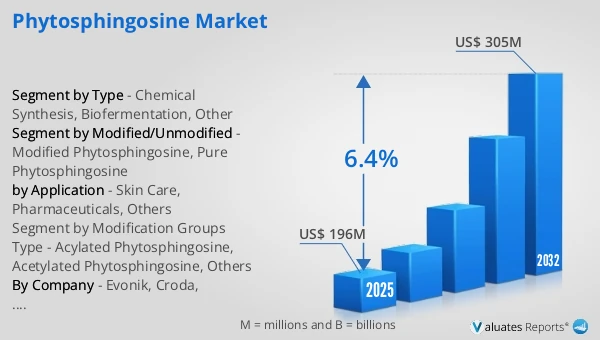
Phytosphingosine Market
The 2025 U.S. tariff policies introduce profound uncertainty into the global economic landscape. This report critically examines the implications of recent tariff adjustments and international strategic countermeasures on Phytosphingosine competitive dynamics, regional economic interdependencies, and supply chain reconfigurations.
Phytosphingosine is a naturally occurring sphingoid base found in the outer layer of human skin and in plants, serving as a key building block of ceramides and sphingolipids that maintain the skin barrier. It plays an important role in strengthening the stratum corneum, reducing transepidermal water loss (TEWL), and providing anti-inflammatory and antimicrobial benefits. In skincare and dermatological products, phytosphingosine is widely used to support barrier repair, soothe sensitive or irritated skin, and improve overall skin health. In 2025, global Phytosphingosine production reached approximately 89.4 tons, with an average global market price of around US$2194 usd per kg.The production capacity for Phytosphingosine in 2025 was approximately 100 tons. The typical gross profit margin for Phytosphingosine is between 20% and 40%.
The Phytosphingosine market is driven by growing demand for skin barrier repair, sensitive-skin care, and functional cosmetic ingredients, as phytosphingosine is a key bioactive lipid naturally present in the human stratum corneum and a precursor to ceramides. It is widely used in skincare and dermatological products for its anti-inflammatory, antimicrobial, and barrier-strengthening properties, with increasing adoption in premium skincare, derma-cosmetics, and medical skincare formulations. Market growth is supported by rising consumer awareness of skin health, the expansion of sensitive-skin and post-procedure care products, and innovation in modified phytosphingosine derivatives such as acetylated and salicyloyl forms. Europe and Asia-Pacific are major production and consumption regions, while industry trends focus on higher purity grades, improved stability, and multifunctional cosmetic actives.
This report delivers a comprehensive overview of the global Phytosphingosine market, with both quantitative and qualitative analyses, to help readers develop growth strategies, assess the competitive landscape, evaluate their position in the current market, and make informed business decisions regarding Phytosphingosine. The Phytosphingosine market size, estimates, and forecasts are provided in terms of output/shipments (Tons) and revenue (US$ millions), with 2025 as the base year and historical and forecast data for 2021–2032.
The report segments the global Phytosphingosine market comprehensively. Regional market sizes by Type, by Application, by Modified/Unmodified, and by company are also provided. For deeper insight, the report profiles the competitive landscape, key competitors, and their respective market rankings, and discusses technological trends and new product developments.
This report will assist Phytosphingosine manufacturers, new entrants, and companies across the industry value chain with information on revenues, production, and average prices for the overall market and its sub-segments, by company, by Type, by Application, and by region.
Market Segmentation
Scope of Phytosphingosine Market Report
| Report Metric |
Details |
| Report Name |
Phytosphingosine Market |
| Accounted market size in 2025 |
US$ 196 million |
| Forecasted market size in 2032 |
US$ 305 million |
| CAGR |
6.4% |
| Base Year |
2025 |
| Forecasted years |
2026 - 2032 |
| Segment by Type |
- Chemical Synthesis
- Biofermentation
- Other
|
| Segment by Modified/Unmodified |
- Modified Phytosphingosine
- Pure Phytosphingosine
|
| Segment by Modification Groups Type |
- Acylated Phytosphingosine
- Acetylated Phytosphingosine
- Others
|
| by Application |
- Skin Care
- Pharmaceuticals
- Others
|
| Production by Region |
- North America
- Europe
- China
- Japan
|
| Consumption by Region |
- North America (United States, Canada)
- Europe (Germany, France, UK, Italy, Russia)
- Asia-Pacific (China, Japan, South Korea, Taiwan)
- Southeast Asia (India)
- Latin America (Mexico, Brazil)
|
| By Company |
Evonik, Croda, Chongqing Zhihe Bio-pharmaceutical Co., Ltd., Cayman Chemical, Xi’an Realin Biotechnology Co., Ltd., Didi (Nanjing) Biotechnology Co., Ltd. |
| Forecast units |
USD million in value |
| Report coverage |
Revenue and volume forecast, company share, competitive landscape, growth factors and trends |
Chapter Outline
- Chapter 1: Defines the scope of the report and presents an executive summary of market segments (by Type, by Application, by Modified/Unmodified, etc.), including the size of each segment and its future growth potential. It offers a high-level view of the current market and its likely evolution in the short, medium, and long term.
- Chapter 2: Provides a detailed analysis of the competitive landscape for Phytosphingosine manufacturers, including prices, production, value-based market shares, latest development plans, and information on mergers and acquisitions.
- Chapter 3: Examines Phytosphingosine production/output and value by region and country, providing a quantitative assessment of market size and growth potential for each region over the next six years.
- Chapter 4: Analyzes Phytosphingosine consumption at the regional and country levels. It quantifies market size and growth potential for each region and its key countries, and outlines market development, outlook, addressable space, and national production.
- Chapter 5: Analyzes market segments by Type, covering the size and growth potential of each segment to help readers identify “blue ocean” opportunities.
- Chapter 6: Analyzes market segments by Application, covering the size and growth potential of each segment to help readers identify “blue ocean” opportunities in downstream markets.
- Chapter 7: Profiles key players, detailing the fundamentals of major companies, including product production/output, value, price, gross margin, product portfolio/introductions, and recent developments.
- Chapter 8: Reviews the industry value chain, including upstream and downstream segments.
- Chapter 9: Discusses market dynamics and recent developments, including drivers, restraints, challenges and risks for manufacturers, U.S. Tariffs and relevant policy analysis.
- Chapter 10: Summarizes the key findings and conclusions of the report.
FAQ for this report
How fast is Phytosphingosine Market growing?
Ans: The Phytosphingosine Market witnessing a CAGR of 6.4% during the forecast period 2026-2032.
What is the Phytosphingosine Market size in 2032?
Ans: The Phytosphingosine Market size in 2032 will be US$ 305 million.
Who are the main players in the Phytosphingosine Market report?
Ans: The main players in the Phytosphingosine Market are Evonik, Croda, Chongqing Zhihe Bio-pharmaceutical Co., Ltd., Cayman Chemical, Xi’an Realin Biotechnology Co., Ltd., Didi (Nanjing) Biotechnology Co., Ltd.
What are the Application segmentation covered in the Phytosphingosine Market report?
Ans: The Applications covered in the Phytosphingosine Market report are Skin Care, Pharmaceuticals, Others
What are the Type segmentation covered in the Phytosphingosine Market report?
Ans: The Types covered in the Phytosphingosine Market report are Acylated Phytosphingosine, Acetylated Phytosphingosine, Others