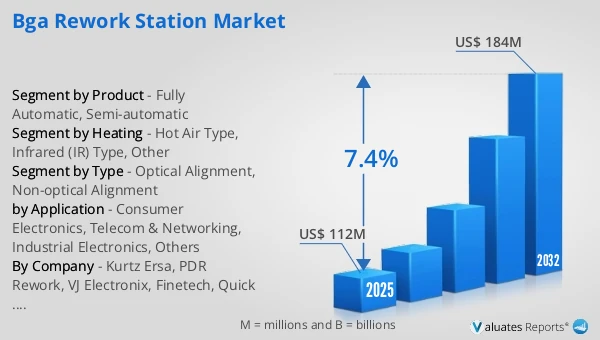
The global BGA Rework Station market was valued at US$ 112 million in 2025 and is anticipated to reach US$ 184 million by 2032, at a CAGR of 7.4% from 2026 to 2032.
BGA Rework Station Market
The 2025 U.S. tariff policies introduce profound uncertainty into the global economic landscape. This report critically examines the implications of recent tariff adjustments and international strategic countermeasures on BGA Rework Station competitive dynamics, regional economic interdependencies, and supply chain reconfigurations.
A BGA Rework Station is a specialized electronic manufacturing and repair machine used to remove, reball, and re-solder BGA (Ball Grid Array) and other area-array packaged components on printed circuit boards (PCBs). It is designed to precisely control temperature, alignment, and soldering profiles so that defective or failed chips can be replaced without damaging the PCB or surrounding components.
In modern electronics—where BGA, CSP, QFN, LGA, PoP, and FC-BGA packages are widely used—BGA rework stations are essential tools in electronics manufacturing (OEM/EMS), repair centers, and R&D labs.
In 2025, global BGA Rework Station sales volume reached approximately 4737 units, with an average global market price of around k US$ 23.58 per unit.
1. Increased Integration of Electronic Products and Continued Rise in BGA Packaging Penetration
As consumer electronics, automotive electronics, industrial control, and communication equipment continue to evolve towards miniaturization, high performance, and high reliability, the penetration rate of BGA (Ball Grid Array) and its derivative packages (such as CSP, FC-BGA, PoP, etc.) on PCBs has significantly increased. Compared to traditional pin-based packages, BGA offers advantages such as high pin density, superior electrical performance, and strong heat dissipation. However, its solder joints are hidden on the bottom of the chip, significantly increasing the difficulty of rework. Once issues such as cold solder joints, open solder joints, solder cracks, or chip failure occur, high-precision BGA rework equipment is essential for disassembly, ball re-balling, and resoldering. Therefore, the continued growth in BGA packaging usage directly drives the rigid demand for professional BGA rework equipment, becoming the most core and long-term structural driver of this market.
2. Manufacturing Yield Control and Repair Cost Pressures Drive Demand for "Reworkability"
In electronic manufacturing, especially in the areas of high-multilayer PCBs and high-value motherboards (such as server motherboards, automotive ECUs, and communication boards), scrapping entire boards results in extremely high material and labor costs. As OEMs and EMS manufacturers increasingly demand refined management of manufacturing yield, rework rates, and unit product costs, BGA rework has evolved from a "remedial measure" to a standardized production and after-sales process. High-repeatability, temperature-controlled, and automatically aligned BGA rework equipment can significantly reduce false rework rates and the risk of secondary damage, enabling companies to effectively control manufacturing and after-sales costs while ensuring product reliability. This demand, stemming from both "cost control" and "quality management," continues to drive the deployment of mid-to-high-end BGA rework equipment in factories and repair centers.
3. Rapid Expansion of the Automotive Electronics, Server, and High-End Industrial Equipment Markets The trends of automotive electrification and intelligentization have significantly increased the electronic content of individual vehicles, leading to a continuous increase in the application of BGA-packaged chips in ADAS, powertrain control, battery management systems (BMS), and in-vehicle infotainment systems. Simultaneously, the rapid growth in demand for high-performance, high-reliability motherboards from data centers, servers, and network communication equipment has expanded the application scenarios for BGA rework equipment in automotive electronics repair, server motherboard rework, and high-end industrial equipment maintenance. These fields place extremely high demands on rework equipment in terms of temperature profile control, repeatability, and process consistency, driving the market towards higher-automation, wider process windows, and higher-priced mid-to-high-end equipment, thereby increasing the overall market size and unit value.
This report delivers a comprehensive overview of the global BGA Rework Station market, with both quantitative and qualitative analyses, to help readers develop growth strategies, assess the competitive landscape, evaluate their position in the current market, and make informed business decisions regarding BGA Rework Station. The BGA Rework Station market size, estimates, and forecasts are provided in terms of output/shipments (K Units) and revenue (US$ millions), with 2025 as the base year and historical and forecast data for 2021–2032.
The report segments the global BGA Rework Station market comprehensively. Regional market sizes by Type, by Application, by Product, and by company are also provided. For deeper insight, the report profiles the competitive landscape, key competitors, and their respective market rankings, and discusses technological trends and new product developments.
This report will assist BGA Rework Station manufacturers, new entrants, and companies across the industry value chain with information on revenues, production, and average prices for the overall market and its sub-segments, by company, by Type, by Application, and by region.
Market Segmentation
Scope of BGA Rework Station Market Report
| Report Metric |
Details |
| Report Name |
BGA Rework Station Market |
| Accounted market size in 2025 |
US$ 112 million |
| Forecasted market size in 2032 |
US$ 184 million |
| CAGR |
7.4% |
| Base Year |
2025 |
| Forecasted years |
2026 - 2032 |
| Segment by Type |
- Optical Alignment
- Non-optical Alignment
|
| Segment by Product |
- Fully Automatic
- Semi-automatic
|
| Segment by Heating |
- Hot Air Type
- Infrared (IR) Type
- Other
|
| by Application |
- Consumer Electronics
- Telecom & Networking
- Industrial Electronics
- Others
|
| Production by Region |
- North America
- Europe
- China
- Japan
|
| Consumption by Region |
- North America (United States, Canada)
- Europe (Germany, France, UK, Italy, Russia)
- Asia-Pacific (China, Japan, South Korea, Taiwan)
- Southeast Asia (India)
- Latin America (Mexico, Brazil)
|
| By Company |
Kurtz Ersa, PDR Rework, VJ Electronix, Finetech, Quick Intelligent, PACE Worldwide, Den-On Instruments, Meisho, Dinghua Innovation, Seamark, Neoden Technology, DEZ Smart Tech |
| Forecast units |
USD million in value |
| Report coverage |
Revenue and volume forecast, company share, competitive landscape, growth factors and trends |
Chapter Outline
- Chapter 1: Defines the scope of the report and presents an executive summary of market segments (by Type, by Application, by Product, etc.), including the size of each segment and its future growth potential. It offers a high-level view of the current market and its likely evolution in the short, medium, and long term.
- Chapter 2: Provides a detailed analysis of the competitive landscape for BGA Rework Station manufacturers, including prices, production, value-based market shares, latest development plans, and information on mergers and acquisitions.
- Chapter 3: Examines BGA Rework Station production/output and value by region and country, providing a quantitative assessment of market size and growth potential for each region over the next six years.
- Chapter 4: Analyzes BGA Rework Station consumption at the regional and country levels. It quantifies market size and growth potential for each region and its key countries, and outlines market development, outlook, addressable space, and national production.
- Chapter 5: Analyzes market segments by Type, covering the size and growth potential of each segment to help readers identify “blue ocean” opportunities.
- Chapter 6: Analyzes market segments by Application, covering the size and growth potential of each segment to help readers identify “blue ocean” opportunities in downstream markets.
- Chapter 7: Profiles key players, detailing the fundamentals of major companies, including product production/output, value, price, gross margin, product portfolio/introductions, and recent developments.
- Chapter 8: Reviews the industry value chain, including upstream and downstream segments.
- Chapter 9: Discusses market dynamics and recent developments, including drivers, restraints, challenges and risks for manufacturers, U.S. Tariffs and relevant policy analysis.
- Chapter 10: Summarizes the key findings and conclusions of the report.
Ans: The BGA Rework Station Market witnessing a CAGR of 7.4% during the forecast period 2026-2032.
Ans: The BGA Rework Station Market size in 2032 will be US$ 184 million.
Ans: The main players in the BGA Rework Station Market are Kurtz Ersa, PDR Rework, VJ Electronix, Finetech, Quick Intelligent, PACE Worldwide, Den-On Instruments, Meisho, Dinghua Innovation, Seamark, Neoden Technology, DEZ Smart Tech
Ans: The Applications covered in the BGA Rework Station Market report are Consumer Electronics, Telecom & Networking, Industrial Electronics, Others
Ans: The Types covered in the BGA Rework Station Market report are Optical Alignment, Non-optical Alignment