FEATURED COMPANIES
Morgan Technical Ceramics
AdTech Ceramics
Kyocera
CeramTec
Ceramic Feedthroughs Market Size
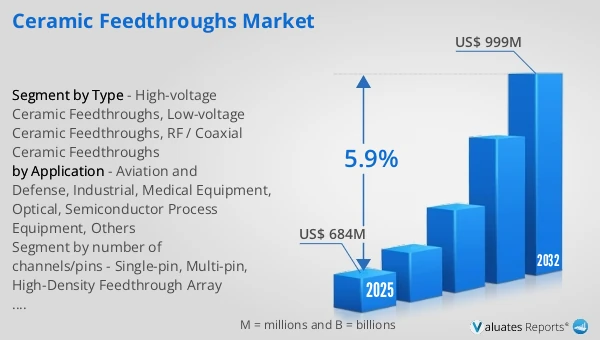
The global Ceramic Feedthroughs market was valued at US$ 684 million in 2025 and is anticipated to reach US$ 999 million by 2032, at a CAGR of 5.9% from 2026 to 2032.
Ceramic Feedthroughs Market
The 2025 U.S. tariff policies introduce profound uncertainty into the global economic landscape. This report critically examines the implications of recent tariff adjustments and international strategic countermeasures on Ceramic Feedthroughs competitive dynamics, regional economic interdependencies, and supply chain reconfigurations.
Ceramic feedthroughs (often called ceramic-to-metal feedthroughs or passthroughs) are assemblies that transfer electrical power/signals (and in some cases gases/fluids) from outside to inside a hermetic chamber, while maintaining hermetic sealing and electrical isolation across the boundary. Their core value proposition is “hermeticity + insulation,” enabling reliable penetrations through vacuum/pressure walls, housings, or sealed packages used in harsh environments. Product families typically span single-pin and multi-pin designs, power feedthroughs, instrumentation/thermocouple feedthroughs, and variants optimized for high voltage, high current, and aggressive environments; analytical/imaging OEM use cases often segment feedthroughs by power, instrumentation, and thermocouple functions.
Alumina (Al₂O₃) is the most widely used ceramic insulator due to its strong electrical insulation, corrosion resistance, and biocompatibility; depending on thermal, mechanical, and CTE-matching requirements, the industry may also use aluminum nitride, zirconia, sapphire, or glass-ceramic systems. From a process standpoint, mainstream routes include: (1) ceramic-to-metal “metallization + brazing/sealing,” a common framework for UHV-grade components and hermetic connectors; (2) glass-to-metal sealing (GTMS) and glass-ceramic-to-metal sealing, widely used to build vacuum-tight electrical connectors/feedthroughs and to address higher-temperature windows; and (3) HTCC/LTCC co-fired multilayer ceramics, where ceramics and conductors are co-fired into a monolithic body to enable higher interconnect density and more integrated feedthrough/package structures. In corrosion-critical domains such as implants, HTCC-based monolithic feedthrough concepts using noble metal conductors (e.g., platinum) are also seen.
Applications span vacuum and ultra-high vacuum systems, high-pressure environments (including subsea), cryogenic/high-temperature operation, and chemically aggressive conditions; key end markets include semiconductor/vacuum processing equipment, scanning/imaging and analytical instruments, aerospace/defense sensors and mil-spec components, and hermetic encapsulation for implantable medical electronics. Helium leak testing is a central qualification and QC step, directly tied to seal effectiveness and long-term reliability (e.g., preventing moisture ingress and corrosion-driven failures). Competitively, the market is capability-driven: leaders differentiate on advanced ceramic materials, ceramic/metal sealing know-how, reliability validation, and application-specific customization. The supplier base includes advanced-ceramics and hermetic component specialists (e.g., CeramTec/Ceramaseal), hermetic packaging and GTMS specialists (e.g., SCHOTT), and ceramic manufacturers with deep ceramic-to-metal joining and vacuum-component experience (e.g., Kyocera, Maruwa). Key trends/drivers include continued upgrades in vacuum/harsh-environment equipment; performance push toward higher voltage/current and tighter leak-rate requirements; miniaturization/high-density hermetic interconnect demand for implants and high-reliability sensing systems; and growth of high-pressure subsea use cases requiring robust insulation and sealing under extreme pressure.
This report delivers a comprehensive overview of the global Ceramic Feedthroughs market, with both quantitative and qualitative analyses, to help readers develop growth strategies, assess the competitive landscape, evaluate their position in the current market, and make informed business decisions regarding Ceramic Feedthroughs. The Ceramic Feedthroughs market size, estimates, and forecasts are provided in terms of output/shipments (Units) and revenue (US$ millions), with 2025 as the base year and historical and forecast data for 2021–2032.
The report segments the global Ceramic Feedthroughs market comprehensively. Regional market sizes by Type, by Application, by geometry/structure, and by company are also provided. For deeper insight, the report profiles the competitive landscape, key competitors, and their respective market rankings, and discusses technological trends and new product developments.
This report will assist Ceramic Feedthroughs manufacturers, new entrants, and companies across the industry value chain with information on revenues, production, and average prices for the overall market and its sub-segments, by company, by Type, by Application, and by region.
Market Segmentation
Scope of Ceramic Feedthroughs Market Report
| Report Metric |
Details |
| Report Name |
Ceramic Feedthroughs Market |
| Accounted market size in 2025 |
US$ 684 million |
| Forecasted market size in 2032 |
US$ 999 million |
| CAGR |
5.9% |
| Base Year |
2025 |
| Forecasted years |
2026 - 2032 |
| Segment by Type |
- High-voltage Ceramic Feedthroughs
- Low-voltage Ceramic Feedthroughs
- RF / Coaxial Ceramic Feedthroughs
|
| Segment by geometry/structure |
- Straight Pin
- Multilayer Routed Feedthrough
- Array
|
| Segment by number of channels/pins |
- Single-pin
- Multi-pin
- High-Density Feedthrough Array
|
| by Application |
- Aviation and Defense
- Industrial
- Medical Equipment
- Optical
- Semiconductor Process Equipment
- Others
|
| Production by Region |
- North America
- Europe
- China
- Japan
|
| Consumption by Region |
- North America (United States, Canada)
- Europe (Germany, France, UK, Italy, Russia)
- Asia-Pacific (China, Japan, South Korea, Taiwan)
- Southeast Asia (India)
- Latin America (Mexico, Brazil)
|
| By Company |
AMETEK AEGIS, AdTech Ceramics, Kyocera, EGIDE, Electronic Products (EPI), SCHOTT AG, Morgan Technical Ceramics, CeramTec, SCT |
| Forecast units |
USD million in value |
| Report coverage |
Revenue and volume forecast, company share, competitive landscape, growth factors and trends |
Chapter Outline
- Chapter 1: Defines the scope of the report and presents an executive summary of market segments (by Type, by Application, by geometry/structure, etc.), including the size of each segment and its future growth potential. It offers a high-level view of the current market and its likely evolution in the short, medium, and long term.
- Chapter 2: Provides a detailed analysis of the competitive landscape for Ceramic Feedthroughs manufacturers, including prices, production, value-based market shares, latest development plans, and information on mergers and acquisitions.
- Chapter 3: Examines Ceramic Feedthroughs production/output and value by region and country, providing a quantitative assessment of market size and growth potential for each region over the next six years.
- Chapter 4: Analyzes Ceramic Feedthroughs consumption at the regional and country levels. It quantifies market size and growth potential for each region and its key countries, and outlines market development, outlook, addressable space, and national production.
- Chapter 5: Analyzes market segments by Type, covering the size and growth potential of each segment to help readers identify “blue ocean” opportunities.
- Chapter 6: Analyzes market segments by Application, covering the size and growth potential of each segment to help readers identify “blue ocean” opportunities in downstream markets.
- Chapter 7: Profiles key players, detailing the fundamentals of major companies, including product production/output, value, price, gross margin, product portfolio/introductions, and recent developments.
- Chapter 8: Reviews the industry value chain, including upstream and downstream segments.
- Chapter 9: Discusses market dynamics and recent developments, including drivers, restraints, challenges and risks for manufacturers, U.S. Tariffs and relevant policy analysis.
- Chapter 10: Summarizes the key findings and conclusions of the report.
FAQ for this report
How fast is Ceramic Feedthroughs Market growing?
Ans: The Ceramic Feedthroughs Market witnessing a CAGR of 5.9% during the forecast period 2026-2032.
What is the Ceramic Feedthroughs Market size in 2032?
Ans: The Ceramic Feedthroughs Market size in 2032 will be US$ 999 million.
Who are the main players in the Ceramic Feedthroughs Market report?
Ans: The main players in the Ceramic Feedthroughs Market are AMETEK AEGIS, AdTech Ceramics, Kyocera, EGIDE, Electronic Products (EPI), SCHOTT AG, Morgan Technical Ceramics, CeramTec, SCT
What are the Application segmentation covered in the Ceramic Feedthroughs Market report?
Ans: The Applications covered in the Ceramic Feedthroughs Market report are Aviation and Defense, Industrial, Medical Equipment, Optical, Semiconductor Process Equipment, Others
What are the Type segmentation covered in the Ceramic Feedthroughs Market report?
Ans: The Types covered in the Ceramic Feedthroughs Market report are High-voltage Ceramic Feedthroughs, Low-voltage Ceramic Feedthroughs, RF / Coaxial Ceramic Feedthroughs