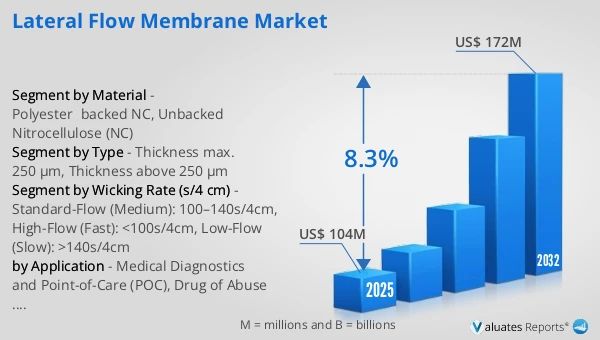
The global Lateral Flow Membrane market was valued at US$ 104 million in 2025 and is anticipated to reach US$ 172 million by 2032, at a CAGR of 8.3% from 2026 to 2032.
Lateral Flow Membrane Market
The 2025 U.S. tariff policies introduce profound uncertainty into the global economic landscape. This report critically examines the implications of recent tariff adjustments and international strategic countermeasures on Lateral Flow Membrane competitive dynamics, regional economic interdependencies, and supply chain reconfigurations.
Lateral Flow Membrane refers to the porous, capillary-driven substrate material in lateral flow test strips that enables liquid transport and immunoreaction on the strip. In its narrower, most common usage in the industry, the term primarily refers to the analytical/reaction membrane, typically a nitrocellulose (NC) membrane laminated onto a backing. NC possesses strong capillary action and high protein binding capacity, allowing the capture of biological reagents to be immobilized on both the test and control lines. As the liquid sample migrates laterally via capillary action, labeled detection conjugates (gold, latex, fluorescent particles, etc.) form complexes with the target analyte; these complexes are captured on the test line, generating a visible/quantifiable signal, while the control line confirms proper flow and reagent function. Note: In this report, "nitrocellulose (NC) membrane" refers only to the LFIA analytical/reaction membrane used in lateral flow test strips and does not include nitrocellulose membranes used for Western blotting.
In 2025, the global gross profit margin for Lateral Flow Membrane companies is projected to be approximately 44.36%-59.54%. Depending on the product's form, some companies use "rolls" (100 meters/roll) as the unit of measurement, while others use "sheets" or "square meters" (1 square meter/sheet). Prices vary depending on product specifications. Retail prices are approximately US$100-285 per roll, with leading international companies generally charging higher prices than Chinese manufacturers. Company production capacity varies; some small companies have only one production line, producing 3,000 rolls per month, while others produce approximately 300,000 square meters per year. This report calculates usage based on "test counts," and the global production of Lateral Flow Membrane is projected to reach 9,556 million tests in 2025. Upstream: Raw materials: cellulose (nitrocellulose, cellulose acetate, wetting agent liquid), solvents (methyl acetate, ethanol, dibutanol), PET film, glassine paper; Equipment: coating and cutting equipment, quality testing equipment, etc.; Downstream: in vitro diagnostics (IVD) and point-of-care testing (POCT) companies.
Market Trends
1. In 2023 and 2024, as the impact of the pandemic subsided, both sales volume and prices declined. Consequently, total market revenue in 2024 was lower than in 2021.
2. Products can be categorized into two types: membranes with a thickness of no more than 250 micrometers and membranes with a thickness greater than 250 micrometers. Membranes with a thickness of no more than 250 micrometers will be used in both 2024 and 2025. In 2025, 250 µm lateral flow immunoassay membranes will account for 89.3% of the global sales market share.
3. Applications are wide-ranging; this report categorizes them into medical diagnostics and point-of-care testing (POC), substance abuse detection, food safety and the environment, and other applications. The medical diagnostics and point-of-care testing (POC) sector is the most widely used application area, projected to account for approximately 79.82% of the global market size by 2025.
4. The United States, the European Union, China, and India are currently the main suppliers.
5. The Asia-Pacific region has been the largest market region globally for the past few years and is expected to continue growing in the coming years. It is projected that by 2024, the Asia-Pacific region will account for approximately 41.54% of the global market share, while Europe and North America will account for approximately 27.63% and 23.83%, respectively.
6. Merck, Sartorius, Danaher (Cytiva), AMD (MDI), and Suzhou Tianren are the major manufacturers in the global Lateral Flow Membrane market. It is projected that by 2025, the top five manufacturers will account for approximately 80.15% of the global market share.
Market Overview
Multi-scenario, Long-Cycle Consumption: Following the peak of the COVID-19 pandemic, lateral flow immunoassay (LFA) has maintained stable demand in areas such as infectious diseases, women's health, substance abuse, food safety, and veterinary testing. Looking ahead, demand will be driven by diversified testing product portfolios rather than single blockbuster products; therefore, the continuity of NC membrane supply and batch-to-batch consistency will receive greater attention.
Home Testing and Retail Channel Expansion, Intensified Price Competition: Home testing remains the primary driver of demand for lateral flow immunoassay (LFA) (especially in women's health and respiratory infections). In the future, more testing will shift to home testing, which will drive the development of NC membranes towards high-throughput roll-to-roll supply, automation-friendly specifications, and stricter control over capillary rate variations and background values. In terms of cost, post-pandemic, human chorionic gonadotropin (HCG) testing is the largest application area in the market. As the field is quite mature, companies compete by lowering prices and costs, with most using 20mm or 18mm pure nitrocellulose (NC) products.
High sensitivity and lower detection limits: Recent LFA development focuses on improving sensitivity and specificity (including signal enhancement, sample enrichment, advanced labeling, and improved analytical methods). A corresponding trend at the membrane end is that developers are increasingly focusing on balancing speed and performance through capillary action time (slower capillary action times generally improve sensitivity), pore structure, and surfactant treatment, making membrane screening a key step in assay optimization.
Multiple detection and more detection lines: Lateral flow immunochromatography (LFA) (detection of multiple targets on a single strip/cassette) is a significant advancement in rapid diagnostics. This raises the requirements for membranes, including uniform surface chemistry/porosity, clean and consistent multi-strip performance, lower background, and stable lateral flow characteristics—which often leads to a more segmented membrane portfolio (offering multiple SKUs based on capillary action rate/pore structure/surfactant system).
High-throughput, automated, and standardized membranes: Demand for lateral flow immunochromatography (LFA) membranes is expected to continue to grow, particularly for high-throughput, automated, and standardized membranes, driven by multiplexing, digital readings, point-of-care testing (POCT), and their wider applications in public health, food safety, and environmental monitoring. Suppliers capable of scaling up production capacity, ensuring consistent quality, and building global supply chain resilience will solidify their competitive advantage in the evolving diagnostics field.
This report delivers a comprehensive overview of the global Lateral Flow Membrane market, with both quantitative and qualitative analyses, to help readers develop growth strategies, assess the competitive landscape, evaluate their position in the current market, and make informed business decisions regarding Lateral Flow Membrane. The Lateral Flow Membrane market size, estimates, and forecasts are provided in terms of output/shipments (M Tests) and revenue (US$ millions), with 2025 as the base year and historical and forecast data for 2021–2032.
The report segments the global Lateral Flow Membrane market comprehensively. Regional market sizes by Type, by Application, by Material, and by company are also provided. For deeper insight, the report profiles the competitive landscape, key competitors, and their respective market rankings, and discusses technological trends and new product developments.
This report will assist Lateral Flow Membrane manufacturers, new entrants, and companies across the industry value chain with information on revenues, production, and average prices for the overall market and its sub-segments, by company, by Type, by Application, and by region.
Market Segmentation
Scope of Lateral Flow Membrane Market Report
| Report Metric |
Details |
| Report Name |
Lateral Flow Membrane Market |
| Accounted market size in 2025 |
US$ 104 million |
| Forecasted market size in 2032 |
US$ 172 million |
| CAGR |
8.3% |
| Base Year |
2025 |
| Forecasted years |
2026 - 2032 |
| Segment by Type |
- Thickness max. 250 µm
- Thickness above 250 µm
|
| Segment by Material |
- Polyester‑backed NC
- Unbacked Nitrocellulose (NC)
|
| Segment by Wicking Rate (s/4 cm) |
- Standard-Flow (Medium): 100–140s/4cm
- High-Flow (Fast): <100s/4cm
- Low-Flow (Slow): >140s/4cm
|
| by Application |
- Medical Diagnostics and Point-of-Care (POC)
- Drug of Abuse Testing
- Food Safety and Environmental
- Other Applications
|
| Production by Region |
- North America
- Europe
- China
- Japan
- India
|
| Consumption by Region |
- North America (United States, Canada)
- Europe (Germany, France, UK, Italy, Russia)
- Asia-Pacific (China, Japan, South Korea, Taiwan)
- Southeast Asia (India)
- Latin America (Mexico, Brazil)
|
| By Company |
Merck, Sartorius, Danaher (Cytiva), Advantec, Advanced Microdevices (MDI), Equinox Biotech, Tianren, Zhejiang Tailin Bioengineering, BSK Basic, Beijia New Material, Kingfa, Cobetter |
| Forecast units |
USD million in value |
| Report coverage |
Revenue and volume forecast, company share, competitive landscape, growth factors and trends |
Chapter Outline
- Chapter 1: Defines the scope of the report and presents an executive summary of market segments (by Type, by Application, by Material, etc.), including the size of each segment and its future growth potential. It offers a high-level view of the current market and its likely evolution in the short, medium, and long term.
- Chapter 2: Provides a detailed analysis of the competitive landscape for Lateral Flow Membrane manufacturers, including prices, production, value-based market shares, latest development plans, and information on mergers and acquisitions.
- Chapter 3: Examines Lateral Flow Membrane production/output and value by region and country, providing a quantitative assessment of market size and growth potential for each region over the next six years.
- Chapter 4: Analyzes Lateral Flow Membrane consumption at the regional and country levels. It quantifies market size and growth potential for each region and its key countries, and outlines market development, outlook, addressable space, and national production.
- Chapter 5: Analyzes market segments by Type, covering the size and growth potential of each segment to help readers identify “blue ocean” opportunities.
- Chapter 6: Analyzes market segments by Application, covering the size and growth potential of each segment to help readers identify “blue ocean” opportunities in downstream markets.
- Chapter 7: Profiles key players, detailing the fundamentals of major companies, including product production/output, value, price, gross margin, product portfolio/introductions, and recent developments.
- Chapter 8: Reviews the industry value chain, including upstream and downstream segments.
- Chapter 9: Discusses market dynamics and recent developments, including drivers, restraints, challenges and risks for manufacturers, U.S. Tariffs and relevant policy analysis.
- Chapter 10: Summarizes the key findings and conclusions of the report.
Ans: The main players in the Lateral Flow Membrane Market are Merck, Sartorius, Danaher (Cytiva), Advantec, Advanced Microdevices (MDI), Equinox Biotech, Tianren, Zhejiang Tailin Bioengineering, BSK Basic, Beijia New Material, Kingfa, Cobetter