0
U.S. (TOLL FREE)
+1 (315) 215-3225
Automative

0
U.S. (TOLL FREE)
+1 (315) 215-3225
Global Robot Operating System (ROS) Market Research Report 2026
Published Date: 2026-03-31
|
Report Code: QYRE-Auto-21G2735
Home | Market Reports
Global Robot Operating System ROS Market Insights and Forecast to 2028
BUY CHAPTERS

Global Robot Operating System (ROS) Market Research Report 2026

Code: QYRE-Auto-21G2735
Report
2026-03-31
Pages:96
QYResearch
Buy Now with 15% Discount
DESCRIPTION
TABLE OF CONTENT
TABLES & FIGURES

Robot Operating System (ROS) Market Size

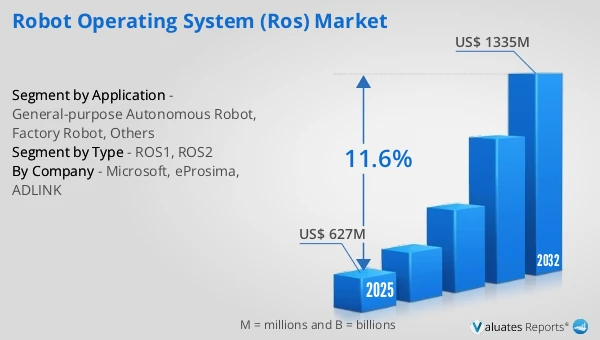
The global Robot Operating System (ROS) market was valued at US$ 627 million in 2025 and is anticipated to reach US$ 1335 million by 2032, at a CAGR of 11.6% from 2026 to 2032.

Robot Operating System (ROS) Market

Robot Operating System (ROS) Market

Robot Operating System (ROS or ros) refers open-source robotics middleware suite. Although ROS is not an operating system but a collection of software frameworks for robot software development, it provides services designed for a heterogeneous computer cluster such as hardware abstraction, low-level device control, implementation of commonly used functionality, message-passing between processes, and package management.
With the development, the influence of ROS has also expanded from academia to commercial use. Over time, ROS has become a widely used platform covering a wide variety of robotics applications. According to market research, many robotics companies and industrial companies have adopted ROS systems to develop products for new markets.
The global Robot Operating System (ROS) market is growing due to rising demand for machine automation. Industrial automation, increased research and development (R&D) funding for collaborative modular robotics execution, and demand for robots-as-a-service (RaaS)-based models have all contributed to the growth of the Robot Operating System (ROS) market.
The continuous improvement of robot technology requires ROS/ROS2 to better and more seamlessly support AI technology, and integrates machine learning and visual analysis capabilities into the basic functions of robots. This is the main technical development direction of ROS in the future.
Key points:
The market prospects are good and is about to usher in explosive growth.
March 19, 2024,Nvidia and Qualcomm join Open Source Robotics Alliance to support ROS development.
18 March 2024,Open Robotics Launches the Open Source Robotics Alliance.
This report delivers a comprehensive overview of the global Robot Operating System (ROS) market, with both quantitative and qualitative analyses, to help readers develop growth strategies, assess the competitive landscape, evaluate their position in the current market, and make informed business decisions regarding Robot Operating System (ROS). The Robot Operating System (ROS) market size, estimates, and forecasts are provided in terms of revenue (US$ millions), with 2025 as the base year and historical and forecast data for 2021–2032.
The report segments the global Robot Operating System (ROS) market comprehensively. Regional market sizes by Type, by Application, , and by player are also provided. For deeper insight, the report profiles the competitive landscape, key competitors, and their respective market rankings, and discusses technological trends and new product developments.
This report will assist Robot Operating System (ROS) manufacturers, new entrants, and companies across the industry value chain with information on revenues, sales volume, and average prices for the overall market and its sub-segments, by company, by Type, by Application, and by region.
Market Segmentation

Scope of Robot Operating System (ROS) Market Report

Report Metric Details
Report Name Robot Operating System (ROS) Market
Accounted market size in 2025 US$ 627 million
Forecasted market size in 2032 US$ 1335 million
CAGR 11.6%
Base Year 2025
Forecasted years 2026 - 2032
Segment by Type
  • ROS1
  • ROS2
Segment by Application
  • General-purpose Autonomous Robot
  • Factory Robot
  • Others
By Region
  • North America (United States, Canada)
  • Europe (Germany, France, UK, Italy, Russia) Rest of Europe
  • Nordic Countries
  • Asia-Pacific (China, Japan, South Korea)
  • Southeast Asia (India, Australia)
  • Rest of Asia
  • Latin America (Mexico, Brazil)
  • Rest of Latin America
  • Middle East & Africa (Turkey, Saudi Arabia, UAE, Rest of MEA)
By Company Microsoft, eProsima, ADLINK
Forecast units USD million in value
Report coverage Revenue and volume forecast, company share, competitive landscape, growth factors and trends

Chapter Outline

  • Chapter 1: Defines the scope of the report and presents an executive summary of market segments (by Type, by Application, , etc.), including the size of each segment and its future growth potential. It offers a high-level view of the current market and its likely evolution in the short, medium, and long term.
  • Chapter 2: Summarizes global and regional market size and outlines market dynamics and recent developments, including key drivers, restraints, challenges and risks for industry participants, and relevant policy analysis.
  • Chapter 3: Provides a detailed view of the competitive landscape for Robot Operating System (ROS) companies, covering revenue share, development plans, and mergers and acquisitions.
  • Chapter 4: Analyzes segments by Type, detailing the size and growth potential of each segment to help readers identify blue-ocean opportunities.
  • Chapter 5: Analyzes segments by Application, detailing the size and growth potential of each downstream segment to help readers identify blue-ocean opportunities.
  • Chapter 6–10: Regional deep dives (North America, Europe, Asia Pacific, Latin America, Middle East & Africa) broken down by country. Each chapter quantifies market size and growth potential by region and key countries, and outlines market development, outlook, addressable space, and capacity.
  • Chapter 11: Profiles key players, presenting essential information on leading companies, including product/ service offerings, revenue, gross margin, product introductions/portfolios, recent developments, etc.
  • Chapter 12: Key findings and conclusions of the report.

FAQ for this report

How fast is Robot Operating System (ROS) Market growing?

Ans: The Robot Operating System (ROS) Market witnessing a CAGR of 11.6% during the forecast period 2026-2032.

What is the Robot Operating System (ROS) Market size in 2032?

Ans: The Robot Operating System (ROS) Market size in 2032 will be US$ 1335 million.

Who are the main players in the Robot Operating System (ROS) Market report?

Ans: The main players in the Robot Operating System (ROS) Market are Microsoft, eProsima, ADLINK

What are the Application segmentation covered in the Robot Operating System (ROS) Market report?

Ans: The Applications covered in the Robot Operating System (ROS) Market report are General-purpose Autonomous Robot, Factory Robot, Others

What are the Type segmentation covered in the Robot Operating System (ROS) Market report?

Ans: The Types covered in the Robot Operating System (ROS) Market report are ROS1, ROS2

1 Report Overview
1.1 Study Scope
1.2 Market Analysis by Type
1.2.1 Global Robot Operating System (ROS) Market Size Growth Rate by Type: 2021 vs 2025 vs 2032
1.2.2 ROS1
1.2.3 ROS2
1.3 Market by Application
1.3.1 Global Robot Operating System (ROS) Market Growth by Application: 2021 vs 2025 vs 2032
1.3.2 General-purpose Autonomous Robot
1.3.3 Factory Robot
1.3.4 Others
1.4 Assumptions and Limitations
1.5 Study Objectives
1.6 Years Considered
2 Global Growth Trends
2.1 Global Robot Operating System (ROS) Market Perspective (2021–2032)
2.2 Global Robot Operating System (ROS) Growth Trends by Region
2.2.1 Global Robot Operating System (ROS) Market Size by Region: 2021 vs 2025 vs 2032
2.2.2 Robot Operating System (ROS) Historic Market Size by Region (2021–2026)
2.2.3 Robot Operating System (ROS) Forecasted Market Size by Region (2027–2032)
2.3 Robot Operating System (ROS) Market Dynamics
2.3.1 Robot Operating System (ROS) Industry Trends
2.3.2 Robot Operating System (ROS) Market Drivers
2.3.3 Robot Operating System (ROS) Market Challenges
2.3.4 Robot Operating System (ROS) Market Restraints
3 Competition Landscape by Key Players
3.1 Global Top Robot Operating System (ROS) Players by Revenue
3.1.1 Global Top Robot Operating System (ROS) Players by Revenue (2021–2026)
3.1.2 Global Robot Operating System (ROS) Revenue Market Share by Players (2021–2026)
3.2 Global Top Robot Operating System (ROS) Players Market Share by Company Tier (Tier 1, Tier 2, Tier 3)
3.3 Global Key Players Ranking by Robot Operating System (ROS) Revenue
3.4 Global Robot Operating System (ROS) Market Concentration Ratio
3.4.1 Global Robot Operating System (ROS) Market Concentration Ratio (CR5 and HHI)
3.4.2 Global Top 10 and Top 5 Companies by Robot Operating System (ROS) Revenue in 2025
3.5 Global Key Players of Robot Operating System (ROS) Head Offices and Areas Served
3.6 Global Key Players of Robot Operating System (ROS), Products and Applications
3.7 Global Key Players of Robot Operating System (ROS), Date of General Availability (GA)
3.8 Mergers and Acquisitions, Expansion Plans
4 Robot Operating System (ROS) Breakdown Data by Type
4.1 Global Robot Operating System (ROS) Historic Market Size by Type (2021–2026)
4.2 Global Robot Operating System (ROS) Forecasted Market Size by Type (2027–2032)
5 Robot Operating System (ROS) Breakdown Data by Application
5.1 Global Robot Operating System (ROS) Historic Market Size by Application (2021–2026)
5.2 Global Robot Operating System (ROS) Forecasted Market Size by Application (2027–2032)
6 North America
6.1 North America Robot Operating System (ROS) Market Size (2021–2032)
6.2 North America Robot Operating System (ROS) Market Growth Rate by Country: 2021 vs 2025 vs 2032
6.3 North America Robot Operating System (ROS) Market Size by Country (2021–2026)
6.4 North America Robot Operating System (ROS) Market Size by Country (2027–2032)
6.5 United States
6.6 Canada
7 Europe
7.1 Europe Robot Operating System (ROS) Market Size (2021–2032)
7.2 Europe Robot Operating System (ROS) Market Growth Rate by Country: 2021 vs 2025 vs 2032
7.3 Europe Robot Operating System (ROS) Market Size by Country (2021–2026)
7.4 Europe Robot Operating System (ROS) Market Size by Country (2027–2032)
7.5 Germany
7.6 France
7.7 U.K.
7.8 Italy
7.9 Russia
7.10 Ireland
8 Asia-Pacific
8.1 Asia-Pacific Robot Operating System (ROS) Market Size (2021–2032)
8.2 Asia-Pacific Robot Operating System (ROS) Market Growth Rate by Region: 2021 vs 2025 vs 2032
8.3 Asia-Pacific Robot Operating System (ROS) Market Size by Region (2021–2026)
8.4 Asia-Pacific Robot Operating System (ROS) Market Size by Region (2027–2032)
8.5 China
8.6 Japan
8.7 South Korea
8.8 Southeast Asia
8.9 India
8.10 Australia & New Zealand
9 Latin America
9.1 Latin America Robot Operating System (ROS) Market Size (2021–2032)
9.2 Latin America Robot Operating System (ROS) Market Growth Rate by Country: 2021 vs 2025 vs 2032
9.3 Latin America Robot Operating System (ROS) Market Size by Country (2021–2026)
9.4 Latin America Robot Operating System (ROS) Market Size by Country (2027–2032)
9.5 Mexico
9.6 Brazil
10 Middle East & Africa
10.1 Middle East & Africa Robot Operating System (ROS) Market Size (2021–2032)
10.2 Middle East & Africa Robot Operating System (ROS) Market Growth Rate by Country: 2021 vs 2025 vs 2032
10.3 Middle East & Africa Robot Operating System (ROS) Market Size by Country (2021–2026)
10.4 Middle East & Africa Robot Operating System (ROS) Market Size by Country (2027–2032)
10.5 Israel
10.6 Saudi Arabia
10.7 UAE
11 Key Players Profiles
11.1 Microsoft
11.1.1 Microsoft Company Details
11.1.2 Microsoft Business Overview
11.1.3 Microsoft Robot Operating System (ROS) Introduction
11.1.4 Microsoft Revenue in Robot Operating System (ROS) Business (2021–2026)
11.1.5 Microsoft Recent Development
11.2 eProsima
11.2.1 eProsima Company Details
11.2.2 eProsima Business Overview
11.2.3 eProsima Robot Operating System (ROS) Introduction
11.2.4 eProsima Revenue in Robot Operating System (ROS) Business (2021–2026)
11.2.5 eProsima Recent Development
11.3 ADLINK
11.3.1 ADLINK Company Details
11.3.2 ADLINK Business Overview
11.3.3 ADLINK Robot Operating System (ROS) Introduction
11.3.4 ADLINK Revenue in Robot Operating System (ROS) Business (2021–2026)
11.3.5 ADLINK Recent Development
12 Analyst's Viewpoints/Conclusions
13 Appendix
13.1 Research Methodology
13.1.1 Methodology/Research Approach
13.1.1.1 Research Programs/Design
13.1.1.2 Market Size Estimation
13.1.1.3 Market Breakdown and Data Triangulation
13.1.2 Data Source
13.1.2.1 Secondary Sources
13.1.2.2 Primary Sources
13.2 Author Details
13.3 Disclaimer
List of Tables
 Table 1. Global Robot Operating System (ROS) Market Size Growth Rate by Type (US$ Million): 2021 vs 2025 vs 2032
 Table 2. Key Players of ROS1
 Table 3. Key Players of ROS2
 Table 4. Global Robot Operating System (ROS) Market Size Growth by Application (US$ Million): 2021 vs 2025 vs 2032
 Table 5. Global Robot Operating System (ROS) Market Size by Region (US$ Million): 2021 vs 2025 vs 2032
 Table 6. Global Robot Operating System (ROS) Market Size by Region (US$ Million), 2021–2026
 Table 7. Global Robot Operating System (ROS) Market Share by Region (2021–2026)
 Table 8. Global Robot Operating System (ROS) Forecasted Market Size by Region (US$ Million), 2027–2032
 Table 9. Global Robot Operating System (ROS) Market Share by Region (2027–2032)
 Table 10. Robot Operating System (ROS) Market Trends
 Table 11. Robot Operating System (ROS) Market Drivers
 Table 12. Robot Operating System (ROS) Market Challenges
 Table 13. Robot Operating System (ROS) Market Restraints
 Table 14. Global Robot Operating System (ROS) Revenue by Players (US$ Million), 2021–2026
 Table 15. Global Robot Operating System (ROS) Market Share by Players (2021–2026)
 Table 16. Global Top Robot Operating System (ROS) Players by Tier (Tier 1, Tier 2, and Tier 3), based on Robot Operating System (ROS) Revenue, 2025
 Table 17. Ranking of Global Top Robot Operating System (ROS) Companies by Revenue (US$ Million) in 2025
 Table 18. Global 5 Largest Players Market Share by Robot Operating System (ROS) Revenue (CR5 and HHI), 2021–2026
 Table 19. Global Key Players of Robot Operating System (ROS), Headquarters and Area Served
 Table 20. Global Key Players of Robot Operating System (ROS), Products and Applications
 Table 21. Global Key Players of Robot Operating System (ROS), Date of General Availability (GA)
 Table 22. Mergers and Acquisitions, Expansion Plans
 Table 23. Global Robot Operating System (ROS) Market Size by Type (US$ Million), 2021–2026
 Table 24. Global Robot Operating System (ROS) Revenue Market Share by Type (2021–2026)
 Table 25. Global Robot Operating System (ROS) Forecasted Market Size by Type (US$ Million), 2027–2032
 Table 26. Global Robot Operating System (ROS) Revenue Market Share by Type (2027–2032)
 Table 27. Global Robot Operating System (ROS) Market Size by Application (US$ Million), 2021–2026
 Table 28. Global Robot Operating System (ROS) Revenue Market Share by Application (2021–2026)
 Table 29. Global Robot Operating System (ROS) Forecasted Market Size by Application (US$ Million), 2027–2032
 Table 30. Global Robot Operating System (ROS) Revenue Market Share by Application (2027–2032)
 Table 31. North America Robot Operating System (ROS) Market Size Growth Rate by Country (US$ Million): 2021 vs 2025 vs 2032
 Table 32. North America Robot Operating System (ROS) Market Size by Country (US$ Million), 2021–2026
 Table 33. North America Robot Operating System (ROS) Market Size by Country (US$ Million), 2027–2032
 Table 34. Europe Robot Operating System (ROS) Market Size Growth Rate by Country (US$ Million): 2021 vs 2025 vs 2032
 Table 35. Europe Robot Operating System (ROS) Market Size by Country (US$ Million), 2021–2026
 Table 36. Europe Robot Operating System (ROS) Market Size by Country (US$ Million), 2027–2032
 Table 37. Asia-Pacific Robot Operating System (ROS) Market Size Growth Rate by Region (US$ Million): 2021 vs 2025 vs 2032
 Table 38. Asia-Pacific Robot Operating System (ROS) Market Size by Region (US$ Million), 2021–2026
 Table 39. Asia-Pacific Robot Operating System (ROS) Market Size by Region (US$ Million), 2027–2032
 Table 40. Latin America Robot Operating System (ROS) Market Size Growth Rate by Country (US$ Million): 2021 vs 2025 vs 2032
 Table 41. Latin America Robot Operating System (ROS) Market Size by Country (US$ Million), 2021–2026
 Table 42. Latin America Robot Operating System (ROS) Market Size by Country (US$ Million), 2027–2032
 Table 43. Middle East & Africa Robot Operating System (ROS) Market Size Growth Rate by Country (US$ Million): 2021 vs 2025 vs 2032
 Table 44. Middle East & Africa Robot Operating System (ROS) Market Size by Country (US$ Million), 2021–2026
 Table 45. Middle East & Africa Robot Operating System (ROS) Market Size by Country (US$ Million), 2027–2032
 Table 46. Microsoft Company Details
 Table 47. Microsoft Business Overview
 Table 48. Microsoft Robot Operating System (ROS) Product
 Table 49. Microsoft Revenue in Robot Operating System (ROS) Business (US$ Million), 2021–2026
 Table 50. Microsoft Recent Development
 Table 51. eProsima Company Details
 Table 52. eProsima Business Overview
 Table 53. eProsima Robot Operating System (ROS) Product
 Table 54. eProsima Revenue in Robot Operating System (ROS) Business (US$ Million), 2021–2026
 Table 55. eProsima Recent Development
 Table 56. ADLINK Company Details
 Table 57. ADLINK Business Overview
 Table 58. ADLINK Robot Operating System (ROS) Product
 Table 59. ADLINK Revenue in Robot Operating System (ROS) Business (US$ Million), 2021–2026
 Table 60. ADLINK Recent Development
 Table 61. Research Programs/Design for This Report
 Table 62. Key Data Information from Secondary Sources
 Table 63. Key Data Information from Primary Sources
 Table 64. Authors List of This Report


List of Figures
 Figure 1. Robot Operating System (ROS) Picture
 Figure 2. Global Robot Operating System (ROS) Market Size Comparison by Type (US$ Million), 2021–2032
 Figure 3. Global Robot Operating System (ROS) Market Share by Type: 2025 vs 2032
 Figure 4. ROS1 Features
 Figure 5. ROS2 Features
 Figure 6. Global Robot Operating System (ROS) Market Size by Application (US$ Million), 2021–2032
 Figure 7. Global Robot Operating System (ROS) Market Share by Application: 2025 vs 2032
 Figure 8. General-purpose Autonomous Robot Case Studies
 Figure 9. Factory Robot Case Studies
 Figure 10. Others Case Studies
 Figure 11. Robot Operating System (ROS) Report Years Considered
 Figure 12. Global Robot Operating System (ROS) Market Size (US$ Million), Year-over-Year: 2021–2032
 Figure 13. Global Robot Operating System (ROS) Market Size, (US$ Million), 2021 vs 2025 vs 2032
 Figure 14. Global Robot Operating System (ROS) Market Share by Region: 2025 vs 2032
 Figure 15. Global Robot Operating System (ROS) Market Share by Players in 2025
 Figure 16. Global Robot Operating System (ROS) Market Share by Company Type (Tier 1, Tier 2, and Tier 3)
 Figure 17. The Top 10 and 5 Players Market Share by Robot Operating System (ROS) Revenue in 2025
 Figure 18. North America Robot Operating System (ROS) Market Size YoY Growth (US$ Million), 2021–2032
 Figure 19. North America Robot Operating System (ROS) Market Share by Country (2021–2032)
 Figure 20. United States Robot Operating System (ROS) Market Size YoY Growth (US$ Million), 2021–2032
 Figure 21. Canada Robot Operating System (ROS) Market Size YoY Growth (US$ Million), 2021–2032
 Figure 22. Europe Robot Operating System (ROS) Market Size YoY Growth (US$ Million), 2021–2032
 Figure 23. Europe Robot Operating System (ROS) Market Share by Country (2021–2032)
 Figure 24. Germany Robot Operating System (ROS) Market Size YoY Growth (US$ Million), 2021–2032
 Figure 25. France Robot Operating System (ROS) Market Size YoY Growth (US$ Million), 2021–2032
 Figure 26. U.K. Robot Operating System (ROS) Market Size YoY Growth (US$ Million), 2021–2032
 Figure 27. Italy Robot Operating System (ROS) Market Size YoY Growth (US$ Million), 2021–2032
 Figure 28. Russia Robot Operating System (ROS) Market Size YoY Growth (US$ Million), 2021–2032
 Figure 29. Ireland Robot Operating System (ROS) Market Size YoY Growth (US$ Million), 2021–2032
 Figure 30. Asia-Pacific Robot Operating System (ROS) Market Size YoY Growth (US$ Million), 2021–2032
 Figure 31. Asia-Pacific Robot Operating System (ROS) Market Share by Region (2021–2032)
 Figure 32. China Robot Operating System (ROS) Market Size YoY Growth (US$ Million), 2021–2032
 Figure 33. Japan Robot Operating System (ROS) Market Size YoY Growth (US$ Million), 2021–2032
 Figure 34. South Korea Robot Operating System (ROS) Market Size YoY Growth (US$ Million), 2021–2032
 Figure 35. Southeast Asia Robot Operating System (ROS) Market Size YoY Growth (US$ Million), 2021–2032
 Figure 36. India Robot Operating System (ROS) Market Size YoY Growth (US$ Million), 2021–2032
 Figure 37. Australia & New Zealand Robot Operating System (ROS) Market Size YoY Growth (US$ Million), 2021–2032
 Figure 38. Latin America Robot Operating System (ROS) Market Size YoY Growth (US$ Million), 2021–2032
 Figure 39. Latin America Robot Operating System (ROS) Market Share by Country (2021–2032)
 Figure 40. Mexico Robot Operating System (ROS) Market Size YoY Growth (US$ Million), 2021–2032
 Figure 41. Brazil Robot Operating System (ROS) Market Size YoY Growth (US$ Million), 2021–2032
 Figure 42. Middle East & Africa Robot Operating System (ROS) Market Size YoY Growth (US$ Million), 2021–2032
 Figure 43. Middle East & Africa Robot Operating System (ROS) Market Share by Country (2021–2032)
 Figure 44. Israel Robot Operating System (ROS) Market Size YoY Growth (US$ Million), 2021–2032
 Figure 45. Saudi Arabia Robot Operating System (ROS) Market Size YoY Growth (US$ Million), 2021–2032
 Figure 46. UAE Robot Operating System (ROS) Market Size YoY Growth (US$ Million), 2021–2032
 Figure 47. Microsoft Revenue Growth Rate in Robot Operating System (ROS) Business (2021–2026)
 Figure 48. eProsima Revenue Growth Rate in Robot Operating System (ROS) Business (2021–2026)
 Figure 49. ADLINK Revenue Growth Rate in Robot Operating System (ROS) Business (2021–2026)
 Figure 50. Bottom-up and Top-down Approaches for This Report
 Figure 51. Data Triangulation
 Figure 52. Key Executives Interviewed

SELECT A FORMAT
Added to Cart
Electronic

$2900

Single User License
Electronic

$4350

Multi User License
Electronic

$5800

Enterprise License
Add to Cart
Buy Now (15% Discount)

OUR CUSTOMER

Nano Dimension