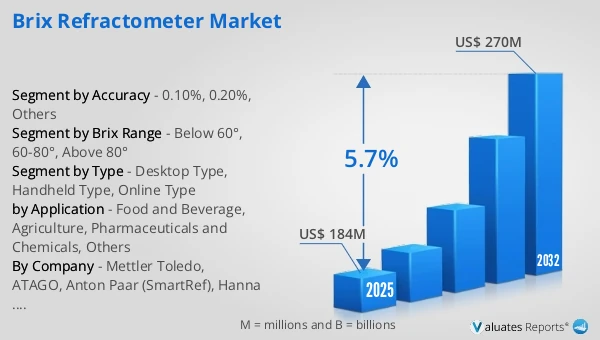
The global Brix Refractometer market was valued at US$ 184 million in 2025 and is anticipated to reach US$ 270 million by 2032, at a CAGR of 5.7% from 2026 to 2032.
Brix Refractometer Market
The 2025 U.S. tariff policies introduce profound uncertainty into the global economic landscape. This report critically examines the implications of recent tariff adjustments and international strategic countermeasures on Brix Refractometer competitive dynamics, regional economic interdependencies, and supply chain reconfigurations.
In 2025, global Brix Refractometer production reached approximately 446.43 K Units, with an average global market price of around 411 USD per Unit.
A Brix Refractometer is a measuring instrument used to determine °Brix, which represents the concentration of dissolved sugars and other soluble solids in a liquid solution. It works by measuring the refractive index of the sample—how much light bends as it passes through the liquid—and converting that optical property into a °Brix value. Brix Refractometers are widely used in agriculture, food and beverage production, and quality control to assess sweetness, ripeness, formulation consistency, and process stability.
The core upstream components of the Portable Brix Refractometer include prisms, temperature sensors, processor chips, stainless steel sample cells, LCD displays, and plastic housings. Typical upstream raw material suppliers include Foctek, Lante Optics, MLOPTIC, Solaris Optics, UPT, Microchip, STMicroelectronics, ROHM, Texas Instruments, ABLIC, Sunny Optical, and O-Film, among others. Downstream applications are primarily in the food and beverage, agriculture, pharmaceutical, and chemical industries, with typical users including Coca-Cola, Pepsi, SUNTORY, ASAHI SOFT DRINKS, and Ito En.
The Portable Brix Refractometer's single-line production capacity exhibits high flexibility, scalability, and rapid adaptability. A single standardized production line can flexibly adjust its output rhythm according to market demand. Under normal single-shift production, the annual capacity is approximately 50,000-80,000 units. If double-shift production is initiated to meet the phased demand of centralized procurement, the annual capacity of a single line can be further increased to 100,000-150,000 units. The overall gross profit margin of the Portable Brix Refractometer industry is in the range of 30%-40%.
The Brix Refractometer, with its unique features such as rapid and accurate detection based on the principle of light refraction, multi-scenario adaptability, and ease of operation, precisely addresses many core pain points in the detection of sugar/soluble solids in industries such as food and beverage, agriculture, and light processing. It has become a key piece of equipment for quality control and production efficiency improvement in various fields. Its core features and adaptability in addressing pain points are reflected in meeting the needs of the entire testing chain: the instrument requires no complex sample pretreatment, requires small sample volumes, and provides immediate results, completely solving the problems of long testing cycles, cumbersome operations, and high sample loss associated with traditional chemical titration methods. It is suitable for the immediate testing needs of production lines and fields, avoiding production errors or deviations in the timing of agricultural product harvesting due to testing delays. The test results are accurate, stable, and highly repeatable, effectively avoiding subjective errors from human experience-based judgment. It solves the problem of quality standardization and consistency control in various industries, providing objective and unified quantitative evidence for agricultural product grading, food production process control, and finished product quality inspection.
Regionally, mature markets in Europe and America focus on improving accuracy, data interconnectivity, and multi-substance testing compatibility. Simultaneously, the upgrading of the food industry and the advancement of precision agriculture continue to drive demand for equipment upgrades and functional enhancements. The Asia-Pacific region has become the core of global growth, relying on its vast food processing industry, large-scale agricultural planting bases, and end-consumer market, with continuously rising demand and leading the way in technological iteration and scenario adaptation. Emerging markets such as Latin America, Central and Eastern Europe, and Southeast Asia are seeing a gradual awakening of demand, driven by stricter food quality and safety controls and the development of agricultural industrialization, becoming a source of new growth for the industry. According to our data, the Asia-Pacific market share will exceed 40% of the global market in 2025, with a projected CAGR of 6.41% during the forecast period (2026-2032).
The global market has formed a mature pattern of differentiated competition and collaborative development between international giants and local leaders, with competition focusing on technology, cost-effectiveness, and adaptability to various scenarios. Key global players include Mettler Toledo, ATAGO, Anton Paar, Hanna Instruments, SCHMIDT + HAENSCH, Reichert (Ametek), KYOTO ELECTRONICS MANUFACTURIN, Rudolph Research Analytical, HM Digital, Fisher Scientific (Thermo Fisher Scientific), MISCO, A.KRÜSS Optronic GmbH, Bellingham + Stanley (Xylem Analytics), Laxco, Extech, PCE Instruments, and InsMark. These international brands dominate the high-end market with their deep expertise in optical technology and precision manufacturing capabilities. Their products emphasize high precision, intelligent data storage, and multi-parameter detection, and are widely used in research institutions and large food companies. Other company relying on their well-established supply chain and cost control capabilities, offer high-performance, cost-effective models to reach the mass market, including SMEs, farmers, and end-users. According to our data, the top five global players will account for over 50% of the global market share by 2025.
With increasingly stringent global food quality and safety controls, the widespread adoption of precision agriculture, and the advancement of large-scale and standardized operations in the food and beverage industry, the Brix Refractometer industry is experiencing core growth. Meanwhile, the expansion of research and testing applications and the increasing demand for consistent quality from end-consumer markets are further broadening its application scope. The Brix Refractometer's growth potential continues to be unleashed, and its development prospects are steadily improving.
This report delivers a comprehensive overview of the global Brix Refractometer market, with both quantitative and qualitative analyses, to help readers develop growth strategies, assess the competitive landscape, evaluate their position in the current market, and make informed business decisions regarding Brix Refractometer. The Brix Refractometer market size, estimates, and forecasts are provided in terms of output/shipments (K Units) and revenue (US$ millions), with 2025 as the base year and historical and forecast data for 2021–2032.
The report segments the global Brix Refractometer market comprehensively. Regional market sizes by Type, by Application, by Brix Range, and by company are also provided. For deeper insight, the report profiles the competitive landscape, key competitors, and their respective market rankings, and discusses technological trends and new product developments.
This report will assist Brix Refractometer manufacturers, new entrants, and companies across the industry value chain with information on revenues, production, and average prices for the overall market and its sub-segments, by company, by Type, by Application, and by region.
Market Segmentation
Scope of Brix Refractometer Market Report
| Report Metric |
Details |
| Report Name |
Brix Refractometer Market |
| Accounted market size in 2025 |
US$ 184 million |
| Forecasted market size in 2032 |
US$ 270 million |
| CAGR |
5.7% |
| Base Year |
2025 |
| Forecasted years |
2026 - 2032 |
| Segment by Type |
- Desktop Type
- Handheld Type
- Online Type
|
| Segment by Brix Range |
- Below 60°
- 60-80°
- Above 80°
|
| Segment by Accuracy |
|
| by Application |
- Food and Beverage
- Agriculture
- Pharmaceuticals and Chemicals
- Others
|
| Production by Region |
- North America
- Europe
- China
- Japan
|
| Consumption by Region |
- North America (United States, Canada)
- Europe (Germany, France, UK, Italy, Russia)
- Asia-Pacific (China, Japan, South Korea, Taiwan)
- Southeast Asia (India)
- Latin America (Mexico, Brazil)
|
| By Company |
Mettler Toledo, ATAGO, Anton Paar (SmartRef), Hanna Instruments, SCHMIDT + HAENSCH, Kyoto Electronics Manufacturing (KEM), Reichert (Ametek), Rudolph Research Analytical, MISCO, HM Digital, Changsha Chuyi Electromechanical, Linghang Lijia Mechanical & Electrical, Bellingham + Stanley (Xylem Analytics), Fisher Scientific (Thermo Fisher Scientific), A.KRÜSS Optronic GmbH, Extech (Teledyne FLIR), PCE Instruments, DeltaTrak, InsMark, Three-In-One Enterprises, Sper Scientific, REED Instruments, Takamori-kohki (TKR-1), Allafrance, VEE GEE Scientific, Milwaukee Instruments, Shinwa, Sinotester Biological, Laxco, Vaisala, Shanghai Zhaohui Pressure Apparatus, YiFan Technology |
| Forecast units |
USD million in value |
| Report coverage |
Revenue and volume forecast, company share, competitive landscape, growth factors and trends |
Chapter Outline
- Chapter 1: Defines the scope of the report and presents an executive summary of market segments (by Type, by Application, by Brix Range, etc.), including the size of each segment and its future growth potential. It offers a high-level view of the current market and its likely evolution in the short, medium, and long term.
- Chapter 2: Provides a detailed analysis of the competitive landscape for Brix Refractometer manufacturers, including prices, production, value-based market shares, latest development plans, and information on mergers and acquisitions.
- Chapter 3: Examines Brix Refractometer production/output and value by region and country, providing a quantitative assessment of market size and growth potential for each region over the next six years.
- Chapter 4: Analyzes Brix Refractometer consumption at the regional and country levels. It quantifies market size and growth potential for each region and its key countries, and outlines market development, outlook, addressable space, and national production.
- Chapter 5: Analyzes market segments by Type, covering the size and growth potential of each segment to help readers identify “blue ocean” opportunities.
- Chapter 6: Analyzes market segments by Application, covering the size and growth potential of each segment to help readers identify “blue ocean” opportunities in downstream markets.
- Chapter 7: Profiles key players, detailing the fundamentals of major companies, including product production/output, value, price, gross margin, product portfolio/introductions, and recent developments.
- Chapter 8: Reviews the industry value chain, including upstream and downstream segments.
- Chapter 9: Discusses market dynamics and recent developments, including drivers, restraints, challenges and risks for manufacturers, U.S. Tariffs and relevant policy analysis.
- Chapter 10: Summarizes the key findings and conclusions of the report.
Ans: The main players in the Brix Refractometer Market are Mettler Toledo, ATAGO, Anton Paar (SmartRef), Hanna Instruments, SCHMIDT + HAENSCH, Kyoto Electronics Manufacturing (KEM), Reichert (Ametek), Rudolph Research Analytical, MISCO, HM Digital, Changsha Chuyi Electromechanical, Linghang Lijia Mechanical & Electrical, Bellingham + Stanley (Xylem Analytics), Fisher Scientific (Thermo Fisher Scientific), A.KRÜSS Optronic GmbH, Extech (Teledyne FLIR), PCE Instruments, DeltaTrak, InsMark, Three-In-One Enterprises, Sper Scientific, REED Instruments, Takamori-kohki (TKR-1), Allafrance, VEE GEE Scientific, Milwaukee Instruments, Shinwa, Sinotester Biological, Laxco, Vaisala, Shanghai Zhaohui Pressure Apparatus, YiFan Technology