0
U.S. (TOLL FREE)
+1 (315) 215-3225
Automative

0
U.S. (TOLL FREE)
+1 (315) 215-3225
Global Co-Processed Excipients Market Research Report 2026
Published Date: 2026-03-31
|
Report Code: QYRE-Auto-21U897
Home | Market Reports | Business & Industrial| Pharmaceuticals & Biotech
Global Co Processed Excipients Market Insights Forecast to 2028
BUY CHAPTERS

Global Co-Processed Excipients Market Research Report 2026

Code: QYRE-Auto-21U897
Report
2026-03-31
Pages:136
QYResearch
Buy Now with 15% Discount
DESCRIPTION
TABLE OF CONTENT
TABLES & FIGURES

Co-Processed Excipients Market Size

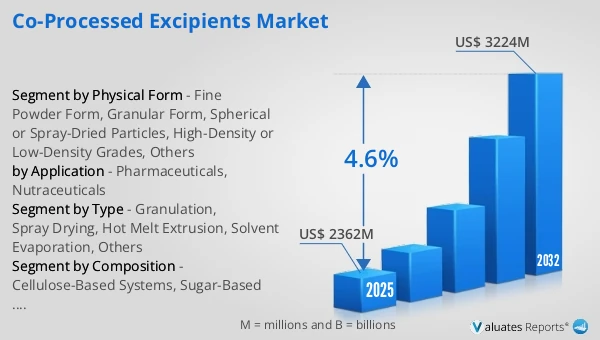
The global Co-Processed Excipients market was valued at US$ 2362 million in 2025 and is anticipated to reach US$ 3224 million by 2032, at a CAGR of 4.6% from 2026 to 2032.

Co-Processed Excipients Market

Co-Processed Excipients Market

The 2025 U.S. tariff policies introduce profound uncertainty into the global economic landscape. This report critically examines the implications of recent tariff adjustments and international strategic countermeasures on Co-Processed Excipients competitive dynamics, regional economic interdependencies, and supply chain reconfigurations.
Co-processed excipients are combinations of two or more individual excipients that are physically modified without chemical alteration to enhance their functionalities, such as flowability, compressibility, or dissolution properties. These excipients are engineered to achieve synergies in performance compared to their individual components, making them particularly valuable in pharmaceutical formulations, especially for direct compression and tablet manufacturing.
Characteristics of Co-Processed Excipients:
Physical but Not Chemical Modification: No chemical bonds are formed; their advantages arise from optimized physical properties.
Improved Functionality: Enhanced performance metrics like compressibility, flowability, and reduced tablet capping.
Reduced Formulation Complexity: Combining multiple functionalities into a single excipient simplifies production and quality control.
Cost Efficiency: They can reduce the total number of excipients and minimize manufacturing steps.
In 2024, global Co-Processed Excipients production reached approximately 336.4 K MT, with an average global market price of around US$ 6,782 per MT. The global single-line production capacity ranges from 25 to 40 K MT per year. The industry's gross profit margin is approximately 25%-35%.
One of the most significant trends shaping the co-processed excipients industry is the move from traditional excipients to functionality-based excipient systems. Historically, excipients were viewed as inert substances that merely served as fillers, binders, or disintegrants. However, modern drug development increasingly recognizes excipients as key formulation enablers. Co-processed excipients exemplify this evolution by delivering multifunctional performance—enhancing flow properties, tablet hardness, disintegration, and content uniformity simultaneously. As new active pharmaceutical ingredients (APIs) become more potent, sensitive, and poorly compressible, formulators are turning to co-processed excipients to overcome these challenges without resorting to complex granulation processes. This functional transformation aligns with the pharmaceutical industry’s broader shift toward efficiency, robustness, and reduced processing steps.
The expansion of direct compression (DC) technology is another major driver of co-processed excipient development. Direct compression simplifies tablet manufacturing by eliminating wet granulation and drying steps, significantly reducing time, cost, and energy consumption. However, DC requires excipients with exceptional flowability and compressibility—properties not always achievable through traditional materials. Co-processed excipients like MCC-lactose or MCC-mannitol blends are specifically engineered for this purpose, providing uniform particle size, reduced segregation, and consistent die filling. The increasing industrial adoption of DC, particularly in generic drug production, is accelerating the demand for co-processed excipients that can perform well under high-speed tableting conditions and maintain tablet uniformity even with low-dose or moisture-sensitive APIs.
Another major trend is the increasing use of co-processed excipients in orally disintegrating tablets (ODTs) and other patient-centric dosage forms. Modern consumers, especially pediatric and geriatric populations, prefer formulations that are easy to swallow and pleasant in taste. Co-processed excipients containing mannitol, sorbitol, or other sugar alcohols are commonly employed to provide rapid disintegration, good mouthfeel, and taste-masking capabilities. Their ability to balance mechanical strength and fast disintegration makes them ideal for ODT manufacturing, which demands both robustness during packaging and rapid dissolution upon administration. The trend toward self-administration, improved patient compliance, and personalized dosing formats further supports the integration of co-processed excipients into new drug delivery systems, including chewable tablets, sublinguals, and dispersible powders.
Regulatory acceptance is another important trend in the co-processed excipient industry. While co-processed excipients are composed of existing, pharmacopeia-listed materials, their combination creates a new physical entity that requires characterization and justification for regulatory submission. Regulatory bodies such as the U.S. Food and Drug Administration (FDA) and European Medicines Agency (EMA) have gradually acknowledged co-processed excipients as legitimate formulation components, provided their safety, performance, and stability are well-documented. The increasing publication of monographs and quality standards for co-processed excipients in compendia such as the European Pharmacopoeia (Ph. Eur.) and United States Pharmacopeia (USP) is a clear sign of regulatory progress. This recognition helps reduce barriers to market entry and encourages further innovation in excipient development.
Co-processed excipients industry has a low level of market concentration, for top 5 companies only occupying less than 30% of the global market. Global important companies in co-processed excipients includes Roquette, JSR Pharma and Shin-Etsu.
This report delivers a comprehensive overview of the global Co-Processed Excipients market, with both quantitative and qualitative analyses, to help readers develop growth strategies, assess the competitive landscape, evaluate their position in the current market, and make informed business decisions regarding Co-Processed Excipients. The Co-Processed Excipients market size, estimates, and forecasts are provided in terms of shipments (Kilotons) and revenue (US$ millions), with 2025 as the base year and historical and forecast data for 2021–2032.
The report segments the global Co-Processed Excipients market comprehensively. Regional market sizes by Type, by Application, by Dosage Form, and by company are also provided. For deeper insight, the report profiles the competitive landscape, key competitors, and their respective market rankings, and discusses technological trends and new product developments.
This report will assist Co-Processed Excipients manufacturers, new entrants, and companies across the industry value chain with information on revenues, production, and average prices for the overall market and its sub-segments, by company, by Type, by Application, and by region.
Market Segmentation

Scope of Co-Processed Excipients Market Report

Report Metric Details
Report Name Co-Processed Excipients Market
Accounted market size in 2025 US$ 2362 million
Forecasted market size in 2032 US$ 3224 million
CAGR 4.6%
Base Year 2025
Forecasted years 2026 - 2032
Segment by Type
  • Granulation
  • Spray Drying
  • Hot Melt Extrusion
  • Solvent Evaporation
  • Others
Segment by Dosage Form
  • Direct Compression Tablets
  • Orally Disintegrating Tablets (ODTs)
  • Effervescent Tablets or Powders
  • Capsule Fillers and Pellets
  • Others
Segment by Composition
  • Cellulose-Based Systems
  • Sugar-Based Systems
  • Inorganic-Organic Blends
  • Polyol-Based Systems
  • Others
Segment by Physical Form
  • Fine Powder Form
  • Granular Form
  • Spherical or Spray-Dried Particles
  • High-Density or Low-Density Grades
  • Others
by Application
  • Pharmaceuticals
  • Nutraceuticals
Production by Region
  • North America
  • Europe
  • China
  • Japan
Consumption by Region
  • North America (United States, Canada)
  • Europe (Germany, France, UK, Italy, Russia)
  • Asia-Pacific (China, Japan, South Korea, Taiwan)
  • Southeast Asia (India)
  • Latin America (Mexico, Brazil)
By Company Meggle, Roquette, BASF, JRS Pharma, ABF Ingredients, Colorcon, Daicel Corporation, Shin-Etsu, IFF (DuPont), Fuji, Topchain
Forecast units USD million in value
Report coverage Revenue and volume forecast, company share, competitive landscape, growth factors and trends

Chapter Outline

  • Chapter 1: Defines the scope of the report and presents an executive summary of market segments (by Type, by Application, by Dosage Form, etc.), including the size of each segment and its future growth potential. It offers a high-level view of the current market and its likely evolution in the short, medium, and long term.
  • Chapter 2: Provides a detailed analysis of the competitive landscape for Co-Processed Excipients manufacturers, including prices, production, value-based market shares, latest development plans, and information on mergers and acquisitions.
  • Chapter 3: Examines Co-Processed Excipients production/output and value by region and country, providing a quantitative assessment of market size and growth potential for each region over the next six years.
  • Chapter 4: Analyzes Co-Processed Excipients consumption at the regional and country levels. It quantifies market size and growth potential for each region and its key countries, and outlines market development, outlook, addressable space, and national production.
  • Chapter 5: Analyzes market segments by Type, covering the size and growth potential of each segment to help readers identify “blue ocean” opportunities.
  • Chapter 6: Analyzes market segments by Application, covering the size and growth potential of each segment to help readers identify “blue ocean” opportunities in downstream markets.
  • Chapter 7: Profiles key players, detailing the fundamentals of major companies, including product production/output, value, price, gross margin, product portfolio/introductions, and recent developments.
  • Chapter 8: Reviews the industry value chain, including upstream and downstream segments.
  • Chapter 9: Discusses market dynamics and recent developments, including drivers, restraints, challenges and risks for manufacturers, U.S. Tariffs and relevant policy analysis.
  • Chapter 10: Summarizes the key findings and conclusions of the report.

FAQ for this report

How fast is Co-Processed Excipients Market growing?

Ans: The Co-Processed Excipients Market witnessing a CAGR of 4.6% during the forecast period 2026-2032.

What is the Co-Processed Excipients Market size in 2032?

Ans: The Co-Processed Excipients Market size in 2032 will be US$ 3224 million.

What is the market share of major companies in Co-Processed Excipients Market?

Ans: Co-processed excipients industry has a low level of market concentration, for top 5 companies only occupying less than 30% of the global market.

Who are the main players in the Co-Processed Excipients Market report?

Ans: The main players in the Co-Processed Excipients Market are Meggle, Roquette, BASF, JRS Pharma, ABF Ingredients, Colorcon, Daicel Corporation, Shin-Etsu, IFF (DuPont), Fuji, Topchain

What are the Application segmentation covered in the Co-Processed Excipients Market report?

Ans: The Applications covered in the Co-Processed Excipients Market report are Pharmaceuticals, Nutraceuticals

What are the Type segmentation covered in the Co-Processed Excipients Market report?

Ans: The Types covered in the Co-Processed Excipients Market report are Granulation, Spray Drying, Hot Melt Extrusion, Solvent Evaporation, Others

1 Co-Processed Excipients Market Overview
1.1 Product Definition
1.2 Co-Processed Excipients by Type
1.2.1 Global Co-Processed Excipients Market Value Growth Rate Analysis by Type: 2025 vs 2032
1.2.2 Granulation
1.2.3 Spray Drying
1.2.4 Hot Melt Extrusion
1.2.5 Solvent Evaporation
1.2.6 Others
1.3 Co-Processed Excipients by Dosage Form
1.3.1 Global Co-Processed Excipients Market Value Growth Rate Analysis by Dosage Form: 2025 vs 2032
1.3.2 Direct Compression Tablets
1.3.3 Orally Disintegrating Tablets (ODTs)
1.3.4 Effervescent Tablets or Powders
1.3.5 Capsule Fillers and Pellets
1.3.6 Others
1.4 Co-Processed Excipients by Composition
1.4.1 Global Co-Processed Excipients Market Value Growth Rate Analysis by Composition: 2025 vs 2032
1.4.2 Cellulose-Based Systems
1.4.3 Sugar-Based Systems
1.4.4 Inorganic-Organic Blends
1.4.5 Polyol-Based Systems
1.4.6 Others
1.5 Co-Processed Excipients by Physical Form
1.5.1 Global Co-Processed Excipients Market Value Growth Rate Analysis by Physical Form: 2025 vs 2032
1.5.2 Fine Powder Form
1.5.3 Granular Form
1.5.4 Spherical or Spray-Dried Particles
1.5.5 High-Density or Low-Density Grades
1.5.6 Others
1.6 Co-Processed Excipients by Application
1.6.1 Global Co-Processed Excipients Market Value Growth Rate Analysis by Application: 2025 vs 2032
1.6.2 Pharmaceuticals
1.6.3 Nutraceuticals
1.7 Global Market Growth Prospects
1.7.1 Global Co-Processed Excipients Production Value Estimates and Forecasts (2021–2032)
1.7.2 Global Co-Processed Excipients Production Capacity Estimates and Forecasts (2021–2032)
1.7.3 Global Co-Processed Excipients Production Estimates and Forecasts (2021–2032)
1.7.4 Global Co-Processed Excipients Market Average Price Estimates and Forecasts (2021–2032)
1.8 Assumptions and Limitations
2 Market Competition by Manufacturers
2.1 Global Co-Processed Excipients Production Market Share by Manufacturers (2021–2026)
2.2 Global Co-Processed Excipients Production Value Market Share by Manufacturers (2021–2026)
2.3 Global Key Players of Co-Processed Excipients, Industry Ranking, 2024 vs 2025
2.4 Global Co-Processed Excipients Market Share by Company Tier (Tier 1, Tier 2, Tier 3)
2.5 Global Co-Processed Excipients Average Price by Manufacturers (2021–2026)
2.6 Global Key Manufacturers of Co-Processed Excipients, Manufacturing Footprints and Headquarters
2.7 Global Key Manufacturers of Co-Processed Excipients, Product Offerings and Applications
2.8 Global Key Manufacturers of Co-Processed Excipients, Date of Entry into the Industry
2.9 Co-Processed Excipients Market Competitive Situation and Trends
2.9.1 Co-Processed Excipients Market Concentration Rate
2.9.2 Top 5 and Top 10 Global Co-Processed Excipients Players Market Share by Revenue
2.10 Mergers & Acquisitions and Expansion
3 Co-Processed Excipients Production by Region
3.1 Global Co-Processed Excipients Production Value Estimates and Forecasts by Region: 2021 vs 2025 vs 2032
3.2 Global Co-Processed Excipients Production Value by Region (2021–2032)
3.2.1 Global Co-Processed Excipients Production Value by Region (2021–2026)
3.2.2 Global Forecasted Production Value of Co-Processed Excipients by Region (2027–2032)
3.3 Global Co-Processed Excipients Production Estimates and Forecasts by Region: 2021 vs 2025 vs 2032
3.4 Global Co-Processed Excipients Production Volume by Region (2021–2032)
3.4.1 Global Co-Processed Excipients Production by Region (2021–2026)
3.4.2 Global Forecasted Production of Co-Processed Excipients by Region (2027–2032)
3.5 Global Co-Processed Excipients Market Price Analysis by Region (2021–2026)
3.6 Global Co-Processed Excipients Production, Value, and Year-over-Year Growth
3.6.1 North America Co-Processed Excipients Production Value Estimates and Forecasts (2021–2032)
3.6.2 Europe Co-Processed Excipients Production Value Estimates and Forecasts (2021–2032)
3.6.3 China Co-Processed Excipients Production Value Estimates and Forecasts (2021–2032)
3.6.4 Japan Co-Processed Excipients Production Value Estimates and Forecasts (2021–2032)
4 Co-Processed Excipients Consumption by Region
4.1 Global Co-Processed Excipients Consumption Estimates and Forecasts by Region: 2021 vs 2025 vs 2032
4.2 Global Co-Processed Excipients Consumption by Region (2021–2032)
4.2.1 Global Co-Processed Excipients Consumption by Region (2021–2026)
4.2.2 Global Co-Processed Excipients Forecasted Consumption by Region (2027–2032)
4.3 North America
4.3.1 North America Co-Processed Excipients Consumption Growth Rate by Country: 2021 vs 2025 vs 2032
4.3.2 North America Co-Processed Excipients Consumption by Country (2021–2032)
4.3.3 U.S.
4.3.4 Canada
4.4 Europe
4.4.1 Europe Co-Processed Excipients Consumption Growth Rate by Country: 2021 vs 2025 vs 2032
4.4.2 Europe Co-Processed Excipients Consumption by Country (2021–2032)
4.4.3 Germany
4.4.4 France
4.4.5 U.K.
4.4.6 Italy
4.4.7 Russia
4.5 Asia Pacific
4.5.1 Asia Pacific Co-Processed Excipients Consumption Growth Rate by Region: 2021 vs 2025 vs 2032
4.5.2 Asia Pacific Co-Processed Excipients Consumption by Region (2021–2032)
4.5.3 China
4.5.4 Japan
4.5.5 South Korea
4.5.6 China Taiwan
4.5.7 Southeast Asia
4.5.8 India
4.6 Latin America, Middle East & Africa
4.6.1 Latin America, Middle East & Africa Co-Processed Excipients Consumption Growth Rate by Country: 2021 vs 2025 vs 2032
4.6.2 Latin America, Middle East & Africa Co-Processed Excipients Consumption by Country (2021–2032)
4.6.3 Mexico
4.6.4 Brazil
4.6.5 Turkey
4.6.6 GCC Countries
5 Segment by Type
5.1 Global Co-Processed Excipients Production by Type (2021–2032)
5.1.1 Global Co-Processed Excipients Production by Type (2021–2026)
5.1.2 Global Co-Processed Excipients Production by Type (2027–2032)
5.1.3 Global Co-Processed Excipients Production Market Share by Type (2021–2032)
5.2 Global Co-Processed Excipients Production Value by Type (2021–2032)
5.2.1 Global Co-Processed Excipients Production Value by Type (2021–2026)
5.2.2 Global Co-Processed Excipients Production Value by Type (2027–2032)
5.2.3 Global Co-Processed Excipients Production Value Market Share by Type (2021–2032)
5.3 Global Co-Processed Excipients Price by Type (2021–2032)
6 Segment by Application
6.1 Global Co-Processed Excipients Production by Application (2021–2032)
6.1.1 Global Co-Processed Excipients Production by Application (2021–2026)
6.1.2 Global Co-Processed Excipients Production by Application (2027–2032)
6.1.3 Global Co-Processed Excipients Production Market Share by Application (2021–2032)
6.2 Global Co-Processed Excipients Production Value by Application (2021–2032)
6.2.1 Global Co-Processed Excipients Production Value by Application (2021–2026)
6.2.2 Global Co-Processed Excipients Production Value by Application (2027–2032)
6.2.3 Global Co-Processed Excipients Production Value Market Share by Application (2021–2032)
6.3 Global Co-Processed Excipients Price by Application (2021–2032)
7 Key Companies Profiled
7.1 Meggle
7.1.1 Meggle Co-Processed Excipients Company Information
7.1.2 Meggle Co-Processed Excipients Product Portfolio
7.1.3 Meggle Co-Processed Excipients Production, Value, Price, and Gross Margin (2021–2026)
7.1.4 Meggle Main Business and Markets Served
7.1.5 Meggle Recent Developments/Updates
7.2 Roquette
7.2.1 Roquette Co-Processed Excipients Company Information
7.2.2 Roquette Co-Processed Excipients Product Portfolio
7.2.3 Roquette Co-Processed Excipients Production, Value, Price, and Gross Margin (2021–2026)
7.2.4 Roquette Main Business and Markets Served
7.2.5 Roquette Recent Developments/Updates
7.3 BASF
7.3.1 BASF Co-Processed Excipients Company Information
7.3.2 BASF Co-Processed Excipients Product Portfolio
7.3.3 BASF Co-Processed Excipients Production, Value, Price, and Gross Margin (2021–2026)
7.3.4 BASF Main Business and Markets Served
7.3.5 BASF Recent Developments/Updates
7.4 JRS Pharma
7.4.1 JRS Pharma Co-Processed Excipients Company Information
7.4.2 JRS Pharma Co-Processed Excipients Product Portfolio
7.4.3 JRS Pharma Co-Processed Excipients Production, Value, Price, and Gross Margin (2021–2026)
7.4.4 JRS Pharma Main Business and Markets Served
7.4.5 JRS Pharma Recent Developments/Updates
7.5 ABF Ingredients
7.5.1 ABF Ingredients Co-Processed Excipients Company Information
7.5.2 ABF Ingredients Co-Processed Excipients Product Portfolio
7.5.3 ABF Ingredients Co-Processed Excipients Production, Value, Price, and Gross Margin (2021–2026)
7.5.4 ABF Ingredients Main Business and Markets Served
7.5.5 ABF Ingredients Recent Developments/Updates
7.6 Colorcon
7.6.1 Colorcon Co-Processed Excipients Company Information
7.6.2 Colorcon Co-Processed Excipients Product Portfolio
7.6.3 Colorcon Co-Processed Excipients Production, Value, Price, and Gross Margin (2021–2026)
7.6.4 Colorcon Main Business and Markets Served
7.6.5 Colorcon Recent Developments/Updates
7.7 Daicel Corporation
7.7.1 Daicel Corporation Co-Processed Excipients Company Information
7.7.2 Daicel Corporation Co-Processed Excipients Product Portfolio
7.7.3 Daicel Corporation Co-Processed Excipients Production, Value, Price, and Gross Margin (2021–2026)
7.7.4 Daicel Corporation Main Business and Markets Served
7.7.5 Daicel Corporation Recent Developments/Updates
7.8 Shin-Etsu
7.8.1 Shin-Etsu Co-Processed Excipients Company Information
7.8.2 Shin-Etsu Co-Processed Excipients Product Portfolio
7.8.3 Shin-Etsu Co-Processed Excipients Production, Value, Price, and Gross Margin (2021–2026)
7.8.4 Shin-Etsu Main Business and Markets Served
7.8.5 Shin-Etsu Recent Developments/Updates
7.9 IFF (DuPont)
7.9.1 IFF (DuPont) Co-Processed Excipients Company Information
7.9.2 IFF (DuPont) Co-Processed Excipients Product Portfolio
7.9.3 IFF (DuPont) Co-Processed Excipients Production, Value, Price, and Gross Margin (2021–2026)
7.9.4 IFF (DuPont) Main Business and Markets Served
7.9.5 IFF (DuPont) Recent Developments/Updates
7.10 Fuji
7.10.1 Fuji Co-Processed Excipients Company Information
7.10.2 Fuji Co-Processed Excipients Product Portfolio
7.10.3 Fuji Co-Processed Excipients Production, Value, Price, and Gross Margin (2021–2026)
7.10.4 Fuji Main Business and Markets Served
7.10.5 Fuji Recent Developments/Updates
7.11 Topchain
7.11.1 Topchain Co-Processed Excipients Company Information
7.11.2 Topchain Co-Processed Excipients Product Portfolio
7.11.3 Topchain Co-Processed Excipients Production, Value, Price, and Gross Margin (2021–2026)
7.11.4 Topchain Main Business and Markets Served
7.11.5 Topchain Recent Developments/Updates
8 Industry Chain and Sales Channels Analysis
8.1 Co-Processed Excipients Industry Chain Analysis
8.2 Co-Processed Excipients Raw Material Supply Analysis
8.2.1 Key Raw Materials
8.2.2 Raw Materials Key Suppliers
8.3 Co-Processed Excipients Production Modes and Processes
8.4 Co-Processed Excipients Sales and Marketing
8.4.1 Co-Processed Excipients Sales Channels
8.4.2 Co-Processed Excipients Distributors
8.5 Co-Processed Excipients Customer Analysis
9 Co-Processed Excipients Market Dynamics
9.1 Co-Processed Excipients Industry Trends
9.2 Co-Processed Excipients Market Drivers
9.3 Co-Processed Excipients Market Challenges
9.4 Co-Processed Excipients Market Restraints
9.5 Impact of U.S. Tariffs
10 Research Findings and Conclusion
11 Methodology and Data Source
11.1 Methodology/Research Approach
11.1.1 Research Programs/Design
11.1.2 Market Size Estimation
11.1.3 Market Breakdown and Data Triangulation
11.2 Data Source
11.2.1 Secondary Sources
11.2.2 Primary Sources
11.3 Author List
11.4 Disclaimer
List of Tables
 Table 1. Global Co-Processed Excipients Market Value by Type (US$ Million), 2025 vs 2032
 Table 2. Global Co-Processed Excipients Market Value by Dosage Form (US$ Million), 2025 vs 2032
 Table 3. Global Co-Processed Excipients Market Value by Composition (US$ Million), 2025 vs 2032
 Table 4. Global Co-Processed Excipients Market Value by Physical Form (US$ Million), 2025 vs 2032
 Table 5. Global Co-Processed Excipients Market Value by Application (US$ Million), 2025 vs 2032
 Table 6. Global Co-Processed Excipients Production Capacity (Kilotons) by Manufacturers in 2025
 Table 7. Global Co-Processed Excipients Production by Manufacturers (Kilotons), 2021–2026
 Table 8. Global Co-Processed Excipients Production Market Share by Manufacturers (2021–2026)
 Table 9. Global Co-Processed Excipients Production Value by Manufacturers (US$ Million), 2021–2026
 Table 10. Global Co-Processed Excipients Production Value Share by Manufacturers (2021–2026)
 Table 11. Global Key Players of Co-Processed Excipients, Industry Ranking, 2024 vs 2025
 Table 12. Classification of Companies by Tier (Tier 1, Tier 2, Tier 3), based on Co-Processed Excipients Production Value, 2025
 Table 13. Global Market Co-Processed Excipients Average Price by Manufacturers (US$/Ton), 2021–2026
 Table 14. Global Key Manufacturers of Co-Processed Excipients, Manufacturing Footprints and Headquarters
 Table 15. Global Key Manufacturers of Co-Processed Excipients, Product Offerings and Applications
 Table 16. Global Key Manufacturers of Co-Processed Excipients, Date of Entry into the Industry
 Table 17. Global Co-Processed Excipients Manufacturers Market Concentration Ratio (CR5 and HHI)
 Table 18. Mergers & Acquisitions and Expansion Plans
 Table 19. Global Co-Processed Excipients Production Value by Region: 2021 vs 2025 vs 2032 (US$ Million)
 Table 20. Global Co-Processed Excipients Production Value (US$ Million) by Region (2021–2026)
 Table 21. Global Co-Processed Excipients Production Value Market Share by Region (2021–2026)
 Table 22. Global Co-Processed Excipients Production Value (US$ Million) Forecast by Region (2027–2032)
 Table 23. Global Co-Processed Excipients Production Value Market Share Forecast by Region (2027–2032)
 Table 24. Global Co-Processed Excipients Production Comparison by Region: 2021 vs 2025 vs 2032 (Kilotons)
 Table 25. Global Co-Processed Excipients Production (Kilotons) by Region (2021–2026)
 Table 26. Global Co-Processed Excipients Production Market Share by Region (2021–2026)
 Table 27. Global Co-Processed Excipients Production (Kilotons) Forecast by Region (2027–2032)
 Table 28. Global Co-Processed Excipients Production Market Share Forecast by Region (2027–2032)
 Table 29. Global Co-Processed Excipients Market Average Price (US$/Ton) by Region (2021–2026)
 Table 30. Global Co-Processed Excipients Market Average Price (US$/Ton) by Region (2027–2032)
 Table 31. Global Co-Processed Excipients Consumption Growth Rate by Region: 2021 vs 2025 vs 2032 (Kilotons)
 Table 32. Global Co-Processed Excipients Consumption by Region (Kilotons), 2021–2026
 Table 33. Global Co-Processed Excipients Consumption Market Share by Region (2021–2026)
 Table 34. Global Co-Processed Excipients Forecasted Consumption by Region (Kilotons), 2027–2032
 Table 35. Global Co-Processed Excipients Forecasted Consumption Market Share by Region (2027–2032)
 Table 36. North America Co-Processed Excipients Consumption Growth Rate by Country: 2021 vs 2025 vs 2032 (Kilotons)
 Table 37. North America Co-Processed Excipients Consumption by Country (Kilotons), 2021–2026
 Table 38. North America Co-Processed Excipients Consumption by Country (Kilotons), 2027–2032
 Table 39. Europe Co-Processed Excipients Consumption Growth Rate by Country: 2021 vs 2025 vs 2032 (Kilotons)
 Table 40. Europe Co-Processed Excipients Consumption by Country (Kilotons), 2021–2026
 Table 41. Europe Co-Processed Excipients Consumption by Country (Kilotons), 2027–2032
 Table 42. Asia Pacific Co-Processed Excipients Consumption Growth Rate by Region: 2021 vs 2025 vs 2032 (Kilotons)
 Table 43. Asia Pacific Co-Processed Excipients Consumption by Region (Kilotons), 2021–2026
 Table 44. Asia Pacific Co-Processed Excipients Consumption by Region (Kilotons), 2027–2032
 Table 45. Latin America, Middle East & Africa Co-Processed Excipients Consumption Growth Rate by Country: 2021 vs 2025 vs 2032 (Kilotons)
 Table 46. Latin America, Middle East & Africa Co-Processed Excipients Consumption by Country (Kilotons), 2021–2026
 Table 47. Latin America, Middle East & Africa Co-Processed Excipients Consumption by Country (Kilotons), 2027–2032
 Table 48. Global Co-Processed Excipients Production (Kilotons) by Type (2021–2026)
 Table 49. Global Co-Processed Excipients Production (Kilotons) by Type (2027–2032)
 Table 50. Global Co-Processed Excipients Production Market Share by Type (2021–2026)
 Table 51. Global Co-Processed Excipients Production Market Share by Type (2027–2032)
 Table 52. Global Co-Processed Excipients Production Value (US$ Million) by Type (2021–2026)
 Table 53. Global Co-Processed Excipients Production Value (US$ Million) by Type (2027–2032)
 Table 54. Global Co-Processed Excipients Production Value Market Share by Type (2021–2026)
 Table 55. Global Co-Processed Excipients Production Value Market Share by Type (2027–2032)
 Table 56. Global Co-Processed Excipients Price (US$/Ton) by Type (2021–2026)
 Table 57. Global Co-Processed Excipients Price (US$/Ton) by Type (2027–2032)
 Table 58. Global Co-Processed Excipients Production (Kilotons) by Application (2021–2026)
 Table 59. Global Co-Processed Excipients Production (Kilotons) by Application (2027–2032)
 Table 60. Global Co-Processed Excipients Production Market Share by Application (2021–2026)
 Table 61. Global Co-Processed Excipients Production Market Share by Application (2027–2032)
 Table 62. Global Co-Processed Excipients Production Value (US$ Million) by Application (2021–2026)
 Table 63. Global Co-Processed Excipients Production Value (US$ Million) by Application (2027–2032)
 Table 64. Global Co-Processed Excipients Production Value Market Share by Application (2021–2026)
 Table 65. Global Co-Processed Excipients Production Value Market Share by Application (2027–2032)
 Table 66. Global Co-Processed Excipients Price (US$/Ton) by Application (2021–2026)
 Table 67. Global Co-Processed Excipients Price (US$/Ton) by Application (2027–2032)
 Table 68. Meggle Co-Processed Excipients Company Information
 Table 69. Meggle Co-Processed Excipients Specification and Application
 Table 70. Meggle Co-Processed Excipients Production (Kilotons), Value (US$ Million), Price (US$/Ton) and Gross Margin (2021–2026)
 Table 71. Meggle Main Business and Markets Served
 Table 72. Meggle Recent Developments/Updates
 Table 73. Roquette Co-Processed Excipients Company Information
 Table 74. Roquette Co-Processed Excipients Specification and Application
 Table 75. Roquette Co-Processed Excipients Production (Kilotons), Value (US$ Million), Price (US$/Ton) and Gross Margin (2021–2026)
 Table 76. Roquette Main Business and Markets Served
 Table 77. Roquette Recent Developments/Updates
 Table 78. BASF Co-Processed Excipients Company Information
 Table 79. BASF Co-Processed Excipients Specification and Application
 Table 80. BASF Co-Processed Excipients Production (Kilotons), Value (US$ Million), Price (US$/Ton) and Gross Margin (2021–2026)
 Table 81. BASF Main Business and Markets Served
 Table 82. BASF Recent Developments/Updates
 Table 83. JRS Pharma Co-Processed Excipients Company Information
 Table 84. JRS Pharma Co-Processed Excipients Specification and Application
 Table 85. JRS Pharma Co-Processed Excipients Production (Kilotons), Value (US$ Million), Price (US$/Ton) and Gross Margin (2021–2026)
 Table 86. JRS Pharma Main Business and Markets Served
 Table 87. JRS Pharma Recent Developments/Updates
 Table 88. ABF Ingredients Co-Processed Excipients Company Information
 Table 89. ABF Ingredients Co-Processed Excipients Specification and Application
 Table 90. ABF Ingredients Co-Processed Excipients Production (Kilotons), Value (US$ Million), Price (US$/Ton) and Gross Margin (2021–2026)
 Table 91. ABF Ingredients Main Business and Markets Served
 Table 92. ABF Ingredients Recent Developments/Updates
 Table 93. Colorcon Co-Processed Excipients Company Information
 Table 94. Colorcon Co-Processed Excipients Specification and Application
 Table 95. Colorcon Co-Processed Excipients Production (Kilotons), Value (US$ Million), Price (US$/Ton) and Gross Margin (2021–2026)
 Table 96. Colorcon Main Business and Markets Served
 Table 97. Colorcon Recent Developments/Updates
 Table 98. Daicel Corporation Co-Processed Excipients Company Information
 Table 99. Daicel Corporation Co-Processed Excipients Specification and Application
 Table 100. Daicel Corporation Co-Processed Excipients Production (Kilotons), Value (US$ Million), Price (US$/Ton) and Gross Margin (2021–2026)
 Table 101. Daicel Corporation Main Business and Markets Served
 Table 102. Daicel Corporation Recent Developments/Updates
 Table 103. Shin-Etsu Co-Processed Excipients Company Information
 Table 104. Shin-Etsu Co-Processed Excipients Specification and Application
 Table 105. Shin-Etsu Co-Processed Excipients Production (Kilotons), Value (US$ Million), Price (US$/Ton) and Gross Margin (2021–2026)
 Table 106. Shin-Etsu Main Business and Markets Served
 Table 107. Shin-Etsu Recent Developments/Updates
 Table 108. IFF (DuPont) Co-Processed Excipients Company Information
 Table 109. IFF (DuPont) Co-Processed Excipients Specification and Application
 Table 110. IFF (DuPont) Co-Processed Excipients Production (Kilotons), Value (US$ Million), Price (US$/Ton) and Gross Margin (2021–2026)
 Table 111. IFF (DuPont) Main Business and Markets Served
 Table 112. IFF (DuPont) Recent Developments/Updates
 Table 113. Fuji Co-Processed Excipients Company Information
 Table 114. Fuji Co-Processed Excipients Specification and Application
 Table 115. Fuji Co-Processed Excipients Production (Kilotons), Value (US$ Million), Price (US$/Ton) and Gross Margin (2021–2026)
 Table 116. Fuji Main Business and Markets Served
 Table 117. Fuji Recent Developments/Updates
 Table 118. Topchain Co-Processed Excipients Company Information
 Table 119. Topchain Co-Processed Excipients Specification and Application
 Table 120. Topchain Co-Processed Excipients Production (Kilotons), Value (US$ Million), Price (US$/Ton) and Gross Margin (2021–2026)
 Table 121. Topchain Main Business and Markets Served
 Table 122. Topchain Recent Developments/Updates
 Table 123. Key Raw Materials Lists
 Table 124. Raw Materials Key Suppliers Lists
 Table 125. Co-Processed Excipients Distributors List
 Table 126. Co-Processed Excipients Customers List
 Table 127. Co-Processed Excipients Market Trends
 Table 128. Co-Processed Excipients Market Drivers
 Table 129. Co-Processed Excipients Market Challenges
 Table 130. Co-Processed Excipients Market Restraints
 Table 131. Research Programs/Design for This Report
 Table 132. Key Data Information from Secondary Sources
 Table 133. Key Data Information from Primary Sources
 Table 134. Authors List of This Report


List of Figures
 Figure 1. Product Picture of Co-Processed Excipients
 Figure 2. Global Co-Processed Excipients Market Value by Type (US$ Million), 2021–2032
 Figure 3. Global Co-Processed Excipients Market Share by Type: 2025 vs 2032
 Figure 4. Granulation Product Picture
 Figure 5. Spray Drying Product Picture
 Figure 6. Hot Melt Extrusion Product Picture
 Figure 7. Solvent Evaporation Product Picture
 Figure 8. Others Product Picture
 Figure 9. Global Co-Processed Excipients Market Value by Dosage Form (US$ Million), 2021–2032
 Figure 10. Global Co-Processed Excipients Market Share by Dosage Form: 2025 vs 2032
 Figure 11. Direct Compression Tablets Product Picture
 Figure 12. Orally Disintegrating Tablets (ODTs) Product Picture
 Figure 13. Effervescent Tablets or Powders Product Picture
 Figure 14. Capsule Fillers and Pellets Product Picture
 Figure 15. Others Product Picture
 Figure 16. Global Co-Processed Excipients Market Value by Composition (US$ Million), 2021–2032
 Figure 17. Global Co-Processed Excipients Market Share by Composition: 2025 vs 2032
 Figure 18. Cellulose-Based Systems Product Picture
 Figure 19. Sugar-Based Systems Product Picture
 Figure 20. Inorganic-Organic Blends Product Picture
 Figure 21. Polyol-Based Systems Product Picture
 Figure 22. Others Product Picture
 Figure 23. Global Co-Processed Excipients Market Value by Physical Form (US$ Million), 2021–2032
 Figure 24. Global Co-Processed Excipients Market Share by Physical Form: 2025 vs 2032
 Figure 25. Fine Powder Form Product Picture
 Figure 26. Granular Form Product Picture
 Figure 27. Spherical or Spray-Dried Particles Product Picture
 Figure 28. High-Density or Low-Density Grades Product Picture
 Figure 29. Others Product Picture
 Figure 30. Global Co-Processed Excipients Market Value by Application (US$ Million), 2021–2032
 Figure 31. Global Co-Processed Excipients Market Share by Application: 2025 vs 2032
 Figure 32. Pharmaceuticals
 Figure 33. Nutraceuticals
 Figure 34. Global Co-Processed Excipients Production Value (US$ Million), 2021 vs 2025 vs 2032
 Figure 35. Global Co-Processed Excipients Production Value (US$ Million), 2021–2032
 Figure 36. Global Co-Processed Excipients Production Capacity (Kilotons), 2021–2032
 Figure 37. Global Co-Processed Excipients Production (Kilotons), 2021–2032
 Figure 38. Global Co-Processed Excipients Average Price (US$/Ton), 2021–2032
 Figure 39. Co-Processed Excipients Report Years Considered
 Figure 40. Co-Processed Excipients Production Share by Manufacturers in 2025
 Figure 41. Global Co-Processed Excipients Production Value Share by Manufacturers (2025)
 Figure 42. Co-Processed Excipients Market Share by Company Type (Tier 1, Tier 2, and Tier 3): 2021 vs 2025
 Figure 43. Top 5 and Top 10 Global Players: Market Share by Co-Processed Excipients Revenue in 2025
 Figure 44. Global Co-Processed Excipients Production Value by Region: 2021 vs 2025 vs 2032 (US$ Million)
 Figure 45. Global Co-Processed Excipients Production Value Market Share by Region: 2021 vs 2025 vs 2032
 Figure 46. Global Co-Processed Excipients Production Comparison by Region: 2021 vs 2025 vs 2032 (Kilotons)
 Figure 47. Global Co-Processed Excipients Production Market Share by Region: 2021 vs 2025 vs 2032
 Figure 48. North America Co-Processed Excipients Production Value (US$ Million) Growth Rate (2021–2032)
 Figure 49. Europe Co-Processed Excipients Production Value (US$ Million) Growth Rate (2021–2032)
 Figure 50. China Co-Processed Excipients Production Value (US$ Million) Growth Rate (2021–2032)
 Figure 51. Japan Co-Processed Excipients Production Value (US$ Million) Growth Rate (2021–2032)
 Figure 52. Global Co-Processed Excipients Consumption by Region: 2021 vs 2025 vs 2032 (Kilotons)
 Figure 53. Global Co-Processed Excipients Consumption Market Share by Region: 2021 vs 2025 vs 2032
 Figure 54. North America Co-Processed Excipients Consumption and Growth Rate (Kilotons), 2021–2032
 Figure 55. North America Co-Processed Excipients Consumption Market Share by Country (2021–2032)
 Figure 56. U.S. Co-Processed Excipients Consumption and Growth Rate (Kilotons), 2021–2032
 Figure 57. Canada Co-Processed Excipients Consumption and Growth Rate (Kilotons), 2021–2032
 Figure 58. Europe Co-Processed Excipients Consumption and Growth Rate (Kilotons), 2021–2032
 Figure 59. Europe Co-Processed Excipients Consumption Market Share by Country (2021–2032)
 Figure 60. Germany Co-Processed Excipients Consumption and Growth Rate (Kilotons), 2021–2032
 Figure 61. France Co-Processed Excipients Consumption and Growth Rate (Kilotons), 2021–2032
 Figure 62. U.K. Co-Processed Excipients Consumption and Growth Rate (Kilotons), 2021–2032
 Figure 63. Italy Co-Processed Excipients Consumption and Growth Rate (Kilotons), 2021–2032
 Figure 64. Russia Co-Processed Excipients Consumption and Growth Rate (Kilotons), 2021–2032
 Figure 65. Asia Pacific Co-Processed Excipients Consumption and Growth Rate (Kilotons), 2021–2032
 Figure 66. Asia Pacific Co-Processed Excipients Consumption Market Share by Region (2021–2032)
 Figure 67. China Co-Processed Excipients Consumption and Growth Rate (Kilotons), 2021–2032
 Figure 68. Japan Co-Processed Excipients Consumption and Growth Rate (Kilotons), 2021–2032
 Figure 69. South Korea Co-Processed Excipients Consumption and Growth Rate (Kilotons), 2021–2032
 Figure 70. China Taiwan Co-Processed Excipients Consumption and Growth Rate (Kilotons), 2021–2032
 Figure 71. Southeast Asia Co-Processed Excipients Consumption and Growth Rate (Kilotons), 2021–2032
 Figure 72. India Co-Processed Excipients Consumption and Growth Rate (Kilotons), 2021–2032
 Figure 73. Latin America, Middle East & Africa Co-Processed Excipients Consumption and Growth Rate (Kilotons), 2021–2032
 Figure 74. Latin America, Middle East & Africa Co-Processed Excipients Consumption Market Share by Country (2021–2032)
 Figure 75. Mexico Co-Processed Excipients Consumption and Growth Rate (Kilotons), 2021–2032
 Figure 76. Brazil Co-Processed Excipients Consumption and Growth Rate (Kilotons), 2021–2032
 Figure 77. Turkey Co-Processed Excipients Consumption and Growth Rate (Kilotons), 2021–2032
 Figure 78. GCC Countries Co-Processed Excipients Consumption and Growth Rate (Kilotons), 2021–2032
 Figure 79. Global Production Market Share of Co-Processed Excipients by Type (2021–2032)
 Figure 80. Global Production Value Market Share of Co-Processed Excipients by Type (2021–2032)
 Figure 81. Global Co-Processed Excipients Price (US$/Ton) by Type (2021–2032)
 Figure 82. Global Production Market Share of Co-Processed Excipients by Application (2021–2032)
 Figure 83. Global Production Value Market Share of Co-Processed Excipients by Application (2021–2032)
 Figure 84. Global Co-Processed Excipients Price (US$/Ton) by Application (2021–2032)
 Figure 85. Co-Processed Excipients Value Chain
 Figure 86. Channels of Distribution (Direct Vs Distribution)
 Figure 87. Bottom-up and Top-down Approaches for This Report
 Figure 88. Data Triangulation

SELECT A FORMAT
Added to Cart
Electronic

$2900

Single User License
Electronic

$4350

Multi User License
Electronic

$5800

Enterprise License
Add to Cart
Buy Now (15% Discount)

OUR CUSTOMER

SIS Group of Schools