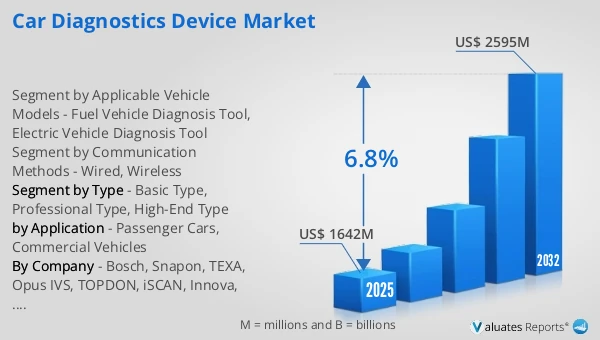
The global Car Diagnostics Device market was valued at US$ 1642 million in 2025 and is anticipated to reach US$ 2595 million by 2032, at a CAGR of 6.8% from 2026 to 2032.
Car Diagnostics Device Market
The 2025 U.S. tariff policies introduce profound uncertainty into the global economic landscape. This report critically examines the implications of recent tariff adjustments and international strategic countermeasures on Car Diagnostics Device competitive dynamics, regional economic interdependencies, and supply chain reconfigurations.
In 2025, global Car Diagnostics Device production reached approximately 410k units, with an average global market price of around US$4k per unit.
A car diagnostics device is a testing tool that communicates with a vehicle’s electronic control units (ECUs) via the onboard diagnostic interface (e.g., OBD) and OEM-specific protocols to read/clear diagnostic trouble codes, view live data streams, perform actuator tests and self-checks, and, in advanced use cases, support service resets, coding/adaptation, calibration, and limited programming. It is widely used in maintenance, troubleshooting, vehicle inspection, and fleet operations, covering powertrain, chassis and safety systems, body/comfort electronics, and high-voltage subsystems for new-energy vehicles. As vehicles move toward electrification, connectivity, and software-defined architectures, diagnostics devices are evolving from standalone tools into integrated platforms combining hardware, software, cloud databases, and remote services.
Upstream for car diagnostics devices consists mainly of electronics and materials suppliers, including MCUs/SoCs and memory, in-vehicle network transceivers and interface ICs (CAN/LIN/FlexRay/automotive Ethernet), display and touch modules, connectors and wiring harnesses, PCBs and power components, as well as plastic/metal housings and protective materials. Midstream players are device and software platform developers responsible for hardware integration, embedded firmware, protocol decoding, vehicle and fault knowledge-base maintenance, app/cloud updates, and subscription services. Downstream users include independent repair shops, authorized dealers, OEMs and tier suppliers, fleets and mobility operators, inspection stations, and training institutes. Representative upstream suppliers include semiconductors (NXP, STMicroelectronics), connectors (TE Connectivity, Amphenol), and displays (BOE, LG Display); representative downstream users include OEMs (Toyota, Volkswagen), service networks (Bosch Car Service), and fleet/inspection organizations.
The car diagnostics device market is shifting from hardware-centric tools toward software- and platform-driven solutions. As vehicle E/E architectures become more complex, powertrain, chassis safety, body/comfort electronics, and high-voltage EV subsystems require deeper data access and bidirectional controls, pushing diagnostics toward broader system coverage, guided troubleshooting, richer knowledge bases, and remote diagnostics capabilities. Industry trends include cloud-based vehicle databases and subscription updates becoming mainstream, tighter integration with workshop workflow management, service records, and fleet remote operations, and rising requirements for multi-protocol support (CAN/LIN/FlexRay/Ethernet) as well as cybersecurity and data compliance. Growth is driven by the expanding vehicle parc and aging fleet structure, increasing professionalism in aftermarket services, more sophisticated fleet maintenance practices, and new failure modes introduced by electrification and intelligent features. Challenges remain: OEM protocol restrictions and access limitations increase R&D and database maintenance burdens; advanced functions (coding/calibration/programming) depend more on compliance and authorization; and intense competition and price pressure, together with tighter security and regulatory requirements, force suppliers to continuously invest in data, algorithms, and service capabilities to stay competitive.
This report delivers a comprehensive overview of the global Car Diagnostics Device market, with both quantitative and qualitative analyses, to help readers develop growth strategies, assess the competitive landscape, evaluate their position in the current market, and make informed business decisions regarding Car Diagnostics Device. The Car Diagnostics Device market size, estimates, and forecasts are provided in terms of output/shipments (K Units) and revenue (US$ millions), with 2025 as the base year and historical and forecast data for 2021–2032.
The report segments the global Car Diagnostics Device market comprehensively. Regional market sizes by Type, by Application, by Applicable Vehicle Models, and by company are also provided. For deeper insight, the report profiles the competitive landscape, key competitors, and their respective market rankings, and discusses technological trends and new product developments.
This report will assist Car Diagnostics Device manufacturers, new entrants, and companies across the industry value chain with information on revenues, production, and average prices for the overall market and its sub-segments, by company, by Type, by Application, and by region.
Market Segmentation
Scope of Car Diagnostics Device Market Report
| Report Metric |
Details |
| Report Name |
Car Diagnostics Device Market |
| Accounted market size in 2025 |
US$ 1642 million |
| Forecasted market size in 2032 |
US$ 2595 million |
| CAGR |
6.8% |
| Base Year |
2025 |
| Forecasted years |
2026 - 2032 |
| Segment by Type |
- Basic Type
- Professional Type
- High-End Type
|
| Segment by Applicable Vehicle Models |
- Fuel Vehicle Diagnosis Tool
- Electric Vehicle Diagnosis Tool
|
| Segment by Communication Methods |
|
| by Application |
- Passenger Cars
- Commercial Vehicles
|
| Production by Region |
- North America
- Europe
- China
- Japan
|
| Consumption by Region |
- North America (United States, Canada)
- Europe (Germany, France, UK, Italy, Russia)
- Asia-Pacific (China, Japan, South Korea, Taiwan)
- Southeast Asia (India)
- Latin America (Mexico, Brazil)
|
| By Company |
Bosch, Snapon, TEXA, Opus IVS, TOPDON, iSCAN, Innova, Autocom, WOW! Würth Online World GmbH, Foxwell, Launch, Autel, THINKCAR, ANCEL, Iinplus, FCAR |
| Forecast units |
USD million in value |
| Report coverage |
Revenue and volume forecast, company share, competitive landscape, growth factors and trends |
Chapter Outline
- Chapter 1: Defines the scope of the report and presents an executive summary of market segments (by Type, by Application, by Applicable Vehicle Models, etc.), including the size of each segment and its future growth potential. It offers a high-level view of the current market and its likely evolution in the short, medium, and long term.
- Chapter 2: Provides a detailed analysis of the competitive landscape for Car Diagnostics Device manufacturers, including prices, production, value-based market shares, latest development plans, and information on mergers and acquisitions.
- Chapter 3: Examines Car Diagnostics Device production/output and value by region and country, providing a quantitative assessment of market size and growth potential for each region over the next six years.
- Chapter 4: Analyzes Car Diagnostics Device consumption at the regional and country levels. It quantifies market size and growth potential for each region and its key countries, and outlines market development, outlook, addressable space, and national production.
- Chapter 5: Analyzes market segments by Type, covering the size and growth potential of each segment to help readers identify “blue ocean” opportunities.
- Chapter 6: Analyzes market segments by Application, covering the size and growth potential of each segment to help readers identify “blue ocean” opportunities in downstream markets.
- Chapter 7: Profiles key players, detailing the fundamentals of major companies, including product production/output, value, price, gross margin, product portfolio/introductions, and recent developments.
- Chapter 8: Reviews the industry value chain, including upstream and downstream segments.
- Chapter 9: Discusses market dynamics and recent developments, including drivers, restraints, challenges and risks for manufacturers, U.S. Tariffs and relevant policy analysis.
- Chapter 10: Summarizes the key findings and conclusions of the report.
Ans: The Car Diagnostics Device Market witnessing a CAGR of 6.8% during the forecast period 2026-2032.
Ans: The Car Diagnostics Device Market size in 2032 will be US$ 2595 million.
Ans: The main players in the Car Diagnostics Device Market are Bosch, Snapon, TEXA, Opus IVS, TOPDON, iSCAN, Innova, Autocom, WOW! Würth Online World GmbH, Foxwell, Launch, Autel, THINKCAR, ANCEL, Iinplus, FCAR
Ans: The Applications covered in the Car Diagnostics Device Market report are Passenger Cars, Commercial Vehicles
Ans: The Types covered in the Car Diagnostics Device Market report are Basic Type, Professional Type, High-End Type