FEATURED COMPANIES
Brooks Automation
RORZE Corporation
Daihen Corporation
Hirata Corporation
Yaskawa
Nidec (Genmark Automation)
JEL Corporation
Kawasaki Robotics
Robostar
Robots and Design (RND)
HYULIM Robot
RAONTEC Inc
Tazmo
Rexxam
ULVAC
Kensington Laboratories
EPSON Robots
Hine Automation
Moog
Innovative Robotics
isel Germany AG
Sanwa Engineering Corporation
Siasun Robot & Automation
He-Five LLC.
Clean Transfer Robot Market Size
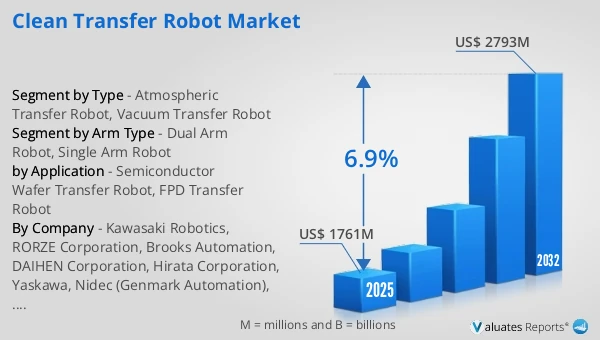
The global Clean Transfer Robot market was valued at US$ 1761 million in 2025 and is anticipated to reach US$ 2793 million by 2032, at a CAGR of 6.9% from 2026 to 2032.
Clean Transfer Robot Market
The 2025 U.S. tariff policies introduce profound uncertainty into the global economic landscape. This report critically examines the implications of recent tariff adjustments and international strategic countermeasures on Clean Transfer Robot competitive dynamics, regional economic interdependencies, and supply chain reconfigurations.
A Clean Transfer Robot generally refers to a class of specialized robots engineered to automatically pick, place, and transfer contamination-sensitive substrates under cleanroom/mini-environment or vacuum conditions. In scope, it typically includes Semiconductor Wafer Transfer Robots and FPD (flat panel display) Glass/Substrate Transfer Robots, and may extend to other substrate-like objects (e.g., photomasks) handled within similar cleanliness constraints. The core requirement is to deliver repeatable, high-precision motion with ultra-low particle generation and low outgassing while maintaining substrate integrity; in mainstream semiconductor architectures, wafer transfer is commonly implemented as a front-end mini-environment (EFEM) with an atmospheric clean robot plus aligner, coupled to a vacuum transfer module that uses a vacuum clean robot to move wafers between load locks and process chambers, returning wafers to the original carrier slots after processing.
By product/type taxonomy, clean transfer robots are first segmented by operating environment: atmospheric (cleanroom/mini-environment) robots versus vacuum robots. Atmospheric designs emphasize contamination-aware materials, clean drive trains, and surface finishes to suppress particles and outgassing, while vacuum robots must additionally ensure vacuum integrity and low leakage—often by keeping motors in ambient atmosphere and transmitting motion across a dynamic vacuum barrier using technologies such as magnetic feedthroughs/couplings, bellows, and magnetic-fluid seals. They are further classified by kinematics (SCARA/link-arm including frog-leg, cylindrical coordinate, articulated horizontal multi-joint, and linear-track/gantry-assisted high-throughput layouts), by end-effector strategy (single/dual arm, single-wafer vs twin end-effector, vacuum chucking vs edge grip), and by substrate size class (200/300 mm wafers vs FPD glass “generation” sizes). On the FPD side, the continuous increase in glass size drives higher requirements for stiffness, synchronized motion control, and accuracy, with commercial examples supporting “Gen-10 class” substrates up to ~2850×3050 mm and designed for high-speed transfer. Application-wise, wafer robots are embedded in EFEM/cluster-tool transfer architectures for etch, deposition, cleaning, and metrology equipment, while FPD robots are used across OLED/LCD panel manufacturing steps such as coating/lamination/transfer/inspection and vacuum-process substrate handling.
In the supply chain, upstream value concentrates in precision and cleanliness-critical components (motors/drives, bearings/transmissions, encoders/sensors, end-effector materials, seals/vacuum feedthroughs, controllers/safety interlocks, and clean surface treatments/low-outgassing auxiliaries). Midstream players provide robot bodies and modules (atmospheric/vacuum robots, aligners, load ports, vacuum platforms, EFEM/sorters), and downstream demand comes from semiconductor and display equipment OEMs and from wafer/panel fabs via integration, qualification, and lifecycle service. Industry trends are shaped by deeper fab automation and tighter linkage between equipment front-ends and factory logistics (e.g., EFEM connectivity to OHT/AGV), along with stronger interoperability and data integration under GEM/GEM300-related SEMI information/control standards; SEMI E84/E87/E90/E94 are frequently referenced as foundational enablers for automated carrier handoff, carrier management, substrate tracking, and control job management in high-throughput manufacturing. Key growth drivers include ever-stricter contamination/yield requirements, throughput and utilization pressure, rising labor and safety/compliance costs, and the expanding need for high-precision handling of large glass and emerging glass-substrate use cases beyond traditional FPD (e.g., cleanroom glass substrate handling for advanced interposer applications).
This report delivers a comprehensive overview of the global Clean Transfer Robot market, with both quantitative and qualitative analyses, to help readers develop growth strategies, assess the competitive landscape, evaluate their position in the current market, and make informed business decisions regarding Clean Transfer Robot. The Clean Transfer Robot market size, estimates, and forecasts are provided in terms of output/shipments (Units) and revenue (US$ millions), with 2025 as the base year and historical and forecast data for 2021–2032.
The report segments the global Clean Transfer Robot market comprehensively. Regional market sizes by Type, by Application, by Arm Type, and by company are also provided. For deeper insight, the report profiles the competitive landscape, key competitors, and their respective market rankings, and discusses technological trends and new product developments.
This report will assist Clean Transfer Robot manufacturers, new entrants, and companies across the industry value chain with information on revenues, production, and average prices for the overall market and its sub-segments, by company, by Type, by Application, and by region.
Market Segmentation
Scope of Clean Transfer Robot Market Report
| Report Metric |
Details |
| Report Name |
Clean Transfer Robot Market |
| Accounted market size in 2025 |
US$ 1761 million |
| Forecasted market size in 2032 |
US$ 2793 million |
| CAGR |
6.9% |
| Base Year |
2025 |
| Forecasted years |
2026 - 2032 |
| Segment by Type |
- Atmospheric Transfer Robot
- Vacuum Transfer Robot
|
| Segment by Arm Type |
- Dual Arm Robot
- Single Arm Robot
|
| by Application |
- Semiconductor Wafer Transfer Robot
- FPD Transfer Robot
|
| Production by Region |
- North America
- Europe
- China
- Japan
- South Korea
- China Taiwan
|
| Consumption by Region |
- North America (United States, Canada)
- Europe (Germany, France, UK, Italy, Russia)
- Asia-Pacific (China, Japan, South Korea, Taiwan)
- Southeast Asia (India)
- Latin America (Mexico, Brazil)
|
| By Company |
Kawasaki Robotics, RORZE Corporation, Brooks Automation, DAIHEN Corporation, Hirata Corporation, Yaskawa, Nidec (Genmark Automation), JEL Corporation, Robostar, Robots and Design (RND), HYULIM Robot, RAONTEC Inc, Cymechs Inc, Sumitomo Heavy Industries (SHI), Tazmo, Rexxam Co Ltd, ULVAC, Kensington Laboratories, EPSON Robots, Hine Automation, Moog Inc, Innovative Robotics, Stäubli, isel Germany AG, Sanwa Engineering Corporation, Siasun Robot & Automation, HIWIN Corporation, He-Five LLC., Shibaura Machine, Shanghai Future Technology, PHT Inc., Wuxi Xinghui Technology, HongHu (Suzhou) Semiconductor Technology |
| Forecast units |
USD million in value |
| Report coverage |
Revenue and volume forecast, company share, competitive landscape, growth factors and trends |
Chapter Outline
- Chapter 1: Defines the scope of the report and presents an executive summary of market segments (by Type, by Application, by Arm Type, etc.), including the size of each segment and its future growth potential. It offers a high-level view of the current market and its likely evolution in the short, medium, and long term.
- Chapter 2: Provides a detailed analysis of the competitive landscape for Clean Transfer Robot manufacturers, including prices, production, value-based market shares, latest development plans, and information on mergers and acquisitions.
- Chapter 3: Examines Clean Transfer Robot production/output and value by region and country, providing a quantitative assessment of market size and growth potential for each region over the next six years.
- Chapter 4: Analyzes Clean Transfer Robot consumption at the regional and country levels. It quantifies market size and growth potential for each region and its key countries, and outlines market development, outlook, addressable space, and national production.
- Chapter 5: Analyzes market segments by Type, covering the size and growth potential of each segment to help readers identify “blue ocean” opportunities.
- Chapter 6: Analyzes market segments by Application, covering the size and growth potential of each segment to help readers identify “blue ocean” opportunities in downstream markets.
- Chapter 7: Profiles key players, detailing the fundamentals of major companies, including product production/output, value, price, gross margin, product portfolio/introductions, and recent developments.
- Chapter 8: Reviews the industry value chain, including upstream and downstream segments.
- Chapter 9: Discusses market dynamics and recent developments, including drivers, restraints, challenges and risks for manufacturers, U.S. Tariffs and relevant policy analysis.
- Chapter 10: Summarizes the key findings and conclusions of the report.
FAQ for this report
How fast is Clean Transfer Robot Market growing?
Ans: The Clean Transfer Robot Market witnessing a CAGR of 6.9% during the forecast period 2026-2032.
What is the Clean Transfer Robot Market size in 2032?
Ans: The Clean Transfer Robot Market size in 2032 will be US$ 2793 million.
Who are the main players in the Clean Transfer Robot Market report?
Ans: The main players in the Clean Transfer Robot Market are Kawasaki Robotics, RORZE Corporation, Brooks Automation, DAIHEN Corporation, Hirata Corporation, Yaskawa, Nidec (Genmark Automation), JEL Corporation, Robostar, Robots and Design (RND), HYULIM Robot, RAONTEC Inc, Cymechs Inc, Sumitomo Heavy Industries (SHI), Tazmo, Rexxam Co Ltd, ULVAC, Kensington Laboratories, EPSON Robots, Hine Automation, Moog Inc, Innovative Robotics, Stäubli, isel Germany AG, Sanwa Engineering Corporation, Siasun Robot & Automation, HIWIN Corporation, He-Five LLC., Shibaura Machine, Shanghai Future Technology, PHT Inc., Wuxi Xinghui Technology, HongHu (Suzhou) Semiconductor Technology
What are the Application segmentation covered in the Clean Transfer Robot Market report?
Ans: The Applications covered in the Clean Transfer Robot Market report are Semiconductor Wafer Transfer Robot, FPD Transfer Robot
What are the Type segmentation covered in the Clean Transfer Robot Market report?
Ans: The Types covered in the Clean Transfer Robot Market report are Dual Arm Robot, Single Arm Robot