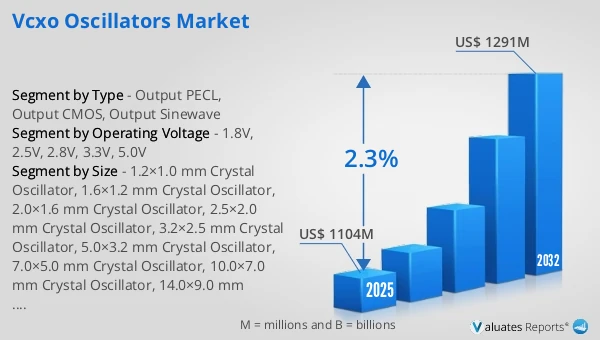
The global VCXO Oscillators market was valued at US$ 1104 million in 2025 and is anticipated to reach US$ 1291 million by 2032, at a CAGR of 2.3% from 2026 to 2032.
VCXO Oscillators Market
The 2025 U.S. tariff policies introduce profound uncertainty into the global economic landscape. This report critically examines the implications of recent tariff adjustments and international strategic countermeasures on VCXO Oscillators competitive dynamics, regional economic interdependencies, and supply chain reconfigurations.
VCXO (Voltage-Controlled Crystal Oscillator) devices are quartz-based oscillators whose output frequency can be continuously “pulled” over a defined range by an external control voltage. In most implementations, a varactor diode (or an equivalent variable-capacitance network) changes the effective load capacitance seen by the crystal resonator, enabling analog frequency tuning while preserving many of the low phase-noise and stability advantages of quartz. VCXOs address a key system need: providing fine, controllable frequency adjustment for phase-locked loops (PLLs), clock synchronization, jitter-cleaning architectures, and frequency tracking in communications and data-transport links, as well as for synchronization and drift compensation in audio/video, broadcast, test-and-measurement, and networking equipment. Historically, “pullable” crystal oscillators were widely used in early analog and digital communications and broadcast systems as tunable references or local oscillators; with the rise of PLLs, clock recovery (CDR), and synchronous networking technologies, VCXOs became a core building block in modern clock-generation and jitter-optimization chains. Over time, they have evolved through smaller packages, lower supply voltages, and broader product tiering—often used alongside TCXO/OCXO solutions depending on stability and environmental requirements. Typical upstream inputs include high-purity quartz and consumables for crystal wafer processing; metallization and lead materials; ceramic/metal packages and lids; substrates or leadframes; solder and sealing compounds; and enabling components and manufacturing elements such as varactor diodes or variable-capacitance networks, oscillator/buffer ICs, low-noise regulators and filtering components, ESD protection and matching parts, frequency-pull and temperature-calibration processes, and automated test, binning, and aging-screening equipment to ensure consistent pull range, linearity, phase-noise performance, and long-term reliability.In 2025, the global production capacity of voltage-controlled crystal oscillators reached 2.0 billion units, with sales volume totaling 1.72 billion units. The average selling price was approximately USD 0.64 per unit, and industry gross margins generally ranged between 20% and 30%.
The VCXO market today is characterized by stable demand with structural shifts in where and how VCXOs are deployed. Traditional use remains strong in communications transport, networking equipment, broadcast A/V, test and measurement, and industrial control, where VCXOs serve as tunable references for PLLs, critical elements in jitter-cleaning chains, or tuning anchors in clock-recovery architectures. As system designs evolve, some applications are migrating from discrete VCXOs to integrated timing solutions—such as clock generators and jitter attenuators with embedded PLLs and DCOs. However, VCXOs retain clear engineering value in designs that require a mature, reliable component providing continuous analog tuning while preserving low phase noise and predictable long-term behavior, especially where qualification history and long-term supply matter. At the same time, emerging requirements in automotive connectivity and in-vehicle Ethernet, industrial Ethernet and TSN, and precision timing/synchronization are expanding VCXO use into higher-reliability grades and more complex clock trees under harsher electromagnetic conditions. On the supply side, platformization is evident: leading frequency-control vendors broaden coverage across pull ranges, temperature grades, and packages, while customers increasingly emphasize lot consistency, tuning linearity, phase-noise performance, and drop-in substitution—driving continued investment in characterization and screening.
Future development will track the evolution of synchronized networks, push toward smaller packages and lower noise, and increasingly coexist with see-more integrated timing architectures rather than replace them outright. As higher-speed wired and wireless links, SyncE/TSN, and distributed timing architectures proliferate, systems impose tighter constraints on reference-clock phase noise, tuning linearity, and susceptibility to power and interference, encouraging VCXO refinements in low-noise circuit design, isolation buffering, power conditioning, and control-path noise suppression. Packaging will continue trending smaller with lower supply voltages to fit dense board designs and low-power platforms, which in turn raises the bar for pull-characteristic consistency and temperature-behavior modeling. At the same time, the market will likely crystallize into a clearer division of labor: discrete VCXOs remain attractive where continuous analog tuning, low-noise performance, qualification requirements, or long-term supply commitments dominate, while integrated clock ICs (with DCO/PLL blocks) win where multi-output functionality, software configurability, and system-level integration cost are primary. These approaches will coexist and complement each other across different platforms.
Key drivers include persistent and rising synchronization requirements across communications and networking, where higher bandwidth, more complex modulation, and tighter jitter budgets force continuous optimization of timing chains. Industrial automation and critical infrastructure are placing greater emphasis on synchronization, reliability, and maintainability, supporting demand for higher-grade VCXOs. Automotive electronics—driven by in-vehicle Ethernet, gateways, and domain controllers—also heightens the focus on robust reference clocks and interference resilience. Constraints include the growing capability of integrated clock generators and jitter attenuators to deliver richer functionality with fewer discrete parts, reducing design slots for mid- and lower-end discrete VCXOs. VCXOs are inherently sensitive to varactor networks, load capacitance, control-voltage noise, and PCB layout, which can increase integration effort and debug costs. Finally, in some high-end use cases requiring ultra-low phase noise or extreme temperature stability, designers may favor OCXO/high-stability solutions or “low-noise XO plus synthesis” architectures, leading to further segmentation of VCXO adoption across applications.
This report delivers a comprehensive overview of the global VCXO Oscillators market, with both quantitative and qualitative analyses, to help readers develop growth strategies, assess the competitive landscape, evaluate their position in the current market, and make informed business decisions regarding VCXO Oscillators. The VCXO Oscillators market size, estimates, and forecasts are provided in terms of output/shipments (Million Units) and revenue (US$ millions), with 2025 as the base year and historical and forecast data for 2021–2032.
The report segments the global VCXO Oscillators market comprehensively. Regional market sizes by Type, by Application, by Size, and by company are also provided. For deeper insight, the report profiles the competitive landscape, key competitors, and their respective market rankings, and discusses technological trends and new product developments.
This report will assist VCXO Oscillators manufacturers, new entrants, and companies across the industry value chain with information on revenues, production, and average prices for the overall market and its sub-segments, by company, by Type, by Application, and by region.
Market Segmentation
Scope of VCXO Oscillators Market Report
| Report Metric |
Details |
| Report Name |
VCXO Oscillators Market |
| Accounted market size in 2025 |
US$ 1104 million |
| Forecasted market size in 2032 |
US$ 1291 million |
| CAGR |
2.3% |
| Base Year |
2025 |
| Forecasted years |
2026 - 2032 |
| Segment by Type |
- Output PECL
- Output CMOS
- Output Sinewave
|
| Segment by Size |
- 1.2×1.0 mm Crystal Oscillator
- 1.6×1.2 mm Crystal Oscillator
- 2.0×1.6 mm Crystal Oscillator
- 2.5×2.0 mm Crystal Oscillator
- 3.2×2.5 mm Crystal Oscillator
- 5.0×3.2 mm Crystal Oscillator
- 7.0×5.0 mm Crystal Oscillator
- 10.0×7.0 mm Crystal Oscillator
- 14.0×9.0 mm Crystal Oscillator
|
| Segment by Operating Voltage |
|
| by Application |
- Communication Equipment
- Industrial Instrument
- Consumer Electronic
- Others
|
| Production by Region |
- North America
- Europe
- China
- Japan
- South Korea
|
| Consumption by Region |
- North America (United States, Canada)
- Europe (Germany, France, UK, Italy, Russia)
- Asia-Pacific (China, Japan, South Korea, Taiwan)
- Southeast Asia (India)
- Latin America (Mexico, Brazil)
|
| By Company |
Microchip, Epson, SiTime, Renesas, Kyocera Corporation, Murata, Rakon, TXC Corporation, Nihon Dempa Kogyo, Onsemi, CTS Corp, Taitien, NEL Frequency Controls, Bliley Technologies, Abracon, IQD Frequency Products |
| Forecast units |
USD million in value |
| Report coverage |
Revenue and volume forecast, company share, competitive landscape, growth factors and trends |
Chapter Outline
- Chapter 1: Defines the scope of the report and presents an executive summary of market segments (by Type, by Application, by Size, etc.), including the size of each segment and its future growth potential. It offers a high-level view of the current market and its likely evolution in the short, medium, and long term.
- Chapter 2: Provides a detailed analysis of the competitive landscape for VCXO Oscillators manufacturers, including prices, production, value-based market shares, latest development plans, and information on mergers and acquisitions.
- Chapter 3: Examines VCXO Oscillators production/output and value by region and country, providing a quantitative assessment of market size and growth potential for each region over the next six years.
- Chapter 4: Analyzes VCXO Oscillators consumption at the regional and country levels. It quantifies market size and growth potential for each region and its key countries, and outlines market development, outlook, addressable space, and national production.
- Chapter 5: Analyzes market segments by Type, covering the size and growth potential of each segment to help readers identify “blue ocean” opportunities.
- Chapter 6: Analyzes market segments by Application, covering the size and growth potential of each segment to help readers identify “blue ocean” opportunities in downstream markets.
- Chapter 7: Profiles key players, detailing the fundamentals of major companies, including product production/output, value, price, gross margin, product portfolio/introductions, and recent developments.
- Chapter 8: Reviews the industry value chain, including upstream and downstream segments.
- Chapter 9: Discusses market dynamics and recent developments, including drivers, restraints, challenges and risks for manufacturers, U.S. Tariffs and relevant policy analysis.
- Chapter 10: Summarizes the key findings and conclusions of the report.
Ans: The VCXO Oscillators Market witnessing a CAGR of 2.3% during the forecast period 2026-2032.
Ans: The VCXO Oscillators Market size in 2032 will be US$ 1291 million.
Ans: The main players in the VCXO Oscillators Market are Microchip, Epson, SiTime, Renesas, Kyocera Corporation, Murata, Rakon, TXC Corporation, Nihon Dempa Kogyo, Onsemi, CTS Corp, Taitien, NEL Frequency Controls, Bliley Technologies, Abracon, IQD Frequency Products
Ans: The Applications covered in the VCXO Oscillators Market report are Communication Equipment, Industrial Instrument, Consumer Electronic, Others
Ans: The Types covered in the VCXO Oscillators Market report are Output PECL, Output CMOS, Output Sinewave