Power Device Heat Sink Material Market Size
The global Power Device Heat Sink Material market was valued at US$ 1179 million in 2025 and is anticipated to reach US$ 1933 million by 2032, at a CAGR of 7.0% from 2026 to 2032.
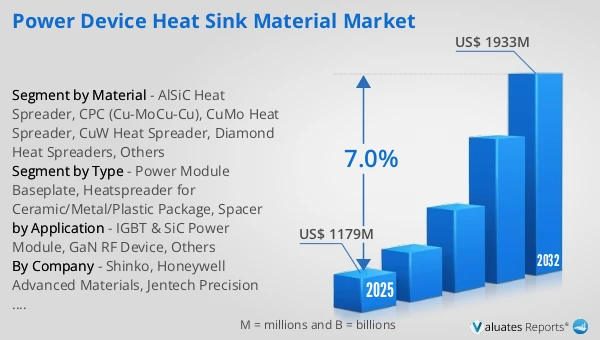
Power Device Heat Sink Material Market
The 2025 U.S. tariff policies introduce profound uncertainty into the global economic landscape. This report critically examines the implications of recent tariff adjustments and international strategic countermeasures on Power Device Heat Sink Material competitive dynamics, regional economic interdependencies, and supply chain reconfigurations.
Power Device Heat Sink Material refers to the material platforms and semi-finished components that realize package/module-level thermal paths for power devices (Si IGBT/MOSFET, SiC MOSFET/diodes, GaN devices), covering power module baseplates, heat spreaders for ceramic/metal/plastic packages, and spacers (often for double-side cooling or stack height control). Engineering selection is driven by the coupled targets of high thermal conductivity, CTE matching, and scalable manufacturability/finishing. The mainstream material set includes Cu/Al metals, controlled-CTE refractory composites (Cu-Mo, Cu-W, WCu), Al-based MMCs (notably Al-SiC, and premium Al-diamond), and ultra-high-k composites (e.g., Ag-diamond). Denka explicitly defines ALSINK as an Al-based MMC consisting of Al-SiC and ceramics, highlighting low thermal expansion and high thermal conductivity.
Differentiation is dominated by thermo-mechanical reliability under power cycling: CTE mismatch drives stress into solder/braze layers and ceramic substrate interfaces, accelerating fatigue and warpage. On the baseplate side, Vincotech notes that AlSiC baseplates are often used in traction instead of copper, and frames CTE and thermal resistance as key factors in the trade-off. On the heat-spreader/spacer side, A.L.M.T. positions CPC™ (Cu/Cu-Mo/Cu laminate) as adjustable-CTE and mass-producible (including stamping), and describes Ag-diamond heat spreaders with thermal conductivity above 600 W/m·K and available Ni/Au/Ag plating—illustrating how plating/finishing is integral to assembly compatibility and reliability. Plansee highlights WCu and refractory-metal solutions for electronics thermal management and states that the combination of thermal conductivity and CTE makes WCu well suited for SiC and GaN applications, aligning with base plate / heat spreader use cases.
Demand clusters into (i) high-reliability power modules (traction inverters, EV powertrain/charging, industrial drives, renewables/grid) where baseplate/substrate stack reliability is paramount; (ii) package heat spreaders for ceramic/metal/plastic power packages where CTE-matching mitigates stress; and (iii) spacers enabling double-side cooling and mechanical tolerance control. The competitive landscape is multi-tiered—materials platform owners (AlSiC, CuMo/CuW/WCu, diamond composites), precision fabricators/platers, and module/system integrators—with barriers built on property control, scale manufacturing, and validated reliability datasets. Technology trends are moving in parallel: higher power density pushes both tighter CTE control (AlSiC and refractory composites) and higher-k solutions (diamond composites) while system integration pushes double-side cooling and reduced/removed baseplate architectures; Vincotech’s recent publications explicitly discuss baseplate-less modules approaching or outperforming conventional copper-baseplate modules.
This report delivers a comprehensive overview of the global Power Device Heat Sink Material market, with both quantitative and qualitative analyses, to help readers develop growth strategies, assess the competitive landscape, evaluate their position in the current market, and make informed business decisions regarding Power Device Heat Sink Material. The Power Device Heat Sink Material market size, estimates, and forecasts are provided in terms of output/shipments (K Units) and revenue (US$ millions), with 2025 as the base year and historical and forecast data for 2021–2032.
The report segments the global Power Device Heat Sink Material market comprehensively. Regional market sizes by Type, by Application, by Material, and by company are also provided. For deeper insight, the report profiles the competitive landscape, key competitors, and their respective market rankings, and discusses technological trends and new product developments.
This report will assist Power Device Heat Sink Material manufacturers, new entrants, and companies across the industry value chain with information on revenues, production, and average prices for the overall market and its sub-segments, by company, by Type, by Application, and by region.
Market Segmentation
Scope of Power Device Heat Sink Material Market Report
| Report Metric |
Details |
| Report Name |
Power Device Heat Sink Material Market |
| Accounted market size in 2025 |
US$ 1179 in million |
| Forecasted market size in 2032 |
US$ 1933 million |
| CAGR |
7.0% |
| Base Year |
2025 |
| Forecasted years |
2026 - 2032 |
| Segment by Type |
- Power Module Baseplate
- Heatspreader for Ceramic/Metal/Plastic Package
- Spacer
|
| Segment by Material |
- AlSiC Heat Spreader
- CPC (Cu-MoCu-Cu)
- CuMo Heat Spreader
- CuW Heat Spreader
- Diamond Heat Spreaders
- Others
|
| by Application |
- IGBT & SiC Power Module
- GaN RF Device
- Others
|
| Production by Region |
- North America
- Europe
- China
- Japan
- South Korea
|
| Consumption by Region |
- North America (United States, Canada)
- Europe (Germany, France, UK, Italy, Russia)
- Asia-Pacific (China, Japan, South Korea, Taiwan)
- Southeast Asia (India)
- Latin America (Mexico, Brazil)
|
| By Company |
Shinko, Honeywell Advanced Materials, Jentech Precision Industrial, Denka, Sumitomo Electric (A.L.M.T. Corp.), Plansee, TAIWA CO., Ltd., Dana Incorporated, Kawaso Texcel, Wieland Microcool, CPS Technologies, Element Six, AMETEK, Huangshan Googe, Jiangyin Saiying electron, Suzhou Haoli Electronic Technology, Kunshan Gootage Thermal Technology, SITRI Material Technologies, Hunan Harvest Technology Development, Malico Inc, Amulaire Thermal Technology, I-Chiun, Favor Precision Technology, Niching Industrial Corporation, Fastrong Technologies Corp., ECE (Excel Cell Electronic), Shandong Ruisi Precision Industry, HongRiDa Electronics (HRD), TBT Co., Ltd |
| Forecast units |
USD million in value |
| Report coverage |
Revenue and volume forecast, company share, competitive landscape, growth factors and trends |
Chapter Outline
- Chapter 1: Defines the scope of the report and presents an executive summary of market segments (by Type, by Application, by Material, etc.), including the size of each segment and its future growth potential. It offers a high-level view of the current market and its likely evolution in the short, medium, and long term.
- Chapter 2: Provides a detailed analysis of the competitive landscape for Power Device Heat Sink Material manufacturers, including prices, production, value-based market shares, latest development plans, and information on mergers and acquisitions.
- Chapter 3: Examines Power Device Heat Sink Material production/output and value by region and country, providing a quantitative assessment of market size and growth potential for each region over the next six years.
- Chapter 4: Analyzes Power Device Heat Sink Material consumption at the regional and country levels. It quantifies market size and growth potential for each region and its key countries, and outlines market development, outlook, addressable space, and national production.
- Chapter 5: Analyzes market segments by Type, covering the size and growth potential of each segment to help readers identify “blue ocean” opportunities.
- Chapter 6: Analyzes market segments by Application, covering the size and growth potential of each segment to help readers identify “blue ocean” opportunities in downstream markets.
- Chapter 7: Profiles key players, detailing the fundamentals of major companies, including product production/output, value, price, gross margin, product portfolio/introductions, and recent developments.
- Chapter 8: Reviews the industry value chain, including upstream and downstream segments.
- Chapter 9: Discusses market dynamics and recent developments, including drivers, restraints, challenges and risks for manufacturers, U.S. Tariffs and relevant policy analysis.
- Chapter 10: Summarizes the key findings and conclusions of the report.
FAQ for this report
How fast is Power Device Heat Sink Material Market growing?
Ans: The Power Device Heat Sink Material Market witnessing a CAGR of 7.0% during the forecast period 2026-2032.
What is the Power Device Heat Sink Material Market size in 2032?
Ans: The Power Device Heat Sink Material Market size in 2032 will be US$ 1933 million.
Who are the main players in the Power Device Heat Sink Material Market report?
Ans: The main players in the Power Device Heat Sink Material Market are Shinko, Honeywell Advanced Materials, Jentech Precision Industrial, Denka, Sumitomo Electric (A.L.M.T. Corp.), Plansee, TAIWA CO., Ltd., Dana Incorporated, Kawaso Texcel, Wieland Microcool, CPS Technologies, Element Six, AMETEK, Huangshan Googe, Jiangyin Saiying electron, Suzhou Haoli Electronic Technology, Kunshan Gootage Thermal Technology, SITRI Material Technologies, Hunan Harvest Technology Development, Malico Inc, Amulaire Thermal Technology, I-Chiun, Favor Precision Technology, Niching Industrial Corporation, Fastrong Technologies Corp., ECE (Excel Cell Electronic), Shandong Ruisi Precision Industry, HongRiDa Electronics (HRD), TBT Co., Ltd
What are the Application segmentation covered in the Power Device Heat Sink Material Market report?
Ans: The Applications covered in the Power Device Heat Sink Material Market report are IGBT & SiC Power Module, GaN RF Device, Others
What are the Type segmentation covered in the Power Device Heat Sink Material Market report?
Ans: The Types covered in the Power Device Heat Sink Material Market report are Power Module Baseplate, Heatspreader for Ceramic/Metal/Plastic Package, Spacer