0
U.S. (TOLL FREE)
+1 (315) 215-3225
Automative

0
U.S. (TOLL FREE)
+1 (315) 215-3225
Global Glass-to-Metal Connectors Market Research Report 2026
Published Date: 2026-02-13
|
Report Code: QYRE-Auto-25P8937
Home | Market Reports
Global Glass to Metal Connectors Market Outlook 2022
BUY CHAPTERS

Global Glass-to-Metal Connectors Market Research Report 2026

Code: QYRE-Auto-25P8937
Report
2026-02-13
Pages:143
QYResearch
Buy Now with 15% Discount
DESCRIPTION
TABLE OF CONTENT
TABLES & FIGURES

Glass-to-Metal Connectors Market Size

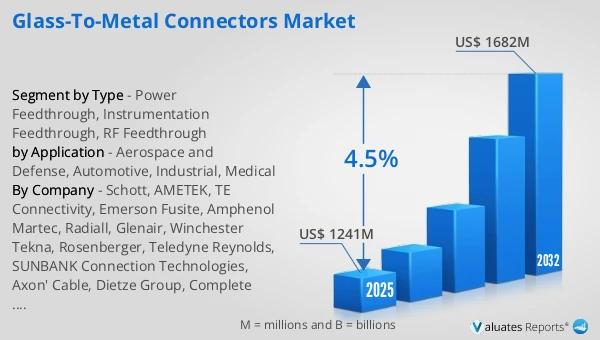
The global Glass-to-Metal Connectors market was valued at US$ 1241 million in 2025 and is anticipated to reach US$ 1682 million by 2032, at a CAGR of 4.5% from 2026 to 2032.

Glass-to-Metal Connectors Market

Glass-to-Metal Connectors Market

The 2025 U.S. tariff policies introduce profound uncertainty into the global economic landscape. This report critically examines the implications of recent tariff adjustments and international strategic countermeasures on Glass-to-Metal Connectors competitive dynamics, regional economic interdependencies, and supply chain reconfigurations.
Hermetic connectors are a special class of sealed Mil /Aero interconnect that incorporates glass-to-metal or other highly-engineered sealing technology. Hermetic seal connectors are specified for applications as divergent as submarines and orbiting satellites.
The driving factors of the glass-metal sealed connector market mainly include the following aspects:
1. Technological progress and demand in emerging fields
Aerospace field: With the continuous development of aerospace technology, the demand for high-performance and high-reliability components is increasing. Glass-metal sealed connectors are widely used in the aerospace field due to their excellent temperature resistance, pressure resistance and corrosion resistance. For example, in scenarios where stability and durability are extremely high in extreme environments, glass-metal sealed connectors have become indispensable components.
New energy vehicle industry: The booming new energy vehicle industry has injected new vitality into the glass-metal sealed connector market. The sealing performance of electric vehicle battery packs is directly related to the safety and service life of the vehicle. The application of high-performance glass-metal sealed connectors effectively improves the overall protection level of the battery system and promotes the healthy development of the new energy vehicle industry.
Other emerging fields: With the continuous development of many emerging downstream application markets such as the Internet of Things, smart security, and military electronics, the demand for high-performance and high-reliability connectors is also increasing. These fields have extremely high performance requirements for connectors, and glass-metal sealed connectors have broad application prospects in these fields due to their unique performance advantages.
2. Improved environmental awareness and green manufacturing trends
The improvement of environmental awareness has prompted the manufacturing industry to transform towards a green and sustainable direction. Glass-metal sealed connectors have gradually replaced some traditional sealing materials due to their recyclability and low impact on the environment, becoming the new favorite of the market. This is in line with the current global green manufacturing and circular economy concepts, and will help promote the sustainable development of related industries.
3. Coordinated development of upstream and downstream of the industrial chain
Upstream raw material supply: The upstream of the metal-glass sealing industry is mainly the supplier of raw materials such as ferroalloys, kovar alloys, and special glass powders. The performance and quality of these raw materials directly affect the production quality and cost of glass-metal sealed connectors. With the continuous development and technological improvement of the upstream raw material industry, a stable and reliable supply of raw materials is provided for the glass-metal sealed connector industry.
Downstream application field expansion: The downstream application fields of glass-metal sealed connectors are extensive, including lithium primary batteries, military thermal batteries, connector manufacturers, high-performance defense equipment manufacturers, etc. With the rapid development of downstream industries and the continuous increase in market demand, a broad market space and development opportunities are provided for the glass-metal sealed connector industry.
4. Technological innovation and industrial upgrading
With the popularization of automated and intelligent production technologies, the manufacturing efficiency and product quality of glass-metal sealed connectors have been significantly improved. At the same time, continuous technological innovation and industrial upgrading have also promoted the rapid development of the glass-metal sealed connector industry. For example, the use of miniaturized and lightweight designs can achieve high-density installation and meet the needs of complex and diverse use environments; the use of new materials and new processes can improve the performance and reliability of connectors and broaden their application range.
In summary, the driving factors of the glass-metal sealed connector market mainly include scientific and technological progress and demand in emerging fields, enhanced environmental awareness and green manufacturing trends, coordinated development of upstream and downstream of the industrial chain, and technological innovation and industrial upgrading. These factors work together to promote the rapid development of the glass-metal sealed connector industry and the continuous expansion of the market scale.
This report delivers a comprehensive overview of the global Glass-to-Metal Connectors market, with both quantitative and qualitative analyses, to help readers develop growth strategies, assess the competitive landscape, evaluate their position in the current market, and make informed business decisions regarding Glass-to-Metal Connectors. The Glass-to-Metal Connectors market size, estimates, and forecasts are provided in terms of shipments (K Units) and revenue (US$ millions), with 2025 as the base year and historical and forecast data for 2021–2032.
The report segments the global Glass-to-Metal Connectors market comprehensively. Regional market sizes by Type, by Application, , and by company are also provided. For deeper insight, the report profiles the competitive landscape, key competitors, and their respective market rankings, and discusses technological trends and new product developments.
This report will assist Glass-to-Metal Connectors manufacturers, new entrants, and companies across the industry value chain with information on revenues, production, and average prices for the overall market and its sub-segments, by company, by Type, by Application, and by region.
Market Segmentation

Scope of Glass-to-Metal Connectors Market Report

Report Metric Details
Report Name Glass-to-Metal Connectors Market
Accounted market size in 2025 US$ 1241 million
Forecasted market size in 2032 US$ 1682 million
CAGR 4.5%
Base Year 2025
Forecasted years 2026 - 2032
Segment by Type
  • Power Feedthrough
  • Instrumentation Feedthrough
  • RF Feedthrough
by Application
  • Aerospace and Defense
  • Automotive
  • Industrial
  • Medical
Production by Region
  • North America
  • Europe
  • China
  • Japan
Consumption by Region
  • North America (United States, Canada)
  • Europe (Germany, France, UK, Italy, Russia)
  • Asia-Pacific (China, Japan, South Korea, Taiwan)
  • Southeast Asia (India)
  • Latin America (Mexico, Brazil)
By Company Schott, AMETEK, TE Connectivity, Emerson Fusite, Amphenol Martec, Radiall, Glenair, Winchester Tekna, Rosenberger, Teledyne Reynolds, SUNBANK Connection Technologies, Axon' Cable, Dietze Group, Complete Hermetics
Forecast units USD million in value
Report coverage Revenue and volume forecast, company share, competitive landscape, growth factors and trends

Chapter Outline

  • Chapter 1: Defines the scope of the report and presents an executive summary of market segments (by Type, by Application, , etc.), including the size of each segment and its future growth potential. It offers a high-level view of the current market and its likely evolution in the short, medium, and long term.
  • Chapter 2: Provides a detailed analysis of the competitive landscape for Glass-to-Metal Connectors manufacturers, including prices, production, value-based market shares, latest development plans, and information on mergers and acquisitions.
  • Chapter 3: Examines Glass-to-Metal Connectors production/output and value by region and country, providing a quantitative assessment of market size and growth potential for each region over the next six years.
  • Chapter 4: Analyzes Glass-to-Metal Connectors consumption at the regional and country levels. It quantifies market size and growth potential for each region and its key countries, and outlines market development, outlook, addressable space, and national production.
  • Chapter 5: Analyzes market segments by Type, covering the size and growth potential of each segment to help readers identify “blue ocean” opportunities.
  • Chapter 6: Analyzes market segments by Application, covering the size and growth potential of each segment to help readers identify “blue ocean” opportunities in downstream markets.
  • Chapter 7: Profiles key players, detailing the fundamentals of major companies, including product production/output, value, price, gross margin, product portfolio/introductions, and recent developments.
  • Chapter 8: Reviews the industry value chain, including upstream and downstream segments.
  • Chapter 9: Discusses market dynamics and recent developments, including drivers, restraints, challenges and risks for manufacturers, U.S. Tariffs and relevant policy analysis.
  • Chapter 10: Summarizes the key findings and conclusions of the report.

FAQ for this report

How fast is Glass-to-Metal Connectors Market growing?

Ans: The Glass-to-Metal Connectors Market witnessing a CAGR of 4.5% during the forecast period 2026-2032.

What is the Glass-to-Metal Connectors Market size in 2032?

Ans: The Glass-to-Metal Connectors Market size in 2032 will be US$ 1682 million.

Who are the main players in the Glass-to-Metal Connectors Market report?

Ans: The main players in the Glass-to-Metal Connectors Market are Schott, AMETEK, TE Connectivity, Emerson Fusite, Amphenol Martec, Radiall, Glenair, Winchester Tekna, Rosenberger, Teledyne Reynolds, SUNBANK Connection Technologies, Axon' Cable, Dietze Group, Complete Hermetics

What are the Application segmentation covered in the Glass-to-Metal Connectors Market report?

Ans: The Applications covered in the Glass-to-Metal Connectors Market report are Aerospace and Defense, Automotive, Industrial, Medical

What are the Type segmentation covered in the Glass-to-Metal Connectors Market report?

Ans: The Types covered in the Glass-to-Metal Connectors Market report are Power Feedthrough, Instrumentation Feedthrough, RF Feedthrough

1 Glass-to-Metal Connectors Market Overview
1.1 Product Definition
1.2 Glass-to-Metal Connectors by Type
1.2.1 Global Glass-to-Metal Connectors Market Value Growth Rate Analysis by Type: 2025 vs 2032
1.2.2 Power Feedthrough
1.2.3 Instrumentation Feedthrough
1.2.4 RF Feedthrough
1.3 Glass-to-Metal Connectors by Application
1.3.1 Global Glass-to-Metal Connectors Market Value Growth Rate Analysis by Application: 2025 vs 2032
1.3.2 Aerospace and Defense
1.3.3 Automotive
1.3.4 Industrial
1.3.5 Medical
1.4 Global Market Growth Prospects
1.4.1 Global Glass-to-Metal Connectors Production Value Estimates and Forecasts (2021–2032)
1.4.2 Global Glass-to-Metal Connectors Production Capacity Estimates and Forecasts (2021–2032)
1.4.3 Global Glass-to-Metal Connectors Production Estimates and Forecasts (2021–2032)
1.4.4 Global Glass-to-Metal Connectors Market Average Price Estimates and Forecasts (2021–2032)
1.5 Assumptions and Limitations
2 Market Competition by Manufacturers
2.1 Global Glass-to-Metal Connectors Production Market Share by Manufacturers (2021–2026)
2.2 Global Glass-to-Metal Connectors Production Value Market Share by Manufacturers (2021–2026)
2.3 Global Key Players of Glass-to-Metal Connectors, Industry Ranking, 2024 vs 2025
2.4 Global Glass-to-Metal Connectors Market Share by Company Tier (Tier 1, Tier 2, Tier 3)
2.5 Global Glass-to-Metal Connectors Average Price by Manufacturers (2021–2026)
2.6 Global Key Manufacturers of Glass-to-Metal Connectors, Manufacturing Footprints and Headquarters
2.7 Global Key Manufacturers of Glass-to-Metal Connectors, Product Offerings and Applications
2.8 Global Key Manufacturers of Glass-to-Metal Connectors, Date of Entry into the Industry
2.9 Glass-to-Metal Connectors Market Competitive Situation and Trends
2.9.1 Glass-to-Metal Connectors Market Concentration Rate
2.9.2 Top 5 and Top 10 Global Glass-to-Metal Connectors Players Market Share by Revenue
2.10 Mergers & Acquisitions and Expansion
3 Glass-to-Metal Connectors Production by Region
3.1 Global Glass-to-Metal Connectors Production Value Estimates and Forecasts by Region: 2021 vs 2025 vs 2032
3.2 Global Glass-to-Metal Connectors Production Value by Region (2021–2032)
3.2.1 Global Glass-to-Metal Connectors Production Value by Region (2021–2026)
3.2.2 Global Forecasted Production Value of Glass-to-Metal Connectors by Region (2027–2032)
3.3 Global Glass-to-Metal Connectors Production Estimates and Forecasts by Region: 2021 vs 2025 vs 2032
3.4 Global Glass-to-Metal Connectors Production Volume by Region (2021–2032)
3.4.1 Global Glass-to-Metal Connectors Production by Region (2021–2026)
3.4.2 Global Forecasted Production of Glass-to-Metal Connectors by Region (2027–2032)
3.5 Global Glass-to-Metal Connectors Market Price Analysis by Region (2021–2026)
3.6 Global Glass-to-Metal Connectors Production, Value, and Year-over-Year Growth
3.6.1 North America Glass-to-Metal Connectors Production Value Estimates and Forecasts (2021–2032)
3.6.2 Europe Glass-to-Metal Connectors Production Value Estimates and Forecasts (2021–2032)
3.6.3 China Glass-to-Metal Connectors Production Value Estimates and Forecasts (2021–2032)
3.6.4 Japan Glass-to-Metal Connectors Production Value Estimates and Forecasts (2021–2032)
4 Glass-to-Metal Connectors Consumption by Region
4.1 Global Glass-to-Metal Connectors Consumption Estimates and Forecasts by Region: 2021 vs 2025 vs 2032
4.2 Global Glass-to-Metal Connectors Consumption by Region (2021–2032)
4.2.1 Global Glass-to-Metal Connectors Consumption by Region (2021–2026)
4.2.2 Global Glass-to-Metal Connectors Forecasted Consumption by Region (2027–2032)
4.3 North America
4.3.1 North America Glass-to-Metal Connectors Consumption Growth Rate by Country: 2021 vs 2025 vs 2032
4.3.2 North America Glass-to-Metal Connectors Consumption by Country (2021–2032)
4.3.3 U.S.
4.3.4 Canada
4.4 Europe
4.4.1 Europe Glass-to-Metal Connectors Consumption Growth Rate by Country: 2021 vs 2025 vs 2032
4.4.2 Europe Glass-to-Metal Connectors Consumption by Country (2021–2032)
4.4.3 Germany
4.4.4 France
4.4.5 U.K.
4.4.6 Italy
4.4.7 Russia
4.5 Asia Pacific
4.5.1 Asia Pacific Glass-to-Metal Connectors Consumption Growth Rate by Region: 2021 vs 2025 vs 2032
4.5.2 Asia Pacific Glass-to-Metal Connectors Consumption by Region (2021–2032)
4.5.3 China
4.5.4 Japan
4.5.5 South Korea
4.5.6 China Taiwan
4.5.7 Southeast Asia
4.5.8 India
4.6 Latin America, Middle East & Africa
4.6.1 Latin America, Middle East & Africa Glass-to-Metal Connectors Consumption Growth Rate by Country: 2021 vs 2025 vs 2032
4.6.2 Latin America, Middle East & Africa Glass-to-Metal Connectors Consumption by Country (2021–2032)
4.6.3 Mexico
4.6.4 Brazil
4.6.5 Israel
4.6.6 GCC Countries
5 Segment by Type
5.1 Global Glass-to-Metal Connectors Production by Type (2021–2032)
5.1.1 Global Glass-to-Metal Connectors Production by Type (2021–2026)
5.1.2 Global Glass-to-Metal Connectors Production by Type (2027–2032)
5.1.3 Global Glass-to-Metal Connectors Production Market Share by Type (2021–2032)
5.2 Global Glass-to-Metal Connectors Production Value by Type (2021–2032)
5.2.1 Global Glass-to-Metal Connectors Production Value by Type (2021–2026)
5.2.2 Global Glass-to-Metal Connectors Production Value by Type (2027–2032)
5.2.3 Global Glass-to-Metal Connectors Production Value Market Share by Type (2021–2032)
5.3 Global Glass-to-Metal Connectors Price by Type (2021–2032)
6 Segment by Application
6.1 Global Glass-to-Metal Connectors Production by Application (2021–2032)
6.1.1 Global Glass-to-Metal Connectors Production by Application (2021–2026)
6.1.2 Global Glass-to-Metal Connectors Production by Application (2027–2032)
6.1.3 Global Glass-to-Metal Connectors Production Market Share by Application (2021–2032)
6.2 Global Glass-to-Metal Connectors Production Value by Application (2021–2032)
6.2.1 Global Glass-to-Metal Connectors Production Value by Application (2021–2026)
6.2.2 Global Glass-to-Metal Connectors Production Value by Application (2027–2032)
6.2.3 Global Glass-to-Metal Connectors Production Value Market Share by Application (2021–2032)
6.3 Global Glass-to-Metal Connectors Price by Application (2021–2032)
7 Key Companies Profiled
7.1 Schott
7.1.1 Schott Glass-to-Metal Connectors Company Information
7.1.2 Schott Glass-to-Metal Connectors Product Portfolio
7.1.3 Schott Glass-to-Metal Connectors Production, Value, Price, and Gross Margin (2021–2026)
7.1.4 Schott Main Business and Markets Served
7.1.5 Schott Recent Developments/Updates
7.2 AMETEK
7.2.1 AMETEK Glass-to-Metal Connectors Company Information
7.2.2 AMETEK Glass-to-Metal Connectors Product Portfolio
7.2.3 AMETEK Glass-to-Metal Connectors Production, Value, Price, and Gross Margin (2021–2026)
7.2.4 AMETEK Main Business and Markets Served
7.2.5 AMETEK Recent Developments/Updates
7.3 TE Connectivity
7.3.1 TE Connectivity Glass-to-Metal Connectors Company Information
7.3.2 TE Connectivity Glass-to-Metal Connectors Product Portfolio
7.3.3 TE Connectivity Glass-to-Metal Connectors Production, Value, Price, and Gross Margin (2021–2026)
7.3.4 TE Connectivity Main Business and Markets Served
7.3.5 TE Connectivity Recent Developments/Updates
7.4 Emerson Fusite
7.4.1 Emerson Fusite Glass-to-Metal Connectors Company Information
7.4.2 Emerson Fusite Glass-to-Metal Connectors Product Portfolio
7.4.3 Emerson Fusite Glass-to-Metal Connectors Production, Value, Price, and Gross Margin (2021–2026)
7.4.4 Emerson Fusite Main Business and Markets Served
7.4.5 Emerson Fusite Recent Developments/Updates
7.5 Amphenol Martec
7.5.1 Amphenol Martec Glass-to-Metal Connectors Company Information
7.5.2 Amphenol Martec Glass-to-Metal Connectors Product Portfolio
7.5.3 Amphenol Martec Glass-to-Metal Connectors Production, Value, Price, and Gross Margin (2021–2026)
7.5.4 Amphenol Martec Main Business and Markets Served
7.5.5 Amphenol Martec Recent Developments/Updates
7.6 Radiall
7.6.1 Radiall Glass-to-Metal Connectors Company Information
7.6.2 Radiall Glass-to-Metal Connectors Product Portfolio
7.6.3 Radiall Glass-to-Metal Connectors Production, Value, Price, and Gross Margin (2021–2026)
7.6.4 Radiall Main Business and Markets Served
7.6.5 Radiall Recent Developments/Updates
7.7 Glenair
7.7.1 Glenair Glass-to-Metal Connectors Company Information
7.7.2 Glenair Glass-to-Metal Connectors Product Portfolio
7.7.3 Glenair Glass-to-Metal Connectors Production, Value, Price, and Gross Margin (2021–2026)
7.7.4 Glenair Main Business and Markets Served
7.7.5 Glenair Recent Developments/Updates
7.8 Winchester Tekna
7.8.1 Winchester Tekna Glass-to-Metal Connectors Company Information
7.8.2 Winchester Tekna Glass-to-Metal Connectors Product Portfolio
7.8.3 Winchester Tekna Glass-to-Metal Connectors Production, Value, Price, and Gross Margin (2021–2026)
7.8.4 Winchester Tekna Main Business and Markets Served
7.8.5 Winchester Tekna Recent Developments/Updates
7.9 Rosenberger
7.9.1 Rosenberger Glass-to-Metal Connectors Company Information
7.9.2 Rosenberger Glass-to-Metal Connectors Product Portfolio
7.9.3 Rosenberger Glass-to-Metal Connectors Production, Value, Price, and Gross Margin (2021–2026)
7.9.4 Rosenberger Main Business and Markets Served
7.9.5 Rosenberger Recent Developments/Updates
7.10 Teledyne Reynolds
7.10.1 Teledyne Reynolds Glass-to-Metal Connectors Company Information
7.10.2 Teledyne Reynolds Glass-to-Metal Connectors Product Portfolio
7.10.3 Teledyne Reynolds Glass-to-Metal Connectors Production, Value, Price, and Gross Margin (2021–2026)
7.10.4 Teledyne Reynolds Main Business and Markets Served
7.10.5 Teledyne Reynolds Recent Developments/Updates
7.11 SUNBANK Connection Technologies
7.11.1 SUNBANK Connection Technologies Glass-to-Metal Connectors Company Information
7.11.2 SUNBANK Connection Technologies Glass-to-Metal Connectors Product Portfolio
7.11.3 SUNBANK Connection Technologies Glass-to-Metal Connectors Production, Value, Price, and Gross Margin (2021–2026)
7.11.4 SUNBANK Connection Technologies Main Business and Markets Served
7.11.5 SUNBANK Connection Technologies Recent Developments/Updates
7.12 Axon' Cable
7.12.1 Axon' Cable Glass-to-Metal Connectors Company Information
7.12.2 Axon' Cable Glass-to-Metal Connectors Product Portfolio
7.12.3 Axon' Cable Glass-to-Metal Connectors Production, Value, Price, and Gross Margin (2021–2026)
7.12.4 Axon' Cable Main Business and Markets Served
7.12.5 Axon' Cable Recent Developments/Updates
7.13 Dietze Group
7.13.1 Dietze Group Glass-to-Metal Connectors Company Information
7.13.2 Dietze Group Glass-to-Metal Connectors Product Portfolio
7.13.3 Dietze Group Glass-to-Metal Connectors Production, Value, Price, and Gross Margin (2021–2026)
7.13.4 Dietze Group Main Business and Markets Served
7.13.5 Dietze Group Recent Developments/Updates
7.14 Complete Hermetics
7.14.1 Complete Hermetics Glass-to-Metal Connectors Company Information
7.14.2 Complete Hermetics Glass-to-Metal Connectors Product Portfolio
7.14.3 Complete Hermetics Glass-to-Metal Connectors Production, Value, Price, and Gross Margin (2021–2026)
7.14.4 Complete Hermetics Main Business and Markets Served
7.14.5 Complete Hermetics Recent Developments/Updates
8 Industry Chain and Sales Channels Analysis
8.1 Glass-to-Metal Connectors Industry Chain Analysis
8.2 Glass-to-Metal Connectors Raw Material Supply Analysis
8.2.1 Key Raw Materials
8.2.2 Raw Materials Key Suppliers
8.3 Glass-to-Metal Connectors Production Modes and Processes
8.4 Glass-to-Metal Connectors Sales and Marketing
8.4.1 Glass-to-Metal Connectors Sales Channels
8.4.2 Glass-to-Metal Connectors Distributors
8.5 Glass-to-Metal Connectors Customer Analysis
9 Glass-to-Metal Connectors Market Dynamics
9.1 Glass-to-Metal Connectors Industry Trends
9.2 Glass-to-Metal Connectors Market Drivers
9.3 Glass-to-Metal Connectors Market Challenges
9.4 Glass-to-Metal Connectors Market Restraints
9.5 Impact of U.S. Tariffs
10 Research Findings and Conclusion
11 Methodology and Data Source
11.1 Methodology/Research Approach
11.1.1 Research Programs/Design
11.1.2 Market Size Estimation
11.1.3 Market Breakdown and Data Triangulation
11.2 Data Source
11.2.1 Secondary Sources
11.2.2 Primary Sources
11.3 Author List
11.4 Disclaimer
List of Tables
 Table 1. Global Glass-to-Metal Connectors Market Value by Type (US$ Million), 2025 vs 2032
 Table 2. Global Glass-to-Metal Connectors Market Value by Application (US$ Million), 2025 vs 2032
 Table 3. Global Glass-to-Metal Connectors Production Capacity (K Units) by Manufacturers in 2025
 Table 4. Global Glass-to-Metal Connectors Production by Manufacturers (K Units), 2021–2026
 Table 5. Global Glass-to-Metal Connectors Production Market Share by Manufacturers (2021–2026)
 Table 6. Global Glass-to-Metal Connectors Production Value by Manufacturers (US$ Million), 2021–2026
 Table 7. Global Glass-to-Metal Connectors Production Value Share by Manufacturers (2021–2026)
 Table 8. Global Key Players of Glass-to-Metal Connectors, Industry Ranking, 2024 vs 2025
 Table 9. Classification of Companies by Tier (Tier 1, Tier 2, Tier 3), based on Glass-to-Metal Connectors Production Value, 2025
 Table 10. Global Market Glass-to-Metal Connectors Average Price by Manufacturers (USD/Unit), 2021–2026
 Table 11. Global Key Manufacturers of Glass-to-Metal Connectors, Manufacturing Footprints and Headquarters
 Table 12. Global Key Manufacturers of Glass-to-Metal Connectors, Product Offerings and Applications
 Table 13. Global Key Manufacturers of Glass-to-Metal Connectors, Date of Entry into the Industry
 Table 14. Global Glass-to-Metal Connectors Manufacturers Market Concentration Ratio (CR5 and HHI)
 Table 15. Mergers & Acquisitions and Expansion Plans
 Table 16. Global Glass-to-Metal Connectors Production Value by Region: 2021 vs 2025 vs 2032 (US$ Million)
 Table 17. Global Glass-to-Metal Connectors Production Value (US$ Million) by Region (2021–2026)
 Table 18. Global Glass-to-Metal Connectors Production Value Market Share by Region (2021–2026)
 Table 19. Global Glass-to-Metal Connectors Production Value (US$ Million) Forecast by Region (2027–2032)
 Table 20. Global Glass-to-Metal Connectors Production Value Market Share Forecast by Region (2027–2032)
 Table 21. Global Glass-to-Metal Connectors Production Comparison by Region: 2021 vs 2025 vs 2032 (K Units)
 Table 22. Global Glass-to-Metal Connectors Production (K Units) by Region (2021–2026)
 Table 23. Global Glass-to-Metal Connectors Production Market Share by Region (2021–2026)
 Table 24. Global Glass-to-Metal Connectors Production (K Units) Forecast by Region (2027–2032)
 Table 25. Global Glass-to-Metal Connectors Production Market Share Forecast by Region (2027–2032)
 Table 26. Global Glass-to-Metal Connectors Market Average Price (USD/Unit) by Region (2021–2026)
 Table 27. Global Glass-to-Metal Connectors Market Average Price (USD/Unit) by Region (2027–2032)
 Table 28. Global Glass-to-Metal Connectors Consumption Growth Rate by Region: 2021 vs 2025 vs 2032 (K Units)
 Table 29. Global Glass-to-Metal Connectors Consumption by Region (K Units), 2021–2026
 Table 30. Global Glass-to-Metal Connectors Consumption Market Share by Region (2021–2026)
 Table 31. Global Glass-to-Metal Connectors Forecasted Consumption by Region (K Units), 2027–2032
 Table 32. Global Glass-to-Metal Connectors Forecasted Consumption Market Share by Region (2027–2032)
 Table 33. North America Glass-to-Metal Connectors Consumption Growth Rate by Country: 2021 vs 2025 vs 2032 (K Units)
 Table 34. North America Glass-to-Metal Connectors Consumption by Country (K Units), 2021–2026
 Table 35. North America Glass-to-Metal Connectors Consumption by Country (K Units), 2027–2032
 Table 36. Europe Glass-to-Metal Connectors Consumption Growth Rate by Country: 2021 vs 2025 vs 2032 (K Units)
 Table 37. Europe Glass-to-Metal Connectors Consumption by Country (K Units), 2021–2026
 Table 38. Europe Glass-to-Metal Connectors Consumption by Country (K Units), 2027–2032
 Table 39. Asia Pacific Glass-to-Metal Connectors Consumption Growth Rate by Region: 2021 vs 2025 vs 2032 (K Units)
 Table 40. Asia Pacific Glass-to-Metal Connectors Consumption by Region (K Units), 2021–2026
 Table 41. Asia Pacific Glass-to-Metal Connectors Consumption by Region (K Units), 2027–2032
 Table 42. Latin America, Middle East & Africa Glass-to-Metal Connectors Consumption Growth Rate by Country: 2021 vs 2025 vs 2032 (K Units)
 Table 43. Latin America, Middle East & Africa Glass-to-Metal Connectors Consumption by Country (K Units), 2021–2026
 Table 44. Latin America, Middle East & Africa Glass-to-Metal Connectors Consumption by Country (K Units), 2027–2032
 Table 45. Global Glass-to-Metal Connectors Production (K Units) by Type (2021–2026)
 Table 46. Global Glass-to-Metal Connectors Production (K Units) by Type (2027–2032)
 Table 47. Global Glass-to-Metal Connectors Production Market Share by Type (2021–2026)
 Table 48. Global Glass-to-Metal Connectors Production Market Share by Type (2027–2032)
 Table 49. Global Glass-to-Metal Connectors Production Value (US$ Million) by Type (2021–2026)
 Table 50. Global Glass-to-Metal Connectors Production Value (US$ Million) by Type (2027–2032)
 Table 51. Global Glass-to-Metal Connectors Production Value Market Share by Type (2021–2026)
 Table 52. Global Glass-to-Metal Connectors Production Value Market Share by Type (2027–2032)
 Table 53. Global Glass-to-Metal Connectors Price (USD/Unit) by Type (2021–2026)
 Table 54. Global Glass-to-Metal Connectors Price (USD/Unit) by Type (2027–2032)
 Table 55. Global Glass-to-Metal Connectors Production (K Units) by Application (2021–2026)
 Table 56. Global Glass-to-Metal Connectors Production (K Units) by Application (2027–2032)
 Table 57. Global Glass-to-Metal Connectors Production Market Share by Application (2021–2026)
 Table 58. Global Glass-to-Metal Connectors Production Market Share by Application (2027–2032)
 Table 59. Global Glass-to-Metal Connectors Production Value (US$ Million) by Application (2021–2026)
 Table 60. Global Glass-to-Metal Connectors Production Value (US$ Million) by Application (2027–2032)
 Table 61. Global Glass-to-Metal Connectors Production Value Market Share by Application (2021–2026)
 Table 62. Global Glass-to-Metal Connectors Production Value Market Share by Application (2027–2032)
 Table 63. Global Glass-to-Metal Connectors Price (USD/Unit) by Application (2021–2026)
 Table 64. Global Glass-to-Metal Connectors Price (USD/Unit) by Application (2027–2032)
 Table 65. Schott Glass-to-Metal Connectors Company Information
 Table 66. Schott Glass-to-Metal Connectors Specification and Application
 Table 67. Schott Glass-to-Metal Connectors Production (K Units), Value (US$ Million), Price (USD/Unit) and Gross Margin (2021–2026)
 Table 68. Schott Main Business and Markets Served
 Table 69. Schott Recent Developments/Updates
 Table 70. AMETEK Glass-to-Metal Connectors Company Information
 Table 71. AMETEK Glass-to-Metal Connectors Specification and Application
 Table 72. AMETEK Glass-to-Metal Connectors Production (K Units), Value (US$ Million), Price (USD/Unit) and Gross Margin (2021–2026)
 Table 73. AMETEK Main Business and Markets Served
 Table 74. AMETEK Recent Developments/Updates
 Table 75. TE Connectivity Glass-to-Metal Connectors Company Information
 Table 76. TE Connectivity Glass-to-Metal Connectors Specification and Application
 Table 77. TE Connectivity Glass-to-Metal Connectors Production (K Units), Value (US$ Million), Price (USD/Unit) and Gross Margin (2021–2026)
 Table 78. TE Connectivity Main Business and Markets Served
 Table 79. TE Connectivity Recent Developments/Updates
 Table 80. Emerson Fusite Glass-to-Metal Connectors Company Information
 Table 81. Emerson Fusite Glass-to-Metal Connectors Specification and Application
 Table 82. Emerson Fusite Glass-to-Metal Connectors Production (K Units), Value (US$ Million), Price (USD/Unit) and Gross Margin (2021–2026)
 Table 83. Emerson Fusite Main Business and Markets Served
 Table 84. Emerson Fusite Recent Developments/Updates
 Table 85. Amphenol Martec Glass-to-Metal Connectors Company Information
 Table 86. Amphenol Martec Glass-to-Metal Connectors Specification and Application
 Table 87. Amphenol Martec Glass-to-Metal Connectors Production (K Units), Value (US$ Million), Price (USD/Unit) and Gross Margin (2021–2026)
 Table 88. Amphenol Martec Main Business and Markets Served
 Table 89. Amphenol Martec Recent Developments/Updates
 Table 90. Radiall Glass-to-Metal Connectors Company Information
 Table 91. Radiall Glass-to-Metal Connectors Specification and Application
 Table 92. Radiall Glass-to-Metal Connectors Production (K Units), Value (US$ Million), Price (USD/Unit) and Gross Margin (2021–2026)
 Table 93. Radiall Main Business and Markets Served
 Table 94. Radiall Recent Developments/Updates
 Table 95. Glenair Glass-to-Metal Connectors Company Information
 Table 96. Glenair Glass-to-Metal Connectors Specification and Application
 Table 97. Glenair Glass-to-Metal Connectors Production (K Units), Value (US$ Million), Price (USD/Unit) and Gross Margin (2021–2026)
 Table 98. Glenair Main Business and Markets Served
 Table 99. Glenair Recent Developments/Updates
 Table 100. Winchester Tekna Glass-to-Metal Connectors Company Information
 Table 101. Winchester Tekna Glass-to-Metal Connectors Specification and Application
 Table 102. Winchester Tekna Glass-to-Metal Connectors Production (K Units), Value (US$ Million), Price (USD/Unit) and Gross Margin (2021–2026)
 Table 103. Winchester Tekna Main Business and Markets Served
 Table 104. Winchester Tekna Recent Developments/Updates
 Table 105. Rosenberger Glass-to-Metal Connectors Company Information
 Table 106. Rosenberger Glass-to-Metal Connectors Specification and Application
 Table 107. Rosenberger Glass-to-Metal Connectors Production (K Units), Value (US$ Million), Price (USD/Unit) and Gross Margin (2021–2026)
 Table 108. Rosenberger Main Business and Markets Served
 Table 109. Rosenberger Recent Developments/Updates
 Table 110. Teledyne Reynolds Glass-to-Metal Connectors Company Information
 Table 111. Teledyne Reynolds Glass-to-Metal Connectors Specification and Application
 Table 112. Teledyne Reynolds Glass-to-Metal Connectors Production (K Units), Value (US$ Million), Price (USD/Unit) and Gross Margin (2021–2026)
 Table 113. Teledyne Reynolds Main Business and Markets Served
 Table 114. Teledyne Reynolds Recent Developments/Updates
 Table 115. SUNBANK Connection Technologies Glass-to-Metal Connectors Company Information
 Table 116. SUNBANK Connection Technologies Glass-to-Metal Connectors Specification and Application
 Table 117. SUNBANK Connection Technologies Glass-to-Metal Connectors Production (K Units), Value (US$ Million), Price (USD/Unit) and Gross Margin (2021–2026)
 Table 118. SUNBANK Connection Technologies Main Business and Markets Served
 Table 119. SUNBANK Connection Technologies Recent Developments/Updates
 Table 120. Axon' Cable Glass-to-Metal Connectors Company Information
 Table 121. Axon' Cable Glass-to-Metal Connectors Specification and Application
 Table 122. Axon' Cable Glass-to-Metal Connectors Production (K Units), Value (US$ Million), Price (USD/Unit) and Gross Margin (2021–2026)
 Table 123. Axon' Cable Main Business and Markets Served
 Table 124. Axon' Cable Recent Developments/Updates
 Table 125. Dietze Group Glass-to-Metal Connectors Company Information
 Table 126. Dietze Group Glass-to-Metal Connectors Specification and Application
 Table 127. Dietze Group Glass-to-Metal Connectors Production (K Units), Value (US$ Million), Price (USD/Unit) and Gross Margin (2021–2026)
 Table 128. Dietze Group Main Business and Markets Served
 Table 129. Dietze Group Recent Developments/Updates
 Table 130. Complete Hermetics Glass-to-Metal Connectors Company Information
 Table 131. Complete Hermetics Glass-to-Metal Connectors Specification and Application
 Table 132. Complete Hermetics Glass-to-Metal Connectors Production (K Units), Value (US$ Million), Price (USD/Unit) and Gross Margin (2021–2026)
 Table 133. Complete Hermetics Main Business and Markets Served
 Table 134. Complete Hermetics Recent Developments/Updates
 Table 135. Key Raw Materials Lists
 Table 136. Raw Materials Key Suppliers Lists
 Table 137. Glass-to-Metal Connectors Distributors List
 Table 138. Glass-to-Metal Connectors Customers List
 Table 139. Glass-to-Metal Connectors Market Trends
 Table 140. Glass-to-Metal Connectors Market Drivers
 Table 141. Glass-to-Metal Connectors Market Challenges
 Table 142. Glass-to-Metal Connectors Market Restraints
 Table 143. Research Programs/Design for This Report
 Table 144. Key Data Information from Secondary Sources
 Table 145. Key Data Information from Primary Sources
 Table 146. Authors List of This Report


List of Figures
 Figure 1. Product Picture of Glass-to-Metal Connectors
 Figure 2. Global Glass-to-Metal Connectors Market Value by Type (US$ Million), 2021–2032
 Figure 3. Global Glass-to-Metal Connectors Market Share by Type: 2025 vs 2032
 Figure 4. Power Feedthrough Product Picture
 Figure 5. Instrumentation Feedthrough Product Picture
 Figure 6. RF Feedthrough Product Picture
 Figure 7. Global Glass-to-Metal Connectors Market Value by Application (US$ Million), 2021–2032
 Figure 8. Global Glass-to-Metal Connectors Market Share by Application: 2025 vs 2032
 Figure 9. Aerospace and Defense
 Figure 10. Automotive
 Figure 11. Industrial
 Figure 12. Medical
 Figure 13. Global Glass-to-Metal Connectors Production Value (US$ Million), 2021 vs 2025 vs 2032
 Figure 14. Global Glass-to-Metal Connectors Production Value (US$ Million), 2021–2032
 Figure 15. Global Glass-to-Metal Connectors Production Capacity (K Units), 2021–2032
 Figure 16. Global Glass-to-Metal Connectors Production (K Units), 2021–2032
 Figure 17. Global Glass-to-Metal Connectors Average Price (USD/Unit), 2021–2032
 Figure 18. Glass-to-Metal Connectors Report Years Considered
 Figure 19. Glass-to-Metal Connectors Production Share by Manufacturers in 2025
 Figure 20. Global Glass-to-Metal Connectors Production Value Share by Manufacturers (2025)
 Figure 21. Glass-to-Metal Connectors Market Share by Company Type (Tier 1, Tier 2, and Tier 3): 2021 vs 2025
 Figure 22. Top 5 and Top 10 Global Players: Market Share by Glass-to-Metal Connectors Revenue in 2025
 Figure 23. Global Glass-to-Metal Connectors Production Value by Region: 2021 vs 2025 vs 2032 (US$ Million)
 Figure 24. Global Glass-to-Metal Connectors Production Value Market Share by Region: 2021 vs 2025 vs 2032
 Figure 25. Global Glass-to-Metal Connectors Production Comparison by Region: 2021 vs 2025 vs 2032 (K Units)
 Figure 26. Global Glass-to-Metal Connectors Production Market Share by Region: 2021 vs 2025 vs 2032
 Figure 27. North America Glass-to-Metal Connectors Production Value (US$ Million) Growth Rate (2021–2032)
 Figure 28. Europe Glass-to-Metal Connectors Production Value (US$ Million) Growth Rate (2021–2032)
 Figure 29. China Glass-to-Metal Connectors Production Value (US$ Million) Growth Rate (2021–2032)
 Figure 30. Japan Glass-to-Metal Connectors Production Value (US$ Million) Growth Rate (2021–2032)
 Figure 31. Global Glass-to-Metal Connectors Consumption by Region: 2021 vs 2025 vs 2032 (K Units)
 Figure 32. Global Glass-to-Metal Connectors Consumption Market Share by Region: 2021 vs 2025 vs 2032
 Figure 33. North America Glass-to-Metal Connectors Consumption and Growth Rate (K Units), 2021–2032
 Figure 34. North America Glass-to-Metal Connectors Consumption Market Share by Country (2021–2032)
 Figure 35. U.S. Glass-to-Metal Connectors Consumption and Growth Rate (K Units), 2021–2032
 Figure 36. Canada Glass-to-Metal Connectors Consumption and Growth Rate (K Units), 2021–2032
 Figure 37. Europe Glass-to-Metal Connectors Consumption and Growth Rate (K Units), 2021–2032
 Figure 38. Europe Glass-to-Metal Connectors Consumption Market Share by Country (2021–2032)
 Figure 39. Germany Glass-to-Metal Connectors Consumption and Growth Rate (K Units), 2021–2032
 Figure 40. France Glass-to-Metal Connectors Consumption and Growth Rate (K Units), 2021–2032
 Figure 41. U.K. Glass-to-Metal Connectors Consumption and Growth Rate (K Units), 2021–2032
 Figure 42. Italy Glass-to-Metal Connectors Consumption and Growth Rate (K Units), 2021–2032
 Figure 43. Russia Glass-to-Metal Connectors Consumption and Growth Rate (K Units), 2021–2032
 Figure 44. Asia Pacific Glass-to-Metal Connectors Consumption and Growth Rate (K Units), 2021–2032
 Figure 45. Asia Pacific Glass-to-Metal Connectors Consumption Market Share by Region (2021–2032)
 Figure 46. China Glass-to-Metal Connectors Consumption and Growth Rate (K Units), 2021–2032
 Figure 47. Japan Glass-to-Metal Connectors Consumption and Growth Rate (K Units), 2021–2032
 Figure 48. South Korea Glass-to-Metal Connectors Consumption and Growth Rate (K Units), 2021–2032
 Figure 49. China Taiwan Glass-to-Metal Connectors Consumption and Growth Rate (K Units), 2021–2032
 Figure 50. Southeast Asia Glass-to-Metal Connectors Consumption and Growth Rate (K Units), 2021–2032
 Figure 51. India Glass-to-Metal Connectors Consumption and Growth Rate (K Units), 2021–2032
 Figure 52. Latin America, Middle East & Africa Glass-to-Metal Connectors Consumption and Growth Rate (K Units), 2021–2032
 Figure 53. Latin America, Middle East & Africa Glass-to-Metal Connectors Consumption Market Share by Country (2021–2032)
 Figure 54. Mexico Glass-to-Metal Connectors Consumption and Growth Rate (K Units), 2021–2032
 Figure 55. Brazil Glass-to-Metal Connectors Consumption and Growth Rate (K Units), 2021–2032
 Figure 56. Israel Glass-to-Metal Connectors Consumption and Growth Rate (K Units), 2021–2032
 Figure 57. GCC Countries Glass-to-Metal Connectors Consumption and Growth Rate (K Units), 2021–2032
 Figure 58. Global Production Market Share of Glass-to-Metal Connectors by Type (2021–2032)
 Figure 59. Global Production Value Market Share of Glass-to-Metal Connectors by Type (2021–2032)
 Figure 60. Global Glass-to-Metal Connectors Price (USD/Unit) by Type (2021–2032)
 Figure 61. Global Production Market Share of Glass-to-Metal Connectors by Application (2021–2032)
 Figure 62. Global Production Value Market Share of Glass-to-Metal Connectors by Application (2021–2032)
 Figure 63. Global Glass-to-Metal Connectors Price (USD/Unit) by Application (2021–2032)
 Figure 64. Glass-to-Metal Connectors Value Chain
 Figure 65. Channels of Distribution (Direct Vs Distribution)
 Figure 66. Bottom-up and Top-down Approaches for This Report
 Figure 67. Data Triangulation

SELECT A FORMAT
Added to Cart
Electronic

$2900

Single User License
Electronic

$4350

Multi User License
Electronic

$5800

Enterprise License
Add to Cart
Buy Now (15% Discount)

OUR CUSTOMER

Accenture

SIMILAR REPORTS