Hydrogen Fuel Cell Engine Market Size
The global Hydrogen Fuel Cell Engine market was valued at US$ 1102 million in 2025 and is anticipated to reach US$ 6917 million by 2032, at a CAGR of 30.0% from 2026 to 2032.
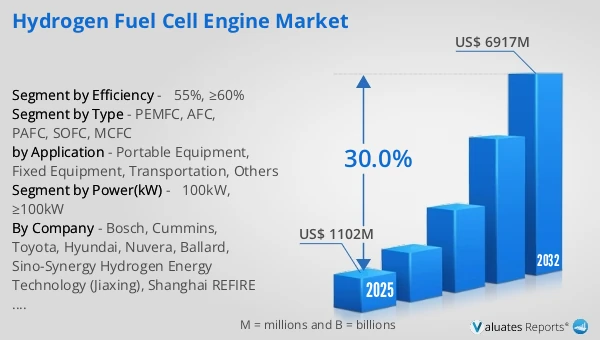
Hydrogen Fuel Cell Engine Market
The 2025 U.S. tariff policies introduce profound uncertainty into the global economic landscape. This report critically examines the implications of recent tariff adjustments and international strategic countermeasures on Hydrogen Fuel Cell Engine competitive dynamics, regional economic interdependencies, and supply chain reconfigurations.
In 2025, global Hydrogen Fuel Cell Engine production reached approximately 16.9 k units with an average global market price of around k US$65 per unit. Single-line annual production capacity averages 350 units with a gross margin of approximately 19.47-23.94%. The upstream of the Hydrogen Fuel Cell Engine industry is primarily composed of key materials such as hydrogen production, catalysts, and membrane electrodes, which are concentrated in the fields of new energy and materials technology; the downstream applications include portable devices, fixed installations, and transportation, with the latter accounting for the highest share at approximately 40%; the industry analysis indicates a robust demand for Hydrogen Fuel Cell Engines, with business opportunities largely centered around the construction of hydrogen energy infrastructure and breakthroughs in fuel cell technology.
The Hydrogen Fuel Cell Engine operates by utilizing hydrogen as the primary fuel source, which undergoes an electrochemical reaction to produce electricity, providing a clean and efficient energy conversion process. This engine not only facilitates the direct conversion of hydrogen into electricity, minimizing energy loss, but also generates zero tailpipe emissions, contributing to environmental sustainability. The engine's design allows for high power density and rapid refueling, ensuring reliable and convenient operation, while its robustness and long-term durability make it a viable solution for various energy-intensive applications.
The future trends in the Hydrogen Fuel Cell Engine industry are set to center around technological innovation for increased efficiency and reduced costs, while concurrently enhancing the development of hydrogen infrastructure to facilitate its commercialization. Governmental policy support, international cooperation, and the advancement of standardization will also contribute to industry growth. Moreover, the deepening of the hydrogen economy concept will drive the application of hydrogen fuel cell engines in a wider range of fields, such as residential power generation and industrial process heating. As technology matures, the safety and reliability of hydrogen fuel cell engines will be significantly improved, further expanding market acceptance. Driven by both competition and collaboration, the industry will witness more opportunities for technological sharing and market expansion, collectively building a more mature and sustainable hydrogen ecosystem.
This report delivers a comprehensive overview of the global Hydrogen Fuel Cell Engine market, with both quantitative and qualitative analyses, to help readers develop growth strategies, assess the competitive landscape, evaluate their position in the current market, and make informed business decisions regarding Hydrogen Fuel Cell Engine. The Hydrogen Fuel Cell Engine market size, estimates, and forecasts are provided in terms of output/shipments (Units) and revenue (US$ millions), with 2025 as the base year and historical and forecast data for 2021–2032.
The report segments the global Hydrogen Fuel Cell Engine market comprehensively. Regional market sizes by Type, by Application, by Power(kW), and by company are also provided. For deeper insight, the report profiles the competitive landscape, key competitors, and their respective market rankings, and discusses technological trends and new product developments.
This report will assist Hydrogen Fuel Cell Engine manufacturers, new entrants, and companies across the industry value chain with information on revenues, production, and average prices for the overall market and its sub-segments, by company, by Type, by Application, and by region.
Market Segmentation
Scope of Hydrogen Fuel Cell Engine Market Report
| Report Metric |
Details |
| Report Name |
Hydrogen Fuel Cell Engine Market |
| Accounted market size in 2025 |
US$ 1102 in million |
| Forecasted market size in 2032 |
US$ 6917 million |
| CAGR |
30.0% |
| Base Year |
2025 |
| Forecasted years |
2026 - 2032 |
| Segment by Type |
|
| Segment by Power(kW) |
|
| Segment by Efficiency |
|
| by Application |
- Portable Equipment
- Fixed Equipment
- Transportation
- Others
|
| Production by Region |
- North America
- Europe
- China
- Japan
|
| Consumption by Region |
- North America (United States, Canada)
- Europe (Germany, France, UK, Italy, Russia)
- Asia-Pacific (China, Japan, South Korea, Taiwan)
- Southeast Asia (India)
- Latin America (Mexico, Brazil)
|
| By Company |
Bosch, Cummins, Toyota, Hyundai, Nuvera, Ballard, Sino-Synergy Hydrogen Energy Technology (Jiaxing), Shanghai REFIRE Group, Shanghai Weishi Energy Technology, Beijing SinoHytec, Shandong Weichai Power, Shenzhen Guohydro New Energy Technology, Dalian Sunrise Power, Jiangsu Horizon New Energy Technologies, Suzhou Foresight Energy, Shanghai Hydrogen Propulsion Technology, Zhejiang Cemt Hydrogen Energy, Foshan CleanEst Energy Technology, Shenzhen Center Power Tech, Zhongshan Broad-Ocean Motor, Zhejiang DR Powertrain System, Beijing Innoreagen Power Technology |
| Forecast units |
USD million in value |
| Report coverage |
Revenue and volume forecast, company share, competitive landscape, growth factors and trends |
Chapter Outline
- Chapter 1: Defines the scope of the report and presents an executive summary of market segments (by Type, by Application, by Power(kW), etc.), including the size of each segment and its future growth potential. It offers a high-level view of the current market and its likely evolution in the short, medium, and long term.
- Chapter 2: Provides a detailed analysis of the competitive landscape for Hydrogen Fuel Cell Engine manufacturers, including prices, production, value-based market shares, latest development plans, and information on mergers and acquisitions.
- Chapter 3: Examines Hydrogen Fuel Cell Engine production/output and value by region and country, providing a quantitative assessment of market size and growth potential for each region over the next six years.
- Chapter 4: Analyzes Hydrogen Fuel Cell Engine consumption at the regional and country levels. It quantifies market size and growth potential for each region and its key countries, and outlines market development, outlook, addressable space, and national production.
- Chapter 5: Analyzes market segments by Type, covering the size and growth potential of each segment to help readers identify “blue ocean” opportunities.
- Chapter 6: Analyzes market segments by Application, covering the size and growth potential of each segment to help readers identify “blue ocean” opportunities in downstream markets.
- Chapter 7: Profiles key players, detailing the fundamentals of major companies, including product production/output, value, price, gross margin, product portfolio/introductions, and recent developments.
- Chapter 8: Reviews the industry value chain, including upstream and downstream segments.
- Chapter 9: Discusses market dynamics and recent developments, including drivers, restraints, challenges and risks for manufacturers, U.S. Tariffs and relevant policy analysis.
- Chapter 10: Summarizes the key findings and conclusions of the report.
FAQ for this report
How fast is Hydrogen Fuel Cell Engine Market growing?
Ans: The Hydrogen Fuel Cell Engine Market witnessing a CAGR of 30.0% during the forecast period 2026-2032.
What is the Hydrogen Fuel Cell Engine Market size in 2032?
Ans: The Hydrogen Fuel Cell Engine Market size in 2032 will be US$ 6917 million.
What is the Hydrogen Fuel Cell Engine Market share by application?
Ans: The upstream of the Hydrogen Fuel Cell Engine industry is primarily composed of key materials such as hydrogen production, catalysts, and membrane electrodes, which are concentrated in the fields of new energy and materials technology; the downstream applications include portable devices, fixed installations, and transportation, with the latter accounting for the highest share at approximately 40%; the industry analysis indicates a robust demand for Hydrogen Fuel Cell Engines, with business opportunities largely centered around the construction of hydrogen energy infrastructure and breakthroughs in fuel cell technology.
Who are the main players in the Hydrogen Fuel Cell Engine Market report?
Ans: The main players in the Hydrogen Fuel Cell Engine Market are Bosch, Cummins, Toyota, Hyundai, Nuvera, Ballard, Sino-Synergy Hydrogen Energy Technology (Jiaxing), Shanghai REFIRE Group, Shanghai Weishi Energy Technology, Beijing SinoHytec, Shandong Weichai Power, Shenzhen Guohydro New Energy Technology, Dalian Sunrise Power, Jiangsu Horizon New Energy Technologies, Suzhou Foresight Energy, Shanghai Hydrogen Propulsion Technology, Zhejiang Cemt Hydrogen Energy, Foshan CleanEst Energy Technology, Shenzhen Center Power Tech, Zhongshan Broad-Ocean Motor, Zhejiang DR Powertrain System, Beijing Innoreagen Power Technology
What are the Application segmentation covered in the Hydrogen Fuel Cell Engine Market report?
Ans: The Applications covered in the Hydrogen Fuel Cell Engine Market report are Portable Equipment, Fixed Equipment, Transportation, Others
What are the Type segmentation covered in the Hydrogen Fuel Cell Engine Market report?
Ans: The Types covered in the Hydrogen Fuel Cell Engine Market report are PEMFC, AFC, PAFC, SOFC, MCFC