FEATURED COMPANIES
Wholewin
Metal Hydride Hydrogen Storage Tanks Market Size
The global Metal Hydride Hydrogen Storage Tanks market was valued at US$ 89.00 million in 2025 and is anticipated to reach US$ 228 million by 2032, at a CAGR of 14.2% from 2026 to 2032.
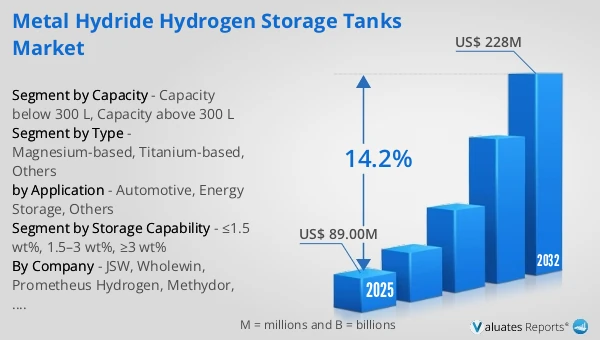
Metal Hydride Hydrogen Storage Tanks Market
The 2025 U.S. tariff policies introduce profound uncertainty into the global economic landscape. This report critically examines the implications of recent tariff adjustments and international strategic countermeasures on Metal Hydride Hydrogen Storage Tanks competitive dynamics, regional economic interdependencies, and supply chain reconfigurations.
Metal hydride hydrogen storage tanks are specialized vessels that store hydrogen by chemically absorbing it into metal or alloy hydrides rather than keeping it as compressed or liquefied gas. Through a reversible reaction, hydrogen is absorbed at relatively low pressure and released upon controlled heating, offering high volumetric storage density and enhanced safety. These tanks typically use alloys such as LaNi₅-based, titanium-based, or magnesium-based hydrides, combined with heat management systems to regulate absorption and desorption efficiency. Owing to their stable operation, low operating pressure, and reduced leakage risk, metal hydride hydrogen storage tanks are widely applied in hydrogen energy systems, fuel cell power supplies, backup energy storage, and research applications.
In 2025, global metal hydride hydrogen storage tanks production reached approximately 30.97 k units, with an average global market price of around US$ 2874 per unit. And global etal hydride hydrogen storage tanks production capacity reached approximately 48 k units. The average gross margin in this industry reached 18.13%.
The upstream segment of metal hydride hydrogen storage tanks centers on hydrogen storage alloys, pressure vessels, and thermal management components. Core materials include metal hydride alloys such as LaNi₅-based (AB₅), Ti–Fe (AB), Zr–Ti–Mn (AB₂), and Mg-based systems, along with alloying elements (Ni, Ti, Zr, Mn, Mg). Tank manufacturing also requires stainless steel or aluminum vessels, heat-exchange tubes/fins, valves, and safety devices, as well as powder metallurgy and alloy activation processes. These inputs determine hydrogen storage capacity, absorption/desorption kinetics, cycle life, and safety. Representative upstream suppliers include Japan Metals & Chemicals (JMC) (hydrogen storage alloys), Toshiba Materials, and Sandvik (high-performance metal materials and tubing).
Downstream applications focus on scenarios requiring safe, low-pressure, and high-volumetric-density hydrogen storage. Typical uses include stationary hydrogen energy storage, backup power systems, hydrogen-powered forklifts and material-handling equipment, fuel-cell auxiliary power units (APUs), hydrogen refueling stations, and portable or off-grid energy systems. Compared with high-pressure cylinders, metal hydride tanks are favored where safety and compactness outweigh weight considerations. Representative downstream users and system integrators include Hydrexia, McPhy Energy, and Toyota Industries, which incorporate metal hydride tanks into hydrogen supply, fuel-cell systems, and industrial energy solutions.
This report delivers a comprehensive overview of the global Metal Hydride Hydrogen Storage Tanks market, with both quantitative and qualitative analyses, to help readers develop growth strategies, assess the competitive landscape, evaluate their position in the current market, and make informed business decisions regarding Metal Hydride Hydrogen Storage Tanks. The Metal Hydride Hydrogen Storage Tanks market size, estimates, and forecasts are provided in terms of output/shipments (K Units) and revenue (US$ millions), with 2025 as the base year and historical and forecast data for 2021–2032.
The report segments the global Metal Hydride Hydrogen Storage Tanks market comprehensively. Regional market sizes by Type, by Application, by Capacity, and by company are also provided. For deeper insight, the report profiles the competitive landscape, key competitors, and their respective market rankings, and discusses technological trends and new product developments.
This report will assist Metal Hydride Hydrogen Storage Tanks manufacturers, new entrants, and companies across the industry value chain with information on revenues, production, and average prices for the overall market and its sub-segments, by company, by Type, by Application, and by region.
Market Segmentation
Scope of Metal Hydride Hydrogen Storage Tanks Market Report
| Report Metric |
Details |
| Report Name |
Metal Hydride Hydrogen Storage Tanks Market |
| Accounted market size in 2025 |
US$ 89.00 million |
| Forecasted market size in 2032 |
US$ 228 million |
| CAGR |
14.2% |
| Base Year |
2025 |
| Forecasted years |
2026 - 2032 |
| Segment by Type |
- Magnesium-based
- Titanium-based
- Others
|
| Segment by Capacity |
- Capacity below 300 L
- Capacity above 300 L
|
| Segment by Storage Capability |
- ≤1.5 wt%
- 1.5–3 wt%
- ≥3 wt%
|
| by Application |
- Automotive
- Energy Storage
- Others
|
| Production by Region |
- North America
- Europe
- China
- Japan
|
| Consumption by Region |
- North America (United States, Canada)
- Europe (Germany, France, UK, Italy, Russia)
- Asia-Pacific (China, Japan, South Korea, Taiwan)
- Southeast Asia (India)
- Latin America (Mexico, Brazil)
|
| By Company |
JSW, Wholewin, Prometheus Hydrogen, Methydor, H2Planet, Hydrexia, Houpu Clean Energy |
| Forecast units |
USD million in value |
| Report coverage |
Revenue and volume forecast, company share, competitive landscape, growth factors and trends |
Chapter Outline
- Chapter 1: Defines the scope of the report and presents an executive summary of market segments (by Type, by Application, by Capacity, etc.), including the size of each segment and its future growth potential. It offers a high-level view of the current market and its likely evolution in the short, medium, and long term.
- Chapter 2: Provides a detailed analysis of the competitive landscape for Metal Hydride Hydrogen Storage Tanks manufacturers, including prices, production, value-based market shares, latest development plans, and information on mergers and acquisitions.
- Chapter 3: Examines Metal Hydride Hydrogen Storage Tanks production/output and value by region and country, providing a quantitative assessment of market size and growth potential for each region over the next six years.
- Chapter 4: Analyzes Metal Hydride Hydrogen Storage Tanks consumption at the regional and country levels. It quantifies market size and growth potential for each region and its key countries, and outlines market development, outlook, addressable space, and national production.
- Chapter 5: Analyzes market segments by Type, covering the size and growth potential of each segment to help readers identify “blue ocean” opportunities.
- Chapter 6: Analyzes market segments by Application, covering the size and growth potential of each segment to help readers identify “blue ocean” opportunities in downstream markets.
- Chapter 7: Profiles key players, detailing the fundamentals of major companies, including product production/output, value, price, gross margin, product portfolio/introductions, and recent developments.
- Chapter 8: Reviews the industry value chain, including upstream and downstream segments.
- Chapter 9: Discusses market dynamics and recent developments, including drivers, restraints, challenges and risks for manufacturers, U.S. Tariffs and relevant policy analysis.
- Chapter 10: Summarizes the key findings and conclusions of the report.
FAQ for this report
How fast is Metal Hydride Hydrogen Storage Tanks Market growing?
Ans: The Metal Hydride Hydrogen Storage Tanks Market witnessing a CAGR of 14.2% during the forecast period 2026-2032.
What is the Metal Hydride Hydrogen Storage Tanks Market size in 2032?
Ans: The Metal Hydride Hydrogen Storage Tanks Market size in 2032 will be US$ 228 million.
Who are the main players in the Metal Hydride Hydrogen Storage Tanks Market report?
Ans: The main players in the Metal Hydride Hydrogen Storage Tanks Market are JSW, Wholewin, Prometheus Hydrogen, Methydor, H2Planet, Hydrexia, Houpu Clean Energy
What are the Application segmentation covered in the Metal Hydride Hydrogen Storage Tanks Market report?
Ans: The Applications covered in the Metal Hydride Hydrogen Storage Tanks Market report are Automotive, Energy Storage, Others
What are the Type segmentation covered in the Metal Hydride Hydrogen Storage Tanks Market report?
Ans: The Types covered in the Metal Hydride Hydrogen Storage Tanks Market report are Magnesium-based, Titanium-based, Others