FEATURED COMPANIES
Voestalpine AG
SCHMOLZ + BICKENBACH
Sandvik
Fushun Special Steel
Baosteel
Nachi-Fujikoshi
Qilu Special Steel
ERAMET
Daido Steel
Sanyo Special Steel
Nippon Koshuha Steel
ArcelorMittal
GMH-Gruppe
Kind & Co.
Universal Stainless
Cold Working Die Steels Market Size
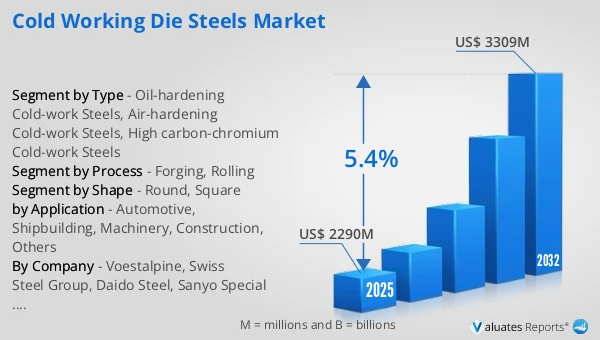
The global Cold Working Die Steels market was valued at US$ 2290 million in 2025 and is anticipated to reach US$ 3309 million by 2032, at a CAGR of 5.4% from 2026 to 2032.
Cold Working Die Steels Market
The 2025 U.S. tariff policies introduce profound uncertainty into the global economic landscape. This report critically examines the implications of recent tariff adjustments and international strategic countermeasures on Cold Working Die Steels competitive dynamics, regional economic interdependencies, and supply chain reconfigurations.
In 2025, global Cold Working Die Steels production reached approximately 654k tons, with an average global market price of around US$3500 per ton.
Cold working die steels are tool and die steels used for forming operations performed at ambient or relatively low temperatures—such as blanking, punching, shearing, cold extrusion, deep drawing, and cold heading. They are designed to maintain high hardness and wear resistance under severe contact stress, repetitive impact, and sliding friction, while retaining adequate toughness, hardenability, heat-treatment dimensional stability, and resistance to chipping/cracking. Typically alloyed with relatively high carbon plus chromium, molybdenum, and vanadium, these steels rely on stable, fine carbides for wear resistance and a properly heat-treated martensitic matrix for a balanced strength-toughness profile, and are widely used in blanking/forming dies, cold extrusion dies, thread-rolling dies, punches, and die inserts.
Upstream supply for cold working die steels centers on steelmaking inputs (hot metal/scrap), alloying and auxiliary materials (Cr, Mo, V, Mn, Si, Ni alloys; carburizers; deoxidizers; refractories), as well as energy such as electricity and natural gas. Midstream manufacturing typically involves specialty steel melting, secondary refining (e.g., LF, VD), optional remelting (ESR/VAR depending on grade), forging/rolling, heat treatment, NDT inspection, and finishing. Downstream demand comes from die makers and cold-forming manufacturers serving end industries including automotive stamping (body panels and components), home-appliance sheet-metal stamping, 3C electronics precision stamping and connectors, fasteners/cold heading, and hardware tools. Representative upstream suppliers/traders include Glencore (base metals), Codelco (copper within the broader metals supply chain), and China Minmetals (metals/alloys supply chain), while representative downstream end users include automakers such as Toyota and Volkswagen, appliance brands Haier and Midea, and electronics manufacturing ecosystem players such as Foxconn.
The cold working die steel market generally grows in line with stamping and cold-forming activity while showing clear up-grading dynamics: end users increasingly prioritize die life, process stability, and dimensional consistency, shifting demand from commodity grades toward higher-toughness, low-chipping, low-distortion, and high-consistency grades. On the technology side, the focus is moving toward inclusion control and carbide refinement/homogenization to extend wear life and reduce chipping/cracking risk; on the process side, wider adoption of advanced refining/remelting levels, distortion-controlled heat treatment, and surface engineering (nitriding, PVD coatings) is enabling a “tough core + wear-resistant surface” performance model. Key demand drivers include large-scale automotive and appliance sheet-metal stamping, high-speed precision stamping and connector manufacturing in 3C electronics with thinner sections and tighter tolerances, and ongoing tooling consumption in fasteners/cold heading industries. Headwinds include cost volatility from alloying elements and energy, tight manufacturing and heat-treatment windows for premium grades (where poor control can lead to early failures and claims), intense competition and price transparency in commodity grades that compress margins, and cyclical swings in downstream manufacturing that can create order and inventory pressure.
This report delivers a comprehensive overview of the global Cold Working Die Steels market, with both quantitative and qualitative analyses, to help readers develop growth strategies, assess the competitive landscape, evaluate their position in the current market, and make informed business decisions regarding Cold Working Die Steels. The Cold Working Die Steels market size, estimates, and forecasts are provided in terms of output/shipments (Kilotons) and revenue (US$ millions), with 2025 as the base year and historical and forecast data for 2021–2032.
The report segments the global Cold Working Die Steels market comprehensively. Regional market sizes by Type, by Application, by Shape, and by company are also provided. For deeper insight, the report profiles the competitive landscape, key competitors, and their respective market rankings, and discusses technological trends and new product developments.
This report will assist Cold Working Die Steels manufacturers, new entrants, and companies across the industry value chain with information on revenues, production, and average prices for the overall market and its sub-segments, by company, by Type, by Application, and by region.
Market Segmentation
Scope of Cold Working Die Steels Market Report
| Report Metric |
Details |
| Report Name |
Cold Working Die Steels Market |
| Accounted market size in 2025 |
US$ 2290 million |
| Forecasted market size in 2032 |
US$ 3309 million |
| CAGR |
5.4% |
| Base Year |
2025 |
| Forecasted years |
2026 - 2032 |
| Segment by Type |
- Oil-hardening Cold-work Steels
- Air-hardening Cold-work Steels
- High carbon-chromium Cold-work Steels
|
| Segment by Shape |
|
| Segment by Process |
|
| by Application |
- Automotive
- Shipbuilding
- Machinery
- Construction
- Others
|
| Production by Region |
- North America
- Europe
- China
- Japan
|
| Consumption by Region |
- North America (United States, Canada)
- Europe (Germany, France, UK, Italy, Russia)
- Asia-Pacific (China, Japan, South Korea, Taiwan)
- Southeast Asia (India)
- Latin America (Mexico, Brazil)
|
| By Company |
Voestalpine, Swiss Steel Group, Daido Steel, Sanyo Special Steel, SIJ Metal Ravne, SeAH CSS, Proterial (Hitachi Metals), ArcelorMittal, Nippon Koshuha Steel, Nachi-Fujikoshi, GMH Gruppe, Universal Stainless, ERAMET, Sandvik, Schmolz + Bickenbach, Dongbei Special Steel, Pangang Group, BaoSteel, Tiangong International, Qilu Special Steel, Fushun Special Steel |
| Forecast units |
USD million in value |
| Report coverage |
Revenue and volume forecast, company share, competitive landscape, growth factors and trends |
Chapter Outline
- Chapter 1: Defines the scope of the report and presents an executive summary of market segments (by Type, by Application, by Shape, etc.), including the size of each segment and its future growth potential. It offers a high-level view of the current market and its likely evolution in the short, medium, and long term.
- Chapter 2: Provides a detailed analysis of the competitive landscape for Cold Working Die Steels manufacturers, including prices, production, value-based market shares, latest development plans, and information on mergers and acquisitions.
- Chapter 3: Examines Cold Working Die Steels production/output and value by region and country, providing a quantitative assessment of market size and growth potential for each region over the next six years.
- Chapter 4: Analyzes Cold Working Die Steels consumption at the regional and country levels. It quantifies market size and growth potential for each region and its key countries, and outlines market development, outlook, addressable space, and national production.
- Chapter 5: Analyzes market segments by Type, covering the size and growth potential of each segment to help readers identify “blue ocean” opportunities.
- Chapter 6: Analyzes market segments by Application, covering the size and growth potential of each segment to help readers identify “blue ocean” opportunities in downstream markets.
- Chapter 7: Profiles key players, detailing the fundamentals of major companies, including product production/output, value, price, gross margin, product portfolio/introductions, and recent developments.
- Chapter 8: Reviews the industry value chain, including upstream and downstream segments.
- Chapter 9: Discusses market dynamics and recent developments, including drivers, restraints, challenges and risks for manufacturers, U.S. Tariffs and relevant policy analysis.
- Chapter 10: Summarizes the key findings and conclusions of the report.
FAQ for this report
How fast is Cold Working Die Steels Market growing?
Ans: The Cold Working Die Steels Market witnessing a CAGR of 5.4% during the forecast period 2026-2032.
What is the Cold Working Die Steels Market size in 2032?
Ans: The Cold Working Die Steels Market size in 2032 will be US$ 3309 million.
Who are the main players in the Cold Working Die Steels Market report?
Ans: The main players in the Cold Working Die Steels Market are Voestalpine, Swiss Steel Group, Daido Steel, Sanyo Special Steel, SIJ Metal Ravne, SeAH CSS, Proterial (Hitachi Metals), ArcelorMittal, Nippon Koshuha Steel, Nachi-Fujikoshi, GMH Gruppe, Universal Stainless, ERAMET, Sandvik, Schmolz + Bickenbach, Dongbei Special Steel, Pangang Group, BaoSteel, Tiangong International, Qilu Special Steel, Fushun Special Steel
What are the Application segmentation covered in the Cold Working Die Steels Market report?
Ans: The Applications covered in the Cold Working Die Steels Market report are Automotive, Shipbuilding, Machinery, Construction, Others
What are the Type segmentation covered in the Cold Working Die Steels Market report?
Ans: The Types covered in the Cold Working Die Steels Market report are Oil-hardening Cold-work Steels, Air-hardening Cold-work Steels, High carbon-chromium Cold-work Steels