Blood Collection Robots Market Size
The global Blood Collection Robots market was valued at US$ 3.13 million in 2025 and is anticipated to reach US$ 48.62 million by 2032, at a CAGR of 38.0% from 2026 to 2032.
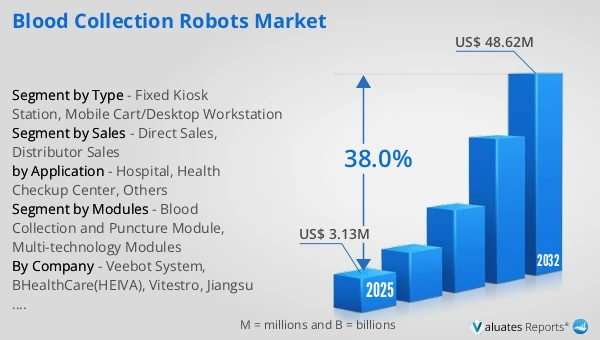
Blood Collection Robots Market
The 2025 U.S. tariff policies introduce profound uncertainty into the global economic landscape. This report critically examines the implications of recent tariff adjustments and international strategic countermeasures on Blood Collection Robots competitive dynamics, regional economic interdependencies, and supply chain reconfigurations.
Blood collection robots are medical robot systems designed for hospital blood collection windows, physical examination centers, and medical laboratory pre-processing scenarios. Their core capabilities include using near-infrared and ultrasound technology to detect veins, reconstructing vein images using 3D technology, and then using AI algorithms to intelligently analyze the images, selecting the most appropriate location and method for needle insertion to achieve automated intravenous puncture blood testing. The system typically integrates identity verification, medical order matching, catheter and needle supply, disinfection, pulse pressure, quantitative blood collection, catheter replacement, mixing, hemostasis, and traceability recording, forming an auditable closed-loop blood collection workflow. This aims to improve the success rate of first-time punctures, reduce pre-test errors, and alleviate the shortage of blood collection personnel. In 2025, the global production of blood collection robots was approximately 32 units, with a unit price of approximately US$97,800 and a gross profit margin of approximately 45%–65%.
Currently, blood collection still faces many challenges, with poor visibility and inaccurate punctures being the main issues. Infants' blood vessels are very thin, and those with thicker fat layers or darker skin tones often have blood vessels that are difficult to visually assess. The failure rate for first-time intravenous punctures in children is around 44%, and repeated punctures increase the psychological stress on nurses. Due to various factors, the efficiency of blood collection and testing in many hospitals is not high. During peak blood collection periods, the average waiting time for patients is 24 minutes, with over 64.5% of patients waiting more than 15 minutes. Even in commercial medical examination institutions, the average time for a "trial" blood collection exceeds 10 minutes. From a clinical perspective, many hospitals face the pain point of high blood collection pressure, creating a significant demand for blood collection robots. Furthermore, the long-term shortage of nursing staff has spurred the need for "substitute labor." Currently, automation solutions exist for queuing, blood collection tube sorting, blood diagnosis, and report output; only the blood collection process still relies on manual labor. Future machine replacement will complete the automated closed loop of blood diagnosis. From the perspective of practical applications in the medical field, blood collection robots are still in their early stages of development. Due to factors such as cost and hospital procurement processes, currently, most hospitals that can implement them are large tertiary hospitals. Companies in this sector are primarily focused on research and development; future commercialization may require more external CSOs (Contract Sales Organizations) to gradually penetrate hospitals. Globally, the European and American markets have significant potential, as nurses in these countries have lower success rates for manual intravenous punctures, making machine replacement a priority. However, cost reduction is a key factor for commercialization. Currently, blood collection robots entering the market are expensive. Significant commercial and social value will only be realized after technological iterations and their integration into primary healthcare systems.
This report delivers a comprehensive overview of the global Blood Collection Robots market, with both quantitative and qualitative analyses, to help readers develop growth strategies, assess the competitive landscape, evaluate their position in the current market, and make informed business decisions regarding Blood Collection Robots. The Blood Collection Robots market size, estimates, and forecasts are provided in terms of sales volume (Unit) and revenue (US$ millions), with 2025 as the base year and historical and forecast data for 2021–2032.
The report segments the global Blood Collection Robots market comprehensively. Regional market sizes by Type, by Application, by Modules, and by company are also provided. For deeper insight, the report profiles the competitive landscape, key competitors, and their respective market rankings, and discusses technological trends and new product developments.
This report will assist Blood Collection Robots manufacturers, new entrants, and companies across the industry value chain with information on revenues, sales volume, and average prices for the overall market and its sub-segments, by company, by Type, by Application, and by region.
Market Segmentation
Scope of Blood Collection Robots Market Report
| Report Metric |
Details |
| Report Name |
Blood Collection Robots Market |
| Accounted market size in 2025 |
US$ 3.13 million |
| Forecasted market size in 2032 |
US$ 48.62 million |
| CAGR |
38.0% |
| Base Year |
2025 |
| Forecasted years |
2026 - 2032 |
| Segment by Type |
- Fixed Kiosk Station
- Mobile Cart/Desktop Workstation
|
| Segment by Modules |
- Blood Collection and Puncture Module
- Multi-technology Modules
|
| Segment by Sales |
- Direct Sales
- Distributor Sales
|
| by Application |
- Hospital
- Health Checkup Center
- Others
|
| Consumption by Region |
- North America (United States, Canada)
- Europe (Germany, France, UK, Italy, Russia)
- Asia-Pacific (China, Japan, South Korea, Taiwan)
- Southeast Asia (India)
- Latin America (Mexico, Brazil)
|
| By Company |
Veebot System, BHealthCare(HEIVA), Vitestro, Jiangsu Hagong Intelligent Robot Co.,Ltd., Beijing mainashi Surgical Robot Technology Co. Ltd., Chengdu Kairui Medical Technology Co., Ltd. (Aixam) |
| Forecast units |
USD million in value |
| Report coverage |
Revenue and volume forecast, company share, competitive landscape, growth factors and trends |
Chapter Outline
- Chapter 1: Defines the scope of the report and presents an executive summary of market segments (by Type, by Application, by Modules, etc.), including the size of each segment and its future growth potential. It offers a high-level view of the current market and its likely evolution in the short, medium, and long term.
- Chapter 2: Provides a detailed analysis of the competitive landscape for Blood Collection Robots manufacturers, covering pricing, sales and revenue shares, latest development plans, and mergers and acquisitions.
- Chapter 3: Examines Blood Collection Robots sales and revenue at the regional and country levels. It quantifies market size and growth potential for each region and its key countries, and outlines market development, outlook, addressable space, and national market size.
- Chapter 4: Analyzes segments by Type, detailing the size and growth potential of each segment to help readers identify “blue ocean” opportunities.
- Chapter 5: Analyzes market segments by Application, covering the size and growth potential of each segment to help readers identify “blue ocean” opportunities in downstream markets.
- Chapter 6: Profiles key players, presenting core information on leading companies, including product sales, revenue, pricing, gross margin, product portfolio/introductions, and recent developments.
- Chapter 7: Reviews the industry value chain, including upstream and downstream segments.
- Chapter 8: Discusses market dynamics and recent developments, including drivers, restraints, challenges and risks for manufacturers, U.S. Tariffs and relevant policy analysis.
- Chapter 9: Summarizes the key findings and conclusions of the report.
FAQ for this report
How fast is Blood Collection Robots Market growing?
Ans: The Blood Collection Robots Market witnessing a CAGR of 38.0% during the forecast period 2026-2032.
What is the Blood Collection Robots Market size in 2032?
Ans: The Blood Collection Robots Market size in 2032 will be US$ 48.62 million.
Who are the main players in the Blood Collection Robots Market report?
Ans: The main players in the Blood Collection Robots Market are Veebot System, BHealthCare(HEIVA), Vitestro, Jiangsu Hagong Intelligent Robot Co.,Ltd., Beijing mainashi Surgical Robot Technology Co. Ltd., Chengdu Kairui Medical Technology Co., Ltd. (Aixam)
What are the Application segmentation covered in the Blood Collection Robots Market report?
Ans: The Applications covered in the Blood Collection Robots Market report are Hospital, Health Checkup Center, Others
What are the Type segmentation covered in the Blood Collection Robots Market report?
Ans: The Types covered in the Blood Collection Robots Market report are Fixed Kiosk Station, Mobile Cart/Desktop Workstation