4
U.S. (TOLL FREE)
+1 (315) 215-3225
Automative

4
U.S. (TOLL FREE)
+1 (315) 215-3225
Global Military Sensors Market Research Report 2025
Published Date: April 2025
|
Report Code: QYRE-Auto-31G9014
Home | Market Reports | Business & Industrial| Aerospace & Defense| Space Technology
Global Military Sensors Market Insights and Forecast to 2028
BUY CHAPTERS

Global Military Sensors Market Research Report 2025

Code: QYRE-Auto-31G9014
Report
April 2025
Pages:73
QYResearch
Buy Now with 15% Discount
DESCRIPTION
TABLE OF CONTENT
TABLES & FIGURES

Military Sensors Market Size

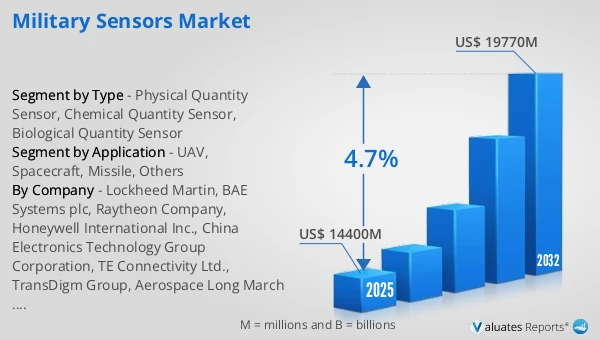
The global market for Military Sensors was valued at US$ 13700 million in the year 2024 and is projected to reach a revised size of US$ 18970 million by 2031, growing at a CAGR of 4.7% during the forecast period.

Military Sensors Market

Military Sensors Market

Military sensors are devices designed specifically for the military field that can convert specific physical quantities (such as temperature, pressure, electromagnetic signals, etc.) into electrical signal outputs for reconnaissance, navigation, weapon guidance, etc. Military sensors are devices that convert electrical signals or other usable signals according to certain rules and are specifically used in the military field.
Global military sensor includes Lockheed Martin, BAE Systems plc, etc. Global top 3 companies hold a share over 30%. North America is the largest market, with a share about 40%, followed by Asia Pacific and Europe with the share about 30% and 20%. In terms of product, physical quantity sensor is the largest segment, with a share over 60%. And in terms of application, the largest application is spacecraft, with a share about 20%.
Analysis of market driving factors
Demand for the development of military technology
Intelligence and integration:
Promote the development of sensors towards high precision and high reliability. For example, the application of MEMS (micro-electromechanical systems) technology and nanotechnology has improved sensor performance;
Intelligent sensors have autonomous compensation, detection, and diagnosis functions, and are adapted to the needs of modern equipment such as drones and smart ammunition.
Emerging military technologies:
The application of quantum sensors, lidar technology, etc. in the military field has enhanced the battlefield situation awareness capability;
Multifunctional sensor arrays (such as temperature, humidity, pressure, and chemical composition integration) provide comprehensive environmental monitoring and support tasks such as chemical warfare agent detection.
Policy and regulatory support
National policy support: Promote industry development through policies such as fiscal and tax incentives and scientific and technological innovation subsidies. For example, the US National Defense Authorization Act increases financial support for sensor technology research and development; China's "14th Five-Year Plan" lists sensor technology as a key development area to promote the localization process. International cooperation and exchanges: International organizations such as NATO promote technical exchanges among member states to improve the overall level of the global military sensor industry; the International Organization for Standardization (ISO) formulates military sensor technology standards to promote the standardized development of technology.
Complexity of the international security environment
Regional conflicts and terrorism: Changes in the global security situation increase the demand for military sensors. For example, the complexity of the security environment in the Asia-Pacific region drives the growth of the sensor market;
Electronic warfare and information security: The application of sensors in the fields of electronic warfare and information security has become an important tool for responding to security challenges. For example, radio frequency sensors are used to identify enemy signal characteristics.
Competition and cooperation pattern
Market competition: Intensified competition among domestic and foreign companies has promoted technological innovation and product quality improvement. For example, Chinese companies have broken foreign monopolies in the fields of pressure sensors and infrared imaging sensors; Localization process: Chinese policies support the acceleration of the localization process and enhance market competitiveness. For example, companies such as China Electronics Technology Group and AVIC Electro-Mechanical Test have taken the lead in the industry.
Future development trends
Technology integration: Deep integration of quantum sensing, artificial intelligence and sensors to achieve autonomous battlefield decision-making; Material innovation: New materials (such as quantum dots and flexible materials) improve sensor performance and adaptability; Global cooperation: International military cooperation promotes the sharing of sensor technology to respond to transnational security challenges.
The military sensor market is driven by multiple factors such as military technology development, policy support, defense budget growth, changes in the security environment and competition pattern. In the future, technological innovation and cooperation will become the core driving force for the development of the industry, promoting the evolution of military sensors towards higher precision and stronger adaptability, and providing strong support for national defense security.
This report aims to provide a comprehensive presentation of the global market for Military Sensors, with both quantitative and qualitative analysis, to help readers develop business/growth strategies, assess the market competitive situation, analyze their position in the current marketplace, and make informed business decisions regarding Military Sensors.
The Military Sensors market size, estimations, and forecasts are provided in terms of and revenue ($ millions), considering 2024 as the base year, with history and forecast data for the period from 2020 to 2031. This report segments the global Military Sensors market comprehensively. Regional market sizes, concerning products by Type, by Application, and by players, are also provided.
For a more in-depth understanding of the market, the report provides profiles of the competitive landscape, key competitors, and their respective market ranks. The report also discusses technological trends and new product developments.
The report will help the Military Sensors companies, new entrants, and industry chain related companies in this market with information on the revenues for the overall market and the sub-segments across the different segments, by company, by Type, by Application, and by regions.
Market Segmentation

Scope of Military Sensors Market Report

Report Metric Details
Report Name Military Sensors Market
Accounted market size in year US$ 13700 million
Forecasted market size in 2031 US$ 18970 million
CAGR 4.7%
Base Year year
Forecasted years 2025 - 2031
Segment by Type
Segment by Application
By Region
  • North America (United States, Canada)
  • Europe (Germany, France, UK, Italy, Russia) Rest of Europe
  • Nordic Countries
  • Asia-Pacific (China, Japan, South Korea)
  • Southeast Asia (India, Australia)
  • Rest of Asia
  • Latin America (Mexico, Brazil)
  • Rest of Latin America
  • Middle East & Africa (Turkey, Saudi Arabia, UAE, Rest of MEA)
By Company Lockheed Martin, BAE Systems plc, Raytheon Company, Honeywell International Inc., China Electronics Technology Group Corporation, TE Connectivity Ltd., TransDigm Group, Aerospace Long March Launch Vehicle Technology CO.,LTD, Curtiss-Wright Corporation
Forecast units USD million in value
Report coverage Revenue and volume forecast, company share, competitive landscape, growth factors and trends

Chapter Outline

  • Chapter 1: Introduces the report scope of the report, executive summary of different market segments (by Type, by Application, etc), including the market size of each market segment, future development potential, and so on. It offers a high-level view of the current state of the market and its likely evolution in the short to mid-term, and long term.
  • Chapter 2: Introduces executive summary of global market size, regional market size, this section also introduces the market dynamics, latest developments of the market, the driving factors and restrictive factors of the market, the challenges and risks faced by companies in the industry, and the analysis of relevant policies in the industry.
  • Chapter 3: Detailed analysis of Military Sensors company competitive landscape, revenue market share, latest development plan, merger, and acquisition information, etc.
  • Chapter 4: Provides the analysis of various market segments by Type, covering the market size and development potential of each market segment, to help readers find the blue ocean market in different market segments.
  • Chapter 5: Provides the analysis of various market segments by Application, covering the market size and development potential of each market segment, to help readers find the blue ocean market in different downstream markets.
  • Chapter 6, 7, 8, 9, 10: North America, Europe, Asia Pacific, Latin America, Middle East and Africa segment by country. It provides a quantitative analysis of the market size and development potential of each region and its main countries and introduces the market development, future development prospects, market space, and capacity of each country in the world.
  • Chapter 11: Provides profiles of key players, introducing the basic situation of the main companies in the market in detail, including product sales, revenue, price, gross margin, product introduction, recent development, etc.
  • Chapter 12: The main points and conclusions of the report.

FAQ for this report

How fast is Military Sensors Market growing?

Ans: The Military Sensors Market witnessing a CAGR of 4.7% during the forecast period 2025-2031.

What is the Military Sensors Market size in 2031?

Ans: The Military Sensors Market size in 2031 will be US$ 18970 million.

What is the Lockheed Martin, BAE Systems plc share in Military Sensors Market?

Ans: Global military sensor includes Lockheed Martin, BAE Systems plc, etc. Global top 3 companies hold a share over 30%. 

What is the Military Sensors Market share by region?

Ans: North America is the largest market, with a share about 40%, followed by Asia Pacific and Europe with the share about 30% and 20%.

What is the Military Sensors Market share by type?

Ans: In terms of product, physical quantity sensor is the largest segment, with a share over 60%.

What is the Military Sensors Market share by application?

Ans: And in terms of application, the largest application is spacecraft, with a share about 20%.

Who are the main players in the Military Sensors Market report?

Ans: The main players in the Military Sensors Market are Lockheed Martin, BAE Systems plc, Raytheon Company, Honeywell International Inc., China Electronics Technology Group Corporation, TE Connectivity Ltd., TransDigm Group, Aerospace Long March Launch Vehicle Technology CO.,LTD, Curtiss-Wright Corporation

What are the Application segmentation covered in the Military Sensors Market report?

Ans: The Applications covered in the Military Sensors Market report are UAV, Spacecraft, Missile, Others

What are the Type segmentation covered in the Military Sensors Market report?

Ans: The Types covered in the Military Sensors Market report are Physical Quantity Sensor, Chemical Quantity Sensor, Biological Quantity Sensor

Recommended Reports

Military Semiconductors

Military Electro-Optics

Military Sensors & Radar

1 Report Overview
1.1 Study Scope
1.2 Market Analysis by Type
1.2.1 Global Military Sensors Market Size Growth Rate by Type: 2020 VS 2024 VS 2031
1.2.2 Physical Quantity Sensor
1.2.3 Chemical Quantity Sensor
1.2.4 Biological Quantity Sensor
1.3 Market by Application
1.3.1 Global Military Sensors Market Growth by Application: 2020 VS 2024 VS 2031
1.3.2 UAV
1.3.3 Spacecraft
1.3.4 Missile
1.3.5 Others
1.4 Assumptions and Limitations
1.5 Study Objectives
1.6 Years Considered
2 Global Growth Trends
2.1 Global Military Sensors Market Perspective (2020-2031)
2.2 Global Military Sensors Growth Trends by Region
2.2.1 Global Military Sensors Market Size by Region: 2020 VS 2024 VS 2031
2.2.2 Military Sensors Historic Market Size by Region (2020-2025)
2.2.3 Military Sensors Forecasted Market Size by Region (2026-2031)
2.3 Military Sensors Market Dynamics
2.3.1 Military Sensors Industry Trends
2.3.2 Military Sensors Market Drivers
2.3.3 Military Sensors Market Challenges
2.3.4 Military Sensors Market Restraints
3 Competition Landscape by Key Players
3.1 Global Top Military Sensors Players by Revenue
3.1.1 Global Top Military Sensors Players by Revenue (2020-2025)
3.1.2 Global Military Sensors Revenue Market Share by Players (2020-2025)
3.2 Global Top Military Sensors Players by Company Type and Market Share by Company Type (Tier 1, Tier 2, and Tier 3)
3.3 Global Key Players Ranking by Military Sensors Revenue
3.4 Global Military Sensors Market Concentration Ratio
3.4.1 Global Military Sensors Market Concentration Ratio (CR5 and HHI)
3.4.2 Global Top 10 and Top 5 Companies by Military Sensors Revenue in 2024
3.5 Global Key Players of Military Sensors Head office and Area Served
3.6 Global Key Players of Military Sensors, Product and Application
3.7 Global Key Players of Military Sensors, Date of Enter into This Industry
3.8 Mergers & Acquisitions, Expansion Plans
4 Military Sensors Breakdown Data by Type
4.1 Global Military Sensors Historic Market Size by Type (2020-2025)
4.2 Global Military Sensors Forecasted Market Size by Type (2026-2031)
5 Military Sensors Breakdown Data by Application
5.1 Global Military Sensors Historic Market Size by Application (2020-2025)
5.2 Global Military Sensors Forecasted Market Size by Application (2026-2031)
6 North America
6.1 North America Military Sensors Market Size (2020-2031)
6.2 North America Military Sensors Market Growth Rate by Country: 2020 VS 2024 VS 2031
6.3 North America Military Sensors Market Size by Country (2020-2025)
6.4 North America Military Sensors Market Size by Country (2026-2031)
6.5 United States
6.6 Canada
7 Europe
7.1 Europe Military Sensors Market Size (2020-2031)
7.2 Europe Military Sensors Market Growth Rate by Country: 2020 VS 2024 VS 2031
7.3 Europe Military Sensors Market Size by Country (2020-2025)
7.4 Europe Military Sensors Market Size by Country (2026-2031)
7.5 Germany
7.6 France
7.7 U.K.
7.8 Italy
7.9 Russia
7.10 Nordic Countries
8 Asia-Pacific
8.1 Asia-Pacific Military Sensors Market Size (2020-2031)
8.2 Asia-Pacific Military Sensors Market Growth Rate by Region: 2020 VS 2024 VS 2031
8.3 Asia-Pacific Military Sensors Market Size by Region (2020-2025)
8.4 Asia-Pacific Military Sensors Market Size by Region (2026-2031)
8.5 China
8.6 Japan
8.7 South Korea
8.8 Southeast Asia
8.9 India
8.10 Australia
9 Latin America
9.1 Latin America Military Sensors Market Size (2020-2031)
9.2 Latin America Military Sensors Market Growth Rate by Country: 2020 VS 2024 VS 2031
9.3 Latin America Military Sensors Market Size by Country (2020-2025)
9.4 Latin America Military Sensors Market Size by Country (2026-2031)
9.5 Mexico
9.6 Brazil
10 Middle East & Africa
10.1 Middle East & Africa Military Sensors Market Size (2020-2031)
10.2 Middle East & Africa Military Sensors Market Growth Rate by Country: 2020 VS 2024 VS 2031
10.3 Middle East & Africa Military Sensors Market Size by Country (2020-2025)
10.4 Middle East & Africa Military Sensors Market Size by Country (2026-2031)
10.5 Turkey
10.6 Saudi Arabia
10.7 UAE
11 Key Players Profiles
11.1 Lockheed Martin
11.1.1 Lockheed Martin Company Details
11.1.2 Lockheed Martin Business Overview
11.1.3 Lockheed Martin Military Sensors Introduction
11.1.4 Lockheed Martin Revenue in Military Sensors Business (2020-2025)
11.1.5 Lockheed Martin Recent Development
11.2 BAE Systems plc
11.2.1 BAE Systems plc Company Details
11.2.2 BAE Systems plc Business Overview
11.2.3 BAE Systems plc Military Sensors Introduction
11.2.4 BAE Systems plc Revenue in Military Sensors Business (2020-2025)
11.2.5 BAE Systems plc Recent Development
11.3 Raytheon Company
11.3.1 Raytheon Company Company Details
11.3.2 Raytheon Company Business Overview
11.3.3 Raytheon Company Military Sensors Introduction
11.3.4 Raytheon Company Revenue in Military Sensors Business (2020-2025)
11.3.5 Raytheon Company Recent Development
11.4 Honeywell International Inc.
11.4.1 Honeywell International Inc. Company Details
11.4.2 Honeywell International Inc. Business Overview
11.4.3 Honeywell International Inc. Military Sensors Introduction
11.4.4 Honeywell International Inc. Revenue in Military Sensors Business (2020-2025)
11.4.5 Honeywell International Inc. Recent Development
11.5 China Electronics Technology Group Corporation
11.5.1 China Electronics Technology Group Corporation Company Details
11.5.2 China Electronics Technology Group Corporation Business Overview
11.5.3 China Electronics Technology Group Corporation Military Sensors Introduction
11.5.4 China Electronics Technology Group Corporation Revenue in Military Sensors Business (2020-2025)
11.5.5 China Electronics Technology Group Corporation Recent Development
11.6 TE Connectivity Ltd.
11.6.1 TE Connectivity Ltd. Company Details
11.6.2 TE Connectivity Ltd. Business Overview
11.6.3 TE Connectivity Ltd. Military Sensors Introduction
11.6.4 TE Connectivity Ltd. Revenue in Military Sensors Business (2020-2025)
11.6.5 TE Connectivity Ltd. Recent Development
11.7 TransDigm Group
11.7.1 TransDigm Group Company Details
11.7.2 TransDigm Group Business Overview
11.7.3 TransDigm Group Military Sensors Introduction
11.7.4 TransDigm Group Revenue in Military Sensors Business (2020-2025)
11.7.5 TransDigm Group Recent Development
11.8 Aerospace Long March Launch Vehicle Technology CO.,LTD
11.8.1 Aerospace Long March Launch Vehicle Technology CO.,LTD Company Details
11.8.2 Aerospace Long March Launch Vehicle Technology CO.,LTD Business Overview
11.8.3 Aerospace Long March Launch Vehicle Technology CO.,LTD Military Sensors Introduction
11.8.4 Aerospace Long March Launch Vehicle Technology CO.,LTD Revenue in Military Sensors Business (2020-2025)
11.8.5 Aerospace Long March Launch Vehicle Technology CO.,LTD Recent Development
11.9 Curtiss-Wright Corporation
11.9.1 Curtiss-Wright Corporation Company Details
11.9.2 Curtiss-Wright Corporation Business Overview
11.9.3 Curtiss-Wright Corporation Military Sensors Introduction
11.9.4 Curtiss-Wright Corporation Revenue in Military Sensors Business (2020-2025)
11.9.5 Curtiss-Wright Corporation Recent Development
12 Analyst's Viewpoints/Conclusions
13 Appendix
13.1 Research Methodology
13.1.1 Methodology/Research Approach
13.1.1.1 Research Programs/Design
13.1.1.2 Market Size Estimation
13.1.1.3 Market Breakdown and Data Triangulation
13.1.2 Data Source
13.1.2.1 Secondary Sources
13.1.2.2 Primary Sources
13.2 Author Details
13.3 Disclaimer
List of Tables
 Table 1. Global Military Sensors Market Size Growth Rate by Type (US$ Million): 2020 VS 2024 VS 2031
 Table 2. Key Players of Physical Quantity Sensor
 Table 3. Key Players of Chemical Quantity Sensor
 Table 4. Key Players of Biological Quantity Sensor
 Table 5. Global Military Sensors Market Size Growth by Application (US$ Million): 2020 VS 2024 VS 2031
 Table 6. Global Military Sensors Market Size by Region (US$ Million): 2020 VS 2024 VS 2031
 Table 7. Global Military Sensors Market Size by Region (2020-2025) & (US$ Million)
 Table 8. Global Military Sensors Market Share by Region (2020-2025)
 Table 9. Global Military Sensors Forecasted Market Size by Region (2026-2031) & (US$ Million)
 Table 10. Global Military Sensors Market Share by Region (2026-2031)
 Table 11. Military Sensors Market Trends
 Table 12. Military Sensors Market Drivers
 Table 13. Military Sensors Market Challenges
 Table 14. Military Sensors Market Restraints
 Table 15. Global Military Sensors Revenue by Players (2020-2025) & (US$ Million)
 Table 16. Global Military Sensors Market Share by Players (2020-2025)
 Table 17. Global Top Military Sensors Players by Company Type (Tier 1, Tier 2, and Tier 3) & (based on the Revenue in Military Sensors as of 2024)
 Table 18. Ranking of Global Top Military Sensors Companies by Revenue (US$ Million) in 2024
 Table 19. Global 5 Largest Players Market Share by Military Sensors Revenue (CR5 and HHI) & (2020-2025)
 Table 20. Global Key Players of Military Sensors, Headquarters and Area Served
 Table 21. Global Key Players of Military Sensors, Product and Application
 Table 22. Global Key Players of Military Sensors, Date of Enter into This Industry
 Table 23. Mergers & Acquisitions, Expansion Plans
 Table 24. Global Military Sensors Market Size by Type (2020-2025) & (US$ Million)
 Table 25. Global Military Sensors Revenue Market Share by Type (2020-2025)
 Table 26. Global Military Sensors Forecasted Market Size by Type (2026-2031) & (US$ Million)
 Table 27. Global Military Sensors Revenue Market Share by Type (2026-2031)
 Table 28. Global Military Sensors Market Size by Application (2020-2025) & (US$ Million)
 Table 29. Global Military Sensors Revenue Market Share by Application (2020-2025)
 Table 30. Global Military Sensors Forecasted Market Size by Application (2026-2031) & (US$ Million)
 Table 31. Global Military Sensors Revenue Market Share by Application (2026-2031)
 Table 32. North America Military Sensors Market Size Growth Rate by Country (US$ Million): 2020 VS 2024 VS 2031
 Table 33. North America Military Sensors Market Size by Country (2020-2025) & (US$ Million)
 Table 34. North America Military Sensors Market Size by Country (2026-2031) & (US$ Million)
 Table 35. Europe Military Sensors Market Size Growth Rate by Country (US$ Million): 2020 VS 2024 VS 2031
 Table 36. Europe Military Sensors Market Size by Country (2020-2025) & (US$ Million)
 Table 37. Europe Military Sensors Market Size by Country (2026-2031) & (US$ Million)
 Table 38. Asia-Pacific Military Sensors Market Size Growth Rate by Region (US$ Million): 2020 VS 2024 VS 2031
 Table 39. Asia-Pacific Military Sensors Market Size by Region (2020-2025) & (US$ Million)
 Table 40. Asia-Pacific Military Sensors Market Size by Region (2026-2031) & (US$ Million)
 Table 41. Latin America Military Sensors Market Size Growth Rate by Country (US$ Million): 2020 VS 2024 VS 2031
 Table 42. Latin America Military Sensors Market Size by Country (2020-2025) & (US$ Million)
 Table 43. Latin America Military Sensors Market Size by Country (2026-2031) & (US$ Million)
 Table 44. Middle East & Africa Military Sensors Market Size Growth Rate by Country (US$ Million): 2020 VS 2024 VS 2031
 Table 45. Middle East & Africa Military Sensors Market Size by Country (2020-2025) & (US$ Million)
 Table 46. Middle East & Africa Military Sensors Market Size by Country (2026-2031) & (US$ Million)
 Table 47. Lockheed Martin Company Details
 Table 48. Lockheed Martin Business Overview
 Table 49. Lockheed Martin Military Sensors Product
 Table 50. Lockheed Martin Revenue in Military Sensors Business (2020-2025) & (US$ Million)
 Table 51. Lockheed Martin Recent Development
 Table 52. BAE Systems plc Company Details
 Table 53. BAE Systems plc Business Overview
 Table 54. BAE Systems plc Military Sensors Product
 Table 55. BAE Systems plc Revenue in Military Sensors Business (2020-2025) & (US$ Million)
 Table 56. BAE Systems plc Recent Development
 Table 57. Raytheon Company Company Details
 Table 58. Raytheon Company Business Overview
 Table 59. Raytheon Company Military Sensors Product
 Table 60. Raytheon Company Revenue in Military Sensors Business (2020-2025) & (US$ Million)
 Table 61. Raytheon Company Recent Development
 Table 62. Honeywell International Inc. Company Details
 Table 63. Honeywell International Inc. Business Overview
 Table 64. Honeywell International Inc. Military Sensors Product
 Table 65. Honeywell International Inc. Revenue in Military Sensors Business (2020-2025) & (US$ Million)
 Table 66. Honeywell International Inc. Recent Development
 Table 67. China Electronics Technology Group Corporation Company Details
 Table 68. China Electronics Technology Group Corporation Business Overview
 Table 69. China Electronics Technology Group Corporation Military Sensors Product
 Table 70. China Electronics Technology Group Corporation Revenue in Military Sensors Business (2020-2025) & (US$ Million)
 Table 71. China Electronics Technology Group Corporation Recent Development
 Table 72. TE Connectivity Ltd. Company Details
 Table 73. TE Connectivity Ltd. Business Overview
 Table 74. TE Connectivity Ltd. Military Sensors Product
 Table 75. TE Connectivity Ltd. Revenue in Military Sensors Business (2020-2025) & (US$ Million)
 Table 76. TE Connectivity Ltd. Recent Development
 Table 77. TransDigm Group Company Details
 Table 78. TransDigm Group Business Overview
 Table 79. TransDigm Group Military Sensors Product
 Table 80. TransDigm Group Revenue in Military Sensors Business (2020-2025) & (US$ Million)
 Table 81. TransDigm Group Recent Development
 Table 82. Aerospace Long March Launch Vehicle Technology CO.,LTD Company Details
 Table 83. Aerospace Long March Launch Vehicle Technology CO.,LTD Business Overview
 Table 84. Aerospace Long March Launch Vehicle Technology CO.,LTD Military Sensors Product
 Table 85. Aerospace Long March Launch Vehicle Technology CO.,LTD Revenue in Military Sensors Business (2020-2025) & (US$ Million)
 Table 86. Aerospace Long March Launch Vehicle Technology CO.,LTD Recent Development
 Table 87. Curtiss-Wright Corporation Company Details
 Table 88. Curtiss-Wright Corporation Business Overview
 Table 89. Curtiss-Wright Corporation Military Sensors Product
 Table 90. Curtiss-Wright Corporation Revenue in Military Sensors Business (2020-2025) & (US$ Million)
 Table 91. Curtiss-Wright Corporation Recent Development
 Table 92. Research Programs/Design for This Report
 Table 93. Key Data Information from Secondary Sources
 Table 94. Key Data Information from Primary Sources
 Table 95. Authors List of This Report


List of Figures
 Figure 1. Military Sensors Picture
 Figure 2. Global Military Sensors Market Size Comparison by Type (2020-2031) & (US$ Million)
 Figure 3. Global Military Sensors Market Share by Type: 2024 VS 2031
 Figure 4. Physical Quantity Sensor Features
 Figure 5. Chemical Quantity Sensor Features
 Figure 6. Biological Quantity Sensor Features
 Figure 7. Global Military Sensors Market Size by Application (2020-2031) & (US$ Million)
 Figure 8. Global Military Sensors Market Share by Application: 2024 VS 2031
 Figure 9. UAV Case Studies
 Figure 10. Spacecraft Case Studies
 Figure 11. Missile Case Studies
 Figure 12. Others Case Studies
 Figure 13. Military Sensors Report Years Considered
 Figure 14. Global Military Sensors Market Size (US$ Million), Year-over-Year: 2020-2031
 Figure 15. Global Military Sensors Market Size, (US$ Million), 2020 VS 2024 VS 2031
 Figure 16. Global Military Sensors Market Share by Region: 2024 VS 2031
 Figure 17. Global Military Sensors Market Share by Players in 2024
 Figure 18. Global Military Sensors Market Share by Company Type (Tier 1, Tier 2, and Tier 3)
 Figure 19. The Top 10 and 5 Players Market Share by Military Sensors Revenue in 2024
 Figure 20. North America Military Sensors Market Size YoY Growth (2020-2031) & (US$ Million)
 Figure 21. North America Military Sensors Market Share by Country (2020-2031)
 Figure 22. United States Military Sensors Market Size YoY Growth (2020-2031) & (US$ Million)
 Figure 23. Canada Military Sensors Market Size YoY Growth (2020-2031) & (US$ Million)
 Figure 24. Europe Military Sensors Market Size YoY Growth (2020-2031) & (US$ Million)
 Figure 25. Europe Military Sensors Market Share by Country (2020-2031)
 Figure 26. Germany Military Sensors Market Size YoY Growth (2020-2031) & (US$ Million)
 Figure 27. France Military Sensors Market Size YoY Growth (2020-2031) & (US$ Million)
 Figure 28. U.K. Military Sensors Market Size YoY Growth (2020-2031) & (US$ Million)
 Figure 29. Italy Military Sensors Market Size YoY Growth (2020-2031) & (US$ Million)
 Figure 30. Russia Military Sensors Market Size YoY Growth (2020-2031) & (US$ Million)
 Figure 31. Nordic Countries Military Sensors Market Size YoY Growth (2020-2031) & (US$ Million)
 Figure 32. Asia-Pacific Military Sensors Market Size YoY Growth (2020-2031) & (US$ Million)
 Figure 33. Asia-Pacific Military Sensors Market Share by Region (2020-2031)
 Figure 34. China Military Sensors Market Size YoY Growth (2020-2031) & (US$ Million)
 Figure 35. Japan Military Sensors Market Size YoY Growth (2020-2031) & (US$ Million)
 Figure 36. South Korea Military Sensors Market Size YoY Growth (2020-2031) & (US$ Million)
 Figure 37. Southeast Asia Military Sensors Market Size YoY Growth (2020-2031) & (US$ Million)
 Figure 38. India Military Sensors Market Size YoY Growth (2020-2031) & (US$ Million)
 Figure 39. Australia Military Sensors Market Size YoY Growth (2020-2031) & (US$ Million)
 Figure 40. Latin America Military Sensors Market Size YoY Growth (2020-2031) & (US$ Million)
 Figure 41. Latin America Military Sensors Market Share by Country (2020-2031)
 Figure 42. Mexico Military Sensors Market Size YoY Growth (2020-2031) & (US$ Million)
 Figure 43. Brazil Military Sensors Market Size YoY Growth (2020-2031) & (US$ Million)
 Figure 44. Middle East & Africa Military Sensors Market Size YoY Growth (2020-2031) & (US$ Million)
 Figure 45. Middle East & Africa Military Sensors Market Share by Country (2020-2031)
 Figure 46. Turkey Military Sensors Market Size YoY Growth (2020-2031) & (US$ Million)
 Figure 47. Saudi Arabia Military Sensors Market Size YoY Growth (2020-2031) & (US$ Million)
 Figure 48. UAE Military Sensors Market Size YoY Growth (2020-2031) & (US$ Million)
 Figure 49. Lockheed Martin Revenue Growth Rate in Military Sensors Business (2020-2025)
 Figure 50. BAE Systems plc Revenue Growth Rate in Military Sensors Business (2020-2025)
 Figure 51. Raytheon Company Revenue Growth Rate in Military Sensors Business (2020-2025)
 Figure 52. Honeywell International Inc. Revenue Growth Rate in Military Sensors Business (2020-2025)
 Figure 53. China Electronics Technology Group Corporation Revenue Growth Rate in Military Sensors Business (2020-2025)
 Figure 54. TE Connectivity Ltd. Revenue Growth Rate in Military Sensors Business (2020-2025)
 Figure 55. TransDigm Group Revenue Growth Rate in Military Sensors Business (2020-2025)
 Figure 56. Aerospace Long March Launch Vehicle Technology CO.,LTD Revenue Growth Rate in Military Sensors Business (2020-2025)
 Figure 57. Curtiss-Wright Corporation Revenue Growth Rate in Military Sensors Business (2020-2025)
 Figure 58. Bottom-up and Top-down Approaches for This Report
 Figure 59. Data Triangulation
 Figure 60. Key Executives Interviewed

SELECT A FORMAT
Added to Cart
Electronic (PDF)

$2900

This license allows only one user to access the PDF.
Electronic (PDF)

$4350

This license allows 1 - 5 user to access the PDF, license is suitable for small groups of 5 users working together
Electronic (PDF)

$5800

This license allows users/teams in a same Enterprise to use this report, various departments within an enterpise can use this report
Add to Cart
Buy Now (15% Discount)

OUR CUSTOMER

SecuX Technology Inc

SIMILAR REPORTS