FEATURED COMPANIES
Terry Laboratories
Aloecorp
Lily of the Desert
Aloe Vera Extract Market Size
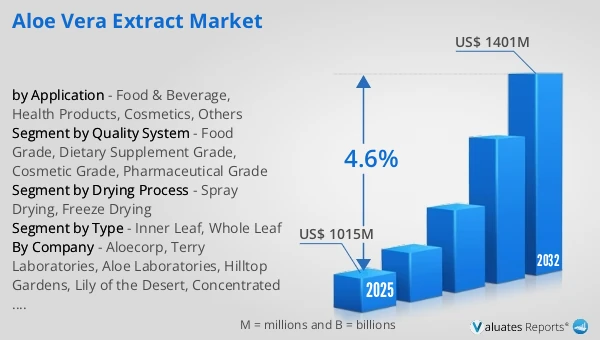
The global Aloe Vera Extract market was valued at US$ 1015 million in 2025 and is anticipated to reach US$ 1401 million by 2032, at a CAGR of 4.6% from 2026 to 2032.
Aloe Vera Extract Market
The 2025 U.S. tariff policies introduce profound uncertainty into the global economic landscape. This report critically examines the implications of recent tariff adjustments and international strategic countermeasures on Aloe Vera Extract competitive dynamics, regional economic interdependencies, and supply chain reconfigurations.
In 2025, global production of aloe vera extract reached 8,752 tons, with an average selling price of US$116/kg. Aloe vera extract refers to an intermediate product of aloe vera leaves, obtained by peeling and extracting the inner leaf gel or crushing the whole leaf to extract the juice. This is followed by processes such as filtration/membrane separation, activated carbon decolorization and purification, heat treatment or aseptic stabilization, concentration, and drying (spray drying/freeze drying). This product can be used in the formulation of food and beverage, dietary supplements, and cosmetics. Downstream applications are concentrated in the food and beverage (functional drinks, aloe vera fruit drinks, yogurt/jelly, etc.), health products (tablets/capsules, powder preparations, gummies, etc.), and daily chemical and personal care (soothing and moisturizing gels, creams, masks, after-sun repair products, oral care, etc.). The upstream of the industry chain involves aloe vera cultivation (tropical/subtropical regions, requiring rapid processing of fresh leaves after harvest to inhibit enzymatic degradation and microbial risks). The midstream includes primary and deep processing (peeling/crushing for juice extraction → coarse filtration → decolorization and purification/membrane filtration → pasteurization or aseptic stabilization → concentration or drying → standardization and batch release). The downstream consists of formulation plants and manufacturers. Gross profit margin is approximately 15%–35%.
The global market supply side benefits from the expansion of planting and processing in Asia and Latin America, as well as China's scale capability in the plant extract industry chain (while also facing cyclical pressure of "increased volume and decreased price," such as the industry phenomenon of declining average price when China's plant extract exports increase in volume); the demand side is driven by "clean label, natural efficacy formula, functional beverages and nutritional supplements, and soothing and repairing personal care products." At the regional level, Asia Pacific is often regarded as one of the largest markets, while Europe is considered by many studies to be a faster-growing region due to regulations and the "natural/organic" consumption trend. Technological development trends focus on four main lines: ① "Safety and compliance first" low aloin/low anthraquinone control and traceable processing (standardization and upgrading of inner leaf and decolorization processes); ② "Activity and consistency" polysaccharide/Acemannan quantification and bioactivity-oriented manufacturing (some leading companies emphasize improving the molecular weight and proportion of polysaccharide active components through proprietary processes to enhance differentiation); ③ "Green processing and authentic drying" low-temperature, energy-saving, and heat-sensitive component-friendly drying/concentration pathways (freeze-drying, vacuum low temperature, and gentler dehydration and purification approaches), and engineering improvements around "instant solubility, low hygroscopicity, low odor, and low microbial content"; ④ "Adulteration and quality risk control" fingerprinting and authenticity testing (reducing the risk of substitution/dilution with carriers, sugar powder, or other plant colloids), which is also the key to the shift from "selling expansion ratios/selling stories" to "selling indicators/selling verification" at the raw material end.
This report delivers a comprehensive overview of the global Aloe Vera Extract market, with both quantitative and qualitative analyses, to help readers develop growth strategies, assess the competitive landscape, evaluate their position in the current market, and make informed business decisions regarding Aloe Vera Extract. The Aloe Vera Extract market size, estimates, and forecasts are provided in terms of output/shipments (Tons) and revenue (US$ millions), with 2025 as the base year and historical and forecast data for 2021–2032.
The report segments the global Aloe Vera Extract market comprehensively. Regional market sizes by Type, by Application, by Quality System, and by company are also provided. For deeper insight, the report profiles the competitive landscape, key competitors, and their respective market rankings, and discusses technological trends and new product developments.
This report will assist Aloe Vera Extract manufacturers, new entrants, and companies across the industry value chain with information on revenues, production, and average prices for the overall market and its sub-segments, by company, by Type, by Application, and by region.
Market Segmentation
Scope of Aloe Vera Extract Market Report
| Report Metric |
Details |
| Report Name |
Aloe Vera Extract Market |
| Accounted market size in 2025 |
US$ 1015 million |
| Forecasted market size in 2032 |
US$ 1401 million |
| CAGR |
4.6% |
| Base Year |
2025 |
| Forecasted years |
2026 - 2032 |
| Segment by Type |
|
| Segment by Quality System |
- Food Grade
- Dietary Supplement Grade
- Cosmetic Grade
- Pharmaceutical Grade
|
| Segment by Drying Process |
- Spray Drying
- Freeze Drying
|
| by Application |
- Food & Beverage
- Health Products
- Cosmetics
- Others
|
| Production by Region |
- North America
- Europe
- China
- Japan
- South America
|
| Consumption by Region |
- North America (United States, Canada)
- Europe (Germany, France, UK, Italy, Russia)
- Asia-Pacific (China, Japan, South Korea, Taiwan)
- Southeast Asia (India)
- Latin America (Mexico, Brazil)
|
| By Company |
Aloecorp, Terry Laboratories, Aloe Laboratories, Hilltop Gardens, Lily of the Desert, Concentrated Aloe Corporation (CAC), AMB Wellness, Aloe Jaumave, LAB 2000, Aloe Queen, Natural Aloe Costa Rica, Naturae, Aloe Plus Lanzarote, Veracetics, WORLEE GmbH, Yunnan Evergreen, Forever Living |
| Forecast units |
USD million in value |
| Report coverage |
Revenue and volume forecast, company share, competitive landscape, growth factors and trends |
Chapter Outline
- Chapter 1: Defines the scope of the report and presents an executive summary of market segments (by Type, by Application, by Quality System, etc.), including the size of each segment and its future growth potential. It offers a high-level view of the current market and its likely evolution in the short, medium, and long term.
- Chapter 2: Provides a detailed analysis of the competitive landscape for Aloe Vera Extract manufacturers, including prices, production, value-based market shares, latest development plans, and information on mergers and acquisitions.
- Chapter 3: Examines Aloe Vera Extract production/output and value by region and country, providing a quantitative assessment of market size and growth potential for each region over the next six years.
- Chapter 4: Analyzes Aloe Vera Extract consumption at the regional and country levels. It quantifies market size and growth potential for each region and its key countries, and outlines market development, outlook, addressable space, and national production.
- Chapter 5: Analyzes market segments by Type, covering the size and growth potential of each segment to help readers identify “blue ocean” opportunities.
- Chapter 6: Analyzes market segments by Application, covering the size and growth potential of each segment to help readers identify “blue ocean” opportunities in downstream markets.
- Chapter 7: Profiles key players, detailing the fundamentals of major companies, including product production/output, value, price, gross margin, product portfolio/introductions, and recent developments.
- Chapter 8: Reviews the industry value chain, including upstream and downstream segments.
- Chapter 9: Discusses market dynamics and recent developments, including drivers, restraints, challenges and risks for manufacturers, U.S. Tariffs and relevant policy analysis.
- Chapter 10: Summarizes the key findings and conclusions of the report.
FAQ for this report
How fast is Aloe Vera Extract Market growing?
Ans: The Aloe Vera Extract Market witnessing a CAGR of 4.6% during the forecast period 2026-2032.
What is the Aloe Vera Extract Market size in 2032?
Ans: The Aloe Vera Extract Market size in 2032 will be US$ 1401 million.
Who are the main players in the Aloe Vera Extract Market report?
Ans: The main players in the Aloe Vera Extract Market are Aloecorp, Terry Laboratories, Aloe Laboratories, Hilltop Gardens, Lily of the Desert, Concentrated Aloe Corporation (CAC), AMB Wellness, Aloe Jaumave, LAB 2000, Aloe Queen, Natural Aloe Costa Rica, Naturae, Aloe Plus Lanzarote, Veracetics, WORLEE GmbH, Yunnan Evergreen, Forever Living
What are the Application segmentation covered in the Aloe Vera Extract Market report?
Ans: The Applications covered in the Aloe Vera Extract Market report are Food & Beverage, Health Products, Cosmetics, Others
What are the Type segmentation covered in the Aloe Vera Extract Market report?
Ans: The Types covered in the Aloe Vera Extract Market report are Inner Leaf, Whole Leaf