0
U.S. (TOLL FREE)
+1 (315) 215-3225
Automative

0
U.S. (TOLL FREE)
+1 (315) 215-3225
Global Pediatric Hemodialysis Systems Market Research Report 2026
Published Date: 2026-02-09
|
Report Code: QYRE-Auto-35E17978
Home | Market Reports | Health| Medical Devices & Equipment
Global Pediatric Hemodialysis Systems Market Research Report 2024
BUY CHAPTERS

Global Pediatric Hemodialysis Systems Market Research Report 2026

Code: QYRE-Auto-35E17978
Report
2026-02-09
Pages:127
QYResearch
Buy Now with 15% Discount
DESCRIPTION
TABLE OF CONTENT
TABLES & FIGURES

Pediatric Hemodialysis Systems Market Size

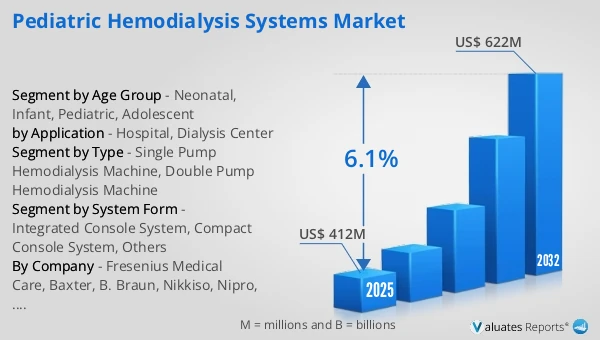
The global Pediatric Hemodialysis Systems market was valued at US$ 412 million in 2025 and is anticipated to reach US$ 622 million by 2032, at a CAGR of 6.1% from 2026 to 2032.

Pediatric Hemodialysis Systems Market

Pediatric Hemodialysis Systems Market

The 2025 U.S. tariff policies introduce profound uncertainty into the global economic landscape. This report critically examines the implications of recent tariff adjustments and international strategic countermeasures on Pediatric Hemodialysis Systems competitive dynamics, regional economic interdependencies, and supply chain reconfigurations.
Pediatric Hemodialysis Systems are extracorporeal blood purification platforms and associated disposables designed specifically for neonates, infants, and children who require renal replacement therapy due to acute kidney injury or chronic/end-stage kidney disease. Their primary purpose is to remove uremic toxins and excess fluid, correct electrolyte and acid–base imbalances, and support hemodynamic stability in patients whose total blood volume is small and highly sensitive to rapid shifts. Compared with adult hemodialysis, pediatric systems emphasize minimized extracorporeal circuit volume, accurate low-flow blood pumping, fine-grained ultrafiltration control, and enhanced safety monitoring to reduce risks such as hypotension, hemolysis, air embolism, thermal loss, and anticoagulation-related bleeding—while also accommodating limited vascular access and wide variability in body size and tolerance. Historically, hemodialysis evolved from early “artificial kidney” concepts into compact, automated machines with increasingly sophisticated sensors and closed-loop controls; pediatric hemodialysis emerged as clinicians sought to translate adult dialysis capabilities into safer, low-volume, low-flow configurations, leading to pediatric-optimized circuits, tighter alarm logic, and more precise fluid management. Upstream materials and component inputs typically include medical-grade polymers (e.g., PVC, TPU, PP, PC) for bloodlines, connectors, and single-use sets; hollow-fiber membrane materials for dialyzers (commonly modified polysulfone/polyethersulfone families); silicone and elastomers for seals and pump segments; and metals/engineering plastics for chassis and fluid-path structures. Key subcomponents commonly include high-precision peristaltic pumps and ultrafiltration actuators, pressure sensors, flow/weight measurement modules, air/bubble detectors with venous line clamping mechanisms, blood-leak detectors, heating and temperature-control units, conductivity/temperature sensing for dialysate management, disinfection/rinse and dialysate proportioning/mixing modules, embedded controllers and software (alarm logic and control loops), electrical isolation/power modules, user interface hardware, and connectivity/data logging—together forming the upstream-to-system architecture that enables safe pediatric renal replacement therapy.In 2025, the global production capacity of pediatric hemodialysis systems is estimated at 40,000 units, with sales reaching approximately 31,500 units. The average selling price is about USD 13,100 per unit, and manufacturers typically achieve gross margins in the range of 30% to 40%.
The pediatric hemodialysis market today is characterized by rigid clinical demand paired with cautious adoption dynamics. On the demand side, pediatric kidney failure care and critical care pathways increasingly depend on reliable blood purification capabilities, and hospitals are paying more attention to how intermittent hemodialysis, CRRT, and adjunct blood purification modalities are coordinated within PICU/NICU workflows. On the supply and adoption side, pediatric-specific constraints—small circulating blood volume, low-flow operation, and narrow safety margins—push providers to prioritize proven safety redundancies, traceable quality systems, standardized staff training, and multidisciplinary collaboration across nephrology, critical care, anesthesia, nursing, biomedical engineering, and infection control. As a result, competitive differentiation is less about “higher specs” and more about delivering reproducible clinical workflows, well-matched disposable configurations, and robust service/training programs, along with smoother integration into hospital data systems and quality management processes.
Looking forward, innovation will concentrate on deeper pediatric tailoring and more integrated therapy management. Technically, systems are expected to further improve control accuracy and alarm logic under low-flow conditions, strengthen multi-layer protections for ultrafiltration, temperature, conductivity, pressure variability, and air risk, and reduce treatment burden through smaller extracorporeal volumes and more practical vascular access strategies. On the disposables side, higher biocompatibility and lower adsorption membranes and bloodline materials, simplified priming/rinsing routines, and clearer size segmentation for neonates and infants will be key differentiators. At the system level, vendors will increasingly bundle hardware, disposables, software, and clinical protocols into a cohesive delivery model, enabling data-driven closed loops (prescription, execution, monitoring, events, and quality indicators) and remote support to help hospitals operationalize complex pediatric blood purification as a standardized, trainable, and auditable capability. Supply-chain robustness and lot-to-lot consistency of disposables will also receive greater attention, given their outsized impact on safety and operational stability.
Key growth drivers come from both clinical priorities and healthcare management. Expansion of pediatric critical care capacity, specialization of children’s hospitals and regional referral centers, stronger emphasis on safety and adverse-event governance, and sustained investment in quality and efficiency all support more structured pediatric blood purification programs. Broader societal focus on long-term pediatric outcomes also encourages adoption of tighter monitoring and management tools. At the same time, barriers remain substantial: case concentration and dependence on experienced teams can prevent many institutions from achieving a stable “people–process–disposables–infection control” operating loop; neonatal and low-weight patients introduce difficult challenges in vascular access, anticoagulation, and fluid management, raising training and operational costs; and practical constraints such as disposable fit, cross-brand compatibility, service responsiveness, spare parts availability, and procurement/compliance cycles can slow deployment. Overall, the market is likely to reward end-to-end operational safety and sustainable program delivery rather than standalone hardware performance.
This report delivers a comprehensive overview of the global Pediatric Hemodialysis Systems market, with both quantitative and qualitative analyses, to help readers develop growth strategies, assess the competitive landscape, evaluate their position in the current market, and make informed business decisions regarding Pediatric Hemodialysis Systems. The Pediatric Hemodialysis Systems market size, estimates, and forecasts are provided in terms of sales volume (Units) and revenue (US$ millions), with 2025 as the base year and historical and forecast data for 2021–2032.
The report segments the global Pediatric Hemodialysis Systems market comprehensively. Regional market sizes by Type, by Application, by Age Group, and by company are also provided. For deeper insight, the report profiles the competitive landscape, key competitors, and their respective market rankings, and discusses technological trends and new product developments.
This report will assist Pediatric Hemodialysis Systems manufacturers, new entrants, and companies across the industry value chain with information on revenues, sales volume, and average prices for the overall market and its sub-segments, by company, by Type, by Application, and by region.
Market Segmentation

Scope of Pediatric Hemodialysis Systems Market Report

Report Metric Details
Report Name Pediatric Hemodialysis Systems Market
Accounted market size in 2025 US$ 412 million
Forecasted market size in 2032 US$ 622 million
CAGR 6.1%
Base Year 2025
Forecasted years 2026 - 2032
Segment by Type
  • Single Pump Hemodialysis Machine
  • Double Pump Hemodialysis Machine
Segment by Age Group
  • Neonatal
  • Infant
  • Pediatric
  • Adolescent
Segment by System Form
  • Integrated Console System
  • Compact Console System
  • Others
by Application
  • Hospital
  • Dialysis Center
Consumption by Region
  • North America (United States, Canada)
  • Europe (Germany, France, UK, Italy, Russia)
  • Asia-Pacific (China, Japan, South Korea, Taiwan)
  • Southeast Asia (India)
  • Latin America (Mexico, Brazil)
By Company Fresenius Medical Care, Baxter, B. Braun, Nikkiso, Nipro, Kawasumi Laboratories, WEGO Blood Purification, Toray Medical, Asahi Kasei Medical, JMS, Mozarc Medical
Forecast units USD million in value
Report coverage Revenue and volume forecast, company share, competitive landscape, growth factors and trends

Chapter Outline

  • Chapter 1: Defines the scope of the report and presents an executive summary of market segments (by Type, by Application, by Age Group, etc.), including the size of each segment and its future growth potential. It offers a high-level view of the current market and its likely evolution in the short, medium, and long term.
  • Chapter 2: Provides a detailed analysis of the competitive landscape for Pediatric Hemodialysis Systems manufacturers, covering pricing, sales and revenue shares, latest development plans, and mergers and acquisitions.
  • Chapter 3: Examines Pediatric Hemodialysis Systems sales and revenue at the regional and country levels. It quantifies market size and growth potential for each region and its key countries, and outlines market development, outlook, addressable space, and national market size.
  • Chapter 4: Analyzes segments by Type, detailing the size and growth potential of each segment to help readers identify “blue ocean” opportunities.
  • Chapter 5: Analyzes market segments by Application, covering the size and growth potential of each segment to help readers identify “blue ocean” opportunities in downstream markets.
  • Chapter 6: Profiles key players, presenting core information on leading companies, including product sales, revenue, pricing, gross margin, product portfolio/introductions, and recent developments.
  • Chapter 7: Reviews the industry value chain, including upstream and downstream segments.
  • Chapter 8: Discusses market dynamics and recent developments, including drivers, restraints, challenges and risks for manufacturers, U.S. Tariffs and relevant policy analysis.
  • Chapter 9: Summarizes the key findings and conclusions of the report.

FAQ for this report

How fast is Pediatric Hemodialysis Systems Market growing?

Ans: The Pediatric Hemodialysis Systems Market witnessing a CAGR of 6.1% during the forecast period 2026-2032.

What is the Pediatric Hemodialysis Systems Market size in 2032?

Ans: The Pediatric Hemodialysis Systems Market size in 2032 will be US$ 622 million.

Who are the main players in the Pediatric Hemodialysis Systems Market report?

Ans: The main players in the Pediatric Hemodialysis Systems Market are Fresenius Medical Care, Baxter, B. Braun, Nikkiso, Nipro, Kawasumi Laboratories, WEGO Blood Purification, Toray Medical, Asahi Kasei Medical, JMS, Mozarc Medical

What are the Application segmentation covered in the Pediatric Hemodialysis Systems Market report?

Ans: The Applications covered in the Pediatric Hemodialysis Systems Market report are Hospital, Dialysis Center

What are the Type segmentation covered in the Pediatric Hemodialysis Systems Market report?

Ans: The Types covered in the Pediatric Hemodialysis Systems Market report are Single Pump Hemodialysis Machine, Double Pump Hemodialysis Machine

1 Report Overview
1.1 Study Scope
1.2 Market Analysis by Type
1.2.1 Global Pediatric Hemodialysis Systems Market Size Growth Rate by Type: 2021 vs 2025 vs 2032
1.2.2 Equipment
1.2.3 Consumables
1.3 Market by Application
1.3.1 Global Pediatric Hemodialysis Systems Market Growth by Application: 2021 vs 2025 vs 2032
1.3.2 Hospital
1.3.3 Dialysis Center
1.4 Assumptions and Limitations
1.5 Study Objectives
1.6 Years Considered
2 Global Growth Trends
2.1 Global Pediatric Hemodialysis Systems Market Perspective (2021–2032)
2.2 Global Pediatric Hemodialysis Systems Growth Trends by Region
2.2.1 Global Pediatric Hemodialysis Systems Market Size by Region: 2021 vs 2025 vs 2032
2.2.2 Pediatric Hemodialysis Systems Historic Market Size by Region (2021–2026)
2.2.3 Pediatric Hemodialysis Systems Forecasted Market Size by Region (2027–2032)
2.3 Pediatric Hemodialysis Systems Market Dynamics
2.3.1 Pediatric Hemodialysis Systems Industry Trends
2.3.2 Pediatric Hemodialysis Systems Market Drivers
2.3.3 Pediatric Hemodialysis Systems Market Challenges
2.3.4 Pediatric Hemodialysis Systems Market Restraints
3 Competition Landscape by Key Players
3.1 Global Top Pediatric Hemodialysis Systems Players by Revenue
3.1.1 Global Top Pediatric Hemodialysis Systems Players by Revenue (2021–2026)
3.1.2 Global Pediatric Hemodialysis Systems Revenue Market Share by Players (2021–2026)
3.2 Global Top Pediatric Hemodialysis Systems Players Market Share by Company Tier (Tier 1, Tier 2, Tier 3)
3.3 Global Key Players Ranking by Pediatric Hemodialysis Systems Revenue
3.4 Global Pediatric Hemodialysis Systems Market Concentration Ratio
3.4.1 Global Pediatric Hemodialysis Systems Market Concentration Ratio (CR5 and HHI)
3.4.2 Global Top 10 and Top 5 Companies by Pediatric Hemodialysis Systems Revenue in 2025
3.5 Global Key Players of Pediatric Hemodialysis Systems Head Offices and Areas Served
3.6 Global Key Players of Pediatric Hemodialysis Systems, Products and Applications
3.7 Global Key Players of Pediatric Hemodialysis Systems, Date of General Availability (GA)
3.8 Mergers and Acquisitions, Expansion Plans
4 Pediatric Hemodialysis Systems Breakdown Data by Type
4.1 Global Pediatric Hemodialysis Systems Historic Market Size by Type (2021–2026)
4.2 Global Pediatric Hemodialysis Systems Forecasted Market Size by Type (2027–2032)
5 Pediatric Hemodialysis Systems Breakdown Data by Application
5.1 Global Pediatric Hemodialysis Systems Historic Market Size by Application (2021–2026)
5.2 Global Pediatric Hemodialysis Systems Forecasted Market Size by Application (2027–2032)
6 North America
6.1 North America Pediatric Hemodialysis Systems Market Size (2021–2032)
6.2 North America Pediatric Hemodialysis Systems Market Growth Rate by Country: 2021 vs 2025 vs 2032
6.3 North America Pediatric Hemodialysis Systems Market Size by Country (2021–2026)
6.4 North America Pediatric Hemodialysis Systems Market Size by Country (2027–2032)
6.5 United States
6.6 Canada
7 Europe
7.1 Europe Pediatric Hemodialysis Systems Market Size (2021–2032)
7.2 Europe Pediatric Hemodialysis Systems Market Growth Rate by Country: 2021 vs 2025 vs 2032
7.3 Europe Pediatric Hemodialysis Systems Market Size by Country (2021–2026)
7.4 Europe Pediatric Hemodialysis Systems Market Size by Country (2027–2032)
7.5 Germany
7.6 France
7.7 U.K.
7.8 Italy
7.9 Russia
7.10 Ireland
8 Asia-Pacific
8.1 Asia-Pacific Pediatric Hemodialysis Systems Market Size (2021–2032)
8.2 Asia-Pacific Pediatric Hemodialysis Systems Market Growth Rate by Region: 2021 vs 2025 vs 2032
8.3 Asia-Pacific Pediatric Hemodialysis Systems Market Size by Region (2021–2026)
8.4 Asia-Pacific Pediatric Hemodialysis Systems Market Size by Region (2027–2032)
8.5 China
8.6 Japan
8.7 South Korea
8.8 Southeast Asia
8.9 India
8.10 Australia & New Zealand
9 Latin America
9.1 Latin America Pediatric Hemodialysis Systems Market Size (2021–2032)
9.2 Latin America Pediatric Hemodialysis Systems Market Growth Rate by Country: 2021 vs 2025 vs 2032
9.3 Latin America Pediatric Hemodialysis Systems Market Size by Country (2021–2026)
9.4 Latin America Pediatric Hemodialysis Systems Market Size by Country (2027–2032)
9.5 Mexico
9.6 Brazil
10 Middle East & Africa
10.1 Middle East & Africa Pediatric Hemodialysis Systems Market Size (2021–2032)
10.2 Middle East & Africa Pediatric Hemodialysis Systems Market Growth Rate by Country: 2021 vs 2025 vs 2032
10.3 Middle East & Africa Pediatric Hemodialysis Systems Market Size by Country (2021–2026)
10.4 Middle East & Africa Pediatric Hemodialysis Systems Market Size by Country (2027–2032)
10.5 Israel
10.6 Saudi Arabia
10.7 UAE
11 Key Players Profiles
11.1 Medtronic
11.1.1 Medtronic Company Details
11.1.2 Medtronic Business Overview
11.1.3 Medtronic Pediatric Hemodialysis Systems Introduction
11.1.4 Medtronic Revenue in Pediatric Hemodialysis Systems Business (2021–2026)
11.1.5 Medtronic Recent Development
11.2 Fresenius
11.2.1 Fresenius Company Details
11.2.2 Fresenius Business Overview
11.2.3 Fresenius Pediatric Hemodialysis Systems Introduction
11.2.4 Fresenius Revenue in Pediatric Hemodialysis Systems Business (2021–2026)
11.2.5 Fresenius Recent Development
11.3 Baxter
11.3.1 Baxter Company Details
11.3.2 Baxter Business Overview
11.3.3 Baxter Pediatric Hemodialysis Systems Introduction
11.3.4 Baxter Revenue in Pediatric Hemodialysis Systems Business (2021–2026)
11.3.5 Baxter Recent Development
11.4 Braun
11.4.1 Braun Company Details
11.4.2 Braun Business Overview
11.4.3 Braun Pediatric Hemodialysis Systems Introduction
11.4.4 Braun Revenue in Pediatric Hemodialysis Systems Business (2021–2026)
11.4.5 Braun Recent Development
11.5 Nikkiso
11.5.1 Nikkiso Company Details
11.5.2 Nikkiso Business Overview
11.5.3 Nikkiso Pediatric Hemodialysis Systems Introduction
11.5.4 Nikkiso Revenue in Pediatric Hemodialysis Systems Business (2021–2026)
11.5.5 Nikkiso Recent Development
11.6 Nipro
11.6.1 Nipro Company Details
11.6.2 Nipro Business Overview
11.6.3 Nipro Pediatric Hemodialysis Systems Introduction
11.6.4 Nipro Revenue in Pediatric Hemodialysis Systems Business (2021–2026)
11.6.5 Nipro Recent Development
11.7 Kawasumi
11.7.1 Kawasumi Company Details
11.7.2 Kawasumi Business Overview
11.7.3 Kawasumi Pediatric Hemodialysis Systems Introduction
11.7.4 Kawasumi Revenue in Pediatric Hemodialysis Systems Business (2021–2026)
11.7.5 Kawasumi Recent Development
12 Analyst's Viewpoints/Conclusions
13 Appendix
13.1 Research Methodology
13.1.1 Methodology/Research Approach
13.1.1.1 Research Programs/Design
13.1.1.2 Market Size Estimation
13.1.1.3 Market Breakdown and Data Triangulation
13.1.2 Data Source
13.1.2.1 Secondary Sources
13.1.2.2 Primary Sources
13.2 Author Details
13.3 Disclaimer
List of Tables
 Table 1. Global Pediatric Hemodialysis Systems Market Size Growth Rate by Type (US$ Million): 2021 vs 2025 vs 2032
 Table 2. Key Players of Equipment
 Table 3. Key Players of Consumables
 Table 4. Global Pediatric Hemodialysis Systems Market Size Growth by Application (US$ Million): 2021 vs 2025 vs 2032
 Table 5. Global Pediatric Hemodialysis Systems Market Size by Region (US$ Million): 2021 vs 2025 vs 2032
 Table 6. Global Pediatric Hemodialysis Systems Market Size by Region (US$ Million), 2021–2026
 Table 7. Global Pediatric Hemodialysis Systems Market Share by Region (2021–2026)
 Table 8. Global Pediatric Hemodialysis Systems Forecasted Market Size by Region (US$ Million), 2027–2032
 Table 9. Global Pediatric Hemodialysis Systems Market Share by Region (2027–2032)
 Table 10. Pediatric Hemodialysis Systems Market Trends
 Table 11. Pediatric Hemodialysis Systems Market Drivers
 Table 12. Pediatric Hemodialysis Systems Market Challenges
 Table 13. Pediatric Hemodialysis Systems Market Restraints
 Table 14. Global Pediatric Hemodialysis Systems Revenue by Players (US$ Million), 2021–2026
 Table 15. Global Pediatric Hemodialysis Systems Market Share by Players (2021–2026)
 Table 16. Global Top Pediatric Hemodialysis Systems Players by Tier (Tier 1, Tier 2, and Tier 3), based on Pediatric Hemodialysis Systems Revenue, 2025
 Table 17. Ranking of Global Top Pediatric Hemodialysis Systems Companies by Revenue (US$ Million) in 2025
 Table 18. Global 5 Largest Players Market Share by Pediatric Hemodialysis Systems Revenue (CR5 and HHI), 2021–2026
 Table 19. Global Key Players of Pediatric Hemodialysis Systems, Headquarters and Area Served
 Table 20. Global Key Players of Pediatric Hemodialysis Systems, Products and Applications
 Table 21. Global Key Players of Pediatric Hemodialysis Systems, Date of General Availability (GA)
 Table 22. Mergers and Acquisitions, Expansion Plans
 Table 23. Global Pediatric Hemodialysis Systems Market Size by Type (US$ Million), 2021–2026
 Table 24. Global Pediatric Hemodialysis Systems Revenue Market Share by Type (2021–2026)
 Table 25. Global Pediatric Hemodialysis Systems Forecasted Market Size by Type (US$ Million), 2027–2032
 Table 26. Global Pediatric Hemodialysis Systems Revenue Market Share by Type (2027–2032)
 Table 27. Global Pediatric Hemodialysis Systems Market Size by Application (US$ Million), 2021–2026
 Table 28. Global Pediatric Hemodialysis Systems Revenue Market Share by Application (2021–2026)
 Table 29. Global Pediatric Hemodialysis Systems Forecasted Market Size by Application (US$ Million), 2027–2032
 Table 30. Global Pediatric Hemodialysis Systems Revenue Market Share by Application (2027–2032)
 Table 31. North America Pediatric Hemodialysis Systems Market Size Growth Rate by Country (US$ Million): 2021 vs 2025 vs 2032
 Table 32. North America Pediatric Hemodialysis Systems Market Size by Country (US$ Million), 2021–2026
 Table 33. North America Pediatric Hemodialysis Systems Market Size by Country (US$ Million), 2027–2032
 Table 34. Europe Pediatric Hemodialysis Systems Market Size Growth Rate by Country (US$ Million): 2021 vs 2025 vs 2032
 Table 35. Europe Pediatric Hemodialysis Systems Market Size by Country (US$ Million), 2021–2026
 Table 36. Europe Pediatric Hemodialysis Systems Market Size by Country (US$ Million), 2027–2032
 Table 37. Asia-Pacific Pediatric Hemodialysis Systems Market Size Growth Rate by Region (US$ Million): 2021 vs 2025 vs 2032
 Table 38. Asia-Pacific Pediatric Hemodialysis Systems Market Size by Region (US$ Million), 2021–2026
 Table 39. Asia-Pacific Pediatric Hemodialysis Systems Market Size by Region (US$ Million), 2027–2032
 Table 40. Latin America Pediatric Hemodialysis Systems Market Size Growth Rate by Country (US$ Million): 2021 vs 2025 vs 2032
 Table 41. Latin America Pediatric Hemodialysis Systems Market Size by Country (US$ Million), 2021–2026
 Table 42. Latin America Pediatric Hemodialysis Systems Market Size by Country (US$ Million), 2027–2032
 Table 43. Middle East & Africa Pediatric Hemodialysis Systems Market Size Growth Rate by Country (US$ Million): 2021 vs 2025 vs 2032
 Table 44. Middle East & Africa Pediatric Hemodialysis Systems Market Size by Country (US$ Million), 2021–2026
 Table 45. Middle East & Africa Pediatric Hemodialysis Systems Market Size by Country (US$ Million), 2027–2032
 Table 46. Medtronic Company Details
 Table 47. Medtronic Business Overview
 Table 48. Medtronic Pediatric Hemodialysis Systems Product
 Table 49. Medtronic Revenue in Pediatric Hemodialysis Systems Business (US$ Million), 2021–2026
 Table 50. Medtronic Recent Development
 Table 51. Fresenius Company Details
 Table 52. Fresenius Business Overview
 Table 53. Fresenius Pediatric Hemodialysis Systems Product
 Table 54. Fresenius Revenue in Pediatric Hemodialysis Systems Business (US$ Million), 2021–2026
 Table 55. Fresenius Recent Development
 Table 56. Baxter Company Details
 Table 57. Baxter Business Overview
 Table 58. Baxter Pediatric Hemodialysis Systems Product
 Table 59. Baxter Revenue in Pediatric Hemodialysis Systems Business (US$ Million), 2021–2026
 Table 60. Baxter Recent Development
 Table 61. Braun Company Details
 Table 62. Braun Business Overview
 Table 63. Braun Pediatric Hemodialysis Systems Product
 Table 64. Braun Revenue in Pediatric Hemodialysis Systems Business (US$ Million), 2021–2026
 Table 65. Braun Recent Development
 Table 66. Nikkiso Company Details
 Table 67. Nikkiso Business Overview
 Table 68. Nikkiso Pediatric Hemodialysis Systems Product
 Table 69. Nikkiso Revenue in Pediatric Hemodialysis Systems Business (US$ Million), 2021–2026
 Table 70. Nikkiso Recent Development
 Table 71. Nipro Company Details
 Table 72. Nipro Business Overview
 Table 73. Nipro Pediatric Hemodialysis Systems Product
 Table 74. Nipro Revenue in Pediatric Hemodialysis Systems Business (US$ Million), 2021–2026
 Table 75. Nipro Recent Development
 Table 76. Kawasumi Company Details
 Table 77. Kawasumi Business Overview
 Table 78. Kawasumi Pediatric Hemodialysis Systems Product
 Table 79. Kawasumi Revenue in Pediatric Hemodialysis Systems Business (US$ Million), 2021–2026
 Table 80. Kawasumi Recent Development
 Table 81. Research Programs/Design for This Report
 Table 82. Key Data Information from Secondary Sources
 Table 83. Key Data Information from Primary Sources
 Table 84. Authors List of This Report


List of Figures
 Figure 1. Pediatric Hemodialysis Systems Picture
 Figure 2. Global Pediatric Hemodialysis Systems Market Size Comparison by Type (US$ Million), 2021–2032
 Figure 3. Global Pediatric Hemodialysis Systems Market Share by Type: 2025 vs 2032
 Figure 4. Equipment Features
 Figure 5. Consumables Features
 Figure 6. Global Pediatric Hemodialysis Systems Market Size by Application (US$ Million), 2021–2032
 Figure 7. Global Pediatric Hemodialysis Systems Market Share by Application: 2025 vs 2032
 Figure 8. Hospital Case Studies
 Figure 9. Dialysis Center Case Studies
 Figure 10. Pediatric Hemodialysis Systems Report Years Considered
 Figure 11. Global Pediatric Hemodialysis Systems Market Size (US$ Million), Year-over-Year: 2021–2032
 Figure 12. Global Pediatric Hemodialysis Systems Market Size, (US$ Million), 2021 vs 2025 vs 2032
 Figure 13. Global Pediatric Hemodialysis Systems Market Share by Region: 2025 vs 2032
 Figure 14. Global Pediatric Hemodialysis Systems Market Share by Players in 2025
 Figure 15. Global Pediatric Hemodialysis Systems Market Share by Company Type (Tier 1, Tier 2, and Tier 3)
 Figure 16. The Top 10 and 5 Players Market Share by Pediatric Hemodialysis Systems Revenue in 2025
 Figure 17. North America Pediatric Hemodialysis Systems Market Size YoY Growth (US$ Million), 2021–2032
 Figure 18. North America Pediatric Hemodialysis Systems Market Share by Country (2021–2032)
 Figure 19. United States Pediatric Hemodialysis Systems Market Size YoY Growth (US$ Million), 2021–2032
 Figure 20. Canada Pediatric Hemodialysis Systems Market Size YoY Growth (US$ Million), 2021–2032
 Figure 21. Europe Pediatric Hemodialysis Systems Market Size YoY Growth (US$ Million), 2021–2032
 Figure 22. Europe Pediatric Hemodialysis Systems Market Share by Country (2021–2032)
 Figure 23. Germany Pediatric Hemodialysis Systems Market Size YoY Growth (US$ Million), 2021–2032
 Figure 24. France Pediatric Hemodialysis Systems Market Size YoY Growth (US$ Million), 2021–2032
 Figure 25. U.K. Pediatric Hemodialysis Systems Market Size YoY Growth (US$ Million), 2021–2032
 Figure 26. Italy Pediatric Hemodialysis Systems Market Size YoY Growth (US$ Million), 2021–2032
 Figure 27. Russia Pediatric Hemodialysis Systems Market Size YoY Growth (US$ Million), 2021–2032
 Figure 28. Ireland Pediatric Hemodialysis Systems Market Size YoY Growth (US$ Million), 2021–2032
 Figure 29. Asia-Pacific Pediatric Hemodialysis Systems Market Size YoY Growth (US$ Million), 2021–2032
 Figure 30. Asia-Pacific Pediatric Hemodialysis Systems Market Share by Region (2021–2032)
 Figure 31. China Pediatric Hemodialysis Systems Market Size YoY Growth (US$ Million), 2021–2032
 Figure 32. Japan Pediatric Hemodialysis Systems Market Size YoY Growth (US$ Million), 2021–2032
 Figure 33. South Korea Pediatric Hemodialysis Systems Market Size YoY Growth (US$ Million), 2021–2032
 Figure 34. Southeast Asia Pediatric Hemodialysis Systems Market Size YoY Growth (US$ Million), 2021–2032
 Figure 35. India Pediatric Hemodialysis Systems Market Size YoY Growth (US$ Million), 2021–2032
 Figure 36. Australia & New Zealand Pediatric Hemodialysis Systems Market Size YoY Growth (US$ Million), 2021–2032
 Figure 37. Latin America Pediatric Hemodialysis Systems Market Size YoY Growth (US$ Million), 2021–2032
 Figure 38. Latin America Pediatric Hemodialysis Systems Market Share by Country (2021–2032)
 Figure 39. Mexico Pediatric Hemodialysis Systems Market Size YoY Growth (US$ Million), 2021–2032
 Figure 40. Brazil Pediatric Hemodialysis Systems Market Size YoY Growth (US$ Million), 2021–2032
 Figure 41. Middle East & Africa Pediatric Hemodialysis Systems Market Size YoY Growth (US$ Million), 2021–2032
 Figure 42. Middle East & Africa Pediatric Hemodialysis Systems Market Share by Country (2021–2032)
 Figure 43. Israel Pediatric Hemodialysis Systems Market Size YoY Growth (US$ Million), 2021–2032
 Figure 44. Saudi Arabia Pediatric Hemodialysis Systems Market Size YoY Growth (US$ Million), 2021–2032
 Figure 45. UAE Pediatric Hemodialysis Systems Market Size YoY Growth (US$ Million), 2021–2032
 Figure 46. Medtronic Revenue Growth Rate in Pediatric Hemodialysis Systems Business (2021–2026)
 Figure 47. Fresenius Revenue Growth Rate in Pediatric Hemodialysis Systems Business (2021–2026)
 Figure 48. Baxter Revenue Growth Rate in Pediatric Hemodialysis Systems Business (2021–2026)
 Figure 49. Braun Revenue Growth Rate in Pediatric Hemodialysis Systems Business (2021–2026)
 Figure 50. Nikkiso Revenue Growth Rate in Pediatric Hemodialysis Systems Business (2021–2026)
 Figure 51. Nipro Revenue Growth Rate in Pediatric Hemodialysis Systems Business (2021–2026)
 Figure 52. Kawasumi Revenue Growth Rate in Pediatric Hemodialysis Systems Business (2021–2026)
 Figure 53. Bottom-up and Top-down Approaches for This Report
 Figure 54. Data Triangulation
 Figure 55. Key Executives Interviewed

SELECT A FORMAT
Added to Cart
Electronic

$2900

Single User License
Electronic

$4350

Multi User License
Electronic

$5800

Enterprise License
Add to Cart
Buy Now (15% Discount)

OUR CUSTOMER

Lukasiewicz Research Network