0
U.S. (TOLL FREE)
+1 (315) 215-3225
Automative

0
U.S. (TOLL FREE)
+1 (315) 215-3225
Global Multivibrator Market Research Report 2026
Published Date: 2026-01-20
|
Report Code: QYRE-Auto-35F12956
Home | Market Reports | Computers & Electronics
Global Multivibrator Market Research Report 2023
BUY CHAPTERS

Global Multivibrator Market Research Report 2026

Code: QYRE-Auto-35F12956
Report
2026-01-20
Pages:144
QYResearch
Buy Now with 15% Discount
DESCRIPTION
TABLE OF CONTENT
TABLES & FIGURES

Multivibrator Market Size

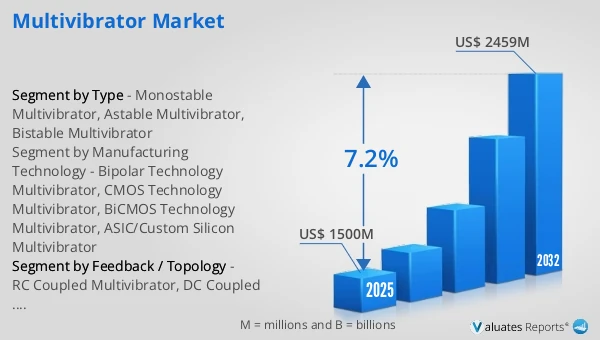
The global Multivibrator market was valued at US$ 1500 million in 2025 and is anticipated to reach US$ 2459 million by 2032, at a CAGR of 7.2% from 2026 to 2032.

Multivibrator Market

Multivibrator Market

The 2025 U.S. tariff policies introduce profound uncertainty into the global economic landscape. This report critically examines the implications of recent tariff adjustments and international strategic countermeasures on Multivibrator competitive dynamics, regional economic interdependencies, and supply chain reconfigurations.
A Multivibrator is an electronic switching or oscillator circuit that produces square waves or pulses by alternating between two states. It consists of two or more amplifying devices (transistors, operational amplifiers, or logic gates) interconnected through resistor‑capacitor networks to achieve controlled state transitions. Multivibrators are typically classified into three types: Astable (continuous oscillation), Monostable (single pulse on trigger), and Bistable (flip‑flop with two stable states). These circuits can be built from discrete components or implemented within integrated circuit families (e.g., TTL/CMOS multivibrator ICs) for timing and trigger applications. They serve as fundamental building blocks in clock generation, pulse shaping, signal timing, frequency synthesis, digital logic triggers, and memory elements. Multivibrators are widely used across consumer electronics, communication systems, industrial automation, automotive electronics, computing platforms, and embedded systems, and require careful design of feedback networks, component tolerances, and power stability to achieve desired frequency and performance.
A multivibrator is a foundational electronic circuit used to generate rectangular waveforms, timing pulses, and switching signals, operating in astable, monostable, or bistable modes. As one of the earliest established building blocks in electronics, multivibrators have long supported clock generation, signal conditioning, power management, and control logic across analog and mixed-signal systems. While discrete multivibrator circuits remain relevant, their functions are increasingly embedded within integrated circuits such as timers, oscillators, microcontrollers, and power management ICs. Leading semiconductor manufacturers consistently emphasize in official documentation that these functions are critical to system reliability, deterministic timing, and low-power operation, particularly in industrial and safety-critical environments. In today’s electronics landscape, multivibrators have evolved from standalone components into embedded, platform-level capabilities that form the invisible infrastructure of stable electronic systems.
The renewed strategic relevance of multivibrator functionality is driven by structural shifts in electronics demand rather than short-term market cycles. The expansion of industrial automation, electrification, and embedded intelligence has elevated the importance of stable timing and pulse-generation functions that operate independently of software. Semiconductor companies and industrial equipment manufacturers have repeatedly highlighted the role of hardware-level determinism in meeting safety regulations, electromagnetic compatibility requirements, and long-term reliability objectives. At the same time, advances in low-power design, wide-temperature operation, and integration density have reduced the cost and complexity of embedding multivibrator functions into system-on-chip solutions. Policy emphasis on industrial resilience, domestic semiconductor capability, and infrastructure modernization across major economies further reinforces demand for mature and proven circuit architectures. Although commoditization and design abstraction present challenges, they also accelerate consolidation around high-reliability and application-specific implementations.
From a supply-chain perspective, the multivibrator ecosystem is tightly integrated with the broader analog and mixed-signal semiconductor landscape. Upstream, mature wafer fabrication processes and stable passive component supply enable cost-efficient and sustainable production, often leveraging long-depreciated manufacturing assets. Downstream demand is more dynamic, led by industrial control systems, automotive electronics, power management modules, and aerospace and defense equipment. Companies such as Texas Instruments, Analog Devices, NXP, onsemi, Nexperia, Toshiba, and Teledyne consistently position timing and control circuitry as core elements of their analog and embedded portfolios. These firms emphasize long product lifecycles, second-source compatibility, and supply continuity—key purchasing criteria for industrial and automotive customers. As a result, downstream system integrators increasingly prioritize supplier credibility and application support over pure component pricing.
Application-level demand for multivibrator functionality varies significantly by context, with the strongest momentum emerging from environments requiring predictable hardware behavior. Industrial automation and process control rely on pulse generators and timing circuits for motor control, sensing, and safety interlocks. Automotive electronics increasingly embed multivibrator-based functions within body control modules, power electronics, and battery management systems, where fail-safe operation is mandated by regulation. Aerospace, defense, and medical devices continue to favor discrete or semi-discrete implementations due to certification and traceability requirements. Consumer electronics, while less explicit, still incorporate these functions within power and interface ICs. Overall, electrified transportation and smart manufacturing represent the fastest-evolving demand trajectories, where hardware timing remains indispensable despite growing software abstraction.
Regional consumption patterns reflect differing industrial structures and policy priorities. North America maintains strong demand from aerospace, defense, industrial automation, and automotive innovation, supported by established semiconductor suppliers and government-backed manufacturing initiatives. China and the broader Asia-Pacific region show robust adoption driven by large-scale electronics manufacturing, infrastructure investment, and accelerating industrial automation, with policy documents emphasizing supply-chain security and foundational technologies. Europe’s demand is anchored in automotive systems, industrial machinery, and energy-efficiency initiatives, where functional safety standards sustain demand for proven timing architectures. Other regions, including the Middle East and Latin America, exhibit more project-based consumption linked to infrastructure development and industrial modernization. Across all regions, reliability and lifecycle support remain decisive purchasing factors.
Latest developments highlight continued strategic investment. In 2021, Texas Instruments reaffirmed in its annual report its long-term commitment to analog and embedded processing, identifying timing and control functions as foundational to industrial and automotive reliability. In 2022, the European Union issued policy communications on semiconductor resilience, emphasizing the strategic importance of mature-node analog technologies for industrial and automotive supply chains. In 2024, automotive semiconductor suppliers including NXP and onsemi announced expanded capacity and portfolio alignment for automotive-grade power and control electronics, underscoring sustained investment in hardware-based timing and control functions.
This report delivers a comprehensive overview of the global Multivibrator market, with both quantitative and qualitative analyses, to help readers develop growth strategies, assess the competitive landscape, evaluate their position in the current market, and make informed business decisions regarding Multivibrator. The Multivibrator market size, estimates, and forecasts are provided in terms of shipments (K Units) and revenue (US$ millions), with 2025 as the base year and historical and forecast data for 2021–2032.
The report segments the global Multivibrator market comprehensively. Regional market sizes by Type, by Application, by Feedback / Topology, and by company are also provided. For deeper insight, the report profiles the competitive landscape, key competitors, and their respective market rankings, and discusses technological trends and new product developments.
This report will assist Multivibrator manufacturers, new entrants, and companies across the industry value chain with information on revenues, production, and average prices for the overall market and its sub-segments, by company, by Type, by Application, and by region.
Market Segmentation

Scope of Multivibrator Market Report

Report Metric Details
Report Name Multivibrator Market
Accounted market size in 2025 US$ 1500 million
Forecasted market size in 2032 US$ 2459 million
CAGR 7.2%
Base Year 2025
Forecasted years 2026 - 2032
Segment by Type
  • Monostable Multivibrator
  • Astable Multivibrator
  • Bistable Multivibrator
Segment by Feedback / Topology
  • RC Coupled Multivibrator
  • DC Coupled Multivibrator
  • Schmitt Trigger Multivibrator
Segment by Manufacturing Technology
  • Bipolar Technology Multivibrator
  • CMOS Technology Multivibrator
  • BiCMOS Technology Multivibrator
  • ASIC/Custom Silicon Multivibrator
by Application
  • Consumer Electronics
  • Aerospace Electronics
  • Other
Production by Region
  • North America
  • Europe
  • China
  • Japan
  • South Korea
  • China Taiwan
Consumption by Region
  • North America (United States, Canada)
  • Europe (Germany, France, UK, Italy, Russia)
  • Asia-Pacific (China, Japan, South Korea, Taiwan)
  • Southeast Asia (India)
  • Latin America (Mexico, Brazil)
By Company Texas Instruments, NXP Semiconductors, onsemi, Analog Devices, Toshiba Electronic Devices & Storage Corporation, Teledyne Technologies (Teledyne MEMS/ICs), Nexperia, Infineon Technologies, STMicroelectronics, Renesas Electronics, Microchip Technology, Samsung Semiconductor
Forecast units USD million in value
Report coverage Revenue and volume forecast, company share, competitive landscape, growth factors and trends

Chapter Outline

  • Chapter 1: Defines the scope of the report and presents an executive summary of market segments (by Type, by Application, by Feedback / Topology, etc.), including the size of each segment and its future growth potential. It offers a high-level view of the current market and its likely evolution in the short, medium, and long term.
  • Chapter 2: Provides a detailed analysis of the competitive landscape for Multivibrator manufacturers, including prices, production, value-based market shares, latest development plans, and information on mergers and acquisitions.
  • Chapter 3: Examines Multivibrator production/output and value by region and country, providing a quantitative assessment of market size and growth potential for each region over the next six years.
  • Chapter 4: Analyzes Multivibrator consumption at the regional and country levels. It quantifies market size and growth potential for each region and its key countries, and outlines market development, outlook, addressable space, and national production.
  • Chapter 5: Analyzes market segments by Type, covering the size and growth potential of each segment to help readers identify “blue ocean” opportunities.
  • Chapter 6: Analyzes market segments by Application, covering the size and growth potential of each segment to help readers identify “blue ocean” opportunities in downstream markets.
  • Chapter 7: Profiles key players, detailing the fundamentals of major companies, including product production/output, value, price, gross margin, product portfolio/introductions, and recent developments.
  • Chapter 8: Reviews the industry value chain, including upstream and downstream segments.
  • Chapter 9: Discusses market dynamics and recent developments, including drivers, restraints, challenges and risks for manufacturers, U.S. Tariffs and relevant policy analysis.
  • Chapter 10: Summarizes the key findings and conclusions of the report.

FAQ for this report

How fast is Multivibrator Market growing?

Ans: The Multivibrator Market witnessing a CAGR of 7.2% during the forecast period 2026-2032.

What is the Multivibrator Market size in 2032?

Ans: The Multivibrator Market size in 2032 will be US$ 2459 million.

Who are the main players in the Multivibrator Market report?

Ans: The main players in the Multivibrator Market are Texas Instruments, NXP Semiconductors, onsemi, Analog Devices, Toshiba Electronic Devices & Storage Corporation, Teledyne Technologies (Teledyne MEMS/ICs), Nexperia, Infineon Technologies, STMicroelectronics, Renesas Electronics, Microchip Technology, Samsung Semiconductor

What are the Application segmentation covered in the Multivibrator Market report?

Ans: The Applications covered in the Multivibrator Market report are Consumer Electronics, Aerospace Electronics, Other

What are the Type segmentation covered in the Multivibrator Market report?

Ans: The Types covered in the Multivibrator Market report are Monostable Multivibrator, Astable Multivibrator, Bistable Multivibrator

1 Multivibrator Market Overview
1.1 Product Definition
1.2 Multivibrator by Type
1.2.1 Global Multivibrator Market Value Growth Rate Analysis by Type: 2025 vs 2032
1.2.2 Monostable Multivibrator
1.2.3 Astable Multivibrator
1.2.4 Bistable Multivibrator
1.3 Multivibrator by Feedback / Topology
1.3.1 Global Multivibrator Market Value Growth Rate Analysis by Feedback / Topology: 2025 vs 2032
1.3.2 RC Coupled Multivibrator
1.3.3 DC Coupled Multivibrator
1.3.4 Schmitt Trigger Multivibrator
1.4 Multivibrator by Manufacturing Technology
1.4.1 Global Multivibrator Market Value Growth Rate Analysis by Manufacturing Technology: 2025 vs 2032
1.4.2 Bipolar Technology Multivibrator
1.4.3 CMOS Technology Multivibrator
1.4.4 BiCMOS Technology Multivibrator
1.4.5 ASIC/Custom Silicon Multivibrator
1.5 Multivibrator by Application
1.5.1 Global Multivibrator Market Value Growth Rate Analysis by Application: 2025 vs 2032
1.5.2 Consumer Electronics
1.5.3 Aerospace Electronics
1.5.4 Other
1.6 Global Market Growth Prospects
1.6.1 Global Multivibrator Production Value Estimates and Forecasts (2021–2032)
1.6.2 Global Multivibrator Production Capacity Estimates and Forecasts (2021–2032)
1.6.3 Global Multivibrator Production Estimates and Forecasts (2021–2032)
1.6.4 Global Multivibrator Market Average Price Estimates and Forecasts (2021–2032)
1.7 Assumptions and Limitations
2 Market Competition by Manufacturers
2.1 Global Multivibrator Production Market Share by Manufacturers (2021–2026)
2.2 Global Multivibrator Production Value Market Share by Manufacturers (2021–2026)
2.3 Global Key Players of Multivibrator, Industry Ranking, 2024 vs 2025
2.4 Global Multivibrator Market Share by Company Tier (Tier 1, Tier 2, Tier 3)
2.5 Global Multivibrator Average Price by Manufacturers (2021–2026)
2.6 Global Key Manufacturers of Multivibrator, Manufacturing Footprints and Headquarters
2.7 Global Key Manufacturers of Multivibrator, Product Offerings and Applications
2.8 Global Key Manufacturers of Multivibrator, Date of Entry into the Industry
2.9 Multivibrator Market Competitive Situation and Trends
2.9.1 Multivibrator Market Concentration Rate
2.9.2 Top 5 and Top 10 Global Multivibrator Players Market Share by Revenue
2.10 Mergers & Acquisitions and Expansion
3 Multivibrator Production by Region
3.1 Global Multivibrator Production Value Estimates and Forecasts by Region: 2021 vs 2025 vs 2032
3.2 Global Multivibrator Production Value by Region (2021–2032)
3.2.1 Global Multivibrator Production Value by Region (2021–2026)
3.2.2 Global Forecasted Production Value of Multivibrator by Region (2027–2032)
3.3 Global Multivibrator Production Estimates and Forecasts by Region: 2021 vs 2025 vs 2032
3.4 Global Multivibrator Production Volume by Region (2021–2032)
3.4.1 Global Multivibrator Production by Region (2021–2026)
3.4.2 Global Forecasted Production of Multivibrator by Region (2027–2032)
3.5 Global Multivibrator Market Price Analysis by Region (2021–2026)
3.6 Global Multivibrator Production, Value, and Year-over-Year Growth
3.6.1 North America Multivibrator Production Value Estimates and Forecasts (2021–2032)
3.6.2 Europe Multivibrator Production Value Estimates and Forecasts (2021–2032)
3.6.3 China Multivibrator Production Value Estimates and Forecasts (2021–2032)
3.6.4 Japan Multivibrator Production Value Estimates and Forecasts (2021–2032)
3.6.5 South Korea Multivibrator Production Value Estimates and Forecasts (2021–2032)
3.6.6 China Taiwan Multivibrator Production Value Estimates and Forecasts (2021–2032)
4 Multivibrator Consumption by Region
4.1 Global Multivibrator Consumption Estimates and Forecasts by Region: 2021 vs 2025 vs 2032
4.2 Global Multivibrator Consumption by Region (2021–2032)
4.2.1 Global Multivibrator Consumption by Region (2021–2026)
4.2.2 Global Multivibrator Forecasted Consumption by Region (2027–2032)
4.3 North America
4.3.1 North America Multivibrator Consumption Growth Rate by Country: 2021 vs 2025 vs 2032
4.3.2 North America Multivibrator Consumption by Country (2021–2032)
4.3.3 U.S.
4.3.4 Canada
4.4 Europe
4.4.1 Europe Multivibrator Consumption Growth Rate by Country: 2021 vs 2025 vs 2032
4.4.2 Europe Multivibrator Consumption by Country (2021–2032)
4.4.3 Germany
4.4.4 France
4.4.5 U.K.
4.4.6 Italy
4.4.7 Russia
4.5 Asia Pacific
4.5.1 Asia Pacific Multivibrator Consumption Growth Rate by Region: 2021 vs 2025 vs 2032
4.5.2 Asia Pacific Multivibrator Consumption by Region (2021–2032)
4.5.3 China
4.5.4 Japan
4.5.5 South Korea
4.5.6 China Taiwan
4.5.7 Southeast Asia
4.5.8 India
4.6 Latin America, Middle East & Africa
4.6.1 Latin America, Middle East & Africa Multivibrator Consumption Growth Rate by Country: 2021 vs 2025 vs 2032
4.6.2 Latin America, Middle East & Africa Multivibrator Consumption by Country (2021–2032)
4.6.3 Mexico
4.6.4 Brazil
4.6.5 Israel
4.6.6 GCC Countries
5 Segment by Type
5.1 Global Multivibrator Production by Type (2021–2032)
5.1.1 Global Multivibrator Production by Type (2021–2026)
5.1.2 Global Multivibrator Production by Type (2027–2032)
5.1.3 Global Multivibrator Production Market Share by Type (2021–2032)
5.2 Global Multivibrator Production Value by Type (2021–2032)
5.2.1 Global Multivibrator Production Value by Type (2021–2026)
5.2.2 Global Multivibrator Production Value by Type (2027–2032)
5.2.3 Global Multivibrator Production Value Market Share by Type (2021–2032)
5.3 Global Multivibrator Price by Type (2021–2032)
6 Segment by Application
6.1 Global Multivibrator Production by Application (2021–2032)
6.1.1 Global Multivibrator Production by Application (2021–2026)
6.1.2 Global Multivibrator Production by Application (2027–2032)
6.1.3 Global Multivibrator Production Market Share by Application (2021–2032)
6.2 Global Multivibrator Production Value by Application (2021–2032)
6.2.1 Global Multivibrator Production Value by Application (2021–2026)
6.2.2 Global Multivibrator Production Value by Application (2027–2032)
6.2.3 Global Multivibrator Production Value Market Share by Application (2021–2032)
6.3 Global Multivibrator Price by Application (2021–2032)
7 Key Companies Profiled
7.1 Texas Instruments
7.1.1 Texas Instruments Multivibrator Company Information
7.1.2 Texas Instruments Multivibrator Product Portfolio
7.1.3 Texas Instruments Multivibrator Production, Value, Price, and Gross Margin (2021–2026)
7.1.4 Texas Instruments Main Business and Markets Served
7.1.5 Texas Instruments Recent Developments/Updates
7.2 NXP Semiconductors
7.2.1 NXP Semiconductors Multivibrator Company Information
7.2.2 NXP Semiconductors Multivibrator Product Portfolio
7.2.3 NXP Semiconductors Multivibrator Production, Value, Price, and Gross Margin (2021–2026)
7.2.4 NXP Semiconductors Main Business and Markets Served
7.2.5 NXP Semiconductors Recent Developments/Updates
7.3 onsemi
7.3.1 onsemi Multivibrator Company Information
7.3.2 onsemi Multivibrator Product Portfolio
7.3.3 onsemi Multivibrator Production, Value, Price, and Gross Margin (2021–2026)
7.3.4 onsemi Main Business and Markets Served
7.3.5 onsemi Recent Developments/Updates
7.4 Analog Devices
7.4.1 Analog Devices Multivibrator Company Information
7.4.2 Analog Devices Multivibrator Product Portfolio
7.4.3 Analog Devices Multivibrator Production, Value, Price, and Gross Margin (2021–2026)
7.4.4 Analog Devices Main Business and Markets Served
7.4.5 Analog Devices Recent Developments/Updates
7.5 Toshiba Electronic Devices & Storage Corporation
7.5.1 Toshiba Electronic Devices & Storage Corporation Multivibrator Company Information
7.5.2 Toshiba Electronic Devices & Storage Corporation Multivibrator Product Portfolio
7.5.3 Toshiba Electronic Devices & Storage Corporation Multivibrator Production, Value, Price, and Gross Margin (2021–2026)
7.5.4 Toshiba Electronic Devices & Storage Corporation Main Business and Markets Served
7.5.5 Toshiba Electronic Devices & Storage Corporation Recent Developments/Updates
7.6 Teledyne Technologies (Teledyne MEMS/ICs)
7.6.1 Teledyne Technologies (Teledyne MEMS/ICs) Multivibrator Company Information
7.6.2 Teledyne Technologies (Teledyne MEMS/ICs) Multivibrator Product Portfolio
7.6.3 Teledyne Technologies (Teledyne MEMS/ICs) Multivibrator Production, Value, Price, and Gross Margin (2021–2026)
7.6.4 Teledyne Technologies (Teledyne MEMS/ICs) Main Business and Markets Served
7.6.5 Teledyne Technologies (Teledyne MEMS/ICs) Recent Developments/Updates
7.7 Nexperia
7.7.1 Nexperia Multivibrator Company Information
7.7.2 Nexperia Multivibrator Product Portfolio
7.7.3 Nexperia Multivibrator Production, Value, Price, and Gross Margin (2021–2026)
7.7.4 Nexperia Main Business and Markets Served
7.7.5 Nexperia Recent Developments/Updates
7.8 Infineon Technologies
7.8.1 Infineon Technologies Multivibrator Company Information
7.8.2 Infineon Technologies Multivibrator Product Portfolio
7.8.3 Infineon Technologies Multivibrator Production, Value, Price, and Gross Margin (2021–2026)
7.8.4 Infineon Technologies Main Business and Markets Served
7.8.5 Infineon Technologies Recent Developments/Updates
7.9 STMicroelectronics
7.9.1 STMicroelectronics Multivibrator Company Information
7.9.2 STMicroelectronics Multivibrator Product Portfolio
7.9.3 STMicroelectronics Multivibrator Production, Value, Price, and Gross Margin (2021–2026)
7.9.4 STMicroelectronics Main Business and Markets Served
7.9.5 STMicroelectronics Recent Developments/Updates
7.10 Renesas Electronics
7.10.1 Renesas Electronics Multivibrator Company Information
7.10.2 Renesas Electronics Multivibrator Product Portfolio
7.10.3 Renesas Electronics Multivibrator Production, Value, Price, and Gross Margin (2021–2026)
7.10.4 Renesas Electronics Main Business and Markets Served
7.10.5 Renesas Electronics Recent Developments/Updates
7.11 Microchip Technology
7.11.1 Microchip Technology Multivibrator Company Information
7.11.2 Microchip Technology Multivibrator Product Portfolio
7.11.3 Microchip Technology Multivibrator Production, Value, Price, and Gross Margin (2021–2026)
7.11.4 Microchip Technology Main Business and Markets Served
7.11.5 Microchip Technology Recent Developments/Updates
7.12 Samsung Semiconductor
7.12.1 Samsung Semiconductor Multivibrator Company Information
7.12.2 Samsung Semiconductor Multivibrator Product Portfolio
7.12.3 Samsung Semiconductor Multivibrator Production, Value, Price, and Gross Margin (2021–2026)
7.12.4 Samsung Semiconductor Main Business and Markets Served
7.12.5 Samsung Semiconductor Recent Developments/Updates
8 Industry Chain and Sales Channels Analysis
8.1 Multivibrator Industry Chain Analysis
8.2 Multivibrator Raw Material Supply Analysis
8.2.1 Key Raw Materials
8.2.2 Raw Materials Key Suppliers
8.3 Multivibrator Production Modes and Processes
8.4 Multivibrator Sales and Marketing
8.4.1 Multivibrator Sales Channels
8.4.2 Multivibrator Distributors
8.5 Multivibrator Customer Analysis
9 Multivibrator Market Dynamics
9.1 Multivibrator Industry Trends
9.2 Multivibrator Market Drivers
9.3 Multivibrator Market Challenges
9.4 Multivibrator Market Restraints
9.5 Impact of U.S. Tariffs
10 Research Findings and Conclusion
11 Methodology and Data Source
11.1 Methodology/Research Approach
11.1.1 Research Programs/Design
11.1.2 Market Size Estimation
11.1.3 Market Breakdown and Data Triangulation
11.2 Data Source
11.2.1 Secondary Sources
11.2.2 Primary Sources
11.3 Author List
11.4 Disclaimer
List of Tables
 Table 1. Global Multivibrator Market Value by Type (US$ Million), 2025 vs 2032
 Table 2. Global Multivibrator Market Value by Feedback / Topology (US$ Million), 2025 vs 2032
 Table 3. Global Multivibrator Market Value by Manufacturing Technology (US$ Million), 2025 vs 2032
 Table 4. Global Multivibrator Market Value by Application (US$ Million), 2025 vs 2032
 Table 5. Global Multivibrator Production Capacity (K Units) by Manufacturers in 2025
 Table 6. Global Multivibrator Production by Manufacturers (K Units), 2021–2026
 Table 7. Global Multivibrator Production Market Share by Manufacturers (2021–2026)
 Table 8. Global Multivibrator Production Value by Manufacturers (US$ Million), 2021–2026
 Table 9. Global Multivibrator Production Value Share by Manufacturers (2021–2026)
 Table 10. Global Key Players of Multivibrator, Industry Ranking, 2024 vs 2025
 Table 11. Classification of Companies by Tier (Tier 1, Tier 2, Tier 3), based on Multivibrator Production Value, 2025
 Table 12. Global Market Multivibrator Average Price by Manufacturers (US$/Unit), 2021–2026
 Table 13. Global Key Manufacturers of Multivibrator, Manufacturing Footprints and Headquarters
 Table 14. Global Key Manufacturers of Multivibrator, Product Offerings and Applications
 Table 15. Global Key Manufacturers of Multivibrator, Date of Entry into the Industry
 Table 16. Global Multivibrator Manufacturers Market Concentration Ratio (CR5 and HHI)
 Table 17. Mergers & Acquisitions and Expansion Plans
 Table 18. Global Multivibrator Production Value by Region: 2021 vs 2025 vs 2032 (US$ Million)
 Table 19. Global Multivibrator Production Value (US$ Million) by Region (2021–2026)
 Table 20. Global Multivibrator Production Value Market Share by Region (2021–2026)
 Table 21. Global Multivibrator Production Value (US$ Million) Forecast by Region (2027–2032)
 Table 22. Global Multivibrator Production Value Market Share Forecast by Region (2027–2032)
 Table 23. Global Multivibrator Production Comparison by Region: 2021 vs 2025 vs 2032 (K Units)
 Table 24. Global Multivibrator Production (K Units) by Region (2021–2026)
 Table 25. Global Multivibrator Production Market Share by Region (2021–2026)
 Table 26. Global Multivibrator Production (K Units) Forecast by Region (2027–2032)
 Table 27. Global Multivibrator Production Market Share Forecast by Region (2027–2032)
 Table 28. Global Multivibrator Market Average Price (US$/Unit) by Region (2021–2026)
 Table 29. Global Multivibrator Market Average Price (US$/Unit) by Region (2027–2032)
 Table 30. Global Multivibrator Consumption Growth Rate by Region: 2021 vs 2025 vs 2032 (K Units)
 Table 31. Global Multivibrator Consumption by Region (K Units), 2021–2026
 Table 32. Global Multivibrator Consumption Market Share by Region (2021–2026)
 Table 33. Global Multivibrator Forecasted Consumption by Region (K Units), 2027–2032
 Table 34. Global Multivibrator Forecasted Consumption Market Share by Region (2027–2032)
 Table 35. North America Multivibrator Consumption Growth Rate by Country: 2021 vs 2025 vs 2032 (K Units)
 Table 36. North America Multivibrator Consumption by Country (K Units), 2021–2026
 Table 37. North America Multivibrator Consumption by Country (K Units), 2027–2032
 Table 38. Europe Multivibrator Consumption Growth Rate by Country: 2021 vs 2025 vs 2032 (K Units)
 Table 39. Europe Multivibrator Consumption by Country (K Units), 2021–2026
 Table 40. Europe Multivibrator Consumption by Country (K Units), 2027–2032
 Table 41. Asia Pacific Multivibrator Consumption Growth Rate by Region: 2021 vs 2025 vs 2032 (K Units)
 Table 42. Asia Pacific Multivibrator Consumption by Region (K Units), 2021–2026
 Table 43. Asia Pacific Multivibrator Consumption by Region (K Units), 2027–2032
 Table 44. Latin America, Middle East & Africa Multivibrator Consumption Growth Rate by Country: 2021 vs 2025 vs 2032 (K Units)
 Table 45. Latin America, Middle East & Africa Multivibrator Consumption by Country (K Units), 2021–2026
 Table 46. Latin America, Middle East & Africa Multivibrator Consumption by Country (K Units), 2027–2032
 Table 47. Global Multivibrator Production (K Units) by Type (2021–2026)
 Table 48. Global Multivibrator Production (K Units) by Type (2027–2032)
 Table 49. Global Multivibrator Production Market Share by Type (2021–2026)
 Table 50. Global Multivibrator Production Market Share by Type (2027–2032)
 Table 51. Global Multivibrator Production Value (US$ Million) by Type (2021–2026)
 Table 52. Global Multivibrator Production Value (US$ Million) by Type (2027–2032)
 Table 53. Global Multivibrator Production Value Market Share by Type (2021–2026)
 Table 54. Global Multivibrator Production Value Market Share by Type (2027–2032)
 Table 55. Global Multivibrator Price (US$/Unit) by Type (2021–2026)
 Table 56. Global Multivibrator Price (US$/Unit) by Type (2027–2032)
 Table 57. Global Multivibrator Production (K Units) by Application (2021–2026)
 Table 58. Global Multivibrator Production (K Units) by Application (2027–2032)
 Table 59. Global Multivibrator Production Market Share by Application (2021–2026)
 Table 60. Global Multivibrator Production Market Share by Application (2027–2032)
 Table 61. Global Multivibrator Production Value (US$ Million) by Application (2021–2026)
 Table 62. Global Multivibrator Production Value (US$ Million) by Application (2027–2032)
 Table 63. Global Multivibrator Production Value Market Share by Application (2021–2026)
 Table 64. Global Multivibrator Production Value Market Share by Application (2027–2032)
 Table 65. Global Multivibrator Price (US$/Unit) by Application (2021–2026)
 Table 66. Global Multivibrator Price (US$/Unit) by Application (2027–2032)
 Table 67. Texas Instruments Multivibrator Company Information
 Table 68. Texas Instruments Multivibrator Specification and Application
 Table 69. Texas Instruments Multivibrator Production (K Units), Value (US$ Million), Price (US$/Unit) and Gross Margin (2021–2026)
 Table 70. Texas Instruments Main Business and Markets Served
 Table 71. Texas Instruments Recent Developments/Updates
 Table 72. NXP Semiconductors Multivibrator Company Information
 Table 73. NXP Semiconductors Multivibrator Specification and Application
 Table 74. NXP Semiconductors Multivibrator Production (K Units), Value (US$ Million), Price (US$/Unit) and Gross Margin (2021–2026)
 Table 75. NXP Semiconductors Main Business and Markets Served
 Table 76. NXP Semiconductors Recent Developments/Updates
 Table 77. onsemi Multivibrator Company Information
 Table 78. onsemi Multivibrator Specification and Application
 Table 79. onsemi Multivibrator Production (K Units), Value (US$ Million), Price (US$/Unit) and Gross Margin (2021–2026)
 Table 80. onsemi Main Business and Markets Served
 Table 81. onsemi Recent Developments/Updates
 Table 82. Analog Devices Multivibrator Company Information
 Table 83. Analog Devices Multivibrator Specification and Application
 Table 84. Analog Devices Multivibrator Production (K Units), Value (US$ Million), Price (US$/Unit) and Gross Margin (2021–2026)
 Table 85. Analog Devices Main Business and Markets Served
 Table 86. Analog Devices Recent Developments/Updates
 Table 87. Toshiba Electronic Devices & Storage Corporation Multivibrator Company Information
 Table 88. Toshiba Electronic Devices & Storage Corporation Multivibrator Specification and Application
 Table 89. Toshiba Electronic Devices & Storage Corporation Multivibrator Production (K Units), Value (US$ Million), Price (US$/Unit) and Gross Margin (2021–2026)
 Table 90. Toshiba Electronic Devices & Storage Corporation Main Business and Markets Served
 Table 91. Toshiba Electronic Devices & Storage Corporation Recent Developments/Updates
 Table 92. Teledyne Technologies (Teledyne MEMS/ICs) Multivibrator Company Information
 Table 93. Teledyne Technologies (Teledyne MEMS/ICs) Multivibrator Specification and Application
 Table 94. Teledyne Technologies (Teledyne MEMS/ICs) Multivibrator Production (K Units), Value (US$ Million), Price (US$/Unit) and Gross Margin (2021–2026)
 Table 95. Teledyne Technologies (Teledyne MEMS/ICs) Main Business and Markets Served
 Table 96. Teledyne Technologies (Teledyne MEMS/ICs) Recent Developments/Updates
 Table 97. Nexperia Multivibrator Company Information
 Table 98. Nexperia Multivibrator Specification and Application
 Table 99. Nexperia Multivibrator Production (K Units), Value (US$ Million), Price (US$/Unit) and Gross Margin (2021–2026)
 Table 100. Nexperia Main Business and Markets Served
 Table 101. Nexperia Recent Developments/Updates
 Table 102. Infineon Technologies Multivibrator Company Information
 Table 103. Infineon Technologies Multivibrator Specification and Application
 Table 104. Infineon Technologies Multivibrator Production (K Units), Value (US$ Million), Price (US$/Unit) and Gross Margin (2021–2026)
 Table 105. Infineon Technologies Main Business and Markets Served
 Table 106. Infineon Technologies Recent Developments/Updates
 Table 107. STMicroelectronics Multivibrator Company Information
 Table 108. STMicroelectronics Multivibrator Specification and Application
 Table 109. STMicroelectronics Multivibrator Production (K Units), Value (US$ Million), Price (US$/Unit) and Gross Margin (2021–2026)
 Table 110. STMicroelectronics Main Business and Markets Served
 Table 111. STMicroelectronics Recent Developments/Updates
 Table 112. Renesas Electronics Multivibrator Company Information
 Table 113. Renesas Electronics Multivibrator Specification and Application
 Table 114. Renesas Electronics Multivibrator Production (K Units), Value (US$ Million), Price (US$/Unit) and Gross Margin (2021–2026)
 Table 115. Renesas Electronics Main Business and Markets Served
 Table 116. Renesas Electronics Recent Developments/Updates
 Table 117. Microchip Technology Multivibrator Company Information
 Table 118. Microchip Technology Multivibrator Specification and Application
 Table 119. Microchip Technology Multivibrator Production (K Units), Value (US$ Million), Price (US$/Unit) and Gross Margin (2021–2026)
 Table 120. Microchip Technology Main Business and Markets Served
 Table 121. Microchip Technology Recent Developments/Updates
 Table 122. Samsung Semiconductor Multivibrator Company Information
 Table 123. Samsung Semiconductor Multivibrator Specification and Application
 Table 124. Samsung Semiconductor Multivibrator Production (K Units), Value (US$ Million), Price (US$/Unit) and Gross Margin (2021–2026)
 Table 125. Samsung Semiconductor Main Business and Markets Served
 Table 126. Samsung Semiconductor Recent Developments/Updates
 Table 127. Key Raw Materials Lists
 Table 128. Raw Materials Key Suppliers Lists
 Table 129. Multivibrator Distributors List
 Table 130. Multivibrator Customers List
 Table 131. Multivibrator Market Trends
 Table 132. Multivibrator Market Drivers
 Table 133. Multivibrator Market Challenges
 Table 134. Multivibrator Market Restraints
 Table 135. Research Programs/Design for This Report
 Table 136. Key Data Information from Secondary Sources
 Table 137. Key Data Information from Primary Sources
 Table 138. Authors List of This Report


List of Figures
 Figure 1. Product Picture of Multivibrator
 Figure 2. Global Multivibrator Market Value by Type (US$ Million), 2021–2032
 Figure 3. Global Multivibrator Market Share by Type: 2025 vs 2032
 Figure 4. Monostable Multivibrator Product Picture
 Figure 5. Astable Multivibrator Product Picture
 Figure 6. Bistable Multivibrator Product Picture
 Figure 7. Global Multivibrator Market Value by Feedback / Topology (US$ Million), 2021–2032
 Figure 8. Global Multivibrator Market Share by Feedback / Topology: 2025 vs 2032
 Figure 9. RC Coupled Multivibrator Product Picture
 Figure 10. DC Coupled Multivibrator Product Picture
 Figure 11. Schmitt Trigger Multivibrator Product Picture
 Figure 12. Global Multivibrator Market Value by Manufacturing Technology (US$ Million), 2021–2032
 Figure 13. Global Multivibrator Market Share by Manufacturing Technology: 2025 vs 2032
 Figure 14. Bipolar Technology Multivibrator Product Picture
 Figure 15. CMOS Technology Multivibrator Product Picture
 Figure 16. BiCMOS Technology Multivibrator Product Picture
 Figure 17. ASIC/Custom Silicon Multivibrator Product Picture
 Figure 18. Global Multivibrator Market Value by Application (US$ Million), 2021–2032
 Figure 19. Global Multivibrator Market Share by Application: 2025 vs 2032
 Figure 20. Consumer Electronics
 Figure 21. Aerospace Electronics
 Figure 22. Other
 Figure 23. Global Multivibrator Production Value (US$ Million), 2021 vs 2025 vs 2032
 Figure 24. Global Multivibrator Production Value (US$ Million), 2021–2032
 Figure 25. Global Multivibrator Production Capacity (K Units), 2021–2032
 Figure 26. Global Multivibrator Production (K Units), 2021–2032
 Figure 27. Global Multivibrator Average Price (US$/Unit), 2021–2032
 Figure 28. Multivibrator Report Years Considered
 Figure 29. Multivibrator Production Share by Manufacturers in 2025
 Figure 30. Global Multivibrator Production Value Share by Manufacturers (2025)
 Figure 31. Multivibrator Market Share by Company Type (Tier 1, Tier 2, and Tier 3): 2021 vs 2025
 Figure 32. Top 5 and Top 10 Global Players: Market Share by Multivibrator Revenue in 2025
 Figure 33. Global Multivibrator Production Value by Region: 2021 vs 2025 vs 2032 (US$ Million)
 Figure 34. Global Multivibrator Production Value Market Share by Region: 2021 vs 2025 vs 2032
 Figure 35. Global Multivibrator Production Comparison by Region: 2021 vs 2025 vs 2032 (K Units)
 Figure 36. Global Multivibrator Production Market Share by Region: 2021 vs 2025 vs 2032
 Figure 37. North America Multivibrator Production Value (US$ Million) Growth Rate (2021–2032)
 Figure 38. Europe Multivibrator Production Value (US$ Million) Growth Rate (2021–2032)
 Figure 39. China Multivibrator Production Value (US$ Million) Growth Rate (2021–2032)
 Figure 40. Japan Multivibrator Production Value (US$ Million) Growth Rate (2021–2032)
 Figure 41. South Korea Multivibrator Production Value (US$ Million) Growth Rate (2021–2032)
 Figure 42. China Taiwan Multivibrator Production Value (US$ Million) Growth Rate (2021–2032)
 Figure 43. Global Multivibrator Consumption by Region: 2021 vs 2025 vs 2032 (K Units)
 Figure 44. Global Multivibrator Consumption Market Share by Region: 2021 vs 2025 vs 2032
 Figure 45. North America Multivibrator Consumption and Growth Rate (K Units), 2021–2032
 Figure 46. North America Multivibrator Consumption Market Share by Country (2021–2032)
 Figure 47. U.S. Multivibrator Consumption and Growth Rate (K Units), 2021–2032
 Figure 48. Canada Multivibrator Consumption and Growth Rate (K Units), 2021–2032
 Figure 49. Europe Multivibrator Consumption and Growth Rate (K Units), 2021–2032
 Figure 50. Europe Multivibrator Consumption Market Share by Country (2021–2032)
 Figure 51. Germany Multivibrator Consumption and Growth Rate (K Units), 2021–2032
 Figure 52. France Multivibrator Consumption and Growth Rate (K Units), 2021–2032
 Figure 53. U.K. Multivibrator Consumption and Growth Rate (K Units), 2021–2032
 Figure 54. Italy Multivibrator Consumption and Growth Rate (K Units), 2021–2032
 Figure 55. Russia Multivibrator Consumption and Growth Rate (K Units), 2021–2032
 Figure 56. Asia Pacific Multivibrator Consumption and Growth Rate (K Units), 2021–2032
 Figure 57. Asia Pacific Multivibrator Consumption Market Share by Region (2021–2032)
 Figure 58. China Multivibrator Consumption and Growth Rate (K Units), 2021–2032
 Figure 59. Japan Multivibrator Consumption and Growth Rate (K Units), 2021–2032
 Figure 60. South Korea Multivibrator Consumption and Growth Rate (K Units), 2021–2032
 Figure 61. China Taiwan Multivibrator Consumption and Growth Rate (K Units), 2021–2032
 Figure 62. Southeast Asia Multivibrator Consumption and Growth Rate (K Units), 2021–2032
 Figure 63. India Multivibrator Consumption and Growth Rate (K Units), 2021–2032
 Figure 64. Latin America, Middle East & Africa Multivibrator Consumption and Growth Rate (K Units), 2021–2032
 Figure 65. Latin America, Middle East & Africa Multivibrator Consumption Market Share by Country (2021–2032)
 Figure 66. Mexico Multivibrator Consumption and Growth Rate (K Units), 2021–2032
 Figure 67. Brazil Multivibrator Consumption and Growth Rate (K Units), 2021–2032
 Figure 68. Israel Multivibrator Consumption and Growth Rate (K Units), 2021–2032
 Figure 69. GCC Countries Multivibrator Consumption and Growth Rate (K Units), 2021–2032
 Figure 70. Global Production Market Share of Multivibrator by Type (2021–2032)
 Figure 71. Global Production Value Market Share of Multivibrator by Type (2021–2032)
 Figure 72. Global Multivibrator Price (US$/Unit) by Type (2021–2032)
 Figure 73. Global Production Market Share of Multivibrator by Application (2021–2032)
 Figure 74. Global Production Value Market Share of Multivibrator by Application (2021–2032)
 Figure 75. Global Multivibrator Price (US$/Unit) by Application (2021–2032)
 Figure 76. Multivibrator Value Chain
 Figure 77. Channels of Distribution (Direct Vs Distribution)
 Figure 78. Bottom-up and Top-down Approaches for This Report
 Figure 79. Data Triangulation

SELECT A FORMAT
Added to Cart
Electronic

$2900

Single User License
Electronic

$4350

Multi User License
Electronic

$5800

Enterprise License
Add to Cart
Buy Now (15% Discount)

OUR CUSTOMER

Bioinformatics Barcelona