FEATURED COMPANIES
Tesla
BYD
BMW
Audi
Li Auto
NIO
Porsche
Premium Electric Vehicle Market Size
The global Premium Electric Vehicle market was valued at US$ 76987 million in 2025 and is anticipated to reach US$ 136278 million by 2032, at a CAGR of 8.5% from 2026 to 2032.
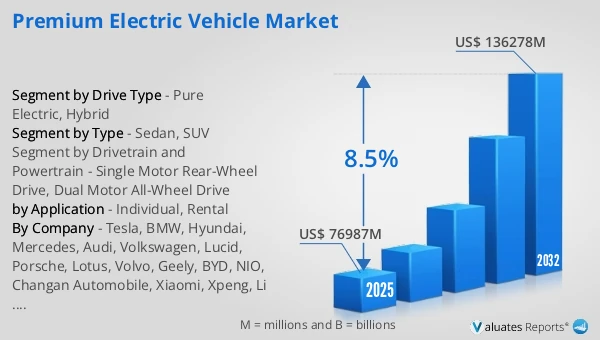
Premium Electric Vehicle Market
The 2025 U.S. tariff policies introduce profound uncertainty into the global economic landscape. This report critically examines the implications of recent tariff adjustments and international strategic countermeasures on Premium Electric Vehicle competitive dynamics, regional economic interdependencies, and supply chain reconfigurations.
In 2025, global Premium Electric Vehicle production reached approximately 770k units, with an average global market price of around US$100k per unit.
A premium electric vehicle (Premium EV) refers to an EV positioned above mainstream models in brand, pricing, and feature content, focusing on stronger performance, longer range and better charging experience, superior NVH and chassis refinement, and a richer software/cockpit and ADAS stack—delivering an integrated premium ownership experience through materials, engineering, and brand services.
Upstream spans batteries and key materials (lithium, nickel, cobalt, graphite, electrolytes), cell/module/pack plus thermal management, e-powertrain components (motor, inverter, power semiconductors), body/chassis materials (aluminum, high-strength steel, lightweight structures), and intelligent hardware (domain controllers/cockpit chips, cameras/radars, harnesses/connectors). Representative supply-chain players include CATL, LG Energy Solution, and Panasonic in batteries, alongside leading Tier-1 ecosystems in e-drive and E/E. Midstream comprises premium OEMs/platform integrators that deliver vehicle engineering, software integration, and brand/service networks. Downstream demand comes from affluent consumers and premium corporate fleets, shaped by fast-charging networks, financing/leasing, and residual values.
The premium EV market is increasingly defined by the convergence of luxury attributes and software-defined vehicle capabilities. Competition is shifting from simple metrics like range and acceleration to a holistic experience centered on fast-charging and efficiency management, chassis/NVH refinement, cockpit ecosystems and OTA cadence, and the real-world usability of driver assistance. Premium buyers are also more sensitive to brand image, service quality, and residual values, pushing OEMs to strengthen direct-to-consumer touchpoints, subscription services, and ecosystem partnerships. Key drivers include affluent consumers’ appetite for technology and performance, emissions and electrification policy signals, improving charging infrastructure, and advances in batteries and e-powertrains. Headwinds include pricing pressure and promotions even in the premium segment, cost and delivery volatility from battery materials and supply chains, uneven charging experience across regions, and rising regulatory/liability requirements for software and ADAS that can slow feature deployment and monetization.
This report delivers a comprehensive overview of the global Premium Electric Vehicle market, with both quantitative and qualitative analyses, to help readers develop growth strategies, assess the competitive landscape, evaluate their position in the current market, and make informed business decisions regarding Premium Electric Vehicle. The Premium Electric Vehicle market size, estimates, and forecasts are provided in terms of output/shipments (K Units) and revenue (US$ millions), with 2025 as the base year and historical and forecast data for 2021–2032.
The report segments the global Premium Electric Vehicle market comprehensively. Regional market sizes by Type, by Application, by Drivetrain and Powertrain, and by company are also provided. For deeper insight, the report profiles the competitive landscape, key competitors, and their respective market rankings, and discusses technological trends and new product developments.
This report will assist Premium Electric Vehicle manufacturers, new entrants, and companies across the industry value chain with information on revenues, production, and average prices for the overall market and its sub-segments, by company, by Type, by Application, and by region.
Market Segmentation
Scope of Premium Electric Vehicle Market Report
| Report Metric |
Details |
| Report Name |
Premium Electric Vehicle Market |
| Accounted market size in 2025 |
US$ 76987 in million |
| Forecasted market size in 2032 |
US$ 136278 million |
| CAGR |
8.5% |
| Base Year |
2025 |
| Forecasted years |
2026 - 2032 |
| Segment by Type |
|
| Segment by Drivetrain and Powertrain |
- Single Motor Rear-Wheel Drive
- Dual Motor All-Wheel Drive
|
| Segment by Drive Type |
|
| by Application |
|
| Production by Region |
- North America
- Europe
- China
- Japan
|
| Consumption by Region |
- North America (United States, Canada)
- Europe (Germany, France, UK, Italy, Russia)
- Asia-Pacific (China, Japan, South Korea, Taiwan)
- Southeast Asia (India)
- Latin America (Mexico, Brazil)
|
| By Company |
Tesla, BMW, Hyundai, Mercedes, Audi, Volkswagen, Lucid, Porsche, Lotus, Volvo, Geely, BYD, NIO, Changan Automobile, Xiaomi, Xpeng, Li Auto, GWM |
| Forecast units |
USD million in value |
| Report coverage |
Revenue and volume forecast, company share, competitive landscape, growth factors and trends |
Chapter Outline
- Chapter 1: Defines the scope of the report and presents an executive summary of market segments (by Type, by Application, by Drivetrain and Powertrain, etc.), including the size of each segment and its future growth potential. It offers a high-level view of the current market and its likely evolution in the short, medium, and long term.
- Chapter 2: Provides a detailed analysis of the competitive landscape for Premium Electric Vehicle manufacturers, including prices, production, value-based market shares, latest development plans, and information on mergers and acquisitions.
- Chapter 3: Examines Premium Electric Vehicle production/output and value by region and country, providing a quantitative assessment of market size and growth potential for each region over the next six years.
- Chapter 4: Analyzes Premium Electric Vehicle consumption at the regional and country levels. It quantifies market size and growth potential for each region and its key countries, and outlines market development, outlook, addressable space, and national production.
- Chapter 5: Analyzes market segments by Type, covering the size and growth potential of each segment to help readers identify “blue ocean” opportunities.
- Chapter 6: Analyzes market segments by Application, covering the size and growth potential of each segment to help readers identify “blue ocean” opportunities in downstream markets.
- Chapter 7: Profiles key players, detailing the fundamentals of major companies, including product production/output, value, price, gross margin, product portfolio/introductions, and recent developments.
- Chapter 8: Reviews the industry value chain, including upstream and downstream segments.
- Chapter 9: Discusses market dynamics and recent developments, including drivers, restraints, challenges and risks for manufacturers, U.S. Tariffs and relevant policy analysis.
- Chapter 10: Summarizes the key findings and conclusions of the report.
FAQ for this report
How fast is Premium Electric Vehicle Market growing?
Ans: The Premium Electric Vehicle Market witnessing a CAGR of 8.5% during the forecast period 2026-2032.
What is the Premium Electric Vehicle Market size in 2032?
Ans: The Premium Electric Vehicle Market size in 2032 will be US$ 136278 million.
Who are the main players in the Premium Electric Vehicle Market report?
Ans: The main players in the Premium Electric Vehicle Market are Tesla, BMW, Hyundai, Mercedes, Audi, Volkswagen, Lucid, Porsche, Lotus, Volvo, Geely, BYD, NIO, Changan Automobile, Xiaomi, Xpeng, Li Auto, GWM
What are the Application segmentation covered in the Premium Electric Vehicle Market report?
Ans: The Applications covered in the Premium Electric Vehicle Market report are Individual, Rental
What are the Type segmentation covered in the Premium Electric Vehicle Market report?
Ans: The Types covered in the Premium Electric Vehicle Market report are Pure Electric, Hybrid