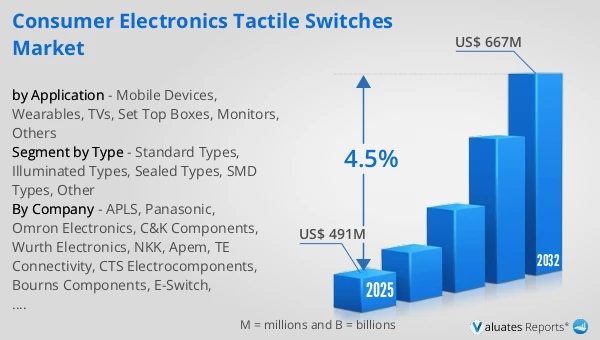
The global Consumer Electronics Tactile Switches market was valued at US$ 491 million in 2025 and is anticipated to reach US$ 667 million by 2032, at a CAGR of 4.5% from 2026 to 2032.
Consumer Electronics Tactile Switches Market
The 2025 U.S. tariff policies introduce profound uncertainty into the global economic landscape. This report critically examines the implications of recent tariff adjustments and international strategic countermeasures on Consumer Electronics Tactile Switches competitive dynamics, regional economic interdependencies, and supply chain reconfigurations.
Tactile switches are electromechanical components used in consumer electronics devices to provide tactile feedback when pressed. These switches are designed to give users a physical sensation or "click" response when actuated, indicating that the input command has been registered. Tactile switches are commonly found in devices such as keyboards, remote controls, game controllers, and various handheld electronic gadgets.
Market Drivers for Consumer Electronics Tactile Switches:
User Experience Enhancement: Tactile switches improve the user experience by providing tactile feedback, which enhances the feel of pressing a button or key on a device. The click sensation helps users confirm that an input has been successfully registered, leading to improved usability and user satisfaction.
Reliability and Durability: Tactile switches are known for their reliability and durability, with the ability to withstand millions of actuations without failure. This longevity contributes to the overall quality and performance of consumer electronics products, ensuring consistent operation over an extended lifespan.
Space Efficiency: Tactile switches are compact and space-efficient, making them suitable for integration into small and slim consumer electronics devices. Their low profile and minimal footprint allow manufacturers to design sleek and ergonomic products without compromising functionality or responsiveness.
Customization and Design Options: Tactile switches offer customization options in terms of actuation force, tactile feedback level, key travel distance, and keycap design. Manufacturers can tailor the tactile switch specifications to meet specific user preferences, product requirements, and design aesthetics, enabling differentiation and brand identity in the market.
Low Power Consumption: Tactile switches consume minimal power during operation, making them energy-efficient components for battery-powered consumer electronics devices. Their low power requirements help optimize device battery life, reduce energy consumption, and enhance overall device sustainability.
Compatibility with Various Applications: Tactile switches are versatile components that can be used in a wide range of consumer electronics applications, including smartphones, tablets, wearables, gaming consoles, and home appliances. Their compatibility with different devices and operating environments makes them a popular choice for electronics manufacturers seeking versatile input solutions.
Market Challenges for Consumer Electronics Tactile Switches:
Competition and Pricing Pressure: The market for tactile switches is competitive, with multiple manufacturers offering a variety of switch options at different price points. Price pressure and competition can pose challenges for manufacturers in terms of maintaining profitability while meeting consumer demand for affordable yet high-quality tactile switches.
Miniaturization and Component Integration: As consumer electronics devices continue to become smaller and more compact, the challenge lies in designing tactile switches that are compatible with miniaturized product designs. Ensuring that tactile switches can be integrated seamlessly into slim devices without sacrificing performance or durability requires innovative engineering solutions.
Environmental Regulations and Sustainability: Meeting environmental regulations and sustainability standards in the production and disposal of tactile switches presents a challenge for manufacturers. Ensuring compliance with regulations related to materials, recycling, and waste management is essential for promoting eco-friendly practices in the consumer electronics industry.
Rapid Technological Advancements: The consumer electronics market is characterized by rapid technological advancements and changing customer preferences. Manufacturers of tactile switches must stay abreast of emerging technologies, such as haptic feedback solutions and touch-sensitive interfaces, to remain competitive and address evolving market demands.
Quality Control and Consistency: Maintaining consistent quality control standards across tactile switch production batches is crucial for ensuring product reliability and performance. Variations in switch actuation force, tactile feedback, key response time, and durability can impact user satisfaction and brand reputation, highlighting the importance of stringent quality assurance processes.
This report delivers a comprehensive overview of the global Consumer Electronics Tactile Switches market, with both quantitative and qualitative analyses, to help readers develop growth strategies, assess the competitive landscape, evaluate their position in the current market, and make informed business decisions regarding Consumer Electronics Tactile Switches. The Consumer Electronics Tactile Switches market size, estimates, and forecasts are provided in terms of shipments (K Units) and revenue (US$ millions), with 2025 as the base year and historical and forecast data for 2021–2032.
The report segments the global Consumer Electronics Tactile Switches market comprehensively. Regional market sizes by Type, by Application, , and by company are also provided. For deeper insight, the report profiles the competitive landscape, key competitors, and their respective market rankings, and discusses technological trends and new product developments.
This report will assist Consumer Electronics Tactile Switches manufacturers, new entrants, and companies across the industry value chain with information on revenues, production, and average prices for the overall market and its sub-segments, by company, by Type, by Application, and by region.
Market Segmentation
Scope of Consumer Electronics Tactile Switches Market Report
| Report Metric |
Details |
| Report Name |
Consumer Electronics Tactile Switches Market |
| Accounted market size in 2025 |
US$ 491 million |
| Forecasted market size in 2032 |
US$ 667 million |
| CAGR |
4.5% |
| Base Year |
2025 |
| Forecasted years |
2026 - 2032 |
| Segment by Type |
- Standard Types
- Illuminated Types
- Sealed Types
- SMD Types
- Other
|
| by Application |
- Mobile Devices
- Wearables
- TVs, Set Top Boxes, Monitors
- Others
|
| Production by Region |
- North America
- Europe
- China
- Japan
- South Korea
|
| Consumption by Region |
- North America (United States, Canada)
- Europe (Germany, France, UK, Italy, Russia)
- Asia-Pacific (China, Japan, South Korea, Taiwan)
- Southeast Asia (India)
- Latin America (Mexico, Brazil)
|
| By Company |
APLS, Panasonic, Omron Electronics, C&K Components, Wurth Electronics, NKK, Apem, TE Connectivity, CTS Electrocomponents, Bourns Components, E-Switch, Knitter-switch, Xinda, Marquardt, Mitsumi Electric, Changfeng, OMTEN, Han Young |
| Forecast units |
USD million in value |
| Report coverage |
Revenue and volume forecast, company share, competitive landscape, growth factors and trends |
Chapter Outline
- Chapter 1: Defines the scope of the report and presents an executive summary of market segments (by Type, by Application, , etc.), including the size of each segment and its future growth potential. It offers a high-level view of the current market and its likely evolution in the short, medium, and long term.
- Chapter 2: Provides a detailed analysis of the competitive landscape for Consumer Electronics Tactile Switches manufacturers, including prices, production, value-based market shares, latest development plans, and information on mergers and acquisitions.
- Chapter 3: Examines Consumer Electronics Tactile Switches production/output and value by region and country, providing a quantitative assessment of market size and growth potential for each region over the next six years.
- Chapter 4: Analyzes Consumer Electronics Tactile Switches consumption at the regional and country levels. It quantifies market size and growth potential for each region and its key countries, and outlines market development, outlook, addressable space, and national production.
- Chapter 5: Analyzes market segments by Type, covering the size and growth potential of each segment to help readers identify “blue ocean” opportunities.
- Chapter 6: Analyzes market segments by Application, covering the size and growth potential of each segment to help readers identify “blue ocean” opportunities in downstream markets.
- Chapter 7: Profiles key players, detailing the fundamentals of major companies, including product production/output, value, price, gross margin, product portfolio/introductions, and recent developments.
- Chapter 8: Reviews the industry value chain, including upstream and downstream segments.
- Chapter 9: Discusses market dynamics and recent developments, including drivers, restraints, challenges and risks for manufacturers, U.S. Tariffs and relevant policy analysis.
- Chapter 10: Summarizes the key findings and conclusions of the report.
Ans: The Consumer Electronics Tactile Switches Market witnessing a CAGR of 4.5% during the forecast period 2026-2032.
Ans: The Consumer Electronics Tactile Switches Market size in 2032 will be US$ 667 million.
Ans: The main players in the Consumer Electronics Tactile Switches Market are APLS, Panasonic, Omron Electronics, C&K Components, Wurth Electronics, NKK, Apem, TE Connectivity, CTS Electrocomponents, Bourns Components, E-Switch, Knitter-switch, Xinda, Marquardt, Mitsumi Electric, Changfeng, OMTEN, Han Young
Ans: The Applications covered in the Consumer Electronics Tactile Switches Market report are Mobile Devices, Wearables, TVs, Set Top Boxes, Monitors, Others
Ans: The Types covered in the Consumer Electronics Tactile Switches Market report are Standard Types, Illuminated Types, Sealed Types, SMD Types, Other