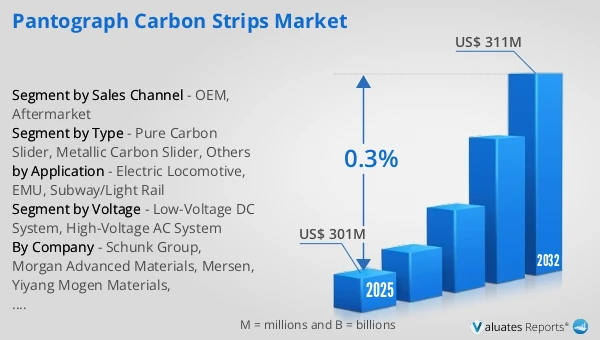
The global Pantograph Carbon Strips market was valued at US$ 301 million in 2025 and is anticipated to reach US$ 311 million by 2032, at a CAGR of 0.3% from 2026 to 2032.
Pantograph Carbon Strips Market
The 2025 U.S. tariff policies introduce profound uncertainty into the global economic landscape. This report critically examines the implications of recent tariff adjustments and international strategic countermeasures on Pantograph Carbon Strips competitive dynamics, regional economic interdependencies, and supply chain reconfigurations.
Pantograph carbon strips are replaceable sliding contact elements mounted on the pantograph head to maintain continuous electrical contact with the overhead contact line and transfer traction current during both running and energized standstill conditions. They are typically engineered as carbon-based grades (carbon-graphite, impregnated carbon, copper-impregnated variants) integrated with a structural carrier (aluminium or steel), and are specified around network voltage, speed class, current duty, pantograph–catenary interaction, and maintenance regimes to control electrical losses, temperature rise, wear, arcing risk, and batch consistency. As a maintenance consumable, demand is fundamentally tied to installed base and utilization rather than new-build cycles.
Upstream include carbon/graphite feedstocks, impregnation systems such as resins and, for higher-conductivity grades, copper or copper-alloy media, plus aluminium or steel carriers and conductive bonding/fastening materials; downstream demand is served mainly through pantograph/panhead OEMs, rolling-stock OEMs, and rail operators' maintenance organizations via tenders and framework agreements.
In 2025, global pantograph carbon strips production reached approximately 2 million units, with an average global market price is $160 per unit.
The global pantograph carbon strips and carbon strip market is structurally installed-base driven and behaves as a maintenance consumable. Ongoing expansion of electrified rail and high-speed rail networks lifts the in-service electrified infrastructure and pantograph population, providing a steadily rising demand foundation, with China’s dominant high-speed rail scale remaining a major contributor to the long-term installed base. As an MRO item, demand is less correlated with short-term rolling-stock deliveries and more tightly linked to utilization intensity and maintenance cadence across the in-service fleet, which supports relatively stable and predictable volume dynamics.
Replacement frequency is not a fixed constant. It is primarily shaped by line conditions, pantograph–catenary matching, material formulation, contact wire condition and wear, traction duty defined by peak and sustained current, and the balance between preventive and condition-based maintenance. Mature networks typically narrow life dispersion through standardized qualification, field validation, batch consistency controls, and life-threshold governance, reducing abnormal wear risk and improving schedule controllability.
From a material perspective, the market is commonly segmented into pure carbon and graphite, metalized or impregnated carbon, and other functionalized or semi-assembled solutions. The engineering value of metalized and impregnated carbon centers on lower resistivity, controlled temperature rise, and more stable current collection under high-current duty, leading to higher penetration in high-current DC urban rail, heavy-haul traction, and long energized dwell scenarios. The technology trajectory indicates that pure carbon remains a meaningful base, while rising current levels, tighter risk management, and stronger consistency requirements continue to push the market toward impregnated and metalized solutions combined with functional features such as end-structure design, arc protection, and anti-icing or heating functions. Premiums in functionalized solutions are more frequently driven by expanded structural responsibility, assembly scope, and failure-risk management than by material value alone.
By application, the demand mix is increasingly shaped by operating duty and maintenance governance. Electric locomotive fleets continue to anchor global consumption because long-duration, high-load service places a premium on predictable wear behavior, stable current collection, and risk containment, pushing operators toward tighter life management and more performance-based procurement. Subway and light rail are the fastest-evolving demand center as expansion of overhead systems and high-utilization service intensify replacement cadence and standardization, while transparent public procurement accelerates consolidation toward suppliers that can prove field performance and deliver reliably at scale. High-speed and intercity EMUs remain smaller in volume but set the highest bar for qualification and consistency; the trend is toward deeper validation, stricter batch-to-batch control, and longer-term sourcing frameworks, which elevates entry thresholds and shifts competition toward demonstrated reliability and life-cycle outcomes.
This report delivers a comprehensive overview of the global Pantograph Carbon Strips market, with both quantitative and qualitative analyses, to help readers develop growth strategies, assess the competitive landscape, evaluate their position in the current market, and make informed business decisions regarding Pantograph Carbon Strips. The Pantograph Carbon Strips market size, estimates, and forecasts are provided in terms of output/shipments (K Units) and revenue (US$ millions), with 2025 as the base year and historical and forecast data for 2021–2032.
The report segments the global Pantograph Carbon Strips market comprehensively. Regional market sizes by Type, by Application, by Sales Channel, and by company are also provided. For deeper insight, the report profiles the competitive landscape, key competitors, and their respective market rankings, and discusses technological trends and new product developments.
This report will assist Pantograph Carbon Strips manufacturers, new entrants, and companies across the industry value chain with information on revenues, production, and average prices for the overall market and its sub-segments, by company, by Type, by Application, and by region.
Market Segmentation
Scope of Pantograph Carbon Strips Market Report
| Report Metric |
Details |
| Report Name |
Pantograph Carbon Strips Market |
| Accounted market size in 2025 |
US$ 301 million |
| Forecasted market size in 2032 |
US$ 311 million |
| CAGR |
0.3% |
| Base Year |
2025 |
| Forecasted years |
2026 - 2032 |
| Segment by Type |
- Pure Carbon Slider
- Metallic Carbon Slider
- Others
|
| Segment by Sales Channel |
|
| Segment by Voltage |
- Low-Voltage DC System
- High-Voltage AC System
|
| by Application |
- Electric Locomotive
- EMU
- Subway/Light Rail
|
| Production by Region |
- North America
- Europe
- China
- India
|
| Consumption by Region |
- North America (United States, Canada)
- Europe (Germany, France, UK, Italy, Russia)
- Asia-Pacific (China, Japan, South Korea, Taiwan)
- Southeast Asia (India)
- Latin America (Mexico, Brazil)
|
| By Company |
Schunk Group, Morgan Advanced Materials, Mersen, Yiyang Mogen Materials, Doneka New Material, Wabtec Corporation(PanTrac), TOYO TANSO, Wangao Zhongye Technology, Hongde Electrical Carbon Products, Kimwan Carbon |
| Forecast units |
USD million in value |
| Report coverage |
Revenue and volume forecast, company share, competitive landscape, growth factors and trends |
Chapter Outline
- Chapter 1: Defines the scope of the report and presents an executive summary of market segments (by Type, by Application, by Sales Channel, etc.), including the size of each segment and its future growth potential. It offers a high-level view of the current market and its likely evolution in the short, medium, and long term.
- Chapter 2: Provides a detailed analysis of the competitive landscape for Pantograph Carbon Strips manufacturers, including prices, production, value-based market shares, latest development plans, and information on mergers and acquisitions.
- Chapter 3: Examines Pantograph Carbon Strips production/output and value by region and country, providing a quantitative assessment of market size and growth potential for each region over the next six years.
- Chapter 4: Analyzes Pantograph Carbon Strips consumption at the regional and country levels. It quantifies market size and growth potential for each region and its key countries, and outlines market development, outlook, addressable space, and national production.
- Chapter 5: Analyzes market segments by Type, covering the size and growth potential of each segment to help readers identify “blue ocean” opportunities.
- Chapter 6: Analyzes market segments by Application, covering the size and growth potential of each segment to help readers identify “blue ocean” opportunities in downstream markets.
- Chapter 7: Profiles key players, detailing the fundamentals of major companies, including product production/output, value, price, gross margin, product portfolio/introductions, and recent developments.
- Chapter 8: Reviews the industry value chain, including upstream and downstream segments.
- Chapter 9: Discusses market dynamics and recent developments, including drivers, restraints, challenges and risks for manufacturers, U.S. Tariffs and relevant policy analysis.
- Chapter 10: Summarizes the key findings and conclusions of the report.
Ans: The Pantograph Carbon Strips Market witnessing a CAGR of 0.3% during the forecast period 2026-2032.
Ans: The Pantograph Carbon Strips Market size in 2032 will be US$ 311 million.
Ans: The main players in the Pantograph Carbon Strips Market are Schunk Group, Morgan Advanced Materials, Mersen, Yiyang Mogen Materials, Doneka New Material, Wabtec Corporation(PanTrac), TOYO TANSO, Wangao Zhongye Technology, Hongde Electrical Carbon Products, Kimwan Carbon
Ans: The Applications covered in the Pantograph Carbon Strips Market report are Electric Locomotive, EMU, Subway/Light Rail
Ans: The Types covered in the Pantograph Carbon Strips Market report are Pure Carbon Slider, Metallic Carbon Slider, Others