Ans: The Ecommerce Order Fulfillment Service Market witnessing a CAGR of 10.2% during the forecast period 2025-2031.

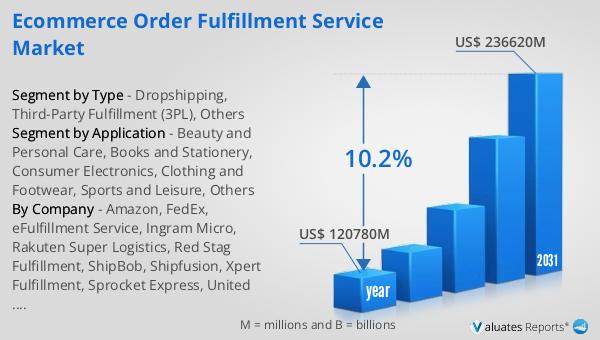
The global market for Ecommerce Order Fulfillment Service was valued at US$ 120780 million in the year 2024 and is projected to reach a revised size of US$ 236620 million by 2031, growing at a CAGR of 10.2% during the forecast period.
Segment Growth (Type & Application):
The third-party fulfillment (3PL) segment is experiencing the fastest growth as online retailers increasingly outsource warehousing, inventory management, picking, packing, shipping, and returns to specialized logistics providers. This trend is driven by the need for faster delivery, cost optimization, and scalability across multiple sales channels. Dropshipping continues to grow steadily, particularly among small merchants and cross-border sellers seeking low upfront investment models, while the others category, including hybrid and in-house fulfillment models, supports niche and omnichannel strategies.
By application, clothing and footwear represents the largest and fastest-growing segment due to high online purchase frequency, fast fashion cycles, and strong demand for efficient returns processing. Consumer electronics and beauty and personal care also show strong growth, supported by rising digital consumption, product personalization, and subscription-based purchasing models.
Government Policies and Regulatory Support:
National e-commerce digitization initiatives, logistics infrastructure investments, and cross-border trade facilitation policies are indirectly accelerating the adoption of professional ecommerce fulfillment services.
The global ecommerce order fulfillment service market is expanding rapidly as online retail continues to reshape consumer purchasing behavior and supply chain strategies. Retailers increasingly recognize that fast, reliable, and cost-efficient fulfillment is central to customer satisfaction, repeat purchases, and brand reputation. As ecommerce platforms scale across regions and channels, fulfillment services have evolved from basic warehousing and shipping functions into integrated, technology-driven logistics ecosystems.
From a service type perspective, third-party fulfillment (3PL) is emerging as the dominant and fastest-growing segment. Online merchants, ranging from startups to global brands, are outsourcing logistics operations to specialized providers to gain access to distributed warehouse networks, automation technologies, and data-driven inventory management systems. This shift is driven by the need to meet rising customer expectations for same-day and next-day delivery, reduce last-mile costs, and improve order accuracy. 3PL providers also offer scalable solutions that allow retailers to manage seasonal demand fluctuations without investing heavily in physical infrastructure. Meanwhile, dropshipping remains an attractive model for entrepreneurs and small businesses due to its low capital requirements and minimal inventory risk. This model supports rapid product testing, cross-border selling, and niche market targeting, although it often involves longer delivery times and limited control over packaging and branding. The others category, including hybrid fulfillment models and in-house operations supported by technology platforms, continues to evolve as retailers adopt omnichannel strategies that integrate online and offline inventory.
By application, clothing and footwear represents the largest and fastest-growing segment of the ecommerce order fulfillment market. The fashion industry is characterized by high order volumes, frequent product launches, and high return rates, making efficient fulfillment and reverse logistics critical. Fulfillment providers are investing in automation, sizing optimization, and intelligent routing to manage returns efficiently and minimize operational costs. Consumer electronics also contribute significantly to market growth, driven by rising demand for smartphones, smart home devices, and personal electronics. These products require specialized handling, secure packaging, and compliance with regulatory standards, further strengthening the role of professional fulfillment services. Beauty and personal care is another high-growth segment, supported by subscription commerce, direct-to-consumer brand expansion, and the increasing importance of fast delivery and premium unboxing experiences. Books and stationery, as well as sports and leisure products, continue to generate stable demand, particularly through seasonal promotions and educational cycles.
A key trend shaping the market is the adoption of automation and smart warehousing technologies. Fulfillment centers are increasingly deploying robotics, automated storage and retrieval systems, conveyor technologies, and AI-powered inventory forecasting tools. These technologies improve order processing speed, reduce labor dependency, and enhance accuracy, enabling fulfillment providers to meet rising service-level expectations while controlling operational costs. Integration with ecommerce platforms and enterprise resource planning systems further enables real-time inventory visibility and order tracking for merchants and customers.
Another major trend is the expansion of distributed and micro-fulfillment networks. To reduce delivery times and last-mile costs, fulfillment providers are establishing smaller, strategically located warehouses closer to end consumers. This approach supports same-day and next-day delivery models, particularly in urban and high-density regions. Micro-fulfillment centers integrated within retail stores or urban hubs are also gaining traction, enabling omnichannel fulfillment strategies such as buy-online-pickup-in-store and ship-from-store.
Cross-border ecommerce and international fulfillment are also driving market growth. As online retailers increasingly target global customers, fulfillment providers are expanding international warehousing, customs brokerage services, and duty optimization solutions. Expertise in regulatory compliance, tax management, and localized delivery networks is becoming a critical competitive differentiator. Providers that offer end-to-end cross-border fulfillment capabilities are well-positioned to capture demand from merchants seeking global expansion.
Customer experience optimization is another defining trend. Consumers expect fast, transparent, and reliable delivery, along with easy returns and responsive customer support. Fulfillment providers are enhancing service offerings through branded packaging, real-time shipment notifications, flexible delivery options, and proactive exception management. These value-added services strengthen brand loyalty and improve lifetime customer value for ecommerce merchants.
Sustainability is increasingly influencing fulfillment strategies. Providers are adopting eco-friendly packaging materials, optimizing delivery routes to reduce carbon emissions, and offering carbon-neutral shipping options. Retailers are prioritizing sustainability in their supply chains, and fulfillment partners that align with environmental goals are gaining preference in procurement decisions.
Finally, the market is benefiting from the professionalization of ecommerce operations. As ecommerce matures, retailers are adopting more structured approaches to demand planning, inventory optimization, and performance measurement. Fulfillment providers are responding by offering analytics dashboards, predictive demand tools, and consultative services to support strategic decision-making and long-term growth.
| Report Metric | Details |
| Report Name | Ecommerce Order Fulfillment Service Market |
| Accounted market size in year | US$ 120780 million |
| Forecasted market size in 2031 | US$ 236620 million |
| CAGR | 10.2% |
| Base Year | year |
| Forecasted years | 2025 - 2031 |
| Segment by Type |
|
| Segment by Application |
|
| By Region |
|
| By Company | Amazon, FedEx, eFulfillment Service, Ingram Micro, Rakuten Super Logistics, Red Stag Fulfillment, ShipBob, Shipfusion, Xpert Fulfillment, Sprocket Express, United Parcel Service, ShipWire, Red Stag, InsightQuote, Fulfillify, IDS Fulfillment, VelocityShip, Ships-a-Lot |
| Forecast units | USD million in value |
| Report coverage | Revenue and volume forecast, company share, competitive landscape, growth factors and trends |
Ans: The Ecommerce Order Fulfillment Service Market witnessing a CAGR of 10.2% during the forecast period 2025-2031.
Ans: The Ecommerce Order Fulfillment Service Market size in 2031 will be US$ 236620 million.
Ans: According to the National Bureau of Statistics, China was the largest online retail market in 2022, with online retail sales of 13.79 trillion yuan and a year-on-year increase of 4%.
Ans: The main players in the Ecommerce Order Fulfillment Service Market are Amazon, FedEx, eFulfillment Service, Ingram Micro, Rakuten Super Logistics, Red Stag Fulfillment, ShipBob, Shipfusion, Xpert Fulfillment, Sprocket Express, United Parcel Service, ShipWire, Red Stag, InsightQuote, Fulfillify, IDS Fulfillment, VelocityShip, Ships-a-Lot
Ans: The Applications covered in the Ecommerce Order Fulfillment Service Market report are Beauty and Personal Care, Books and Stationery, Consumer Electronics, Clothing and Footwear, Sports and Leisure, Others
Ans: The Types covered in the Ecommerce Order Fulfillment Service Market report are Dropshipping, Third-Party Fulfillment (3PL), Others
$2900
$4350
$5800
HAVE A QUERY?
OUR CUSTOMER

SIMILAR REPORTS