0
U.S. (TOLL FREE)
+1 (315) 215-3225
Automative

0
U.S. (TOLL FREE)
+1 (315) 215-3225
Global Shaped Refractory Materials Market Research Report 2025
Published Date: October 2025
|
Report Code: QYRE-Auto-38G7561
Home | Market Reports | Business & Industrial| Construction & Maintenance| Building Materials & Supplies
Global Shaped Refractory Materials Market Insights and Forecast to 2028
BUY CHAPTERS

Global Shaped Refractory Materials Market Research Report 2025

Code: QYRE-Auto-38G7561
Report
October 2025
Pages:114
QYResearch
Buy Now with 15% Discount
DESCRIPTION
TABLE OF CONTENT
TABLES & FIGURES

Shaped Refractory Materials Market Size

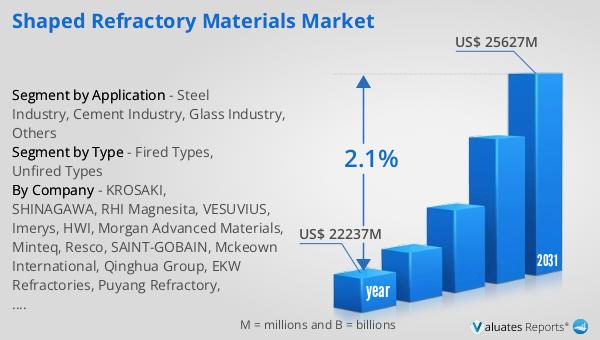
The global market for Shaped Refractory Materials was valued at US$ 22237 million in the year 2024 and is projected to reach a revised size of US$ 25627 million by 2031, growing at a CAGR of 2.1% during the forecast period.

Shaped Refractory Materials Market

Shaped Refractory Materials Market

The 2025 U.S. tariff policies introduce profound uncertainty into the global economic landscape. This report critically examines the implications of recent tariff adjustments and international strategic countermeasures on Shaped Refractory Materials competitive dynamics, regional economic interdependencies, and supply chain reconfigurations.
Shaped refractory materials refer to pre-formed, dimensionally stable ceramic products that are manufactured in specific shapes and sizes to meet the structural and thermal demands of high-temperature industrial processes. Unlike monolithic refractories, which are installed in situ as castables, ramming mixes, or gunning materials, shaped refractories are sintered or fused into solid bricks, blocks, tiles, or custom geometries before being installed. These materials are engineered to retain strength and stability under extreme conditions such as high heat, pressure, abrasion, and corrosive chemical environments. Shaped refractories are typically composed of oxides and non-oxides such as alumina (Al₂O₃), magnesia (MgO), silica (SiO₂), chromite (FeCr₂O₄), and carbon-based compounds. Their composition and microstructure are optimized to deliver precise thermal expansion characteristics, low porosity, and long service life.
The market for shaped refractory materials plays a critical role in enabling the global production of metals, cement, glass, petrochemicals, and ceramics. In the iron and steel industry, which remains the largest consumer segment, shaped refractories are extensively used in blast furnaces, converters, ladles, and continuous casting units to resist molten metal erosion and slag attack. Similarly, in the non-ferrous metallurgy sector, these materials line furnaces for copper, aluminum, and nickel smelting, where they must withstand both high thermal loads and reactive fluxes. In cement and glass manufacturing, shaped refractories form the structural lining of rotary kilns, preheaters, and regenerators, contributing to energy efficiency and product quality. As industrial processes evolve toward higher temperatures and more aggressive chemical environments, the need for high-performance shaped refractories continues to expand.
In 2024, global Shaped Refractory Materials production reached approximately 30887 K MT, with an average global market price of around US$ 720 per MT. The global single-line production capacity ranges from 200 to 300 K MT per year. The industry's gross profit margin is approximately 25%-35%.
The development perspectives of the shaped refractory materials market are closely linked to the industrialization patterns and energy transitions occurring worldwide. The traditional stronghold of the market lies in the steel industry, which historically accounts for over half of global refractory consumption. As emerging economies continue to expand their steel production capacities to meet infrastructure and manufacturing needs, shaped refractory demand remains robust in Asia-Pacific, particularly in China, India, and Southeast Asia. Meanwhile, in developed regions, the focus has shifted toward improving operational efficiency, extending furnace lifespans, and reducing downtime, which drive demand for high-end, specialized refractories. Shaped refractory producers are therefore increasingly investing in material innovation and service integration, offering tailor-made solutions that combine physical performance with digital monitoring for predictive maintenance.
Looking ahead, the development of shaped refractory materials will likely be characterized by three main themes: material innovation, digital transformation, and sustainability integration. On the material front, research into nano-engineered composites, carbon-neutral binders, and multi-phase ceramic structures promises to deliver products that combine thermal stability with mechanical flexibility. In digital transformation, simulation-driven design and intelligent manufacturing will enhance production consistency and shorten time-to-market. Finally, in sustainability, the convergence of recycling technologies, cleaner production, and life-cycle optimization will become essential for competitiveness.
The shaped refractory materials market represents a mature yet continuously evolving segment of the high-temperature materials industry. Its foundation lies in its indispensable role in global heavy industries, while its future lies in technological, environmental, and digital adaptation. As industries worldwide pursue higher efficiency and sustainability, shaped refractories will continue to advance from basic structural components toward intelligent, eco-efficient systems that support the next generation of industrial processes. With growing emphasis on performance, longevity, and ecological responsibility, the shaped refractory materials market is poised for stable, innovation-driven expansion over the coming decades.

Report Scope

This report aims to provide a comprehensive presentation of the global market for Shaped Refractory Materials, with both quantitative and qualitative analysis, to help readers develop business/growth strategies, assess the market competitive situation, analyze their position in the current marketplace, and make informed business decisions regarding Shaped Refractory Materials.
The Shaped Refractory Materials market size, estimations, and forecasts are provided in terms of output/shipments (K MT) and revenue ($ millions), considering 2024 as the base year, with history and forecast data for the period from 2020 to 2031. This report segments the global Shaped Refractory Materials market comprehensively. Regional market sizes, concerning products by Type, by Application, and by players, are also provided.
For a more in-depth understanding of the market, the report provides profiles of the competitive landscape, key competitors, and their respective market ranks. The report also discusses technological trends and new product developments.
The report will help the Shaped Refractory Materials manufacturers, new entrants, and industry chain related companies in this market with information on the revenues, production, and average price for the overall market and the sub-segments across the different segments, by company, by Type, by Application, and by regions.

Scope of Shaped Refractory Materials Market Report

Report Metric Details
Report Name Shaped Refractory Materials Market
Accounted market size in year US$ 22237 million
Forecasted market size in 2031 US$ 25627 million
CAGR 2.1%
Base Year year
Forecasted years 2025 - 2031
Segment by Type
  • Fired Types
  • Unfired Types
Segment by Application
  • Steel Industry
  • Cement Industry
  • Glass Industry
  • Others
Production by Region
  • North America
  • Europe
  • China
  • Japan
Consumption by Region
  • North America (United States, Canada)
  • Europe (Germany, France, UK, Italy, Russia)
  • Asia-Pacific (China, Japan, South Korea, Taiwan)
  • Southeast Asia (India)
  • Latin America (Mexico, Brazil)
By Company KROSAKI, SHINAGAWA, RHI Magnesita, VESUVIUS, Imerys, HWI, Morgan Advanced Materials, Minteq, Resco, SAINT-GOBAIN, Mckeown International, Qinghua Group, EKW Refractories, Puyang Refractory, Sinosteel, Lier, Jinlong Group, Sujia
Forecast units USD million in value
Report coverage Revenue and volume forecast, company share, competitive landscape, growth factors and trends

Chapter Outline

  • Chapter 1: Introduces the report scope of the report, executive summary of different market segments (by region, by Type, by Application, etc), including the market size of each market segment, future development potential, and so on. It offers a high-level view of the current state of the market and its likely evolution in the short to mid-term, and long term.
  • Chapter 2: Detailed analysis of Shaped Refractory Materials manufacturers competitive landscape, price, production and value market share, latest development plan, merger, and acquisition information, etc.
  • Chapter 3: Production/output, value of Shaped Refractory Materials by region/country. It provides a quantitative analysis of the market size and development potential of each region in the next six years.
  • Chapter 4: Consumption of Shaped Refractory Materials in regional level and country level. It provides a quantitative analysis of the market size and development potential of each region and its main countries and introduces the market development, future development prospects, market space, and production of each country in the world.
  • Chapter 5: Provides the analysis of various market segments by Type, covering the market size and development potential of each market segment, to help readers find the blue ocean market in different market segments.
  • Chapter 6: Provides the analysis of various market segments by Application, covering the market size and development potential of each market segment, to help readers find the blue ocean market in different downstream markets.
  • Chapter 7: Provides profiles of key players, introducing the basic situation of the main companies in the market in detail, including product production/output, value, price, gross margin, product introduction, recent development, etc.
  • Chapter 8: Analysis of industrial chain, including the upstream and downstream of the industry.
  • Chapter 9: Introduces the market dynamics, latest developments of the market, the driving factors and restrictive factors of the market, the challenges and risks faced by manufacturers in the industry, and the analysis of relevant policies in the industry.
  • Chapter 10: The main points and conclusions of the report.

FAQ for this report

How fast is Shaped Refractory Materials Market growing?

Ans: The Shaped Refractory Materials Market witnessing a CAGR of 2.1% during the forecast period 2025-2031.

What is the Shaped Refractory Materials Market size in 2031?

Ans: The Shaped Refractory Materials Market size in 2031 will be US$ 25627 million.

Who are the main players in the Shaped Refractory Materials Market report?

Ans: The main players in the Shaped Refractory Materials Market are KROSAKI, SHINAGAWA, RHI Magnesita, VESUVIUS, Imerys, HWI, Morgan Advanced Materials, Minteq, Resco, SAINT-GOBAIN, Mckeown International, Qinghua Group, EKW Refractories, Puyang Refractory, Sinosteel, Lier, Jinlong Group, Sujia

What are the Application segmentation covered in the Shaped Refractory Materials Market report?

Ans: The Applications covered in the Shaped Refractory Materials Market report are Steel Industry, Cement Industry, Glass Industry, Others

What are the Type segmentation covered in the Shaped Refractory Materials Market report?

Ans: The Types covered in the Shaped Refractory Materials Market report are Fired Types, Unfired Types

1 Shaped Refractory Materials Market Overview
1.1 Product Definition
1.2 Shaped Refractory Materials by Type
1.2.1 Global Shaped Refractory Materials Market Value Growth Rate Analysis by Type: 2024 VS 2031
1.2.2 Fired Types
1.2.3 Unfired Types
1.3 Shaped Refractory Materials by Application
1.3.1 Global Shaped Refractory Materials Market Value Growth Rate Analysis by Application: 2024 VS 2031
1.3.2 Steel Industry
1.3.3 Cement Industry
1.3.4 Glass Industry
1.3.5 Others
1.4 Global Market Growth Prospects
1.4.1 Global Shaped Refractory Materials Production Value Estimates and Forecasts (2020-2031)
1.4.2 Global Shaped Refractory Materials Production Capacity Estimates and Forecasts (2020-2031)
1.4.3 Global Shaped Refractory Materials Production Estimates and Forecasts (2020-2031)
1.4.4 Global Shaped Refractory Materials Market Average Price Estimates and Forecasts (2020-2031)
1.5 Assumptions and Limitations
2 Market Competition by Manufacturers
2.1 Global Shaped Refractory Materials Production Market Share by Manufacturers (2020-2025)
2.2 Global Shaped Refractory Materials Production Value Market Share by Manufacturers (2020-2025)
2.3 Global Key Players of Shaped Refractory Materials, Industry Ranking, 2023 VS 2024
2.4 Global Shaped Refractory Materials Company Type and Market Share by Company Type (Tier 1, Tier 2, and Tier 3)
2.5 Global Shaped Refractory Materials Average Price by Manufacturers (2020-2025)
2.6 Global Key Manufacturers of Shaped Refractory Materials, Manufacturing Base Distribution and Headquarters
2.7 Global Key Manufacturers of Shaped Refractory Materials, Product Offered and Application
2.8 Global Key Manufacturers of Shaped Refractory Materials, Date of Enter into This Industry
2.9 Shaped Refractory Materials Market Competitive Situation and Trends
2.9.1 Shaped Refractory Materials Market Concentration Rate
2.9.2 Global 5 and 10 Largest Shaped Refractory Materials Players Market Share by Revenue
2.10 Mergers & Acquisitions, Expansion
3 Shaped Refractory Materials Production by Region
3.1 Global Shaped Refractory Materials Production Value Estimates and Forecasts by Region: 2020 VS 2024 VS 2031
3.2 Global Shaped Refractory Materials Production Value by Region (2020-2031)
3.2.1 Global Shaped Refractory Materials Production Value by Region (2020-2025)
3.2.2 Global Forecasted Production Value of Shaped Refractory Materials by Region (2026-2031)
3.3 Global Shaped Refractory Materials Production Estimates and Forecasts by Region: 2020 VS 2024 VS 2031
3.4 Global Shaped Refractory Materials Production Volume by Region (2020-2031)
3.4.1 Global Shaped Refractory Materials Production by Region (2020-2025)
3.4.2 Global Forecasted Production of Shaped Refractory Materials by Region (2026-2031)
3.5 Global Shaped Refractory Materials Market Price Analysis by Region (2020-2025)
3.6 Global Shaped Refractory Materials Production and Value, Year-over-Year Growth
3.6.1 North America Shaped Refractory Materials Production Value Estimates and Forecasts (2020-2031)
3.6.2 Europe Shaped Refractory Materials Production Value Estimates and Forecasts (2020-2031)
3.6.3 China Shaped Refractory Materials Production Value Estimates and Forecasts (2020-2031)
3.6.4 Japan Shaped Refractory Materials Production Value Estimates and Forecasts (2020-2031)
4 Shaped Refractory Materials Consumption by Region
4.1 Global Shaped Refractory Materials Consumption Estimates and Forecasts by Region: 2020 VS 2024 VS 2031
4.2 Global Shaped Refractory Materials Consumption by Region (2020-2031)
4.2.1 Global Shaped Refractory Materials Consumption by Region (2020-2025)
4.2.2 Global Shaped Refractory Materials Forecasted Consumption by Region (2026-2031)
4.3 North America
4.3.1 North America Shaped Refractory Materials Consumption Growth Rate by Country: 2020 VS 2024 VS 2031
4.3.2 North America Shaped Refractory Materials Consumption by Country (2020-2031)
4.3.3 U.S.
4.3.4 Canada
4.4 Europe
4.4.1 Europe Shaped Refractory Materials Consumption Growth Rate by Country: 2020 VS 2024 VS 2031
4.4.2 Europe Shaped Refractory Materials Consumption by Country (2020-2031)
4.4.3 Germany
4.4.4 France
4.4.5 U.K.
4.4.6 Italy
4.4.7 Russia
4.5 Asia Pacific
4.5.1 Asia Pacific Shaped Refractory Materials Consumption Growth Rate by Region: 2020 VS 2024 VS 2031
4.5.2 Asia Pacific Shaped Refractory Materials Consumption by Region (2020-2031)
4.5.3 China
4.5.4 Japan
4.5.5 South Korea
4.5.6 China Taiwan
4.5.7 Southeast Asia
4.5.8 India
4.6 Latin America, Middle East & Africa
4.6.1 Latin America, Middle East & Africa Shaped Refractory Materials Consumption Growth Rate by Country: 2020 VS 2024 VS 2031
4.6.2 Latin America, Middle East & Africa Shaped Refractory Materials Consumption by Country (2020-2031)
4.6.3 Mexico
4.6.4 Brazil
4.6.5 Turkey
4.6.6 GCC Countries
5 Segment by Type
5.1 Global Shaped Refractory Materials Production by Type (2020-2031)
5.1.1 Global Shaped Refractory Materials Production by Type (2020-2025)
5.1.2 Global Shaped Refractory Materials Production by Type (2026-2031)
5.1.3 Global Shaped Refractory Materials Production Market Share by Type (2020-2031)
5.2 Global Shaped Refractory Materials Production Value by Type (2020-2031)
5.2.1 Global Shaped Refractory Materials Production Value by Type (2020-2025)
5.2.2 Global Shaped Refractory Materials Production Value by Type (2026-2031)
5.2.3 Global Shaped Refractory Materials Production Value Market Share by Type (2020-2031)
5.3 Global Shaped Refractory Materials Price by Type (2020-2031)
6 Segment by Application
6.1 Global Shaped Refractory Materials Production by Application (2020-2031)
6.1.1 Global Shaped Refractory Materials Production by Application (2020-2025)
6.1.2 Global Shaped Refractory Materials Production by Application (2026-2031)
6.1.3 Global Shaped Refractory Materials Production Market Share by Application (2020-2031)
6.2 Global Shaped Refractory Materials Production Value by Application (2020-2031)
6.2.1 Global Shaped Refractory Materials Production Value by Application (2020-2025)
6.2.2 Global Shaped Refractory Materials Production Value by Application (2026-2031)
6.2.3 Global Shaped Refractory Materials Production Value Market Share by Application (2020-2031)
6.3 Global Shaped Refractory Materials Price by Application (2020-2031)
7 Key Companies Profiled
7.1 KROSAKI
7.1.1 KROSAKI Shaped Refractory Materials Company Information
7.1.2 KROSAKI Shaped Refractory Materials Product Portfolio
7.1.3 KROSAKI Shaped Refractory Materials Production, Value, Price and Gross Margin (2020-2025)
7.1.4 KROSAKI Main Business and Markets Served
7.1.5 KROSAKI Recent Developments/Updates
7.2 SHINAGAWA
7.2.1 SHINAGAWA Shaped Refractory Materials Company Information
7.2.2 SHINAGAWA Shaped Refractory Materials Product Portfolio
7.2.3 SHINAGAWA Shaped Refractory Materials Production, Value, Price and Gross Margin (2020-2025)
7.2.4 SHINAGAWA Main Business and Markets Served
7.2.5 SHINAGAWA Recent Developments/Updates
7.3 RHI Magnesita
7.3.1 RHI Magnesita Shaped Refractory Materials Company Information
7.3.2 RHI Magnesita Shaped Refractory Materials Product Portfolio
7.3.3 RHI Magnesita Shaped Refractory Materials Production, Value, Price and Gross Margin (2020-2025)
7.3.4 RHI Magnesita Main Business and Markets Served
7.3.5 RHI Magnesita Recent Developments/Updates
7.4 VESUVIUS
7.4.1 VESUVIUS Shaped Refractory Materials Company Information
7.4.2 VESUVIUS Shaped Refractory Materials Product Portfolio
7.4.3 VESUVIUS Shaped Refractory Materials Production, Value, Price and Gross Margin (2020-2025)
7.4.4 VESUVIUS Main Business and Markets Served
7.4.5 VESUVIUS Recent Developments/Updates
7.5 Imerys
7.5.1 Imerys Shaped Refractory Materials Company Information
7.5.2 Imerys Shaped Refractory Materials Product Portfolio
7.5.3 Imerys Shaped Refractory Materials Production, Value, Price and Gross Margin (2020-2025)
7.5.4 Imerys Main Business and Markets Served
7.5.5 Imerys Recent Developments/Updates
7.6 HWI
7.6.1 HWI Shaped Refractory Materials Company Information
7.6.2 HWI Shaped Refractory Materials Product Portfolio
7.6.3 HWI Shaped Refractory Materials Production, Value, Price and Gross Margin (2020-2025)
7.6.4 HWI Main Business and Markets Served
7.6.5 HWI Recent Developments/Updates
7.7 Morgan Advanced Materials
7.7.1 Morgan Advanced Materials Shaped Refractory Materials Company Information
7.7.2 Morgan Advanced Materials Shaped Refractory Materials Product Portfolio
7.7.3 Morgan Advanced Materials Shaped Refractory Materials Production, Value, Price and Gross Margin (2020-2025)
7.7.4 Morgan Advanced Materials Main Business and Markets Served
7.7.5 Morgan Advanced Materials Recent Developments/Updates
7.8 Minteq
7.8.1 Minteq Shaped Refractory Materials Company Information
7.8.2 Minteq Shaped Refractory Materials Product Portfolio
7.8.3 Minteq Shaped Refractory Materials Production, Value, Price and Gross Margin (2020-2025)
7.8.4 Minteq Main Business and Markets Served
7.8.5 Minteq Recent Developments/Updates
7.9 Resco
7.9.1 Resco Shaped Refractory Materials Company Information
7.9.2 Resco Shaped Refractory Materials Product Portfolio
7.9.3 Resco Shaped Refractory Materials Production, Value, Price and Gross Margin (2020-2025)
7.9.4 Resco Main Business and Markets Served
7.9.5 Resco Recent Developments/Updates
7.10 SAINT-GOBAIN
7.10.1 SAINT-GOBAIN Shaped Refractory Materials Company Information
7.10.2 SAINT-GOBAIN Shaped Refractory Materials Product Portfolio
7.10.3 SAINT-GOBAIN Shaped Refractory Materials Production, Value, Price and Gross Margin (2020-2025)
7.10.4 SAINT-GOBAIN Main Business and Markets Served
7.10.5 SAINT-GOBAIN Recent Developments/Updates
7.11 Mckeown International
7.11.1 Mckeown International Shaped Refractory Materials Company Information
7.11.2 Mckeown International Shaped Refractory Materials Product Portfolio
7.11.3 Mckeown International Shaped Refractory Materials Production, Value, Price and Gross Margin (2020-2025)
7.11.4 Mckeown International Main Business and Markets Served
7.11.5 Mckeown International Recent Developments/Updates
7.12 Qinghua Group
7.12.1 Qinghua Group Shaped Refractory Materials Company Information
7.12.2 Qinghua Group Shaped Refractory Materials Product Portfolio
7.12.3 Qinghua Group Shaped Refractory Materials Production, Value, Price and Gross Margin (2020-2025)
7.12.4 Qinghua Group Main Business and Markets Served
7.12.5 Qinghua Group Recent Developments/Updates
7.13 EKW Refractories
7.13.1 EKW Refractories Shaped Refractory Materials Company Information
7.13.2 EKW Refractories Shaped Refractory Materials Product Portfolio
7.13.3 EKW Refractories Shaped Refractory Materials Production, Value, Price and Gross Margin (2020-2025)
7.13.4 EKW Refractories Main Business and Markets Served
7.13.5 EKW Refractories Recent Developments/Updates
7.14 Puyang Refractory
7.14.1 Puyang Refractory Shaped Refractory Materials Company Information
7.14.2 Puyang Refractory Shaped Refractory Materials Product Portfolio
7.14.3 Puyang Refractory Shaped Refractory Materials Production, Value, Price and Gross Margin (2020-2025)
7.14.4 Puyang Refractory Main Business and Markets Served
7.14.5 Puyang Refractory Recent Developments/Updates
7.15 Sinosteel
7.15.1 Sinosteel Shaped Refractory Materials Company Information
7.15.2 Sinosteel Shaped Refractory Materials Product Portfolio
7.15.3 Sinosteel Shaped Refractory Materials Production, Value, Price and Gross Margin (2020-2025)
7.15.4 Sinosteel Main Business and Markets Served
7.15.5 Sinosteel Recent Developments/Updates
7.16 Lier
7.16.1 Lier Shaped Refractory Materials Company Information
7.16.2 Lier Shaped Refractory Materials Product Portfolio
7.16.3 Lier Shaped Refractory Materials Production, Value, Price and Gross Margin (2020-2025)
7.16.4 Lier Main Business and Markets Served
7.16.5 Lier Recent Developments/Updates
7.17 Jinlong Group
7.17.1 Jinlong Group Shaped Refractory Materials Company Information
7.17.2 Jinlong Group Shaped Refractory Materials Product Portfolio
7.17.3 Jinlong Group Shaped Refractory Materials Production, Value, Price and Gross Margin (2020-2025)
7.17.4 Jinlong Group Main Business and Markets Served
7.17.5 Jinlong Group Recent Developments/Updates
7.18 Sujia
7.18.1 Sujia Shaped Refractory Materials Company Information
7.18.2 Sujia Shaped Refractory Materials Product Portfolio
7.18.3 Sujia Shaped Refractory Materials Production, Value, Price and Gross Margin (2020-2025)
7.18.4 Sujia Main Business and Markets Served
7.18.5 Sujia Recent Developments/Updates
8 Industry Chain and Sales Channels Analysis
8.1 Shaped Refractory Materials Industry Chain Analysis
8.2 Shaped Refractory Materials Raw Material Supply Analysis
8.2.1 Key Raw Materials
8.2.2 Raw Materials Key Suppliers
8.3 Shaped Refractory Materials Production Mode & Process Analysis
8.4 Shaped Refractory Materials Sales and Marketing
8.4.1 Shaped Refractory Materials Sales Channels
8.4.2 Shaped Refractory Materials Distributors
8.5 Shaped Refractory Materials Customer Analysis
9 Shaped Refractory Materials Market Dynamics
9.1 Shaped Refractory Materials Industry Trends
9.2 Shaped Refractory Materials Market Drivers
9.3 Shaped Refractory Materials Market Challenges
9.4 Shaped Refractory Materials Market Restraints
10 Research Findings and Conclusion
11 Methodology and Data Source
11.1 Methodology/Research Approach
11.1.1 Research Programs/Design
11.1.2 Market Size Estimation
11.1.3 Market Breakdown and Data Triangulation
11.2 Data Source
11.2.1 Secondary Sources
11.2.2 Primary Sources
11.3 Author List
11.4 Disclaimer
List of Tables
 Table 1. Global Shaped Refractory Materials Market Value by Type, (US$ Million) & (2024 VS 2031)
 Table 2. Global Shaped Refractory Materials Market Value by Application, (US$ Million) & (2024 VS 2031)
 Table 3. Global Shaped Refractory Materials Production Capacity (K MT) by Manufacturers in 2024
 Table 4. Global Shaped Refractory Materials Production by Manufacturers (2020-2025) & (K MT)
 Table 5. Global Shaped Refractory Materials Production Market Share by Manufacturers (2020-2025)
 Table 6. Global Shaped Refractory Materials Production Value by Manufacturers (2020-2025) & (US$ Million)
 Table 7. Global Shaped Refractory Materials Production Value Share by Manufacturers (2020-2025)
 Table 8. Global Key Players of Shaped Refractory Materials, Industry Ranking, 2023 VS 2024
 Table 9. Company Type (Tier 1, Tier 2, and Tier 3) & (based on the Production Value in Shaped Refractory Materials as of 2024)
 Table 10. Global Market Shaped Refractory Materials Average Price by Manufacturers (USD/MT) & (2020-2025)
 Table 11. Global Key Manufacturers of Shaped Refractory Materials, Manufacturing Base Distribution and Headquarters
 Table 12. Global Key Manufacturers of Shaped Refractory Materials, Product Offered and Application
 Table 13. Global Key Manufacturers of Shaped Refractory Materials, Date of Enter into This Industry
 Table 14. Global Shaped Refractory Materials Manufacturers Market Concentration Ratio (CR5 and HHI)
 Table 15. Mergers & Acquisitions, Expansion Plans
 Table 16. Global Shaped Refractory Materials Production Value by Region: 2020 VS 2024 VS 2031 (US$ Million)
 Table 17. Global Shaped Refractory Materials Production Value (US$ Million) by Region (2020-2025)
 Table 18. Global Shaped Refractory Materials Production Value Market Share by Region (2020-2025)
 Table 19. Global Shaped Refractory Materials Production Value (US$ Million) Forecast by Region (2026-2031)
 Table 20. Global Shaped Refractory Materials Production Value Market Share Forecast by Region (2026-2031)
 Table 21. Global Shaped Refractory Materials Production Comparison by Region: 2020 VS 2024 VS 2031 (K MT)
 Table 22. Global Shaped Refractory Materials Production (K MT) by Region (2020-2025)
 Table 23. Global Shaped Refractory Materials Production Market Share by Region (2020-2025)
 Table 24. Global Shaped Refractory Materials Production (K MT) Forecast by Region (2026-2031)
 Table 25. Global Shaped Refractory Materials Production Market Share Forecast by Region (2026-2031)
 Table 26. Global Shaped Refractory Materials Market Average Price (USD/MT) by Region (2020-2025)
 Table 27. Global Shaped Refractory Materials Market Average Price (USD/MT) by Region (2026-2031)
 Table 28. Global Shaped Refractory Materials Consumption Growth Rate by Region: 2020 VS 2024 VS 2031 (K MT)
 Table 29. Global Shaped Refractory Materials Consumption by Region (2020-2025) & (K MT)
 Table 30. Global Shaped Refractory Materials Consumption Market Share by Region (2020-2025)
 Table 31. Global Shaped Refractory Materials Forecasted Consumption by Region (2026-2031) & (K MT)
 Table 32. Global Shaped Refractory Materials Forecasted Consumption Market Share by Region (2026-2031)
 Table 33. North America Shaped Refractory Materials Consumption Growth Rate by Country: 2020 VS 2024 VS 2031 (K MT)
 Table 34. North America Shaped Refractory Materials Consumption by Country (2020-2025) & (K MT)
 Table 35. North America Shaped Refractory Materials Consumption by Country (2026-2031) & (K MT)
 Table 36. Europe Shaped Refractory Materials Consumption Growth Rate by Country: 2020 VS 2024 VS 2031 (K MT)
 Table 37. Europe Shaped Refractory Materials Consumption by Country (2020-2025) & (K MT)
 Table 38. Europe Shaped Refractory Materials Consumption by Country (2026-2031) & (K MT)
 Table 39. Asia Pacific Shaped Refractory Materials Consumption Growth Rate by Region: 2020 VS 2024 VS 2031 (K MT)
 Table 40. Asia Pacific Shaped Refractory Materials Consumption by Region (2020-2025) & (K MT)
 Table 41. Asia Pacific Shaped Refractory Materials Consumption by Region (2026-2031) & (K MT)
 Table 42. Latin America, Middle East & Africa Shaped Refractory Materials Consumption Growth Rate by Country: 2020 VS 2024 VS 2031 (K MT)
 Table 43. Latin America, Middle East & Africa Shaped Refractory Materials Consumption by Country (2020-2025) & (K MT)
 Table 44. Latin America, Middle East & Africa Shaped Refractory Materials Consumption by Country (2026-2031) & (K MT)
 Table 45. Global Shaped Refractory Materials Production (K MT) by Type (2020-2025)
 Table 46. Global Shaped Refractory Materials Production (K MT) by Type (2026-2031)
 Table 47. Global Shaped Refractory Materials Production Market Share by Type (2020-2025)
 Table 48. Global Shaped Refractory Materials Production Market Share by Type (2026-2031)
 Table 49. Global Shaped Refractory Materials Production Value (US$ Million) by Type (2020-2025)
 Table 50. Global Shaped Refractory Materials Production Value (US$ Million) by Type (2026-2031)
 Table 51. Global Shaped Refractory Materials Production Value Market Share by Type (2020-2025)
 Table 52. Global Shaped Refractory Materials Production Value Market Share by Type (2026-2031)
 Table 53. Global Shaped Refractory Materials Price (USD/MT) by Type (2020-2025)
 Table 54. Global Shaped Refractory Materials Price (USD/MT) by Type (2026-2031)
 Table 55. Global Shaped Refractory Materials Production (K MT) by Application (2020-2025)
 Table 56. Global Shaped Refractory Materials Production (K MT) by Application (2026-2031)
 Table 57. Global Shaped Refractory Materials Production Market Share by Application (2020-2025)
 Table 58. Global Shaped Refractory Materials Production Market Share by Application (2026-2031)
 Table 59. Global Shaped Refractory Materials Production Value (US$ Million) by Application (2020-2025)
 Table 60. Global Shaped Refractory Materials Production Value (US$ Million) by Application (2026-2031)
 Table 61. Global Shaped Refractory Materials Production Value Market Share by Application (2020-2025)
 Table 62. Global Shaped Refractory Materials Production Value Market Share by Application (2026-2031)
 Table 63. Global Shaped Refractory Materials Price (USD/MT) by Application (2020-2025)
 Table 64. Global Shaped Refractory Materials Price (USD/MT) by Application (2026-2031)
 Table 65. KROSAKI Shaped Refractory Materials Company Information
 Table 66. KROSAKI Shaped Refractory Materials Specification and Application
 Table 67. KROSAKI Shaped Refractory Materials Production (K MT), Value (US$ Million), Price (USD/MT) and Gross Margin (2020-2025)
 Table 68. KROSAKI Main Business and Markets Served
 Table 69. KROSAKI Recent Developments/Updates
 Table 70. SHINAGAWA Shaped Refractory Materials Company Information
 Table 71. SHINAGAWA Shaped Refractory Materials Specification and Application
 Table 72. SHINAGAWA Shaped Refractory Materials Production (K MT), Value (US$ Million), Price (USD/MT) and Gross Margin (2020-2025)
 Table 73. SHINAGAWA Main Business and Markets Served
 Table 74. SHINAGAWA Recent Developments/Updates
 Table 75. RHI Magnesita Shaped Refractory Materials Company Information
 Table 76. RHI Magnesita Shaped Refractory Materials Specification and Application
 Table 77. RHI Magnesita Shaped Refractory Materials Production (K MT), Value (US$ Million), Price (USD/MT) and Gross Margin (2020-2025)
 Table 78. RHI Magnesita Main Business and Markets Served
 Table 79. RHI Magnesita Recent Developments/Updates
 Table 80. VESUVIUS Shaped Refractory Materials Company Information
 Table 81. VESUVIUS Shaped Refractory Materials Specification and Application
 Table 82. VESUVIUS Shaped Refractory Materials Production (K MT), Value (US$ Million), Price (USD/MT) and Gross Margin (2020-2025)
 Table 83. VESUVIUS Main Business and Markets Served
 Table 84. VESUVIUS Recent Developments/Updates
 Table 85. Imerys Shaped Refractory Materials Company Information
 Table 86. Imerys Shaped Refractory Materials Specification and Application
 Table 87. Imerys Shaped Refractory Materials Production (K MT), Value (US$ Million), Price (USD/MT) and Gross Margin (2020-2025)
 Table 88. Imerys Main Business and Markets Served
 Table 89. Imerys Recent Developments/Updates
 Table 90. HWI Shaped Refractory Materials Company Information
 Table 91. HWI Shaped Refractory Materials Specification and Application
 Table 92. HWI Shaped Refractory Materials Production (K MT), Value (US$ Million), Price (USD/MT) and Gross Margin (2020-2025)
 Table 93. HWI Main Business and Markets Served
 Table 94. HWI Recent Developments/Updates
 Table 95. Morgan Advanced Materials Shaped Refractory Materials Company Information
 Table 96. Morgan Advanced Materials Shaped Refractory Materials Specification and Application
 Table 97. Morgan Advanced Materials Shaped Refractory Materials Production (K MT), Value (US$ Million), Price (USD/MT) and Gross Margin (2020-2025)
 Table 98. Morgan Advanced Materials Main Business and Markets Served
 Table 99. Morgan Advanced Materials Recent Developments/Updates
 Table 100. Minteq Shaped Refractory Materials Company Information
 Table 101. Minteq Shaped Refractory Materials Specification and Application
 Table 102. Minteq Shaped Refractory Materials Production (K MT), Value (US$ Million), Price (USD/MT) and Gross Margin (2020-2025)
 Table 103. Minteq Main Business and Markets Served
 Table 104. Minteq Recent Developments/Updates
 Table 105. Resco Shaped Refractory Materials Company Information
 Table 106. Resco Shaped Refractory Materials Specification and Application
 Table 107. Resco Shaped Refractory Materials Production (K MT), Value (US$ Million), Price (USD/MT) and Gross Margin (2020-2025)
 Table 108. Resco Main Business and Markets Served
 Table 109. Resco Recent Developments/Updates
 Table 110. SAINT-GOBAIN Shaped Refractory Materials Company Information
 Table 111. SAINT-GOBAIN Shaped Refractory Materials Specification and Application
 Table 112. SAINT-GOBAIN Shaped Refractory Materials Production (K MT), Value (US$ Million), Price (USD/MT) and Gross Margin (2020-2025)
 Table 113. SAINT-GOBAIN Main Business and Markets Served
 Table 114. SAINT-GOBAIN Recent Developments/Updates
 Table 115. Mckeown International Shaped Refractory Materials Company Information
 Table 116. Mckeown International Shaped Refractory Materials Specification and Application
 Table 117. Mckeown International Shaped Refractory Materials Production (K MT), Value (US$ Million), Price (USD/MT) and Gross Margin (2020-2025)
 Table 118. Mckeown International Main Business and Markets Served
 Table 119. Mckeown International Recent Developments/Updates
 Table 120. Qinghua Group Shaped Refractory Materials Company Information
 Table 121. Qinghua Group Shaped Refractory Materials Specification and Application
 Table 122. Qinghua Group Shaped Refractory Materials Production (K MT), Value (US$ Million), Price (USD/MT) and Gross Margin (2020-2025)
 Table 123. Qinghua Group Main Business and Markets Served
 Table 124. Qinghua Group Recent Developments/Updates
 Table 125. EKW Refractories Shaped Refractory Materials Company Information
 Table 126. EKW Refractories Shaped Refractory Materials Specification and Application
 Table 127. EKW Refractories Shaped Refractory Materials Production (K MT), Value (US$ Million), Price (USD/MT) and Gross Margin (2020-2025)
 Table 128. EKW Refractories Main Business and Markets Served
 Table 129. EKW Refractories Recent Developments/Updates
 Table 130. Puyang Refractory Shaped Refractory Materials Company Information
 Table 131. Puyang Refractory Shaped Refractory Materials Specification and Application
 Table 132. Puyang Refractory Shaped Refractory Materials Production (K MT), Value (US$ Million), Price (USD/MT) and Gross Margin (2020-2025)
 Table 133. Puyang Refractory Main Business and Markets Served
 Table 134. Puyang Refractory Recent Developments/Updates
 Table 135. Sinosteel Shaped Refractory Materials Company Information
 Table 136. Sinosteel Shaped Refractory Materials Specification and Application
 Table 137. Sinosteel Shaped Refractory Materials Production (K MT), Value (US$ Million), Price (USD/MT) and Gross Margin (2020-2025)
 Table 138. Sinosteel Main Business and Markets Served
 Table 139. Sinosteel Recent Developments/Updates
 Table 140. Lier Shaped Refractory Materials Company Information
 Table 141. Lier Shaped Refractory Materials Specification and Application
 Table 142. Lier Shaped Refractory Materials Production (K MT), Value (US$ Million), Price (USD/MT) and Gross Margin (2020-2025)
 Table 143. Lier Main Business and Markets Served
 Table 144. Lier Recent Developments/Updates
 Table 145. Jinlong Group Shaped Refractory Materials Company Information
 Table 146. Jinlong Group Shaped Refractory Materials Specification and Application
 Table 147. Jinlong Group Shaped Refractory Materials Production (K MT), Value (US$ Million), Price (USD/MT) and Gross Margin (2020-2025)
 Table 148. Jinlong Group Main Business and Markets Served
 Table 149. Jinlong Group Recent Developments/Updates
 Table 150. Sujia Shaped Refractory Materials Company Information
 Table 151. Sujia Shaped Refractory Materials Specification and Application
 Table 152. Sujia Shaped Refractory Materials Production (K MT), Value (US$ Million), Price (USD/MT) and Gross Margin (2020-2025)
 Table 153. Sujia Main Business and Markets Served
 Table 154. Sujia Recent Developments/Updates
 Table 155. Key Raw Materials Lists
 Table 156. Raw Materials Key Suppliers Lists
 Table 157. Shaped Refractory Materials Distributors List
 Table 158. Shaped Refractory Materials Customers List
 Table 159. Shaped Refractory Materials Market Trends
 Table 160. Shaped Refractory Materials Market Drivers
 Table 161. Shaped Refractory Materials Market Challenges
 Table 162. Shaped Refractory Materials Market Restraints
 Table 163. Research Programs/Design for This Report
 Table 164. Key Data Information from Secondary Sources
 Table 165. Key Data Information from Primary Sources
 Table 166. Authors List of This Report


List of Figures
 Figure 1. Product Picture of Shaped Refractory Materials
 Figure 2. Global Shaped Refractory Materials Market Value by Type, (US$ Million) & (2020-2031)
 Figure 3. Global Shaped Refractory Materials Market Share by Type: 2024 VS 2031
 Figure 4. Fired Types Product Picture
 Figure 5. Unfired Types Product Picture
 Figure 6. Global Shaped Refractory Materials Market Value by Application, (US$ Million) & (2020-2031)
 Figure 7. Global Shaped Refractory Materials Market Share by Application: 2024 VS 2031
 Figure 8. Application One
 Figure 9. Application Two
 Figure 10. Application Three
 Figure 11. Application Four
 Figure 12. Application Five
 Figure 13. Application Six
 Figure 14. Application Seven
 Figure 15. Application Eight
 Figure 16. Application Nine
 Figure 17. Global Shaped Refractory Materials Production Value (US$ Million), 2020 VS 2024 VS 2031
 Figure 18. Global Shaped Refractory Materials Production Value (US$ Million) & (2020-2031)
 Figure 19. Global Shaped Refractory Materials Production Capacity (K MT) & (2020-2031)
 Figure 20. Global Shaped Refractory Materials Production (K MT) & (2020-2031)
 Figure 21. Global Shaped Refractory Materials Average Price (USD/MT) & (2020-2031)
 Figure 22. Shaped Refractory Materials Report Years Considered
 Figure 23. Shaped Refractory Materials Production Share by Manufacturers in 2024
 Figure 24. Global Shaped Refractory Materials Production Value Share by Manufacturers (2024)
 Figure 25. Shaped Refractory Materials Market Share by Company Type (Tier 1, Tier 2, and Tier 3): 2020 VS 2024
 Figure 26. The Global 5 and 10 Largest Players: Market Share by Shaped Refractory Materials Revenue in 2024
 Figure 27. Global Shaped Refractory Materials Production Value by Region: 2020 VS 2024 VS 2031 (US$ Million)
 Figure 28. Global Shaped Refractory Materials Production Value Market Share by Region: 2020 VS 2024 VS 2031
 Figure 29. Global Shaped Refractory Materials Production Comparison by Region: 2020 VS 2024 VS 2031 (K MT)
 Figure 30. Global Shaped Refractory Materials Production Market Share by Region: 2020 VS 2024 VS 2031
 Figure 31. North America Shaped Refractory Materials Production Value (US$ Million) Growth Rate (2020-2031)
 Figure 32. Europe Shaped Refractory Materials Production Value (US$ Million) Growth Rate (2020-2031)
 Figure 33. China Shaped Refractory Materials Production Value (US$ Million) Growth Rate (2020-2031)
 Figure 34. Japan Shaped Refractory Materials Production Value (US$ Million) Growth Rate (2020-2031)
 Figure 35. Global Shaped Refractory Materials Consumption by Region: 2020 VS 2024 VS 2031 (K MT)
 Figure 36. Global Shaped Refractory Materials Consumption Market Share by Region: 2020 VS 2024 VS 2031
 Figure 37. North America Shaped Refractory Materials Consumption and Growth Rate (2020-2031) & (K MT)
 Figure 38. North America Shaped Refractory Materials Consumption Market Share by Country (2020-2031)
 Figure 39. U.S. Shaped Refractory Materials Consumption and Growth Rate (2020-2031) & (K MT)
 Figure 40. Canada Shaped Refractory Materials Consumption and Growth Rate (2020-2031) & (K MT)
 Figure 41. Europe Shaped Refractory Materials Consumption and Growth Rate (2020-2031) & (K MT)
 Figure 42. Europe Shaped Refractory Materials Consumption Market Share by Country (2020-2031)
 Figure 43. Germany Shaped Refractory Materials Consumption and Growth Rate (2020-2031) & (K MT)
 Figure 44. France Shaped Refractory Materials Consumption and Growth Rate (2020-2031) & (K MT)
 Figure 45. U.K. Shaped Refractory Materials Consumption and Growth Rate (2020-2031) & (K MT)
 Figure 46. Italy Shaped Refractory Materials Consumption and Growth Rate (2020-2031) & (K MT)
 Figure 47. Russia Shaped Refractory Materials Consumption and Growth Rate (2020-2031) & (K MT)
 Figure 48. Asia Pacific Shaped Refractory Materials Consumption and Growth Rate (2020-2031) & (K MT)
 Figure 49. Asia Pacific Shaped Refractory Materials Consumption Market Share by Region (2020-2031)
 Figure 50. China Shaped Refractory Materials Consumption and Growth Rate (2020-2031) & (K MT)
 Figure 51. Japan Shaped Refractory Materials Consumption and Growth Rate (2020-2031) & (K MT)
 Figure 52. South Korea Shaped Refractory Materials Consumption and Growth Rate (2020-2031) & (K MT)
 Figure 53. China Taiwan Shaped Refractory Materials Consumption and Growth Rate (2020-2031) & (K MT)
 Figure 54. Southeast Asia Shaped Refractory Materials Consumption and Growth Rate (2020-2031) & (K MT)
 Figure 55. India Shaped Refractory Materials Consumption and Growth Rate (2020-2031) & (K MT)
 Figure 56. Latin America, Middle East & Africa Shaped Refractory Materials Consumption and Growth Rate (2020-2031) & (K MT)
 Figure 57. Latin America, Middle East & Africa Shaped Refractory Materials Consumption Market Share by Country (2020-2031)
 Figure 58. Mexico Shaped Refractory Materials Consumption and Growth Rate (2020-2031) & (K MT)
 Figure 59. Brazil Shaped Refractory Materials Consumption and Growth Rate (2020-2031) & (K MT)
 Figure 60. Turkey Shaped Refractory Materials Consumption and Growth Rate (2020-2031) & (K MT)
 Figure 61. GCC Countries Shaped Refractory Materials Consumption and Growth Rate (2020-2031) & (K MT)
 Figure 62. Global Production Market Share of Shaped Refractory Materials by Type (2020-2031)
 Figure 63. Global Production Value Market Share of Shaped Refractory Materials by Type (2020-2031)
 Figure 64. Global Shaped Refractory Materials Price (USD/MT) by Type (2020-2031)
 Figure 65. Global Production Market Share of Shaped Refractory Materials by Application (2020-2031)
 Figure 66. Global Production Value Market Share of Shaped Refractory Materials by Application (2020-2031)
 Figure 67. Global Shaped Refractory Materials Price (USD/MT) by Application (2020-2031)
 Figure 68. Shaped Refractory Materials Value Chain
 Figure 69. Channels of Distribution (Direct Vs Distribution)
 Figure 70. Bottom-up and Top-down Approaches for This Report
 Figure 71. Data Triangulation

SELECT A FORMAT
Added to Cart
Electronic (PDF)

$2900

This license allows only one user to access the PDF.
Electronic (PDF)

$4350

This license allows 1 - 5 user to access the PDF, license is suitable for small groups of 5 users working together
Electronic (PDF)

$5800

This license allows users/teams in a same Enterprise to use this report, various departments within an enterpise can use this report
Add to Cart
Buy Now (15% Discount)

OUR CUSTOMER

Seventh Sense AI

RELATED REPORTS

Global Flame Retardant PC Insulation Material Market Research Report 2025

120 Pages
Type: Report
Code: QYRE-Auto-17X20274
Wed Dec 03 00:00:00 UTC 2025

Add to Cart

Global Commercial Heat Pump Air Conditioner Market Research Report 2025

120 Pages
Type: Report
Code: QYRE-Auto-18D20133
Wed Dec 03 00:00:00 UTC 2025

Add to Cart

Global Hex Flange Bolts Market Research Report 2025

120 Pages
Type: Report
Code: QYRE-Auto-24P19792
Wed Dec 03 00:00:00 UTC 2025

Add to Cart

Global Water Source Heat Pump Air Conditioner Market Research Report 2025

120 Pages
Type: Report
Code: QYRE-Auto-13A20245
Wed Dec 03 00:00:00 UTC 2025

Add to Cart