FEATURED COMPANIES
Screen
Kodak
Heidelberg
Fujifilm
Mitsubishi Imaging (MPM)
Esko
Presstek
Platesetter Market Size
The global Platesetter market was valued at US$ 315 million in 2025 and is anticipated to reach US$ 318 million by 2032, at a CAGR of 0.1% from 2026 to 2032.
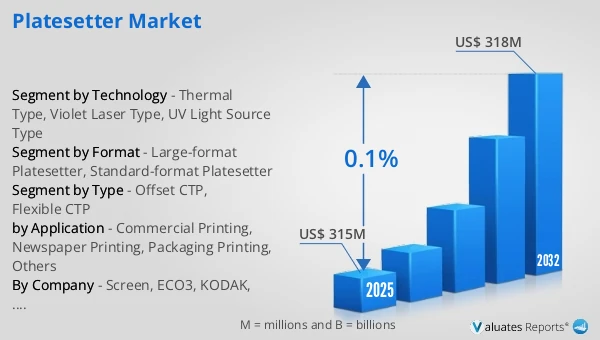
Platesetter Market
The 2025 U.S. tariff policies introduce profound uncertainty into the global economic landscape. This report critically examines the implications of recent tariff adjustments and international strategic countermeasures on Platesetter competitive dynamics, regional economic interdependencies, and supply chain reconfigurations.
Platesetters are computer-to-plate (CTP) imaging machines used in offset printing that write digital page data directly onto printing plates, eliminating the need for film-based plate making. They use a precision optical system—most commonly thermal laser or violet laser—to expose a photosensitive (or processless) coating on aluminum plates, producing the image areas that will accept ink and the non-image areas that repel ink. After exposure, the plate may be processed (developed) or, in “processless” workflows, go straight to press, and the finished plates are then mounted on an offset press for high-volume, consistent printing in commercial print, packaging, and newspaper applications. Many marketplace quotes for Platesetter cluster around ~US$50,000–$150,000.
Upstream of Platesetter is built around a mix of precision opto-electronics and motion-control manufacturing: key inputs include laser/LED light sources (thermal IR, violet, or near-UV), optics and beam modulation components, high-precision drum/flatbed mechanics, servo motors, linear guides, encoders, control electronics, sensors, and industrial PCs, plus the RIP/workflow software that converts prepress files into imaging data; systems integrators combine these with calibration, safety, thermal management, and enclosure design, while critical sub-suppliers include laser diode makers, optics vendors, motion-control/automation suppliers, and software OEMs. Downstream, platesetters sit in the prepress link between design and press: they are purchased and used by commercial printers, packaging converters, and newspaper plants, as well as trade prepress bureaus, and they are tightly coupled to printing plate manufacturers (plate compatibility is a major purchase driver) and to prepress workflow vendors (RIP/DFE, imposition, color management); recurring downstream value comes from installation, training, service contracts, spare parts, periodic laser/head replacement, and upgrades, and in many regions a secondary market exists for refurbished units, relocation services, and parts harvesting.
Platesetter is a mature, replacement-driven segment, but they stay strategically relevant because offset remains the workhorse for many packaging and mid-run commercial jobs, which keeps plate demand resilient even as some legacy print volumes shift elsewhere. The competitive direction is clear: buyers prioritize automation and uptime to cut labor and remake risk, and vendors increasingly sell platesetters as part of an integrated workflow with remote diagnostics and serviceability, not as a standalone box. At the same time, sustainability and operating cost pressure is accelerating the pull toward chemistry-free and lower-chem platemaking workflows, which nudges fleets toward newer thermal systems and compatible plate ecosystems, while price-sensitive markets still consider violet or CTcP where economics and supply chains fit.
This report delivers a comprehensive overview of the global Platesetter market, with both quantitative and qualitative analyses, to help readers develop growth strategies, assess the competitive landscape, evaluate their position in the current market, and make informed business decisions regarding Platesetter. The Platesetter market size, estimates, and forecasts are provided in terms of output/shipments (Units) and revenue (US$ millions), with 2025 as the base year and historical and forecast data for 2021–2032.
The report segments the global Platesetter market comprehensively. Regional market sizes by Technology, by Application, by Type, and by company are also provided. For deeper insight, the report profiles the competitive landscape, key competitors, and their respective market rankings, and discusses technological trends and new product developments.
This report will assist Platesetter manufacturers, new entrants, and companies across the industry value chain with information on revenues, production, and average prices for the overall market and its sub-segments, by company, by Technology, by Application, and by region.
Market Segmentation
Scope of Platesetter Market Report
| Report Metric |
Details |
| Report Name |
Platesetter Market |
| Accounted market size in 2025 |
US$ 315 million |
| Forecasted market size in 2032 |
US$ 318 million |
| CAGR |
0.1% |
| Base Year |
2025 |
| Forecasted years |
2026 - 2032 |
| Segment by Technology |
- Thermal Type
- Violet Laser Type
- UV Light Source Type
|
| Segment by Type |
|
| Segment by Format |
- Large-format Platesetter
- Standard-format Platesetter
|
| by Application |
- Commercial Printing
- Newspaper Printing
- Packaging Printing
- Others
|
| Production by Region |
- North America
- Europe
- China
- Japan
|
| Consumption by Region |
- North America (United States, Canada)
- Europe (Germany, France, UK, Italy, Russia)
- Asia-Pacific (China, Japan, South Korea, Taiwan)
- Southeast Asia (India)
- Latin America (Mexico, Brazil)
|
| By Company |
Screen, ECO3, KODAK, Heidelberg, Fujifilm, Mitsubishi Imaging (MPM), AMSKY Technology, Hangzhou CRON Machinery & Electronics, Beijing Founder Easiprint, ESKO, Presstek, Hangzhou Eastcom Optoelectronic Technology, Shenzhen Yintech, Wuhan Xiangyin Technology |
| Forecast units |
USD million in value |
| Report coverage |
Revenue and volume forecast, company share, competitive landscape, growth factors and trends |
Chapter Outline
- Chapter 1: Defines the scope of the report and presents an executive summary of market segments (by Technology, by Application, by Type, etc.), including the size of each segment and its future growth potential. It offers a high-level view of the current market and its likely evolution in the short, medium, and long term.
- Chapter 2: Provides a detailed analysis of the competitive landscape for Platesetter manufacturers, including prices, production, value-based market shares, latest development plans, and information on mergers and acquisitions.
- Chapter 3: Examines Platesetter production/output and value by region and country, providing a quantitative assessment of market size and growth potential for each region over the next six years.
- Chapter 4: Analyzes Platesetter consumption at the regional and country levels. It quantifies market size and growth potential for each region and its key countries, and outlines market development, outlook, addressable space, and national production.
- Chapter 5: Analyzes market segments by Technology, covering the size and growth potential of each segment to help readers identify “blue ocean” opportunities.
- Chapter 6: Analyzes market segments by Application, covering the size and growth potential of each segment to help readers identify “blue ocean” opportunities in downstream markets.
- Chapter 7: Profiles key players, detailing the fundamentals of major companies, including product production/output, value, price, gross margin, product portfolio/introductions, and recent developments.
- Chapter 8: Reviews the industry value chain, including upstream and downstream segments.
- Chapter 9: Discusses market dynamics and recent developments, including drivers, restraints, challenges and risks for manufacturers, U.S. Tariffs and relevant policy analysis.
- Chapter 10: Summarizes the key findings and conclusions of the report.
FAQ for this report
How fast is Platesetter Market growing?
Ans: The Platesetter Market witnessing a CAGR of 0.1% during the forecast period 2026-2032.
What is the Platesetter Market size in 2032?
Ans: The Platesetter Market size in 2032 will be US$ 318 million.
Who are the main players in the Platesetter Market report?
Ans: The main players in the Platesetter Market are Screen, ECO3, KODAK, Heidelberg, Fujifilm, Mitsubishi Imaging (MPM), AMSKY Technology, Hangzhou CRON Machinery & Electronics, Beijing Founder Easiprint, ESKO, Presstek, Hangzhou Eastcom Optoelectronic Technology, Shenzhen Yintech, Wuhan Xiangyin Technology
What are the Application segmentation covered in the Platesetter Market report?
Ans: The Applications covered in the Platesetter Market report are Commercial Printing, Newspaper Printing, Packaging Printing, Others
What are the Type segmentation covered in the Platesetter Market report?
Ans: The Types covered in the Platesetter Market report are Offset CTP, Flexible CTP