FEATURED COMPANIES
Intercable Automotive Solutions (Aptiv)
Rogers Corporation
Methode Electronics
Suncall
Mersen
EG Electronics
Eaton
ENNOVI
Legrand
Crefact
Jenkent Electric Technology
TB&C
Automotive Busbar Market Size
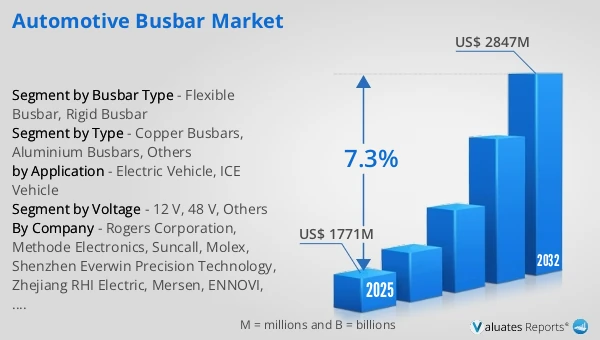
The global Automotive Busbar market was valued at US$ 1771 million in 2025 and is anticipated to reach US$ 2847 million by 2032, at a CAGR of 7.3% from 2026 to 2032.
Automotive Busbar Market
The 2025 U.S. tariff policies introduce profound uncertainty into the global economic landscape. This report critically examines the implications of recent tariff adjustments and international strategic countermeasures on Automotive Busbar competitive dynamics, regional economic interdependencies, and supply chain reconfigurations.
An Automotive Busbar is a rigid or laminated conductive component designed to distribute electrical power efficiently within vehicle electrical and electronic systems. Typically manufactured from copper or aluminum, automotive busbars replace traditional wiring harnesses in high-current and high-voltage applications, offering lower electrical resistance, improved thermal performance, and enhanced reliability. They are widely used in electric vehicles and hybrid vehicles, particularly in battery packs, inverters, power distribution units, and onboard charging systems. As vehicles evolve toward electrification, higher voltage platforms, and centralized electrical architectures, automotive busbars have become a critical enabler for compact design, weight reduction, and safe, efficient power transmission.
In 2025, global Automotive Busbar production reached approximately 10296 k meters, with an average global market price of around US$ 172.03 per meter. And global Automotive Busbar production capacity reached approximately 13000 k meters. The average gross margin in this industry reached 20.65%.
In the upstream supply chain, automotive busbars rely on high-purity copper or aluminum materials, insulation films, and surface treatment chemicals. Representative upstream suppliers include Aurubis for copper materials, Norsk Hydro for lightweight aluminum solutions, and DuPont for insulation and coating materials. The conductivity, mechanical strength, and thermal stability of these inputs directly affect busbar safety and performance. Midstream manufacturers focus on busbar design, stamping or bending, lamination, insulation integration, and automotive-grade validation. Downstream, automotive busbars are supplied to vehicle manufacturers such as Tesla, BYD, and Volkswagen, where they are integrated into battery systems and power electronics. Rapid growth in electric vehicles continues to drive strong downstream demand.
This report delivers a comprehensive overview of the global Automotive Busbar market, with both quantitative and qualitative analyses, to help readers develop growth strategies, assess the competitive landscape, evaluate their position in the current market, and make informed business decisions regarding Automotive Busbar. The Automotive Busbar market size, estimates, and forecasts are provided in terms of output/shipments (K Meter) and revenue (US$ millions), with 2025 as the base year and historical and forecast data for 2021–2032.
The report segments the global Automotive Busbar market comprehensively. Regional market sizes by Type, by Application, by Busbar Type, and by company are also provided. For deeper insight, the report profiles the competitive landscape, key competitors, and their respective market rankings, and discusses technological trends and new product developments.
This report will assist Automotive Busbar manufacturers, new entrants, and companies across the industry value chain with information on revenues, production, and average prices for the overall market and its sub-segments, by company, by Type, by Application, and by region.
Market Segmentation
Scope of Automotive Busbar Market Report
| Report Metric |
Details |
| Report Name |
Automotive Busbar Market |
| Accounted market size in 2025 |
US$ 1771 million |
| Forecasted market size in 2032 |
US$ 2847 million |
| CAGR |
7.3% |
| Base Year |
2025 |
| Forecasted years |
2026 - 2032 |
| Segment by Type |
- Copper Busbars
- Aluminium Busbars
- Others
|
| Segment by Busbar Type |
- Flexible Busbar
- Rigid Busbar
|
| Segment by Voltage |
|
| by Application |
- Electric Vehicle
- ICE Vehicle
|
| Production by Region |
- North America
- Europe
- China
- Japan
|
| Consumption by Region |
- North America (United States, Canada)
- Europe (Germany, France, UK, Italy, Russia)
- Asia-Pacific (China, Japan, South Korea, Taiwan)
- Southeast Asia (India)
- Latin America (Mexico, Brazil)
|
| By Company |
Rogers Corporation, Methode Electronics, Suncall, Molex, Shenzhen Everwin Precision Technology, Zhejiang RHI Electric, Mersen, ENNOVI, EG Electronics, TB&C, Eaton, Oriental Copper, Luvata, EMS Industrial & Service Company, Legrand, Connor Manufacturing, Crefact, Jenkent Electric Technology, Intercable Automotive Solutions (Aptiv) |
| Forecast units |
USD million in value |
| Report coverage |
Revenue and volume forecast, company share, competitive landscape, growth factors and trends |
Chapter Outline
- Chapter 1: Defines the scope of the report and presents an executive summary of market segments (by Type, by Application, by Busbar Type, etc.), including the size of each segment and its future growth potential. It offers a high-level view of the current market and its likely evolution in the short, medium, and long term.
- Chapter 2: Provides a detailed analysis of the competitive landscape for Automotive Busbar manufacturers, including prices, production, value-based market shares, latest development plans, and information on mergers and acquisitions.
- Chapter 3: Examines Automotive Busbar production/output and value by region and country, providing a quantitative assessment of market size and growth potential for each region over the next six years.
- Chapter 4: Analyzes Automotive Busbar consumption at the regional and country levels. It quantifies market size and growth potential for each region and its key countries, and outlines market development, outlook, addressable space, and national production.
- Chapter 5: Analyzes market segments by Type, covering the size and growth potential of each segment to help readers identify “blue ocean” opportunities.
- Chapter 6: Analyzes market segments by Application, covering the size and growth potential of each segment to help readers identify “blue ocean” opportunities in downstream markets.
- Chapter 7: Profiles key players, detailing the fundamentals of major companies, including product production/output, value, price, gross margin, product portfolio/introductions, and recent developments.
- Chapter 8: Reviews the industry value chain, including upstream and downstream segments.
- Chapter 9: Discusses market dynamics and recent developments, including drivers, restraints, challenges and risks for manufacturers, U.S. Tariffs and relevant policy analysis.
- Chapter 10: Summarizes the key findings and conclusions of the report.
FAQ for this report
How fast is Automotive Busbar Market growing?
Ans: The Automotive Busbar Market witnessing a CAGR of 7.3% during the forecast period 2026-2032.
What is the Automotive Busbar Market size in 2032?
Ans: The Automotive Busbar Market size in 2032 will be US$ 2847 million.
Who are the main players in the Automotive Busbar Market report?
Ans: The main players in the Automotive Busbar Market are Rogers Corporation, Methode Electronics, Suncall, Molex, Shenzhen Everwin Precision Technology, Zhejiang RHI Electric, Mersen, ENNOVI, EG Electronics, TB&C, Eaton, Oriental Copper, Luvata, EMS Industrial & Service Company, Legrand, Connor Manufacturing, Crefact, Jenkent Electric Technology, Intercable Automotive Solutions (Aptiv)
What are the Application segmentation covered in the Automotive Busbar Market report?
Ans: The Applications covered in the Automotive Busbar Market report are Electric Vehicle, ICE Vehicle
What are the Type segmentation covered in the Automotive Busbar Market report?
Ans: The Types covered in the Automotive Busbar Market report are Flexible Busbar, Rigid Busbar