0
U.S. (TOLL FREE)
+1 (315) 215-3225
Automative

0
U.S. (TOLL FREE)
+1 (315) 215-3225
Global Infertility Drugs Market Research Report 2026
Published Date: 2026-03-04
|
Report Code: QYRE-Auto-490
Home | Market Reports
Global Infertility Drugs Market Size Status and Forecast 2021 2027
BUY CHAPTERS

Global Infertility Drugs Market Research Report 2026

Code: QYRE-Auto-490
Report
2026-03-04
Pages:105
QYResearch
Buy Now with 15% Discount
DESCRIPTION
TABLE OF CONTENT
TABLES & FIGURES

Infertility Drugs Market Size

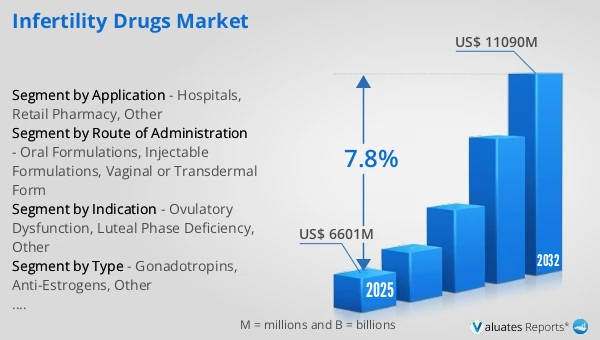
The global Infertility Drugs market was valued at US$ 6601 million in 2025 and is anticipated to reach US$ 11090 million by 2032, at a CAGR of 7.8% from 2026 to 2032.

Infertility Drugs Market

Infertility Drugs Market

Infertility drugs refer to therapeutic agents designed to treat reproductive dysfunctions in both men and women by restoring fertility or enhancing the success of assisted reproductive technologies (ART). These drugs act through various mechanisms such as regulating the hypothalamic–pituitary–gonadal axis, stimulating ovulation or spermatogenesis, improving ovarian and testicular functions, and supporting luteal phase or embryo implantation. The category encompasses gonadotropins, ovulation inducers, anti-estrogen drugs, progestogens, GnRH modulators, testosterone supplements, and emerging molecular-targeted therapies. Widely used in treating ovulatory disorders, male factor infertility, endocrine imbalances, and IVF protocols, infertility drugs have become integral to modern fertility management. With advancements in reproductive medicine and precision therapeutics, these drugs are driving improvements in global fertility rates and the evolution of reproductive healthcare systems.The average gross profit margin of this product is 55%.
The growth of the infertility drug market is primarily driven by demographic shifts and the rising demand for fertility management. Global trends toward delayed marriage and childbirth, increasing environmental stressors, and the prevalence of obesity and metabolic disorders have led to a higher incidence of infertility. The rapid expansion of assisted reproductive technologies (ART) has widened the clinical application of ovulation inducers, luteal support agents, and spermatogenesis stimulators. The adoption of precision medicine and genetic testing has enabled more individualized treatment approaches, fostering innovation in hormonal and targeted therapies. In addition, favorable government policies and broader insurance coverage for reproductive health services are strengthening the long-term market foundation. The infertility drug industry faces several notable challenges, including variable therapeutic efficacy, long treatment durations, and potential adverse effects. Some drugs carry risks such as ovarian hyperstimulation syndrome (OHSS), multiple pregnancies, or hormonal imbalances, which may reduce patient adherence. Moreover, lengthy and costly R&D processes, coupled with heterogeneous regulatory and ethical standards across regions, hinder the global rollout of innovative therapies. The market is characterized by high concentration, with multinational pharmaceutical firms dominating the premium segment, creating barriers for new entrants in both technology and distribution. Additionally, social stigma and privacy concerns surrounding infertility continue to restrain patient engagement and treatment adoption.
Downstream demand for infertility drugs is becoming increasingly diversified and sophisticated. With declining fertility rates and growing awareness of reproductive health, these drugs are now used not only for ovulation or spermatogenesis induction but also as integral components of IVF cycle management, hormonal balance maintenance, and pregnancy support therapies. Female patients are showing greater preference for recombinant hormones and individualized endocrine therapies, while male patients increasingly adopt testosterone supplements and spermatogenic agents. The expansion of telemedicine and online prescription platforms has improved drug accessibility, while fertility clinics and IVF centers remain the dominant end-use settings.
The upstream supply chain for infertility drugs consists primarily of hormonal raw materials, recombinant proteins, chemical intermediates, and pharmaceutical excipients. Gonadotropin-based therapies rely on high-purity recombinant proteins produced via mammalian cell expression systems, which require sophisticated processes and entail high production costs. Synthetic small-molecule agents, such as clomiphene and letrozole, depend heavily on steroidal intermediates, making them sensitive to fluctuations in raw material prices and environmental regulations. As biopharmaceutical manufacturing advances, recombinant FSH and LH production efficiency and purification consistency have improved significantly. Moreover, the global active pharmaceutical ingredient (API) industry is shifting toward Asia, with China and India emerging as key suppliers of hormonal and intermediate materials, enhancing upstream integration and cost competitiveness.
This report delivers a comprehensive overview of the global Infertility Drugs market, with both quantitative and qualitative analyses, to help readers develop growth strategies, assess the competitive landscape, evaluate their position in the current market, and make informed business decisions regarding Infertility Drugs. The Infertility Drugs market size, estimates, and forecasts are provided in terms of revenue (US$ millions), with 2025 as the base year and historical and forecast data for 2021–2032.
The report segments the global Infertility Drugs market comprehensively. Regional market sizes by Type, by Application, by Indication, and by player are also provided. For deeper insight, the report profiles the competitive landscape, key competitors, and their respective market rankings, and discusses technological trends and new product developments.
This report will assist Infertility Drugs manufacturers, new entrants, and companies across the industry value chain with information on revenues, sales volume, and average prices for the overall market and its sub-segments, by company, by Type, by Application, and by region.
Market Segmentation

Scope of Infertility Drugs Market Report

Report Metric Details
Report Name Infertility Drugs Market
Accounted market size in 2025 US$ 6601 million
Forecasted market size in 2032 US$ 11090 million
CAGR 7.8%
Base Year 2025
Forecasted years 2026 - 2032
Segment by Type
  • Gonadotropins
  • Anti-Estrogens
  • Other
Segment by Indication
  • Ovulatory Dysfunction
  • Luteal Phase Deficiency
  • Other
Segment by Route of Administration
  • Oral Formulations
  • Injectable Formulations
  • Vaginal or Transdermal Form
Segment by Application
  • Hospitals
  • Retail Pharmacy
  • Other
By Region
  • North America (United States, Canada)
  • Europe (Germany, France, UK, Italy, Russia) Rest of Europe
  • Nordic Countries
  • Asia-Pacific (China, Japan, South Korea)
  • Southeast Asia (India, Australia)
  • Rest of Asia
  • Latin America (Mexico, Brazil)
  • Rest of Latin America
  • Middle East & Africa (Turkey, Saudi Arabia, UAE, Rest of MEA)
By Company Merck, Ferring, MSD, LIVZON, Abbott, Bayer Zydus Pharma
Forecast units USD million in value
Report coverage Revenue and volume forecast, company share, competitive landscape, growth factors and trends

Chapter Outline

  • Chapter 1: Defines the scope of the report and presents an executive summary of market segments (by Type, by Application, by Indication, etc.), including the size of each segment and its future growth potential. It offers a high-level view of the current market and its likely evolution in the short, medium, and long term.
  • Chapter 2: Summarizes global and regional market size and outlines market dynamics and recent developments, including key drivers, restraints, challenges and risks for industry participants, and relevant policy analysis.
  • Chapter 3: Provides a detailed view of the competitive landscape for Infertility Drugs companies, covering revenue share, development plans, and mergers and acquisitions.
  • Chapter 4: Analyzes segments by Type, detailing the size and growth potential of each segment to help readers identify blue-ocean opportunities.
  • Chapter 5: Analyzes segments by Application, detailing the size and growth potential of each downstream segment to help readers identify blue-ocean opportunities.
  • Chapter 6–10: Regional deep dives (North America, Europe, Asia Pacific, Latin America, Middle East & Africa) broken down by country. Each chapter quantifies market size and growth potential by region and key countries, and outlines market development, outlook, addressable space, and capacity.
  • Chapter 11: Profiles key players, presenting essential information on leading companies, including product/ service offerings, revenue, gross margin, product introductions/portfolios, recent developments, etc.
  • Chapter 12: Key findings and conclusions of the report.

FAQ for this report

How fast is Infertility Drugs Market growing?

Ans: The Infertility Drugs Market witnessing a CAGR of 7.8% during the forecast period 2026-2032.

What is the Infertility Drugs Market size in 2032?

Ans: The Infertility Drugs Market size in 2032 will be US$ 11090 million.

Who are the main players in the Infertility Drugs Market report?

Ans: The main players in the Infertility Drugs Market are Merck, Ferring, MSD, LIVZON, Abbott, Bayer Zydus Pharma

What are the Application segmentation covered in the Infertility Drugs Market report?

Ans: The Applications covered in the Infertility Drugs Market report are Hospitals, Retail Pharmacy, Other

What are the Type segmentation covered in the Infertility Drugs Market report?

Ans: The Types covered in the Infertility Drugs Market report are Gonadotropins, Anti-Estrogens, Other

1 Report Overview
1.1 Study Scope
1.2 Market Analysis by Type
1.2.1 Global Infertility Drugs Market Size Growth Rate by Type: 2021 vs 2025 vs 2032
1.2.2 Gonadotropins
1.2.3 Anti-Estrogens
1.2.4 Other
1.3 Market by Indication
1.3.1 Global Infertility Drugs Market Size Growth Rate by Indication: 2021 vs 2025 vs 2032
1.3.2 Ovulatory Dysfunction
1.3.3 Luteal Phase Deficiency
1.3.4 Other
1.4 Market by Route of Administration
1.4.1 Global Infertility Drugs Market Size Growth Rate by Route of Administration: 2021 vs 2025 vs 2032
1.4.2 Oral Formulations
1.4.3 Injectable Formulations
1.4.4 Vaginal or Transdermal Form
1.5 Market by Application
1.5.1 Global Infertility Drugs Market Growth by Application: 2021 vs 2025 vs 2032
1.5.2 Hospitals
1.5.3 Retail Pharmacy
1.5.4 Other
1.6 Assumptions and Limitations
1.7 Study Objectives
1.8 Years Considered
2 Global Growth Trends
2.1 Global Infertility Drugs Market Perspective (2021–2032)
2.2 Global Infertility Drugs Growth Trends by Region
2.2.1 Global Infertility Drugs Market Size by Region: 2021 vs 2025 vs 2032
2.2.2 Infertility Drugs Historic Market Size by Region (2021–2026)
2.2.3 Infertility Drugs Forecasted Market Size by Region (2027–2032)
2.3 Infertility Drugs Market Dynamics
2.3.1 Infertility Drugs Industry Trends
2.3.2 Infertility Drugs Market Drivers
2.3.3 Infertility Drugs Market Challenges
2.3.4 Infertility Drugs Market Restraints
3 Competition Landscape by Key Players
3.1 Global Top Infertility Drugs Players by Revenue
3.1.1 Global Top Infertility Drugs Players by Revenue (2021–2026)
3.1.2 Global Infertility Drugs Revenue Market Share by Players (2021–2026)
3.2 Global Top Infertility Drugs Players Market Share by Company Tier (Tier 1, Tier 2, Tier 3)
3.3 Global Key Players Ranking by Infertility Drugs Revenue
3.4 Global Infertility Drugs Market Concentration Ratio
3.4.1 Global Infertility Drugs Market Concentration Ratio (CR5 and HHI)
3.4.2 Global Top 10 and Top 5 Companies by Infertility Drugs Revenue in 2025
3.5 Global Key Players of Infertility Drugs Head Offices and Areas Served
3.6 Global Key Players of Infertility Drugs, Products and Applications
3.7 Global Key Players of Infertility Drugs, Date of General Availability (GA)
3.8 Mergers and Acquisitions, Expansion Plans
4 Infertility Drugs Breakdown Data by Type
4.1 Global Infertility Drugs Historic Market Size by Type (2021–2026)
4.2 Global Infertility Drugs Forecasted Market Size by Type (2027–2032)
5 Infertility Drugs Breakdown Data by Application
5.1 Global Infertility Drugs Historic Market Size by Application (2021–2026)
5.2 Global Infertility Drugs Forecasted Market Size by Application (2027–2032)
6 North America
6.1 North America Infertility Drugs Market Size (2021–2032)
6.2 North America Infertility Drugs Market Growth Rate by Country: 2021 vs 2025 vs 2032
6.3 North America Infertility Drugs Market Size by Country (2021–2026)
6.4 North America Infertility Drugs Market Size by Country (2027–2032)
6.5 United States
6.6 Canada
7 Europe
7.1 Europe Infertility Drugs Market Size (2021–2032)
7.2 Europe Infertility Drugs Market Growth Rate by Country: 2021 vs 2025 vs 2032
7.3 Europe Infertility Drugs Market Size by Country (2021–2026)
7.4 Europe Infertility Drugs Market Size by Country (2027–2032)
7.5 Germany
7.6 France
7.7 U.K.
7.8 Italy
7.9 Russia
7.10 Ireland
8 Asia-Pacific
8.1 Asia-Pacific Infertility Drugs Market Size (2021–2032)
8.2 Asia-Pacific Infertility Drugs Market Growth Rate by Region: 2021 vs 2025 vs 2032
8.3 Asia-Pacific Infertility Drugs Market Size by Region (2021–2026)
8.4 Asia-Pacific Infertility Drugs Market Size by Region (2027–2032)
8.5 China
8.6 Japan
8.7 South Korea
8.8 Southeast Asia
8.9 India
8.10 Australia & New Zealand
9 Latin America
9.1 Latin America Infertility Drugs Market Size (2021–2032)
9.2 Latin America Infertility Drugs Market Growth Rate by Country: 2021 vs 2025 vs 2032
9.3 Latin America Infertility Drugs Market Size by Country (2021–2026)
9.4 Latin America Infertility Drugs Market Size by Country (2027–2032)
9.5 Mexico
9.6 Brazil
10 Middle East & Africa
10.1 Middle East & Africa Infertility Drugs Market Size (2021–2032)
10.2 Middle East & Africa Infertility Drugs Market Growth Rate by Country: 2021 vs 2025 vs 2032
10.3 Middle East & Africa Infertility Drugs Market Size by Country (2021–2026)
10.4 Middle East & Africa Infertility Drugs Market Size by Country (2027–2032)
10.5 Israel
10.6 Saudi Arabia
10.7 UAE
11 Key Players Profiles
11.1 Merck
11.1.1 Merck Company Details
11.1.2 Merck Business Overview
11.1.3 Merck Infertility Drugs Introduction
11.1.4 Merck Revenue in Infertility Drugs Business (2021–2026)
11.1.5 Merck Recent Development
11.2 Ferring
11.2.1 Ferring Company Details
11.2.2 Ferring Business Overview
11.2.3 Ferring Infertility Drugs Introduction
11.2.4 Ferring Revenue in Infertility Drugs Business (2021–2026)
11.2.5 Ferring Recent Development
11.3 MSD
11.3.1 MSD Company Details
11.3.2 MSD Business Overview
11.3.3 MSD Infertility Drugs Introduction
11.3.4 MSD Revenue in Infertility Drugs Business (2021–2026)
11.3.5 MSD Recent Development
11.4 LIVZON
11.4.1 LIVZON Company Details
11.4.2 LIVZON Business Overview
11.4.3 LIVZON Infertility Drugs Introduction
11.4.4 LIVZON Revenue in Infertility Drugs Business (2021–2026)
11.4.5 LIVZON Recent Development
11.5 Abbott
11.5.1 Abbott Company Details
11.5.2 Abbott Business Overview
11.5.3 Abbott Infertility Drugs Introduction
11.5.4 Abbott Revenue in Infertility Drugs Business (2021–2026)
11.5.5 Abbott Recent Development
11.6 Bayer Zydus Pharma
11.6.1 Bayer Zydus Pharma Company Details
11.6.2 Bayer Zydus Pharma Business Overview
11.6.3 Bayer Zydus Pharma Infertility Drugs Introduction
11.6.4 Bayer Zydus Pharma Revenue in Infertility Drugs Business (2021–2026)
11.6.5 Bayer Zydus Pharma Recent Development
12 Analyst's Viewpoints/Conclusions
13 Appendix
13.1 Research Methodology
13.1.1 Methodology/Research Approach
13.1.1.1 Research Programs/Design
13.1.1.2 Market Size Estimation
13.1.1.3 Market Breakdown and Data Triangulation
13.1.2 Data Source
13.1.2.1 Secondary Sources
13.1.2.2 Primary Sources
13.2 Author Details
13.3 Disclaimer
List of Tables
 Table 1. Global Infertility Drugs Market Size Growth Rate by Type (US$ Million): 2021 vs 2025 vs 2032
 Table 2. Key Players of Gonadotropins
 Table 3. Key Players of Anti-Estrogens
 Table 4. Key Players of Other
 Table 5. Global Infertility Drugs Market Size Growth Rate by Indication (US$ Million): 2021 vs 2025 vs 2032
 Table 6. Key Players of Ovulatory Dysfunction
 Table 7. Key Players of Luteal Phase Deficiency
 Table 8. Key Players of Other
 Table 9. Global Infertility Drugs Market Size Growth Rate by Route of Administration (US$ Million): 2021 vs 2025 vs 2032
 Table 10. Key Players of Oral Formulations
 Table 11. Key Players of Injectable Formulations
 Table 12. Key Players of Vaginal or Transdermal Form
 Table 13. Global Infertility Drugs Market Size Growth by Application (US$ Million): 2021 vs 2025 vs 2032
 Table 14. Global Infertility Drugs Market Size by Region (US$ Million): 2021 vs 2025 vs 2032
 Table 15. Global Infertility Drugs Market Size by Region (US$ Million), 2021–2026
 Table 16. Global Infertility Drugs Market Share by Region (2021–2026)
 Table 17. Global Infertility Drugs Forecasted Market Size by Region (US$ Million), 2027–2032
 Table 18. Global Infertility Drugs Market Share by Region (2027–2032)
 Table 19. Infertility Drugs Market Trends
 Table 20. Infertility Drugs Market Drivers
 Table 21. Infertility Drugs Market Challenges
 Table 22. Infertility Drugs Market Restraints
 Table 23. Global Infertility Drugs Revenue by Players (US$ Million), 2021–2026
 Table 24. Global Infertility Drugs Market Share by Players (2021–2026)
 Table 25. Global Top Infertility Drugs Players by Tier (Tier 1, Tier 2, and Tier 3), based on Infertility Drugs Revenue, 2025
 Table 26. Ranking of Global Top Infertility Drugs Companies by Revenue (US$ Million) in 2025
 Table 27. Global 5 Largest Players Market Share by Infertility Drugs Revenue (CR5 and HHI), 2021–2026
 Table 28. Global Key Players of Infertility Drugs, Headquarters and Area Served
 Table 29. Global Key Players of Infertility Drugs, Products and Applications
 Table 30. Global Key Players of Infertility Drugs, Date of General Availability (GA)
 Table 31. Mergers and Acquisitions, Expansion Plans
 Table 32. Global Infertility Drugs Market Size by Type (US$ Million), 2021–2026
 Table 33. Global Infertility Drugs Revenue Market Share by Type (2021–2026)
 Table 34. Global Infertility Drugs Forecasted Market Size by Type (US$ Million), 2027–2032
 Table 35. Global Infertility Drugs Revenue Market Share by Type (2027–2032)
 Table 36. Global Infertility Drugs Market Size by Application (US$ Million), 2021–2026
 Table 37. Global Infertility Drugs Revenue Market Share by Application (2021–2026)
 Table 38. Global Infertility Drugs Forecasted Market Size by Application (US$ Million), 2027–2032
 Table 39. Global Infertility Drugs Revenue Market Share by Application (2027–2032)
 Table 40. North America Infertility Drugs Market Size Growth Rate by Country (US$ Million): 2021 vs 2025 vs 2032
 Table 41. North America Infertility Drugs Market Size by Country (US$ Million), 2021–2026
 Table 42. North America Infertility Drugs Market Size by Country (US$ Million), 2027–2032
 Table 43. Europe Infertility Drugs Market Size Growth Rate by Country (US$ Million): 2021 vs 2025 vs 2032
 Table 44. Europe Infertility Drugs Market Size by Country (US$ Million), 2021–2026
 Table 45. Europe Infertility Drugs Market Size by Country (US$ Million), 2027–2032
 Table 46. Asia-Pacific Infertility Drugs Market Size Growth Rate by Region (US$ Million): 2021 vs 2025 vs 2032
 Table 47. Asia-Pacific Infertility Drugs Market Size by Region (US$ Million), 2021–2026
 Table 48. Asia-Pacific Infertility Drugs Market Size by Region (US$ Million), 2027–2032
 Table 49. Latin America Infertility Drugs Market Size Growth Rate by Country (US$ Million): 2021 vs 2025 vs 2032
 Table 50. Latin America Infertility Drugs Market Size by Country (US$ Million), 2021–2026
 Table 51. Latin America Infertility Drugs Market Size by Country (US$ Million), 2027–2032
 Table 52. Middle East & Africa Infertility Drugs Market Size Growth Rate by Country (US$ Million): 2021 vs 2025 vs 2032
 Table 53. Middle East & Africa Infertility Drugs Market Size by Country (US$ Million), 2021–2026
 Table 54. Middle East & Africa Infertility Drugs Market Size by Country (US$ Million), 2027–2032
 Table 55. Merck Company Details
 Table 56. Merck Business Overview
 Table 57. Merck Infertility Drugs Product
 Table 58. Merck Revenue in Infertility Drugs Business (US$ Million), 2021–2026
 Table 59. Merck Recent Development
 Table 60. Ferring Company Details
 Table 61. Ferring Business Overview
 Table 62. Ferring Infertility Drugs Product
 Table 63. Ferring Revenue in Infertility Drugs Business (US$ Million), 2021–2026
 Table 64. Ferring Recent Development
 Table 65. MSD Company Details
 Table 66. MSD Business Overview
 Table 67. MSD Infertility Drugs Product
 Table 68. MSD Revenue in Infertility Drugs Business (US$ Million), 2021–2026
 Table 69. MSD Recent Development
 Table 70. LIVZON Company Details
 Table 71. LIVZON Business Overview
 Table 72. LIVZON Infertility Drugs Product
 Table 73. LIVZON Revenue in Infertility Drugs Business (US$ Million), 2021–2026
 Table 74. LIVZON Recent Development
 Table 75. Abbott Company Details
 Table 76. Abbott Business Overview
 Table 77. Abbott Infertility Drugs Product
 Table 78. Abbott Revenue in Infertility Drugs Business (US$ Million), 2021–2026
 Table 79. Abbott Recent Development
 Table 80. Bayer Zydus Pharma Company Details
 Table 81. Bayer Zydus Pharma Business Overview
 Table 82. Bayer Zydus Pharma Infertility Drugs Product
 Table 83. Bayer Zydus Pharma Revenue in Infertility Drugs Business (US$ Million), 2021–2026
 Table 84. Bayer Zydus Pharma Recent Development
 Table 85. Research Programs/Design for This Report
 Table 86. Key Data Information from Secondary Sources
 Table 87. Key Data Information from Primary Sources
 Table 88. Authors List of This Report


List of Figures
 Figure 1. Infertility Drugs Picture
 Figure 2. Global Infertility Drugs Market Size Comparison by Type (US$ Million), 2021–2032
 Figure 3. Global Infertility Drugs Market Share by Type: 2025 vs 2032
 Figure 4. Gonadotropins Features
 Figure 5. Anti-Estrogens Features
 Figure 6. Other Features
 Figure 7. Global Infertility Drugs Market Size Comparison by Indication (US$ Million), 2021–2032
 Figure 8. Ovulatory Dysfunction Features
 Figure 9. Luteal Phase Deficiency Features
 Figure 10. Other Features
 Figure 11. Global Infertility Drugs Market Size Comparison by Route of Administration (US$ Million), 2021–2032
 Figure 12. Oral Formulations Features
 Figure 13. Injectable Formulations Features
 Figure 14. Vaginal or Transdermal Form Features
 Figure 15. Global Infertility Drugs Market Size by Application (US$ Million), 2021–2032
 Figure 16. Global Infertility Drugs Market Share by Application: 2025 vs 2032
 Figure 17. Hospitals Case Studies
 Figure 18. Retail Pharmacy Case Studies
 Figure 19. Other Case Studies
 Figure 20. Infertility Drugs Report Years Considered
 Figure 21. Global Infertility Drugs Market Size (US$ Million), Year-over-Year: 2021–2032
 Figure 22. Global Infertility Drugs Market Size, (US$ Million), 2021 vs 2025 vs 2032
 Figure 23. Global Infertility Drugs Market Share by Region: 2025 vs 2032
 Figure 24. Global Infertility Drugs Market Share by Players in 2025
 Figure 25. Global Infertility Drugs Market Share by Company Type (Tier 1, Tier 2, and Tier 3)
 Figure 26. The Top 10 and 5 Players Market Share by Infertility Drugs Revenue in 2025
 Figure 27. North America Infertility Drugs Market Size YoY Growth (US$ Million), 2021–2032
 Figure 28. North America Infertility Drugs Market Share by Country (2021–2032)
 Figure 29. United States Infertility Drugs Market Size YoY Growth (US$ Million), 2021–2032
 Figure 30. Canada Infertility Drugs Market Size YoY Growth (US$ Million), 2021–2032
 Figure 31. Europe Infertility Drugs Market Size YoY Growth (US$ Million), 2021–2032
 Figure 32. Europe Infertility Drugs Market Share by Country (2021–2032)
 Figure 33. Germany Infertility Drugs Market Size YoY Growth (US$ Million), 2021–2032
 Figure 34. France Infertility Drugs Market Size YoY Growth (US$ Million), 2021–2032
 Figure 35. U.K. Infertility Drugs Market Size YoY Growth (US$ Million), 2021–2032
 Figure 36. Italy Infertility Drugs Market Size YoY Growth (US$ Million), 2021–2032
 Figure 37. Russia Infertility Drugs Market Size YoY Growth (US$ Million), 2021–2032
 Figure 38. Ireland Infertility Drugs Market Size YoY Growth (US$ Million), 2021–2032
 Figure 39. Asia-Pacific Infertility Drugs Market Size YoY Growth (US$ Million), 2021–2032
 Figure 40. Asia-Pacific Infertility Drugs Market Share by Region (2021–2032)
 Figure 41. China Infertility Drugs Market Size YoY Growth (US$ Million), 2021–2032
 Figure 42. Japan Infertility Drugs Market Size YoY Growth (US$ Million), 2021–2032
 Figure 43. South Korea Infertility Drugs Market Size YoY Growth (US$ Million), 2021–2032
 Figure 44. Southeast Asia Infertility Drugs Market Size YoY Growth (US$ Million), 2021–2032
 Figure 45. India Infertility Drugs Market Size YoY Growth (US$ Million), 2021–2032
 Figure 46. Australia & New Zealand Infertility Drugs Market Size YoY Growth (US$ Million), 2021–2032
 Figure 47. Latin America Infertility Drugs Market Size YoY Growth (US$ Million), 2021–2032
 Figure 48. Latin America Infertility Drugs Market Share by Country (2021–2032)
 Figure 49. Mexico Infertility Drugs Market Size YoY Growth (US$ Million), 2021–2032
 Figure 50. Brazil Infertility Drugs Market Size YoY Growth (US$ Million), 2021–2032
 Figure 51. Middle East & Africa Infertility Drugs Market Size YoY Growth (US$ Million), 2021–2032
 Figure 52. Middle East & Africa Infertility Drugs Market Share by Country (2021–2032)
 Figure 53. Israel Infertility Drugs Market Size YoY Growth (US$ Million), 2021–2032
 Figure 54. Saudi Arabia Infertility Drugs Market Size YoY Growth (US$ Million), 2021–2032
 Figure 55. UAE Infertility Drugs Market Size YoY Growth (US$ Million), 2021–2032
 Figure 56. Merck Revenue Growth Rate in Infertility Drugs Business (2021–2026)
 Figure 57. Ferring Revenue Growth Rate in Infertility Drugs Business (2021–2026)
 Figure 58. MSD Revenue Growth Rate in Infertility Drugs Business (2021–2026)
 Figure 59. LIVZON Revenue Growth Rate in Infertility Drugs Business (2021–2026)
 Figure 60. Abbott Revenue Growth Rate in Infertility Drugs Business (2021–2026)
 Figure 61. Bayer Zydus Pharma Revenue Growth Rate in Infertility Drugs Business (2021–2026)
 Figure 62. Bottom-up and Top-down Approaches for This Report
 Figure 63. Data Triangulation
 Figure 64. Key Executives Interviewed

SELECT A FORMAT
Added to Cart
Electronic

$2900

Single User License
Electronic

$4350

Multi User License
Electronic

$5800

Enterprise License
Add to Cart
Buy Now (15% Discount)

OUR CUSTOMER

Samsung SD

SIMILAR REPORTS