Ans: The and India Chlorantraniliprole Market size in 2029 will be US$ 2443 million.

The global Chlorantraniliprole revenue was US$ 1800.8 million in 2022 and is forecast to a readjusted size of US$ 2443 million by 2029 with a CAGR of 4.4% during the forecast period (2023-2029).
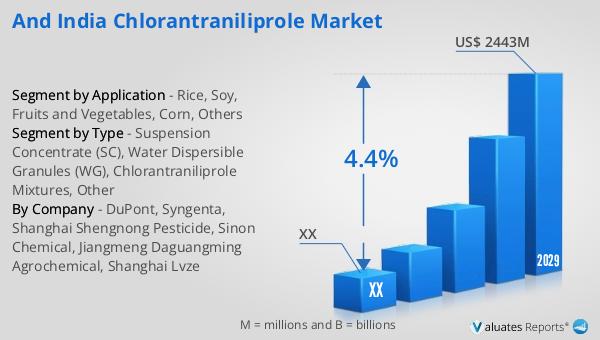
The global and India Chlorantraniliprole market is experiencing significant growth driven by the increasing demand for effective and sustainable pest control solutions in agriculture. Chlorantraniliprole is a highly selective and broad-spectrum insecticide belonging to the anthranilic diamide class, widely used for controlling lepidopteran pests in various crops such as cotton, corn, and vegetables. The rising agricultural productivity and the need to protect crops from yield-detrimental pests are major factors propelling the demand for Chlorantraniliprole. Additionally, its favorable safety profile, low toxicity to non-target organisms, and minimal environmental persistence make it an attractive choice for farmers seeking eco-friendly pest management options. Government initiatives promoting integrated pest management (IPM) practices and the adoption of advanced agricultural technologies further support the market growth by encouraging the use of effective and sustainable insecticides like Chlorantraniliprole.
A prominent trend in the global and India Chlorantraniliprole market is the increasing adoption of biopesticides and eco-friendly pest control methods in conjunction with chemical insecticides. Farmers are seeking integrated pest management strategies that combine biological controls, such as beneficial insects and microbial agents, with chemical solutions like Chlorantraniliprole to achieve effective and sustainable pest suppression. This trend is driven by the growing awareness of environmental conservation, the need to reduce chemical residues on food products, and the rising regulatory pressures to minimize the use of harmful pesticides. Manufacturers are responding by developing Chlorantraniliprole formulations that are compatible with biopesticides, enhancing their effectiveness and promoting sustainable agricultural practices.
Another emerging trend is the advancement in formulation technologies aimed at enhancing the efficacy and application convenience of Chlorantraniliprole. Innovations such as controlled-release formulations, emulsifiable concentrates, and suspension concentrates are improving the delivery and performance of Chlorantraniliprole in various environmental conditions. These advanced formulations offer better coverage, longer residual activity, and reduced application frequency, making pest control more efficient and cost-effective for farmers. Additionally, the development of tank-mix formulations that combine Chlorantraniliprole with other active ingredients is gaining traction, providing synergistic effects and broad-spectrum pest control capabilities to address multiple pest challenges simultaneously.
Furthermore, there is a growing emphasis on precision agriculture and the use of digital technologies to optimize the application of Chlorantraniliprole. The integration of GPS-guided equipment, drone-based spraying, and data analytics in agricultural practices is enabling more precise and targeted application of insecticides, reducing wastage and minimizing environmental impact. This trend is particularly significant in regions like India, where large-scale farming operations are increasingly adopting smart farming techniques to enhance productivity and sustainability. Manufacturers are investing in research and development to create formulations that are compatible with precision application technologies, ensuring optimal performance and efficiency in modern agricultural systems.
The global and India Chlorantraniliprole market is highly competitive, with a mix of established agrochemical companies and specialized pesticide manufacturers holding significant market shares. Leading players such as Bayer CropScience, Syngenta, BASF SE, and FMC Corporation dominate the market through extensive product portfolios, advanced research and development capabilities, and strong distribution networks. These companies leverage their expertise in agrochemical innovation to offer high-quality Chlorantraniliprole products that meet the diverse needs of farmers across different crops and regions.
In addition to major players, numerous small and medium-sized enterprises (SMEs) are gaining traction in the Chlorantraniliprole market by focusing on niche segments, such as organic farming or specialty crops, catering to specific agricultural needs and enhancing market diversity. These SMEs often emphasize formulation customization, responsive customer service, and localized marketing strategies to differentiate themselves in the competitive landscape. Furthermore, the rise of contract manufacturing organizations (CMOs) and local agrochemical suppliers is contributing to market growth, as farmers seek reliable and accessible Chlorantraniliprole solutions through outsourced partnerships.
The Asia-Pacific region, particularly India and China, holds a dominant position in the global Chlorantraniliprole market, driven by the high demand for effective pest control solutions in the region's diverse and expansive agricultural sector. The region benefits from a large and growing population, increasing food demand, and the presence of extensive farming communities that rely on efficient pest management to ensure crop yields and food security. North America and Europe also play crucial roles, supported by advanced agricultural practices, high adoption rates of integrated pest management (IPM), and substantial investments in agrochemical research and development.
The Middle East and Africa are emerging markets, with rising investments in agricultural infrastructure, increasing adoption of modern farming techniques, and the growing need for sustainable pest control solutions contributing to market expansion. Additionally, the increasing focus on export-oriented agriculture and the need to meet international quality standards are driving the demand for high-performance insecticides like Chlorantraniliprole in these regions. Competitive strategies such as product innovation, strategic acquisitions, and geographic expansions are shaping the market dynamics, ensuring continued growth and development in the global and India Chlorantraniliprole market.
| Report Metric | Details |
| Report Name | and India Chlorantraniliprole Market |
| Forecasted market size in 2029 | US$ 2443 million |
| CAGR | 4.4% |
| Forecasted years | 2023 - 2029 |
| Segment by Type |
|
| Segment by Application |
|
| By Region |
|
| By Company | DuPont, Syngenta, Shanghai Shengnong Pesticide, Sinon Chemical, Jiangmeng Daguangming Agrochemical, Shanghai Lvze |
| Forecast units | USD million in value |
| Report coverage | Revenue and volume forecast, company share, competitive landscape, growth factors and trends |
Ans: The and India Chlorantraniliprole Market size in 2029 will be US$ 2443 million.
Ans: According to IMF (its July update to its World Economic Outlook), India’s GDP growth is projected at 6.1% in 2023, powered by domestic investment.
Ans: The main players in the and India Chlorantraniliprole Market are DuPont, Syngenta, Shanghai Shengnong Pesticide, Sinon Chemical, Jiangmeng Daguangming Agrochemical, Shanghai Lvze
Ans: The Applications covered in the and India Chlorantraniliprole Market report are Rice, Soy, Fruits and Vegetables, Corn, Others
Ans: The Types covered in the and India Chlorantraniliprole Market report are Suspension Concentrate (SC), Water Dispersible Granules (WG), Chlorantraniliprole Mixtures, Other
$4350
$6525
$8700
HAVE A QUERY?
OUR CUSTOMER